Explained
Record Cleaning Kits, Explained
After reading this you will know which type of cleaner your collection needs, what the spec-sheet words mean, and why almost nobody should buy just one product.
In this guide
Record cleaning looks like one problem and is actually two. Bonded grime, mould release and fingerprints sit down inside the groove and need fluid or ultrasonic cavitation to lift out, while loose dust and static sit on the surface and need a dry brush before every play. Most disappointment in this category comes from buying a product built for one job and expecting it to do the other, closely followed by letting a freshly washed record air dry.
The 30-second version
- It is two jobs, not one. A wet bath or ultrasonic cycle is a one-time deep clean per record; a carbon-fibre anti-static brush is a before-every-side habit. Neither substitutes for the other, and the usual buying mistake is expecting a brush to rescue a dirty second-hand LP.
- Drying is where good cleans go bad. Fluid left to evaporate carries dissolved dirt back into the groove, so a record can come out of a wash noisier than it went in. Any wet system needs lint-free cloths, a powered fan or a built-in dry cycle.
- Running cost matters more than sticker price. Proprietary spray bottles, filters and replacement pads add up fast, while a system with a bath you can strain and reuse spreads its cost across hundreds of records.
- Ultrasonic buys back your time as much as cleanliness. Cavitation does reach further into the groove than any brush, but the stronger argument is automation: machines get backlogs cleaned that a manual routine leaves sitting on a shelf.
- Check what the fluid is made of. Alcohol-free concentrates are the safer choice across vinyl and shellac 78s; alcohol-based mixes are fine on modern vinyl but attack shellac, and generic cheap solutions are often vague about what is in them.
The products this guide is about
Our verdict on each, with the full reasoning on the companion review.
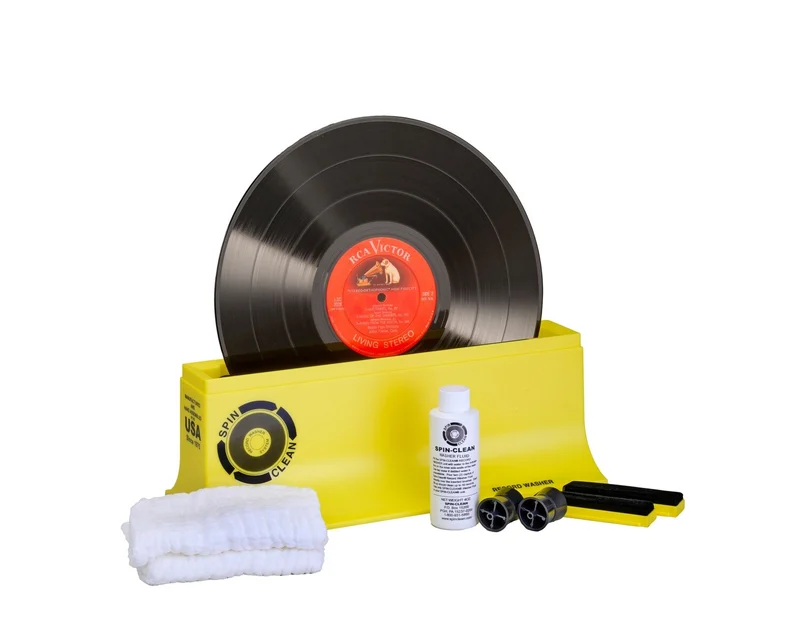
- Buy Spin-Clean Record Washer MKII Complete Kit A plastic bath, a pair of brushes and no electricity, and it still outcleans most things under a vacuum machine. Amazon
- Buy AudioQuest Silver Anti-Static Record Brush The cheapest thing here and the one you will use before every single side. Amazon
- It depends HumminGuru HG01 Ultrasonic Vinyl Record Cleaner Load it, press a button, walk away, and roughly ten minutes later a clean dry record comes back out. Amazon
- Skip Vinyl Styl Deep Groove Record Washer System Better spec sheet than the system it copies, and owner reports keep landing on the same three problems. Amazon
What actually matters
- Cleaning method matched to the dirt. Dry carbon-fibre sweep for dust and static, wet bath or ultrasonic for anything second-hand, fingerprinted, or audibly crackling. Spray-and-pad kits sit awkwardly between the two and owner reports on them are the least consistent in the category.
- A credible drying step. Lint-free cloths, a powered fan cycle or a genuinely dust-free rack. Air drying on a rack in a normal room is the single most reported cause of streaking and new surface noise.
- Reusable, filterable fluid. Systems that let you strain the bath and pour it back cost a fraction per record of ones that burn through spray bottles, and they make cleaning a stack in one session practical.
- An uncoated metal grip on any anti-static brush. The charge has to travel from the record through the fibres, the handle and your hand. A painted or plastic-coated grip breaks that path and quietly turns an anti-static brush into an ordinary dust brush.
- Record sizes covered out of the box. Manual baths usually take 7, 10 and 12 inch with a size adjustment; several machines handle 12 inch only and sell adapters separately, which matters if you buy singles.
- Effort per record versus your real routine. The best cleaner is the one you actually use. Something needing twenty minutes of setup gets used twice; something that lives beside the turntable gets used every session.
- Consumable availability. A system that depends on one manufacturer's concentrate or filter cartridge is only convenient while that part is in stock, so check current supply before committing.
The specs, in plain English
Green flags vs red flags
Green flags
- The system covers a full wash and a defined drying method, rather than leaving drying as your problem
- Fluid is stated as alcohol-free, or the ingredients are actually listed rather than described as a secret formula
- The bath can be strained and reused across a stack of records, so cost per record stays low
- An anti-static brush has a bare metal grip your skin contacts, not a painted or rubberised handle
- 7, 10 and 12 inch records are handled without buying extra parts
- Owner reports over several years repeat the same praise rather than splitting between delighted and disappointed
Red flags
- A dry pad or brush marketed as a complete cleaning solution for second-hand records
- A supplied drying rack presented as the drying step, when air drying is the classic cause of streaks
- Repeated owner reports of residue or film left behind, usually accompanied by a home-brewed rinse-pass workaround
- Spray bottles of proprietary fluid with no reuse path, which quietly become the most expensive part of ownership
- Vague fluid descriptions with no mention of alcohol content, especially if you own shellac 78s
- A basin or reservoir owners describe as spill-prone, which undermines the reuse feature the design depends on
Who's who: the brands
- Spin-Clean - One product, decades old and only lightly revised: a manual bath with brushes and alcohol-free concentrate, and the default recommendation most collectors land on.
- AudioQuest - A cable and accessories maker whose carbon-fibre record brush is the reference version of that tool, largely because of the uncoated metal grip that keeps it genuinely anti-static.
- HumminGuru - Brought ultrasonic cleaning down from lab-tank prices to a compact desktop machine with an automatic wash-and-fan-dry cycle; now sells a step-up model above the original.
- Vinyl Styl - An accessories house whose deep-groove washer copies the manual bath idea with more features on paper, though owner reports keep circling back to fluid residue.
- Pro-Ject - Turntable maker that also builds compact vacuum cleaning machines, the traditional powered route for people who want fluid sucked off rather than wiped or fanned away.
- Degritter - High-end ultrasonic machines aimed at serious collectors and dealers, useful mainly as the reference point that shows what the affordable ultrasonic units are approximating.
How to read a listing without getting fooled
Start by working out which of the two jobs a listing is really selling. If the words are brush, fibres, static and sweep, it is a maintenance tool for before each play and will not clean anything. If they are bath, fluid, cavitation, vacuum or wash, it is a deep cleaner. Anything that claims to be both, particularly a pad with a spray bottle, deserves suspicion. Next, find the drying sentence. Manufacturers describe washing in loving detail and drying in one vague line, so if the answer is a rack, assume you will be hand-drying anyway. Then convert the feature list into consumables: does the fluid come as a concentrate you dilute, and can the bath be strained and reused, or is every wash another bottle? Check the size handling, because 12-inch-only with adapters sold separately is common on machines and easy to miss. On brushes, look for a specific fibre count and, more importantly, a photograph showing bare metal where your hand goes. And treat cleaning claims stated as percentages or decibels with the same scepticism you would apply anywhere else, because nobody publishes the method behind them. What holds up better is the pattern in owner reports a few years after launch, where the same three complaints repeating is far more informative than any launch-day claim.
How much should you spend?
This is a category where the entry point is genuinely competent, so the question is less how much to spend than how to split it. The dry anti-static brush is the cheapest item in vinyl care and the one you will touch most, so buy a good one outright; the saving on a look-alike with a coated handle is small and it costs you the anti-static function entirely. For the deep clean, a mid-priced manual bath does the hard part of the job with no power, no pump and nothing to break, and for a collection in the low hundreds of records that is the sensible stopping point. Spending several times more on an automated ultrasonic machine buys two things: a genuine step up in cleaning on badly contaminated records, and the removal of labour, which for a large or fast-growing collection is what actually gets the backlog cleaned. If you buy second-hand in volume, that premium earns out; if your shelves are mostly new pressings, it is a luxury. Where extra money is rarely well spent is on mid-priced kits that add features on the spec sheet but need workarounds to match a simpler rival, and on proprietary spray fluids whose cost is invisible at purchase and obvious after a hundred records. Budget separately for the boring consumables, because concentrate, spare lint-free cloths and any size adapters you need are a real part of ownership.
Questions, answered
Do I really need both a wet cleaner and a dry brush?
Yes, because they solve different problems. A wet bath or ultrasonic cycle lifts mould release, fingerprints and embedded grime out of the groove, which you do once per record. A carbon-fibre brush drains static and sweeps loose surface dust, which you do before every side. Most complaints about record cleaning products trace back to someone expecting a dry brush to fix a genuinely dirty record.
Is an ultrasonic machine worth it over a manual bath?
It depends on volume and honesty about your own habits. Independent testing and owner reports agree cavitation reaches deeper than brush-based methods, but on a moderately dirty record the audible gap over a well-executed manual wash is real rather than dramatic. The stronger case is automation: because the machine does the work, backlogs get cleaned instead of shelved. Under a couple of hundred mostly-new records, a manual bath plus a brush covers you.
Can I just mix isopropyl alcohol and distilled water?
Many collectors do and it works on standard vinyl, with two cautions. Alcohol must never touch shellac 78s, where it attacks the surface. And home mixes usually skip the surfactant that helps fluid flow into the groove rather than sit on top, so results are less consistent than a purpose-made concentrate. If you mix your own, use distilled water only, because tap water leaves mineral deposits behind.
Why do new records need cleaning?
Pressing plants use a mould release compound to help the record separate from the stamper, and a certain amount of it stays in the groove. That is on top of paper dust from the inner sleeve. It is why a brand-new LP can sound slightly gritty on a first play and noticeably quieter after a proper wash.
What is the biggest mistake people make?
Letting a wet record air dry. The fluid carries dissolved dirt as it evaporates and deposits it back into the groove, so a record can come out of a wash noisier than it went in. Use lint-free cloths, a powered fan or a machine with a dry cycle. A close second is not changing the bath once it greys, at which point you are circulating dirt rather than removing it.
How often should I clean my records?
Deep clean each record once as it enters the collection, second-hand or new. After that, a wet clean is only needed if a record has been mishandled, stored badly, or starts sounding noisier than it used to. The dry anti-static brush is the routine part: two or three rotations before each side, every time.
Or jump to the head-to-head: Spin-Clean Record Washer MKII Complete Kit vs HumminGuru HG01 Ultrasonic Vinyl Record Cleaner.