

Audio
The Best Power Conditioners and Surge Protectors: 4 Compared (and One to Skip)
We compared four AC power products on what can actually be checked: published clamping voltage, surge current and joule ratings, which conductor pairs get protected, and whether the maker states noise attenuation in decibels or only in adjectives.
The short version
The Furman PL-8C wins because Furman publishes a figure for nearly everything it claims: a clamping voltage of 188 V peak at 3,000 amps, a 6,500 amp maximum surge current, noise attenuation given as 10 dB at 10 kHz rising to 50 dB at 500 kHz, and an over-voltage cutoff around 140 V AC. The Tripp Lite by Eaton Isobar 6 Ultra is the value pick and the right answer for most households, with 3,330 joules, a 330 V let-through rating, a listing to UL 1449 5th Edition and suppression across all three conductor pairs rather than just one. The Zero Surge 8R15W suits one specific buyer: it contains no metal oxide varistors at all, so nothing inside degrades, and it is rated for 1,000 worst-case 6,000 V / 3,000 A pulses without failure. It is also premium-priced for eight outlets, it filters line to neutral only, and it is listed as an interference filter rather than under the surge standard. Skip the AudioQuest Niagara 1200, whose own specification table gives no joule rating, no clamping voltage and not a single decibel figure for the noise dissipation it is named after, at a premium tier. Buy the protection you can verify and treat the filtering as a bonus. Best for: anyone who wants their gear to survive the next storm and would rather settle the noise-floor argument with numbers than with adjectives.
Our picks at a glance
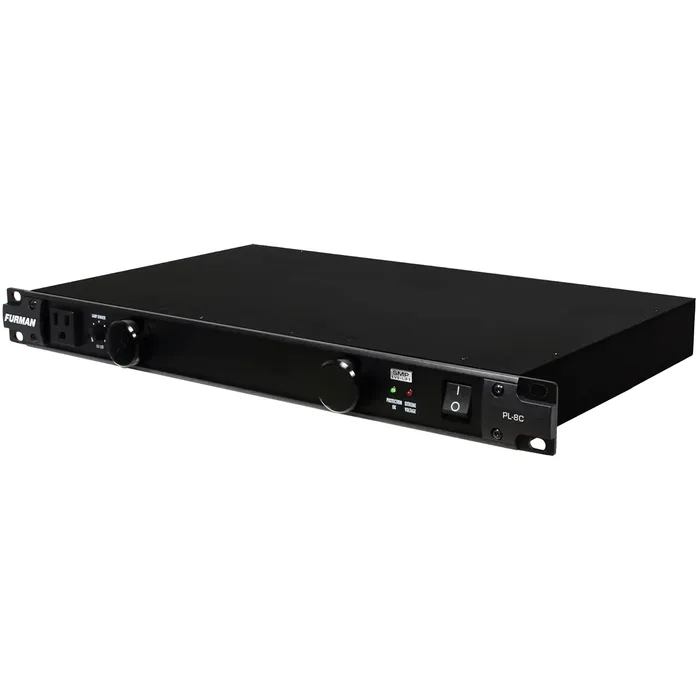
- Furman Classic Series PL-8C - Buy. A 1U rack conditioner that publishes a clamping voltage, a surge current rating and an attenuation curve in decibels, which is more than most of this category will tell you.
- Tripp Lite by Eaton Isobar 6 Ultra (ISOBAR6ULTRA) - Buy. Budget tier, network-grade surge numbers, and the only unit here whose datasheet spells out suppression on all three conductor pairs and names its UL 1449 edition.
- Zero Surge 8R15W 8-Outlet Series Mode Surge Protector - It depends. Series-mode protection with no metal oxide varistors at all, so there is nothing inside that quietly wears out with every surge it absorbs.
- AudioQuest Niagara 1200 - Skip. A premium-tier conditioner whose own specification table names technologies but publishes no surge rating, no clamping voltage and no attenuation figure at all.
The verdict in 30 seconds
What mattered most
- Surge technology
- Published clamping or let-through
- Joule rating
- Protection modes
- Published noise attenuation
- Outlets and current
Power conditioning is really two products sharing one name. Surge protection is genuine, standardised and measurable, with published let-through voltages and a safety standard, UL 1449, behind it. Noise filtering is measurable too, but whether the filtering you can buy makes an audible difference on a normal domestic supply is a far weaker claim, and most of the marketing in this category leans on it anyway. We picked four units that sit at different points on that line and judged each one on what its own maker is willing to state as a number.
A 1U rack conditioner that publishes a clamping voltage, a surge current rating and an attenuation curve in decibels, which is more than most of this category will tell you.
Best for: Someone with a rack who wants a conditioner that documents its own behaviour, plus retractable lights and a front convenience outlet as genuinely useful extras.
- Specifications state a spike clamping voltage of 188 V AC peak at 3,000 amps and a maximum surge current of 6,500 amps, so you can compare it against something.
- Noise attenuation is published as 10 dB at 10 kHz, 40 dB at 100 kHz and 50 dB at 500 kHz, with the line impedance range stated, rather than described as a trademarked technology.
- Extreme Voltage Shutdown latches the outlets off above roughly 140 V AC and needs a manual reset, which is the right behaviour for the wiring faults that actually destroy equipment.
- Furman calls the SMP circuit non-sacrificial, but the manual says the Protection OK light can go dark after a severe event and that the clamping rating is then compromised, with the unit needing service.
- Spike protection modes are listed as line to neutral only, so there is no line to ground or neutral to ground suppression.
- The safety agency listing is TUV; Furman does not publish a UL 1449 let-through rating or a joule figure for this model.
- The manual states plainly that Classic Series units do not compensate for high or low line voltage, so sags and swells need a separate regulator.
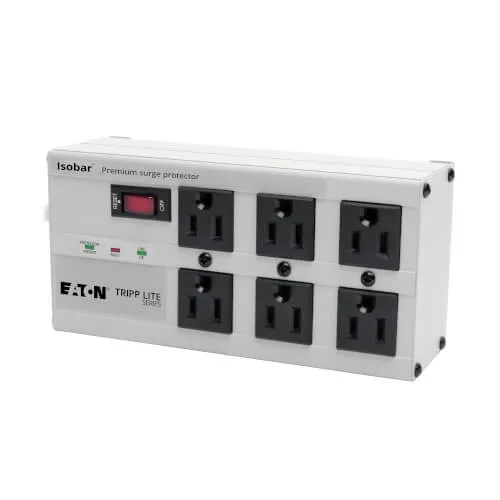
Budget tier, network-grade surge numbers, and the only unit here whose datasheet spells out suppression on all three conductor pairs and names its UL 1449 edition.
Best for: Almost everyone: a television, a receiver, a console and a streamer that need real surge protection with no conditioning story attached.
- Rated 3,330 joules with a 330 V UL 1449 let-through rating, listed to UL 1449 5th Edition and rated at 97,000 amps of surge current split across normal and common mode.
- Suppresses full normal mode line to neutral plus common mode neutral to ground and line to ground, which most budget strips quietly leave out.
- Six outlets in three isolated filter banks built from toroidal chokes, ferrite rod-core inductors and VHF capacitors, with EMI/RFI attenuation published as 40 to 80 dB, plus a lifetime limited warranty.
- Twelve-amp breaker and a 1,440 W ceiling, so a large power amplifier plus the rest of a system can trip it.
- Six outlets only, on a strip rather than spread across a rack panel.
- No over-voltage relay: a sustained high-voltage fault is handled by thermal fusing rather than by shutting the outlets down and telling you why.
- Plain grey metal housing designed for a workstation, not a living room.
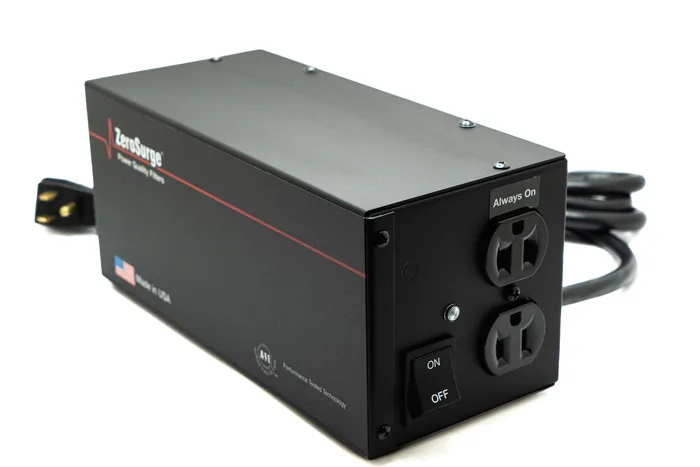
Series-mode protection with no metal oxide varistors at all, so there is nothing inside that quietly wears out with every surge it absorbs.
Best for: Someone in a storm-prone area who is tired of replacing sacrificial protectors and wants a unit whose protection is documented not to degrade.
- No MOVs, and Zero Surge rates the design for 1,000 worst-case 6,000 V / 3,000 A pulses with no resulting degradation or failure, plus more than 10,000 pulses at 4,000 V and more than 100,000 at 2,000 V.
- Let-through is published as 130 V above peak line voltage at that same combination wave, and the filter operates independently of the ground line, so surge energy is not dumped onto safety ground.
- EMI/RFI response is published as 3 dB at 7 kHz, 25 dB at 100 kHz and 38 dB at 300 kHz, with a ten-year warranty, US manufacture and a magnetically shielded steel case.
- Premium tier for eight outlets, and the spec sheet lists no over-voltage shutdown and no coaxial or telephone line protection.
- Protection is line to neutral only, listed as Mode 1 applications, so there is nothing on the two ground pairs.
- Certified to UL 1283 and UL 1363 rather than UL 1449, so it carries no UL surge Type classification and no voltage protection rating to compare with mainstream units.
- Zero Surge states the series may not be daisy chained with power strips, surge protectors or uninterruptible supplies, which constrains how you wire a rack.
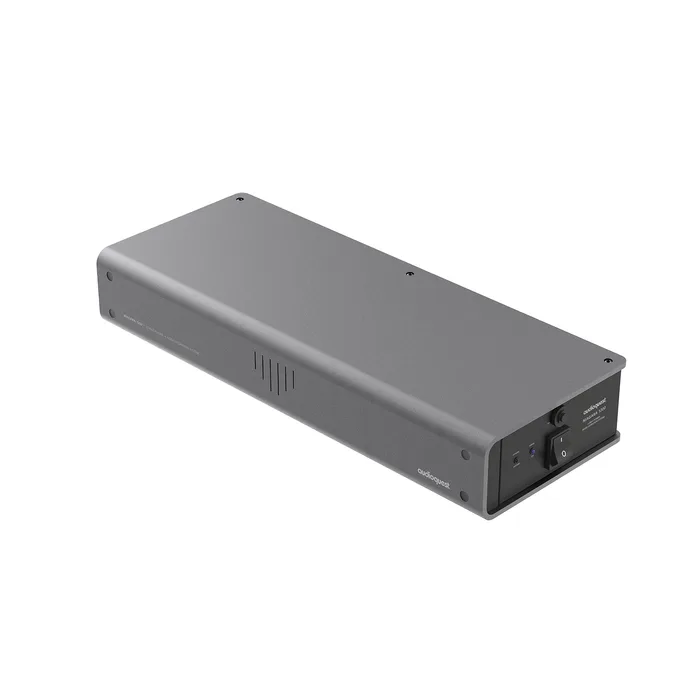
A premium-tier conditioner whose own specification table names technologies but publishes no surge rating, no clamping voltage and no attenuation figure at all.
Best for: Buyers who have already decided that conditioning improves their system and want a handsomely built box from a known audio brand rather than a documented one.
- Seven outlets split into five source outlets and two high-current outlets, so an amplifier gets its own tap rather than sharing with sources.
- Rated at 15 amps RMS at 120 V, in a low, solidly built chassis that sits neatly on a rack shelf.
- The surge protection is described as non-sacrificial, so there is no replacement schedule implied.
- The published specification table gives no joule rating, no clamping or let-through voltage, no UL 1449 rating and no noise attenuation in decibels, so there is nothing here to compare with the other three.
- The noise claims rest on named technologies, Linear Noise-Dissipation and Ground-Noise-Dissipation, with no measurement attached on the product page.
- Transient Power Correction is listed as No on this model, while the larger Niagaras carry a published peak-current figure, so the one measured current-delivery number in the range is the one missing here.
- Costs several tiers above the value pick while documenting considerably less about what it does.
| Criteria | Classic Series PL-8C Top pick | Isobar 6 Ultra (ISOBAR6ULTRA) | 8R15W 8-Outlet Series Mode Surge Protector | Niagara 1200 |
|---|---|---|---|---|
| Verdict | Buy it | Buy it | It depends | Skip it |
| Best for | Someone with a rack who wants a conditioner that documents its own behaviour, plus retractable lights and a front convenience outlet as genuinely useful extras. | Almost everyone: a television, a receiver, a console and a streamer that need real surge protection with no conditioning story attached. | Someone in a storm-prone area who is tired of replacing sacrificial protectors and wants a unit whose protection is documented not to degrade. | Buyers who have already decided that conditioning improves their system and want a handsomely built box from a known audio brand rather than a documented one. |
| Price tier | $$ · mid-range | $ · budget | $$$ · premium | $$$ · premium |
| Surge technology | Series Multi-Stage Protection (SMP); components not published | MOVs with toroidal chokes, ferrite rod-core inductors and VHF capacitors | Series mode, no MOVs at all | Named as non-sacrificial; components not published |
| Published clamping or let-through | 188 V AC peak at 3,000 A | 330 V UL 1449 let-through rating | 130 V above peak line at 6,000 V / 3,000 A | None published |
| Joule rating | Not published | 3,330 joules | Not applicable, no MOVs to consume | Not published |
| Protection modes | Line to neutral only, zero ground leakage | Line to neutral plus neutral to ground and line to ground | Line to neutral only, independent of ground | Not published |
| Published noise attenuation | 10 dB at 10 kHz, 40 dB at 100 kHz, 50 dB at 500 kHz | EMI/RFI 40 to 80 dB | 3 dB at 7 kHz, 25 dB at 100 kHz, 38 dB at 300 kHz | No figures published |
| Outlets and current | 9 outlets, 15 A, 1,800 W | 6 outlets, 12 A breaker, 1,440 W | 8 outlets, 15 A | 7 outlets, 15 A RMS |
| Over-voltage response | Latching shutdown around 140 V AC, manual reset | Thermal fusing plus permanent automatic shutoff | Operates across an 85 V to 175 V range | Not published |
| Safety listing and warranty | TUV listed; five year limited | UL 1449 5th Edition; lifetime limited plus connected-equipment insurance | UL 1283 and UL 1363; ten years | Not published on the product page |
Which one is right for you?
- Someone with a rack who wants a conditioner that documents its own behaviour, plus retractable lights and a front convenience outlet as genuinely useful extras. Buy it Furman Classic Series PL-8C
- Almost everyone: a television, a receiver, a console and a streamer that need real surge protection with no conditioning story attached. Buy it Tripp Lite by Eaton Isobar 6 Ultra (ISOBAR6ULTRA)
- Someone in a storm-prone area who is tired of replacing sacrificial protectors and wants a unit whose protection is documented not to degrade. It depends Zero Surge 8R15W 8-Outlet Series Mode Surge Protector
- Buyers who have already decided that conditioning improves their system and want a handsomely built box from a known audio brand rather than a documented one. Skip it AudioQuest Niagara 1200
How we judged the field
Five things decide whether one of these boxes earns its place. First, what it does to a surge: a clamping or let-through voltage measured against a stated test surge tells you far more than a large joule number, because a joule figure has no standard method behind it and is not something UL 1449 requires a device to be marked with. Second, which conductor pairs it protects, since plenty of units cover line to neutral only and leave line to ground and neutral to ground open. Third, whether it degrades and whether it tells you: MOV-based protection wears out cumulatively, so an indicator and a defined end-of-life behaviour are features rather than decoration. Fourth, whether the filtering is quantified in decibels at named frequencies or merely trademarked. Fifth, whether it can pass the current an amplifier wants on a musical peak instead of becoming the bottleneck.
The field splits cleanly on the fourth point. On one side sit products that publish numbers: Eaton’s Isobar datasheet lists joules, let-through, protection modes, surge current and attenuation; Furman’s PL-8C manual gives a clamping voltage, a maximum surge current and a three-point attenuation curve; Zero Surge publishes an endurance test result and its own filter response. On the other side sit products that publish named technologies and leave the reader to supply the meaning. We took one documented unit at the mid tier, one at the budget tier, one series-mode outlier that solves the wear-out problem at a premium, and one premium unit from the second group so that the contrast is concrete rather than theoretical.
Furman Classic Series PL-8C
Buy itThe PL-8C is what a well-documented conditioner looks like. The manual gives a spike clamping voltage of 188 V AC peak at 3,000 amps, a maximum surge current of 6,500 amps, an operating window of 90 to 139 V AC and a noise attenuation curve of 10 dB at 10 kHz, 40 dB at 100 kHz and 50 dB at 500 kHz, with the line impedance range it was taken over. Extreme Voltage Shutdown latches the outlets off above about 140 V AC and requires a manual reset, which is the right response to an open neutral. Nine outlets, eight on the back in two isolated banks plus one on the front, a 15 amp breaker and a 10 foot cord, in a 1U rack chassis with retractable lights. The caveats are Furman’s own: protection modes are line to neutral only, the safety listing is TUV rather than UL 1449, and the manual concedes the Protection OK light can go dark with the clamping rating compromised. For a rack, it is still the most evidence per outlet here.
Tripp Lite by Eaton Isobar 6 Ultra (ISOBAR6ULTRA)
Buy itThe Isobar 6 Ultra is the one we would actually put behind most televisions. Eaton publishes what matters: 3,330 joules, a 330 V UL 1449 let-through rating, a listing to UL 1449 5th Edition, 97,000 amps of surge current split between normal and common mode, and suppression across full normal mode line to neutral plus common mode neutral to ground and line to ground. That completeness is exactly what budget strips leave out. Six outlets sit in three isolated filter banks of toroidal chokes, ferrite rod-core inductors and VHF capacitors, with EMI/RFI attenuation given as 40 to 80 dB. Three LEDs report power, protection and line fault, and the unit permanently cuts power if the protection circuit is incapacitated, so it stops rather than pretending. The limits are honest ones: a twelve-amp breaker and a 1,440 watt ceiling, six outlets, no over-voltage relay and a grey metal case nobody will call handsome. Against its price, nothing here is close.
Zero Surge 8R15W 8-Outlet Series Mode Surge Protector
It dependsThe Zero Surge 8R15W is the one genuinely different piece of engineering in this group. It contains no metal oxide varistors, using series inductance and capacitance to slow and absorb a surge rather than shunting it to ground, and the filter works independently of the ground line, so it will even function on an ungrounded outlet. The spec sheet backs the pitch: 1,000 worst-case 6,000 V / 3,000 A pulses with no resulting degradation or failure, more than 10,000 pulses at 4,000 V, let-through of 130 V above peak line voltage, and a filter response of 3 dB at 7 kHz rising to 38 dB at 300 kHz. Eight outlets, 15 amps, ten-year warranty, US manufacture, magnetically shielded steel. The trade-offs are equally plain: premium pricing for a featureless box, line to neutral protection only, certification as an interference filter rather than under UL 1449 so there is no Type rating or voltage protection rating to compare, and an explicit instruction never to daisy chain it.
AudioQuest Niagara 1200
Skip itThe Niagara 1200 is well made and pleasant to own, and that is most of what the published record supports. AudioQuest lists seven outlets, five for sources and two high-current, 15 amps RMS at 120 V, Linear Noise-Dissipation, patented Ground-Noise-Dissipation and non-sacrificial surge protection. What the specification table does not contain is a joule rating, a clamping or let-through voltage, a UL 1449 rating, an over-voltage threshold, or one decibel figure for the noise dissipation the product is named after. The same table lists Transient Power Correction as No on this model while quoting a peak-current figure for it further up the range, so the one measured current-delivery claim in the line is the one this unit lacks. At a premium tier that is a poor trade against three rivals that document themselves. If the numbers appear, revisit it.
Sources
Specs in this review come from these pages.
- Furman - PL-8C owner's manual and specifications (cdn.shopify.com)
- Eaton Tripp Lite - ISOBAR6ULTRA product datasheet (assets.tripplite.com)
- Zero Surge - 6R / 8R Series product information and technical specifications (zerosurge.com)
- AudioQuest - Niagara 1200 product page and specifications (audioquest.com)
- NIST Special Publication 960-6, Surges Happen! How to Protect the Appliances in Your Home (nvlpubs.nist.gov)
- IAEI Magazine - Metal Oxide Varistor Degradation (iaeimagazine.org)
Furman Classic Series PL-8C vs Tripp Lite by Eaton Isobar 6 Ultra (ISOBAR6ULTRA): which should you buy?
The PL-8C and the Isobar 6 Ultra are closer on protection than their prices suggest, and they differ most in what each one is honest about. Furman’s clamping figure is the lower of the two published numbers, 188 V AC peak against Eaton’s 330 V let-through rating, and Furman’s latching over-voltage cutoff is a genuine feature the Isobar has no equivalent for. Eaton answers with a specific joule rating, a named UL 1449 edition, a surge current rating broken down by mode, and suppression across all three conductor pairs where Furman covers only line to neutral. Both publish attenuation figures in decibels, neither publishes any evidence that the attenuation is audible, and neither is trying to sell you a different sound.
So choose on shape and headroom rather than on safety. Take the Furman if you have a rack, if sources and amplifiers on the same strip currently misbehave, if you want the full 15 amps and two isolated banks, and if your supply is unstable enough that an over-voltage cutoff is worth paying for. Take the Isobar if you have a television, a receiver, a console and a streamer: it protects more completely across the conductor pairs, it shuts itself down and tells you when it is spent, the warranty is lifetime with connected-equipment cover, and it costs a fraction as much. Spend up for the rack, the outlets and the over-voltage relay, not for better protection.
What to look for
- Clamping voltage, not joules: ask what the unit lets through to your equipment during a standard test surge, because that describes protection, while a joule number has no standard calculation method behind it and is not a rating UL 1449 requires on the label.
- All three conductor pairs: proper protection covers line to neutral, line to ground and neutral to ground, and a datasheet that names only one mode is telling you what it leaves uncovered.
- A protection indicator with defined behaviour: MOV-based protection degrades with every surge it absorbs, so you want a light or a shutoff when the circuit is spent, and a manual that says whether the unit cuts power or keeps passing it.
- Attenuation in decibels at named frequencies: if the specification says a trademarked noise technology but never says how many decibels at what frequency, you are buying a name rather than a filter.
- Enough current for the amplifier: check the breaker rating and the wattage ceiling, look for dedicated high-current outlets, and remember that a musical peak can ask an amplifier for several times its average draw.
- Ignore the response-time race: protectors overwhelmingly use the same protective components, their speed of response is inherently adequate for power-line surges, and a nanosecond figure on the box is marketing rather than a differentiator.
Our final take
Buy for the surge, not for the sound. All four of these will do something measurable to a transient, three of the four will tell you exactly what, and none has published a measurement showing the filtering changes anything you can hear. That is not a reason to go unprotected; it is a reason to spend where the claims can be checked. The Isobar 6 Ultra covers a television and its accessories more thoroughly than its price suggests, and is where most people should stop. The PL-8C earns its premium with a published clamping figure, isolated banks and a latching over-voltage cutoff. The Zero Surge is right if wear-out genuinely bothers you. A conditioner that names its technologies but quantifies none of them is not a bargain at any tier.
Questions, answered
Does a power conditioner actually make my system sound better?
Separate two claims carefully. Filters do measurably attenuate high-frequency noise on the mains, and the better makers publish the figures: Furman states 40 dB at 100 kHz and 50 dB at 500 kHz for the PL-8C, Zero Surge states 25 dB at 100 kHz and 38 dB at 300 kHz. What no manufacturer publishes is a measurement showing that this attenuation produces an audible change in a normal system. The gap matters because your equipment's own power supply already does this job, and does it in a place the conditioner cannot reach. Ripple rejection is a specified, measured property of a voltage regulator: an ordinary adjustable regulator that has been in production since the 1970s is specified at around 80 dB of ripple rejection at 120 Hz, which is a factor of ten thousand, and it works at exactly the low frequencies where a mains filter does nothing at all. So the filtering is real, the audibility is unproven, and adjectives are not evidence.
Can a conditioner choke my power amplifier and hurt dynamics?
It is a real mechanism rather than a myth, and the manufacturers effectively concede it. Furman sells a separate Power Factor line, such as the P-1800 PF R, whose selling point is a 45 amp peak current reservoir for amplifiers on musical peaks, which concedes that a plain 15-amp tap can fall short on transients. AudioQuest publishes a peak-current figure for its transient correction on the larger Niagaras and lists it as absent on the Niagara 1200. All of that points the same way: a conditioner sits in series with your amplifier and its inductance and breaker are real constraints. Use a dedicated high-current outlet if the unit has one, or put the amplifier straight into the wall and the sources through the conditioner.
How do I know when a surge protector needs replacing?
If it uses MOVs, it is a consumable, and that is physics rather than marketing. Varistors lose voltage with each surge they absorb; end of life is commonly defined as the point where the measured varistor voltage has shifted by about ten percent, and repeated events stack that shift until the part conducts continuously and runs away thermally. Rising standby leakage current is the usual symptom. Safety guidance from the electrical safety bodies is consistent: a point-of-use protector must be replaced over time or after a major surge event, and you should buy one with an indicator light or alarm. Treat that light with mild suspicion, though, because the indications are not standardised across brands and government guidance specifically warns that their meaning can be confusing, so read the manual and find out whether your unit cuts power when it fails or just keeps passing it.
What does a joule rating actually tell me?
Less than its prominence on the box suggests. It is a simplified measure of how much surge energy a protector can absorb before damaging itself, and higher is broadly better within one product family. The problems are that there is no industry standard for how the number is calculated, so figures from different brands are not really comparable, and that the quoted value is often a total across all three wiring combinations rather than a per-mode breakdown. It is also not one of the ratings UL 1449 requires a device to be marked with. Maximum surge current is usually more informative, and clamping or let-through voltage tells you what actually reaches your equipment. For a series-mode design the field is meaningless, which is why Zero Surge lists it as not applicable instead of inventing a big number.
Do I need voltage regulation or an isolation transformer instead?
They fix different faults, so work out which one you have. Automatic voltage regulation uses an autotransformer to pull the incoming supply back toward nominal across a stated input window. That is worth buying if your supply genuinely sags or swells, and pointless if it does not. An isolation transformer is the tool for common-mode noise and ground loops rather than for voltage level: differential noise responds to a low-pass filter, while common-mode noise is better handled by a balanced isolation transformer. Both add weight, cost and inrush current, so buy one for a symptom you have actually observed rather than on principle.
Deciding between the top two? See our head-to-head: Furman Classic Series PL-8C vs Tripp Lite by Eaton Isobar 6 Ultra (ISOBAR6ULTRA).
More Audio reviews
 The Best Premium Wireless Earbuds: 4 Compared (and One to Skip)
  The Best Record Cleaning Kits: 4 Compared (and One to Skip)
  The Best Replacement Headphone Earpads: 4 Compared (and One to Skip)
  The Best Rugged Outdoor Bluetooth Speakers: 4 Compared (and One to Skip)
  The Best Sleep Headphones: 4 Compared (and One to Skip)
  The Best Speaker Isolation Pads: 4 Compared (and One to Skip)