Explained
Nursery Humidifiers, Explained
After reading, you'll understand why two cool mist humidifiers with identical tank sizes can behave completely differently in the same room.
In this guide
Most first-time buyers assume the only real decision is cool mist or warm mist, then pick by looks and tank size. That skips the choice that actually changes the air in the room, which is how the machine gets water airborne. Listings make this worse by using 'cool mist' as an umbrella term for two technologies that behave nothing alike in terms of dust, cleaning and noise. Once you can tell them apart, the rest of the spec sheet becomes readable.
The 30-second version
- Cool mist is a safety category, not a technology, and it covers both evaporative and ultrasonic machines that work in completely different ways.
- Ultrasonic units disperse what is dissolved in the water, which is why white dust and distilled water come up constantly in this category.
- Evaporative units trap most minerals in a wick, so they can run on tap water but they need that wick replaced on a schedule.
- Cleaning access beats mist output, because a humidifier that is annoying to clean stops getting cleaned by the second month.
- Aim for the middle of the normal humidity band, not the highest number the machine will reach, and confirm it with a cheap hygrometer.
The products this guide is about
Our verdict on each, with the full reasoning on the companion review.
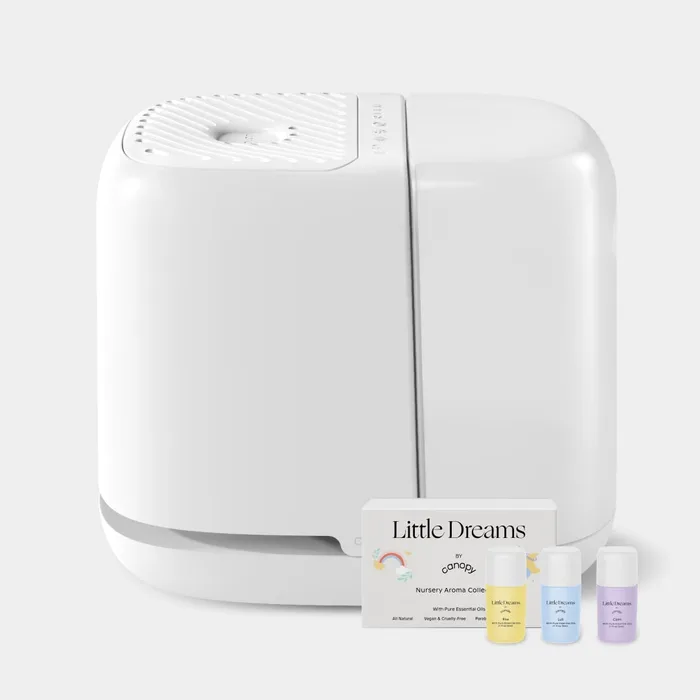
- Buy Canopy Nursery Humidifier 2.0 An evaporative, no-visible-mist nursery unit built around the assumption that you will actually clean it. Amazon
- Buy Honeywell HCM350 Cool Moisture Humidifier The plain, boring evaporative workhorse that gets the physics right and charges you very little for the filters. Amazon
- It depends Levoit Classic 300S Smart Ultrasonic Humidifier The best-equipped ultrasonic unit here, and a good buy only if you commit to distilled water and descaling. Amazon
- Skip Crane Adorables 1 Gallon Ultrasonic Cool Mist Humidifier The animal shape sells it, and little else about it beats the alternatives. Amazon
What actually matters
- Evaporative vs ultrasonic - this is the fork in the road for everything else on the spec sheet. Evaporative uses a fan and a wet wick, so it is quieter about minerals but louder in the room, while ultrasonic uses a vibrating plate and is near-silent but atomizes whatever is in the tank.
- Tank capacity and rated runtime - together these tell you how often you will be carrying water. A big tank on the lowest setting can run for days, but the same tank on high may not last a night.
- Filter or wick requirement - a wick is a recurring cost with a stated replacement interval, usually somewhere between roughly a month and two months. Filter-free sounds cheaper right up until you start buying distilled water.
- Cleaning access - the width of the tank opening, whether the base comes apart, and whether wetted parts are dishwasher safe. EPA guidance recommends cleaning portable humidifiers every third day, so this is not a theoretical concern.
- Humidistat or auto mode - a machine that targets a relative humidity level rather than just a fan speed will not over-humidify the room while you sleep. Without one, you are the humidistat.
- Room coverage rating - a published square footage figure lets you sanity-check the unit against your nursery. Vague labels like 'medium room' are harder to argue with and easier for a maker to defend.
- Noise and light behavior - a fan-driven unit adds white noise, which some parents want and others cannot stand. Indicator lights that cannot be dimmed are a real problem in a dark nursery.
The specs, in plain English
Green flags vs red flags
Green flags
- The maker publishes a specific square footage coverage rating rather than a vague room-size label.
- Wetted parts such as the tank, cap and tray are explicitly listed as dishwasher safe.
- There is an auto or humidistat mode that targets a stated relative humidity range.
- The tank opening is wide enough to get a hand and a brush inside, and the base comes apart for cleaning.
- The warranty runs two or three years rather than the category-minimum one year.
Red flags
- An ultrasonic unit sold for a nursery with no mention of water quality, minerals or descaling anywhere on the page.
- Runtime headlines that only make sense on the lowest possible output setting, with no figure for higher settings.
- Molded decorative shapes and textured surfaces on a device that will be wet for months at a time.
- No published cleaning instructions, or instructions that require a proprietary product you can only buy from one seller.
- Marketing that implies the humidifier treats an illness rather than adding moisture to dry air.
Who's who: the brands
- Canopy - A newer direct-to-consumer brand built around evaporative, no-visible-mist designs with dishwasher-safe parts and a filter subscription.
- Honeywell - Licensed to Kaz USA, a Helen of Troy company, and known for plain, long-warranty evaporative units with widely available wicking filters.
- Levoit - A VeSync brand that dominates the app-connected end of the market with large-tank ultrasonic units and auto humidity modes.
- Vicks - Also part of the Kaz and Helen of Troy stable, best known for pairing humidifiers and vaporizers with its own scent pads.
- Crane - Built its nursery presence on animal-shaped ultrasonic humidifiers aimed squarely at kids' rooms.
How to read a listing without getting fooled
Start at the bottom of the listing, not the top. Find the technology first, because 'cool mist' alone does not tell you whether the machine will leave dust on the crib rail. Then read tank capacity and runtime together and assume the runtime headline refers to the lowest output setting, since that is how it is nearly always measured. Check whether a coverage figure is given in square feet or hidden behind a word like 'medium'. Look for the filter part number and its replacement interval, because that is your recurring cost, and note that 'filter free' on an ultrasonic unit usually means the cost moves to distilled water instead. Finally, scan the cleaning section for which parts are dishwasher safe and whether the base opens up, and treat the warranty length as a rough statement of how long the maker expects it to last.
How much should you spend?
Budget nursery humidifiers are almost always filter-free ultrasonic units, often with a decorative shell, and they buy you a working machine with the mineral problem left as your homework. Mid-range is where the category gets interesting, covering both large-tank smart ultrasonic units with real auto modes and plain evaporative workhorses with long warranties and cheap wicks, and most people are best served somewhere in this tier. Premium buys design, nursery-specific extras like dimmable nightlights and soundscapes, and above all cleaning convenience through dishwasher-safe parts, usually paired with a filter subscription that keeps costing after the purchase. The honest way to compare is to add the consumable to the picture: a mid-range evaporative unit with inexpensive wicks can cost less over three winters than a budget ultrasonic unit you feed with bottled distilled water.
Questions, answered
Does a nursery humidifier need to run all night?
It depends on how dry the room actually is, which is why a hygrometer is worth more than an extra fan speed. If the room sits comfortably in the normal indoor humidity band on its own, running the machine all night mostly gets you condensation on the windows. A unit with an auto mode solves this by cycling output to hold a target instead of running flat out. If you are setting it manually, start low and check the room in the morning.
Can I put essential oils in any humidifier?
Only where the manufacturer provides for it, and usually only in a designated place rather than the tank. Levoit's Classic 300S, for example, uses a separate aroma pad rather than oils in the water, and other makers may provide a dedicated spot; check each manual. Putting oils directly into a tank that was not designed for them can degrade plastics and void the warranty. For a baby's room, check with your pediatrician before adding any scent at all.
Are warm mist humidifiers ever the better choice?
For an adult bedroom they are a reasonable option, and boiling the water addresses microbial growth in the tank differently than a cool mist unit does. In a room with a small child, the heating element and the hot water reservoir introduce a burn and scald risk that cool mist simply does not have, which is why cool mist is the standard recommendation for nurseries. That is a safety argument about the hardware, not a claim about which one humidifies better. If you want warm mist elsewhere in the house, that is a separate decision.
Where should the humidifier sit in the room?
Off the floor if you can manage it, on a hard surface rather than carpet or wood that can be damaged by dampness, and not right next to the crib. Keeping it a few feet away avoids soaking the bedding and keeps the cord well out of reach, which matters more than mist coverage geometry. Give it clearance on all sides so the fan or plume is not blowing straight into a wall. Check the wall and window nearest the unit after a few nights for any damp, and move it if you find some.
Or jump to the head-to-head: Canopy Nursery Humidifier 2.0 vs Honeywell HCM350 Cool Moisture Humidifier.