Explained
Play Kitchens, Explained
After reading, you'll understand how to compare play kitchens by age, size, materials, box contents and assembly, and which details listings often leave out.
In this guide
First-time buyers usually pick a play kitchen by color and photos, then find it is too big for the room, too tall for a toddler, or arrives with nothing to cook with. Listings mix assembled and boxed dimensions, and material lines can be vague. The age on the box is the maker's call, not a guess, and it matters. A few minutes with the spec lines saves a return of a 40 pound box.
The 30-second version
- Read the stated age first, because 2+ and 3+ kitchens are designed for different heights and different small-part rules.
- Check whether dimensions are assembled, since some listings give a product size without saying so, and boxed sizes are different again.
- Look at the box contents line, as some kitchens include 25 or more accessories and others include none.
- Decide on electronics deliberately, since lights and sounds need batteries and some kids love them while some parents do not.
- Plan for assembly, because every flat-packed kitchen needs an adult and some makers quote two hours.
The products this guide is about
Our verdict on each, with the full reasoning on the companion review.
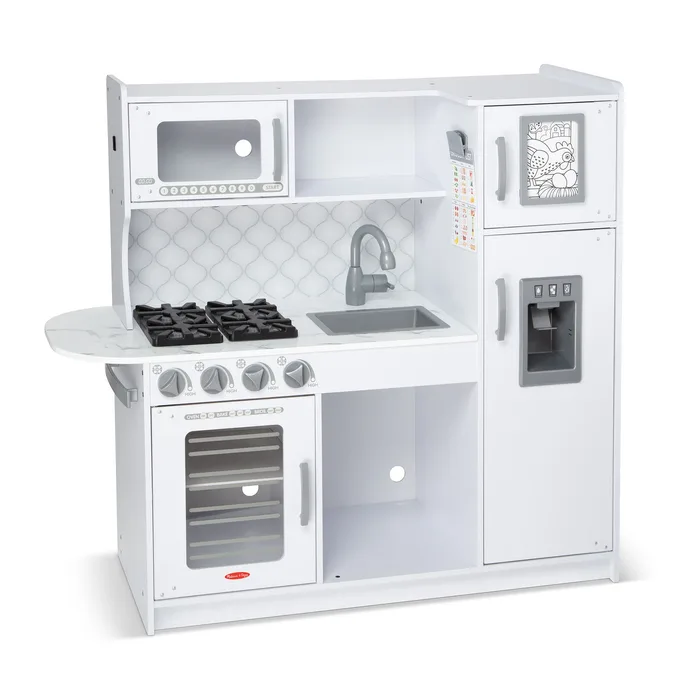
- Buy Melissa & Doug Chef's Kitchen - Cloud A large wooden kitchen with every appliance a child expects, sized for more than one cook at a time.
- Buy Step2 Best Chef's Kitchen A molded kitchen that comes ready to play, with a 25-piece accessory kit and a burner that lights up and sizzles.
- It depends Little Tikes First Prep Kitchen A slim, toddler-friendly kitchen with light-up burners and a prep counter that folds flat when floor space is short.
- Skip KidKraft Vintage Play Kitchen - Pink with White Fixtures A pretty retro kitchen that arrives with no accessories and no electronics, and takes a couple of hours to build.
What actually matters
- Stated age - The maker's age range reflects the height of the counters and the parts in the box. Follow it rather than buying up for a child to grow into.
- Footprint - Width and depth decide whether the kitchen fits the room with space for a child to stand. Measure the spot before you shop.
- Height - Counter and stove height should suit your child now and in two years. Compare the listed height against your child standing at a table.
- Material - Wooden kitchens look like furniture and usually have more appliances, while molded kitchens are lighter and easier to wipe. Neither is automatically safer; follow the maker's age and warning lines.
- Box contents - Accessories can be a large share of the value. A kitchen with nothing in the box needs a second purchase before it is fun.
- Electronics - Light-up burners and sounds are a big draw for 2 and 3 year olds. Check the battery type and whether batteries are included.
- Layout for group play - Pass-through windows and open designs let several children play together. A single wall kitchen suits one child better.
The specs, in plain English
Green flags vs red flags
Green flags
- A clear age range and assembled dimensions on the maker's page.
- An itemized box contents line, or a stated accessory count.
- Battery type and whether batteries are included are spelled out.
- Downloadable assembly instructions before you buy.
- A layout with room for more than one child if you have siblings or host playdates.
Red flags
- Dimensions given without saying whether they are assembled.
- No box contents listed, which usually means no accessories.
- A material line that only says premium or quality materials.
- Photos full of accessories that are sold separately.
- No stated age, or an age that is older than your child.
Who's who: the brands
- Melissa & Doug - Known for wooden toys and larger wooden play kitchens with many appliances.
- Step2 - Known for molded kitchens and outdoor play equipment, often with accessories and electronics included.
- Little Tikes - A long-running maker of molded toddler toys, including kitchens it states are made in the USA.
- KidKraft - Known for wooden kitchens, dollhouses and play furniture, often with retro styling.
How to read a listing without getting fooled
Start with the age line and the assembled dimensions, and ignore any size that does not say assembled until you have checked it. Then find the box contents: an accessory count or itemized list tells you whether you need a second purchase. Look for the battery line next, including the type and whether batteries are included. Check the material line, but treat vague phrases like quality materials as no information. Finally, read the warnings and assembly notes, and download the instructions if the maker offers them, because they show how many parts and steps you face.
How much should you spend?
Play kitchens span three rough tiers. At the budget end you find small or simple kitchens with few appliances and usually no accessories. The mid-range tier, where the Step2, Little Tikes and KidKraft models sit, covers most full-size molded and many wooden kitchens, and this is where included accessories and electronics make the biggest difference to value. Premium kitchens, like the Melissa & Doug Chef's Kitchen, are larger wooden designs with more appliances and a furniture-like finish, though they often ship with few accessories. Compare what is in the box, not just the sticker.
Questions, answered
Is a play kitchen worth it for a 2 year old?
Yes, if you choose one labeled 2+. Kitchens like the Step2 and Little Tikes are designed for that age, with lights, sounds and doors that suit toddler play. A 3+ kitchen may have small parts or a height that does not suit a young toddler yet. Many children keep using a good kitchen until 5 or 6.
Should I buy play food at the same time?
Usually yes. Most kitchens include little or no food, and even those with accessory kits focus on dishes and cookware. Wooden or fabric play food tends to outlast thin plastic. Store it in a bin near the kitchen so cleanup is part of the game.
Can a play kitchen go in a small apartment?
Yes, if you measure depth and look for compact or folding designs. The kitchens here range from 11.5 to 15.5 inches deep. A fold-flat counter like the Little Tikes model helps when the kitchen shares a room. Leave space in front for your child to stand and open doors.
How do I clean a play kitchen?
Follow the maker's care line. KidKraft, for example, advises surface cleaning with a damp cloth. Molded kitchens and removable sinks are the easiest to wipe down. Wash accessories separately and check for wear on small pieces.
Or jump to the head-to-head: Melissa & Doug Chef's Kitchen - Cloud vs Step2 Best Chef's Kitchen.