

Baby & Family
The Best Nursery Humidifiers: 4 Compared (and One to Skip)
We compared four cool mist humidifiers commonly bought for babies' rooms on how they turn water into moisture, what they leave behind in the room, how hard they are to clean, and what the manufacturer actually rates them for.
The short version
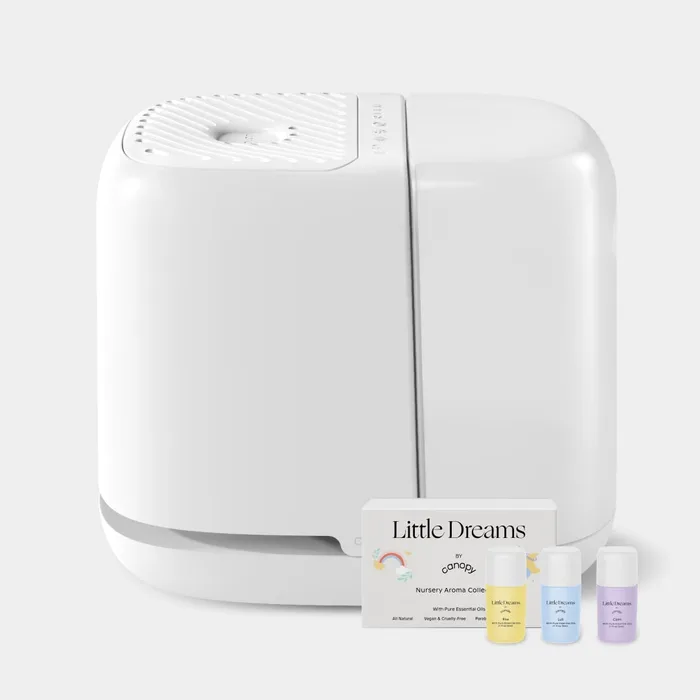
The Canopy Nursery Humidifier 2.0 is our pick, because it is evaporative, its water passes through a filter before it leaves the machine, and the tank, cap, tray and grill all go in the dishwasher, which is the part parents give up on first. The Honeywell HCM350 is the value pick and does the same evaporative job with a cheap replaceable wicking filter, a longer warranty and a wide tank opening, at the cost of a large footprint and an audible fan. The Levoit Classic 300S is the 'depends' pick: a 6 L tank, up to 60 hours on low and app control are genuinely useful, but it is ultrasonic, so it only makes sense if you are prepared to run distilled water and descale it. The Crane Adorables is the one to skip, since the animal shell buys you nothing functional while the bottom-fill tank, filter-free ultrasonic output and one year warranty all work against you. Cleaning burden is the real differentiator here, not mist output, and every one of these needs a routine. Aim for the low end of normal indoor humidity rather than the highest setting the machine offers. Best for: parents who want the humidifier they can still face cleaning in February.
Our picks at a glance
- Canopy Nursery Humidifier 2.0 - Buy. An evaporative, no-visible-mist nursery unit built around the assumption that you will actually clean it.
- Honeywell HCM350 Cool Moisture Humidifier - Buy. The plain, boring evaporative workhorse that gets the physics right and charges you very little for the filters.
- Levoit Classic 300S Smart Ultrasonic Humidifier - It depends. The best-equipped ultrasonic unit here, and a good buy only if you commit to distilled water and descaling.
- Crane Adorables 1 Gallon Ultrasonic Cool Mist Humidifier - Skip. The animal shape sells it, and little else about it beats the alternatives.
The verdict in 30 seconds
What mattered most
- Method
- Tank capacity
- Rated runtime
- Room coverage (maker's figure)
- Filter
- Mineral handling
A nursery humidifier is one of the few baby purchases where the technology choice genuinely changes what ends up in the air. Cool mist is the settled part: there is no heating element, so there is no pot of hot water in reach of a toddler. The unsettled part is evaporative versus ultrasonic, because ultrasonic units atomize whatever is dissolved in the tank and put it into the room, and the EPA has published guidance on exactly that. We picked four units that parents actually buy, from a filter-based evaporative machine to a filter-free animal-shaped ultrasonic, and judged them on output method, cleaning access, and what the maker will put in writing.
An evaporative, no-visible-mist nursery unit built around the assumption that you will actually clean it.
Best for: Parents who want the lowest-friction cleaning routine and are willing to pay for it in filters.
- Tank, cap, tray and grill are listed as dishwasher safe, which removes the usual excuse for skipping cleaning.
- Water is filtered and passes UV light before it evaporates, so minerals are handled inside the machine rather than in the room.
- Canopy states it runs on tap water, with up to 36 hours of runtime from a 2.5 L tank and up to 500 sq ft of coverage.
- The filter is a scheduled consumable on a 45 day replacement interval, so this is a machine with an ongoing cost.
- At 2.5 L the tank is the smallest here, so a dry winter week means frequent refills.
- Canopy does not publish a noise figure, and the design depends on a fan running rather than silent atomization.
- Warranty is one year, shorter than the Honeywell.
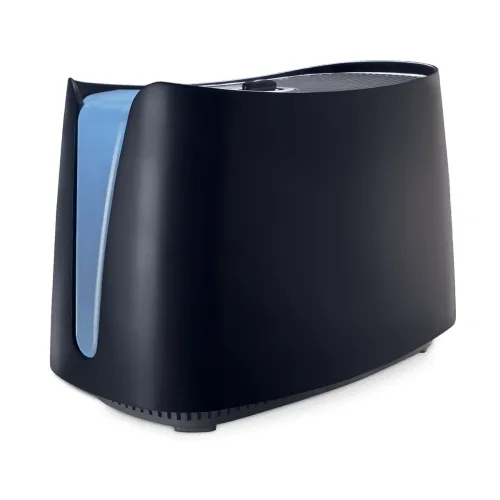
The plain, boring evaporative workhorse that gets the physics right and charges you very little for the filters.
Best for: Anyone who wants evaporative moisture, a long warranty and cheap consumables, and does not care how it looks.
- Wicking filter design, which Honeywell says removes impurities from the water and reduces white dust while the moisture leaves invisibly.
- Longer warranty than the Canopy (verify current terms), plus UV treatment of the water in the maker's description.
- Break-resistant water tank with a wide opening that is easier to reach into and brush clean (check the maker's care page for dishwasher use).
- Big and unsubtle next to the Canopy, which is a lot of surface area on a nursery floor.
- The HAC504 wicking filter is a recurring purchase and wicks can stiffen with scale in hard water.
- Honeywell rates it for 'medium' rooms without publishing a square footage figure.
- It moves air with a fan, so the higher settings can be audible in a quiet room.
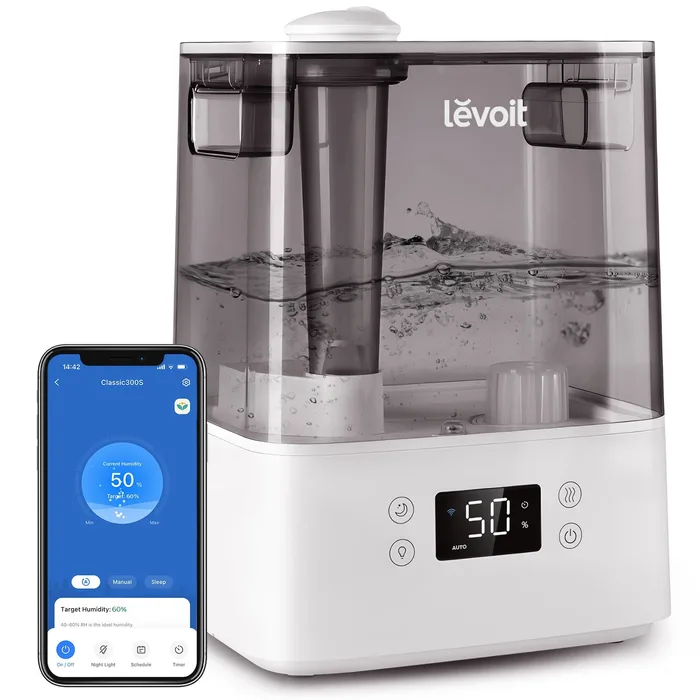
The best-equipped ultrasonic unit here, and a good buy only if you commit to distilled water and descaling.
Best for: Parents with soft water or a distilled water habit who want long unattended runtime and app control.
- 6 L top-fill tank rated for up to 60 hours on the low setting, far more than anything else in this group.
- Auto mode targets 40 to 50 percent relative humidity or a level you set, and the VeSync app adds schedules and voice control.
- Levoit rates it for 215 to 505 sq ft and lists 30 dB or less operation, plus a two year limited warranty.
- Ultrasonic output means dissolved minerals from tap water can end up as dust on the crib rail and in the room air.
- Descaling pads are sold separately, which tells you scale is an expected maintenance item.
- There is no filter to catch anything, so the water quality you pour in is the water quality you breathe out.
- A 6 L tank of standing water is heavier to carry to a sink and easier to leave sitting between cleanings.
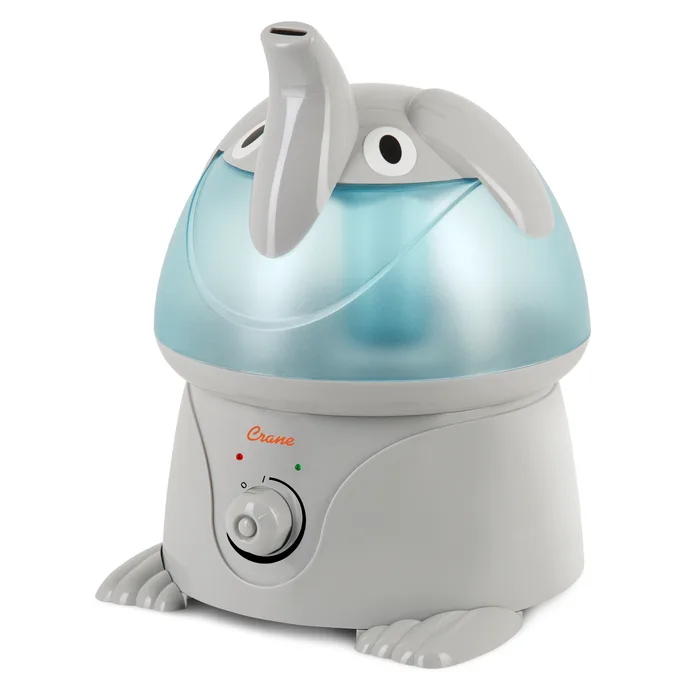
The animal shape sells it, and little else about it beats the alternatives.
Best for: If the animal shape is the whole point for your kid, treat it as decor and buy a real humidifier too.
- One gallon tank rated for up to 24 hours with an auto shut-off when the water runs out.
- The tank detaches, fits under a standard sink, and the water level sensor and cap come out for base access.
- Rated for rooms up to 500 sq ft and priced at the bottom of the category.
- Ultrasonic and filter free by default, so tap water minerals go into the nursery air unless you buy the optional HS-1932 demineralization cartridge.
- Bottom fill means you carry a full gallon tank back from the sink and invert it over the base every time.
- The molded animal shell adds crevices to a device that spends its life wet, and none of it is listed as dishwasher safe.
- One year limited warranty on a device you will run several months a year for years.
| Criteria | Nursery Humidifier 2.0 Top pick | HCM350 Cool Moisture Humidifier | Classic 300S Smart Ultrasonic Humidifier | Adorables 1 Gallon Ultrasonic Cool Mist Humidifier |
|---|---|---|---|---|
| Verdict | Buy it | Buy it | It depends | Skip it |
| Best for | Parents who want the lowest-friction cleaning routine and are willing to pay for it in filters. | Anyone who wants evaporative moisture, a long warranty and cheap consumables, and does not care how it looks. | Parents with soft water or a distilled water habit who want long unattended runtime and app control. | If the animal shape is the whole point for your kid, treat it as decor and buy a real humidifier too. |
| Price tier | $$$ · premium | $$ · mid-range | $$ · mid-range | $ · budget |
| Method | Evaporative, filter and fan | Evaporative, wicking filter | Ultrasonic | Ultrasonic |
| Tank capacity | 2.5 L | 1 gal | 6 L (1.58 gal) | 1 gal |
| Rated runtime | Up to 36 hours | Up to 24 hours | Up to 60 hours on low | Up to 24 hours |
| Room coverage (maker's figure) | Up to 500 sq ft | Medium rooms, no sq ft published | 215 to 505 sq ft | Up to 500 sq ft |
| Filter | MERV 5 pre-filter plus antimicrobial core, replace every 45 days | HAC504 wicking filter, one included | None required | None required, optional HS-1932 demineralization cartridge |
| Mineral handling | Water filtered and UV treated before evaporation | Maker says wicking filter reduces white dust | No filter, minerals in tap water can be dispersed | No filter by default, minerals in tap water can be dispersed |
| Fill and cleaning access | Removable 2.5 L tank, dishwasher-safe tank, cap, tray and grill | Wide tank opening, break-resistant tank | Top fill, cleaning brush included | Bottom fill detachable tank, removable water level sensor and cap |
| Warranty | 1 year | Longer than Canopy, verify current terms | 2 years | 1 year |
Which one is right for you?
- Parents who want the lowest-friction cleaning routine and are willing to pay for it in filters. Buy it Canopy Nursery Humidifier 2.0
- Anyone who wants evaporative moisture, a long warranty and cheap consumables, and does not care how it looks. Buy it Honeywell HCM350 Cool Moisture Humidifier
- Parents with soft water or a distilled water habit who want long unattended runtime and app control. It depends Levoit Classic 300S Smart Ultrasonic Humidifier
- If the animal shape is the whole point for your kid, treat it as decor and buy a real humidifier too. Skip it Crane Adorables 1 Gallon Ultrasonic Cool Mist Humidifier
How we judged the field
Five things decide whether a nursery humidifier is worth owning. First, how it produces moisture, because ultrasonic units atomize the water and everything dissolved in it, while evaporative units pull air through a wet wick and leave most of the mineral content behind. Second, what the manufacturer will actually commit to in writing for tank size, runtime and coverage, since those three numbers together tell you how often you will be at the sink. Third, cleaning access, meaning the size of the tank opening, whether the base comes apart, and whether the wetted parts are dishwasher safe. Fourth, the ongoing consumable, because a filter on a fixed replacement schedule is a real cost and a filter-free ultrasonic quietly shifts that cost to distilled water. Fifth, warranty length, as a rough proxy for how long the maker expects the thing to survive.
The field splits cleanly along the ultrasonic and evaporative line, and almost every other difference follows from it. On the evaporative side we took the Canopy Nursery Humidifier 2.0, which is the design most obviously built around cleaning, and the Honeywell HCM350, which is the long-running plain-box version of the same idea with a much longer warranty. On the ultrasonic side we took the Levoit Classic 300S, which is the strongest argument for the technology thanks to a 6 L tank and a real auto mode, and the Crane Adorables, which is the version most people are actually shown when they search for a baby humidifier. Those four cover the choice a parent is realistically making.
Canopy Nursery Humidifier 2.0
Buy itCanopy built the Nursery Humidifier 2.0 around the part everyone else treats as an afterthought. The tank, cap, tray and grill are all listed as dishwasher safe, so the weekly clean stops being a chore involving vinegar and a bottle brush. Water is filtered through a MERV 5 pre-filter and an antimicrobial core and passes UV light before it evaporates, which is why Canopy can say tap water is fine and why nothing settles on the crib rail. The specs are honest rather than impressive: a 2.5 L tank, up to 36 hours of runtime, up to 500 sq ft of coverage, three pounds, and a footprint of roughly 10 by 8.5 by 7 inches. The nursery-specific extras, a dimmable red nightlight and three soundscapes, are the kind of thing you either want on the nightstand or ignore. The trade-off is a filter on a 45 day replacement schedule and a one year warranty. If you would rather pay a subscription than fight scale, this is the one.
Honeywell HCM350 Cool Moisture Humidifier
Buy itThe Honeywell HCM350 is what an evaporative humidifier looks like when nobody is trying to make it pretty. A one gallon tank, adjustable output and a HAC504 wicking filter sits in the airflow removing impurities from the water so the moisture leaves the machine invisibly. Honeywell also describes UV treatment of the water. The practical wins are the ones that matter month after month: a wide tank opening you can get a brush into, a break-resistant tank, and a longer warranty than the Canopy. The cost is presence. It takes real floor space, and Honeywell rates it for ‘medium’ rooms without publishing a square footage number, so you are trusting the description. It is also a fan-driven machine, which can be audible on the top setting. Buy it if function beats form.
Levoit Classic 300S Smart Ultrasonic Humidifier
It dependsThe Levoit Classic 300S is the ultrasonic unit that makes the strongest case for itself. Its 6 L top-fill tank is rated for up to 60 hours on low, which means you fill it twice a week rather than daily, and the auto mode holds 40 to 50 percent relative humidity or a target you set. Levoit rates coverage at 215 to 505 sq ft and lists 30 dB or less, and the VeSync app adds schedules and voice control that are genuinely useful when the baby is finally asleep. All of that runs into one physical fact: there is no filter, so whatever is dissolved in your tap water gets atomized into the room. EPA guidance on home humidifiers notes that ultrasonic units are efficient at dispersing tap water minerals and suggests distilled water where white dust is a problem. Levoit selling descaling pads separately tells the rest of the story. Right buy for soft water or a distilled water routine, wrong buy otherwise.
Crane Adorables 1 Gallon Ultrasonic Cool Mist Humidifier
Skip itThe Crane Adorables is the humidifier most parents get shown first, and that is mostly a marketing outcome. On paper it is fine: a one gallon tank, up to 24 hours of runtime, rated for rooms up to 500 sq ft, variable output settings and an auto shut-off when the water runs out. Crane also deserves credit for a detachable tank that fits under a standard sink and a removable water level sensor and cap that open up the base. The problems are structural. It is ultrasonic and filter free by default, so mineral dust is on the table unless you buy the optional HS-1932 demineralization cartridge that screws into the tank. It is bottom fill, so every refill involves carrying and inverting a full gallon. The molded animal shell adds crevices to something that is permanently damp, and none of it is listed as dishwasher safe. One year of warranty closes the case. For the same money you can buy a plain box that does the job better.
Sources
Specs in this review come from these pages.
- EPA, Indoor Air Facts No. 8: Use and Care of Home Humidifiers (epa.gov)
- EPA, A Brief Guide to Mold, Moisture and Your Home (epa.gov)
- Canopy, Nursery Humidifier 2.0 product page (getcanopy.co)
- Honeywell (Kaz USA), Filtered Cool Moisture Humidifier HCM350 product page (honeywellpluggedin.com)
- Levoit, Classic 300S Ultrasonic Humidifier product page (levoit.com)
- Crane Baby, Adorable 1 Gallon Ultrasonic Cool Mist Humidifier product page (crane-baby.com)
Canopy Nursery Humidifier 2.0 vs Honeywell HCM350 Cool Moisture Humidifier: which should you buy?
Canopy and Honeywell are doing the same physics and arriving at very different objects. Both are evaporative, both put moisture into the room without a visible plume, and both keep the mineral content of your tap water inside the machine rather than on the furniture. Canopy wins on everything to do with living with it: it is small enough for a dresser at roughly 10 by 8.5 by 7 inches, it weighs three pounds, and four of its wetted parts go in the dishwasher, which is the single biggest predictor of whether a humidifier stays clean past January. Honeywell wins on economics and durability: a longer warranty than Canopy’s one year, a cheap and widely stocked HAC504 filter against a 45 day subscription cadence, and a tank opening wide enough that cleaning by hand is not a wrestling match.
Choose by which failure mode you are more likely to hit. If your honest read on yourself is that maintenance only happens when it is easy, buy the Canopy and accept the filter schedule as the price of a routine you will keep. If you already own a bottle brush and some vinegar and you would rather spend less over five years, buy the Honeywell and give it the floor space. Room size is a mild tiebreaker too, since Canopy publishes a 500 sq ft figure while Honeywell only says ‘medium’, so a larger nursery or an open-plan room slightly favors the Canopy. Neither choice is a mistake.
What to look for
- Method before features: decide evaporative or ultrasonic first, because that single choice determines whether tap water minerals stay in the machine or end up in the room.
- Tank opening and dishwasher-safe parts: you will clean this thing dozens of times, so the width of the opening and how many parts survive a dishwasher matter more than mist output.
- A published coverage figure: a maker that prints a square footage rating is easier to check against your room than one that says ‘medium’ and leaves it there.
- The consumable you are signing up for: a wick or filter on a fixed replacement interval is a recurring cost, and a filter-free ultrasonic quietly substitutes distilled water instead.
- A real humidity target, not just speed settings: an auto mode aiming at a set relative humidity is far more useful than low, medium and high, and pair it with a cheap hygrometer either way.
- Warranty length as a durability hint: a longer term signals a different expectation than one year on a device that lives wet for months at a time.
Our final take
Buy the Canopy Nursery Humidifier 2.0 if you want the humidifier you will still be willing to clean in the middle of winter, because dishwasher-safe parts and a filtered evaporative design remove both excuses at once. Buy the Honeywell HCM350 if you would rather have a longer warranty and cheap filters and you have the floor space for a large plain box. Take the Levoit Classic 300S only with your eyes open, since 60 hours of runtime and app control are real advantages that come attached to a distilled water habit. Skip the Crane Adorables, because a molded animal shell is not worth a bottom-fill tank and unfiltered ultrasonic output. Whichever you pick, put a hygrometer in the room and aim low rather than high.
Questions, answered
Is cool mist actually safer than warm mist for a baby's room?
Cool mist units have no heating element and no reservoir of hot water, which removes the scald and burn pathway that a steam vaporizer introduces. That is the reason cool mist is the default recommendation for rooms where small children are unsupervised at night. It is worth saying that the safety difference is about the hot water and the steam plume, not about how well the machine humidifies. Both types raise humidity effectively. If you are weighing a specific health situation rather than general comfort, that is a conversation for your pediatrician rather than a spec sheet.
What is the white dust on the crib rail, and does it matter?
That dust is the dissolved mineral content of your tap water, left behind after the water evaporates. The EPA's guidance on home humidifiers notes that ultrasonic and impeller units are efficient at dispersing minerals from tap water into the air, and it points to distilled water as the way to reduce that. Evaporative machines behave differently, because the water evaporates off a wick and the minerals are largely trapped in the wick material instead. If you see white film settling on furniture near an ultrasonic unit, that is the mechanism working exactly as described. It is also a good signal that the machine is due for descaling.
How often do I really have to clean it?
The EPA's home humidifier factsheet advises cleaning portable humidifiers every third day, and empties and refills daily are part of the same guidance. That is more frequent than most people expect, which is exactly why dishwasher-safe parts and a wide tank opening matter more than mist output. In practice the routine is: empty and dry the tank daily, and do a proper scrub and descale on a regular schedule. Scale is not just cosmetic, because mineral crust gives microorganisms somewhere to sit. A machine you can take apart quickly is a machine that stays clean.
What humidity level should I aim for in a nursery?
General indoor guidance sits in the roughly 30 to 50 percent relative humidity band, and the EPA's mold guidance is explicit that keeping indoor humidity in that range helps limit mold growth. Levoit's auto mode targets 40 to 50 percent, which is a reasonable middle. The mistake is treating a humidifier like a comfort dial and running it flat out, because condensation on windows and damp on walls is the visible sign you have gone too far. A cheap hygrometer in the room is the single most useful accessory you can add. If the walls or windows are wet in the morning, turn it down.
Do I have to use distilled water?
It depends entirely on the type of machine. For an ultrasonic unit like the Levoit or the Crane, distilled water is the practical way to avoid mineral dust and slow down scale build-up, and EPA guidance points in that direction if white dust is a problem for you. For an evaporative unit, the mineral load is handled by the wick or filter, and Canopy states plainly that tap water is all its unit needs. That difference is the real reason evaporative machines are easier to live with in a nursery. Factor the cost and hassle of hauling distilled water home every week into your decision before you buy ultrasonic.
Deciding between the top two? See our head-to-head: Canopy Nursery Humidifier 2.0 vs Honeywell HCM350 Cool Moisture Humidifier.
More Baby & Family reviews
 The Best Nursing Pillows: 4 Compared (and One to Skip)
  The Best Pack 'n Plays: 4 Compared (and One to Skip)
  The Best Play Kitchens: 4 Compared (and One to Skip)
  The Best Sippy Cups: 4 Compared (and One to Skip)
  The Best Stroller Footmuffs: 4 Compared (and One to Skip)
  The Best Stroller Organizers: 4 Compared (and One to Skip)