Explained
Nursery Blackout Curtains and Blinds, Explained
After reading, you'll understand why two curtains with identical blackout claims perform completely differently, and which spec on the listing actually predicts a dark nursery.
In this guide
First-time buyers get tripped up by the same two things. They assume blackout is a defined standard, so they compare percentages that were never measured the same way. And they assume the fabric is what blocks the light, so they buy the densest panel available, hang it on a rod, and discover the room is still bright at 6am. The light was never coming through the fabric. It was coming around it.
The 30-second version
- Cordless is the requirement, not the upgrade, and federal rules now back that up for both stock and custom window coverings.
- Blackout has no universal threshold, so a percentage on a listing tells you about the fabric at best and about the marketing team at worst.
- Mounting beats fabric, because in a normal room the light that wakes a child arrives around the edges rather than through the weave.
- The header style is a spec, and grommet tops leak at the top of the window in a way rod pocket and back tab tops do not.
- Travel is a separate product category, solved by suction-cup panels or a canopy over the crib, not by anything you hang on a rod.
The products this guide is about
Our verdict on each, with the full reasoning on the companion review.
- Buy Sleepout Portable Blackout Curtain A one pound blackout panel that suction cups directly onto the window glass, which is the design here built most directly around killing edge light.
- Buy Redi Shade Easy Lift Fabric Cellular Blackout Shade A cordless blackout honeycomb shade you trim to width at home and install with no tools, which makes it the easiest safe starting point for a nursery. Amazon
- It depends SlumberPod Not a window covering at all but a blackout canopy over the crib, which is the right answer when the real problem is a shared room or a hotel rather than the window. Amazon
- Skip NICETOWN Super-heavy 100% Blackout Grommet Curtains Genuinely dense fabric in the one header style that guarantees a bright band above the rod, which is the light that wakes a baby at dawn. Amazon
What actually matters
- Operating cords - the cord you pull to raise or lower a covering is the piece that has killed children, which is why the standard singles it out. In a nursery the only acceptable answers are no cord at all, a cord too short to form a loop, or a cord made physically inaccessible.
- Inner cords - these are the cords running through the slats or the back of a shade, and they are covered by the standard separately from operating cords. A covering can be cordless to operate and still have inner cords that a child can pull into a loop, so both matter.
- Header style - rod pocket and back tab headers carry the fabric behind the rod, grommet and ring headers hang it in front. That single choice decides whether there is an open band of light across the top of your window every morning.
- Mount position - inside mounts look tidy and leak at the sides; outside mounts look bulkier and darken the room. In a nursery, choose the outside mount and overshoot the opening generously on every side.
- Window depth - inside-mounted shades need a minimum frame depth to sit properly, often more than an inch, and a shallower frame means the shade protrudes and leaks. Measure the depth before you measure anything else.
- Fabric construction - triple weave means density with no coating, foam backed or rubber backed means a coated layer, and a separate liner means two layers sewn together. All three can block light well, and they differ mostly in drape, smell, washability and how they age.
- Portability - a nursery blackout setup that cannot travel means every trip is a sleep experiment. Suction-cup panels and crib canopies exist because hotel curtains are reliably terrible.
The specs, in plain English
Green flags vs red flags
Green flags
- The listing says cordless, and the product photos show a bottom rail or wand rather than a dangling cord or bead chain.
- A rod pocket or back tab header, or a mounting method that puts the fabric behind the rod rather than in front of it.
- The maker publishes a minimum window depth, a trim-to-fit range, or an outside mount option, which means they expect you to fit it properly.
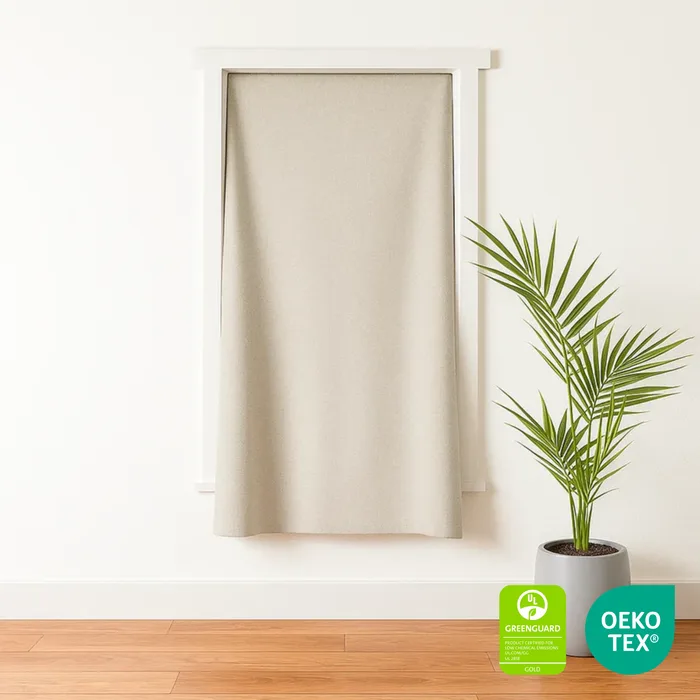
- Named certifications you can look up, such as OEKO-TEX Standard 100 or GREENGUARD Gold, rather than generic non-toxic language.
- Side channels, magnetic light blockers, or a wraparound rod offered in the same range, which shows the maker knows where the light gets in.
Red flags
- Any accessible operating cord or continuous bead chain, in a product intended for a room with a young child.
- A blackout percentage with no test method, no certification, and no explanation of what was measured.
- Grommet or ring headers marketed specifically for nurseries, which is the one room where that header hurts most.
- One length only, no trim option, and no outside mount hardware, which usually means a poor fit and visible gaps.
- Listings that lean on thermal, noise reducing and blackout claims all at once without a single verifiable number among them.
Who's who: the brands
- Sleepout - Known for portable blackout panels that mount on the window glass with locking suction cups, aimed at travellers and renters.
- Redi Shade - Makes trim-at-home, no-tools shades, from budget paper blackout shades to cordless fabric cellular blackout shades.
- SlumberPod - Makes the blackout canopy that fits over a playard or mini crib, aimed squarely at room sharing and travel.
- NICETOWN - A high volume curtain brand covering blackout panels in many headers and lengths, plus accessories like wraparound rods.
- Deconovo - Sells ready made blackout curtains alongside custom cordless honeycomb shades and motorized roller shades.
How to read a listing without getting fooled
Work through a listing in a fixed order and you will not get fooled. Start with the operating mechanism: cordless, short cord, or inaccessible cord, and if the listing will not tell you, treat that as an answer. Next find the header style or mount type, since that determines the top gap, and check whether an outside mount is possible. Then find the actual dimensions, including the minimum window depth for a shade and the finished panel width for curtains, and compare them to your window rather than to the picture. Only then read the fabric description, and prefer construction words like triple weave, foam backed, or lined honeycomb over adjectives. Treat any percentage as unverified unless a test or certification sits behind it, and check whether light-sealing accessories exist in the range, because a maker that sells side channels is a maker who knows their shade leaks without them.
How much should you spend?
Budget tier gets you trim-at-home cordless shades and mass market curtain panels, and honestly a well mounted budget shade beats a badly mounted premium curtain most mornings, so this is a reasonable place to start. Mid tier buys better fabric, more sizes, detachable liners, and accessories like wraparound rods and side channels, which is where the money actually converts into darkness. Premium tier covers custom-sized cordless shades, motorized roller shades, portable panels with published certifications, and crib canopies, and it makes sense when the window is an odd shape, when you travel often, or when you have already tried the cheap fix and the room is still bright. The single highest-return spend in this category is not fabric at all: it is whatever hardware pulls the covering tight to the wall.
Questions, answered
Is total darkness necessary for a baby to sleep?
Not necessarily, and children vary enormously. What is consistent is that light around the edges of a window is what tends to become noticeable at dawn, when sleep is already lightest. Plenty of babies sleep fine in a merely dim room, so treat full blackout as a tool to try rather than a rule to follow. Anything about your own child's sleep is a question for your pediatrician.
Can I just tape cardboard or foil over the window?
It works, which is why so many exhausted parents end up doing it. The downsides are that it looks grim, adhesives can damage paint and frames, foil traps heat against the glass in summer, and some rental agreements object. A trim-to-fit cordless shade or a suction-cup panel does the same job, comes down in seconds, and does not leave marks.
What do I do about an existing corded blind I cannot replace yet?
Move the crib and any climbable furniture well away from the window first, since reach is what turns a cord into a hazard. Retrofit devices such as cord cleats and tension devices exist and are better than nothing, but the certification programs run by the industry deliberately exclude products that rely on them, which tells you how much confidence to place in that approach. Replacing the covering with a cordless one is the actual fix.
Do blackout curtains really help with heat or noise?
Heat, yes, to a modest degree: dense fabric and honeycomb cells slow heat transfer at the glass, and cellular shades are the better performers because the trapped air does the work. Noise, barely. Fabric absorbs some high-frequency sound and does essentially nothing about the low-frequency traffic rumble that people actually complain about. Buy for light, and treat any thermal benefit as a bonus.
Or jump to the head-to-head: Sleepout Portable Blackout Curtain vs Redi Shade Easy Lift Fabric Cellular Blackout Shade.