Explained
ND Filters, Explained
After reading, you'll know how many stops you need, why hard stops matter on a variable ND, and how to spot a filter that will not be neutral.
In this guide
A neutral density filter reduces the light reaching the sensor without changing anything else, which lets you use a slower shutter or a wider aperture than the scene would otherwise allow. Everything interesting about the category comes from the two words in the name: how much density, and how neutral.
The 30-second version
- Each stop halves the light, so a six stop ND passes one sixty-fourth of what hits it.
- Variable NDs are two polarisers, which is why they can cross-polarise into a dark X.
- Hard stops prevent that failure, by physically limiting the rotation range.
- Colour cast worsens with strength, and infrared leakage is the part white balance cannot fix.
- Published evidence is rare and decisive, so a reflectance figure or transmission curve is worth seeking out.
The products this guide is about
Our verdict on each, with the full reasoning on the companion review.
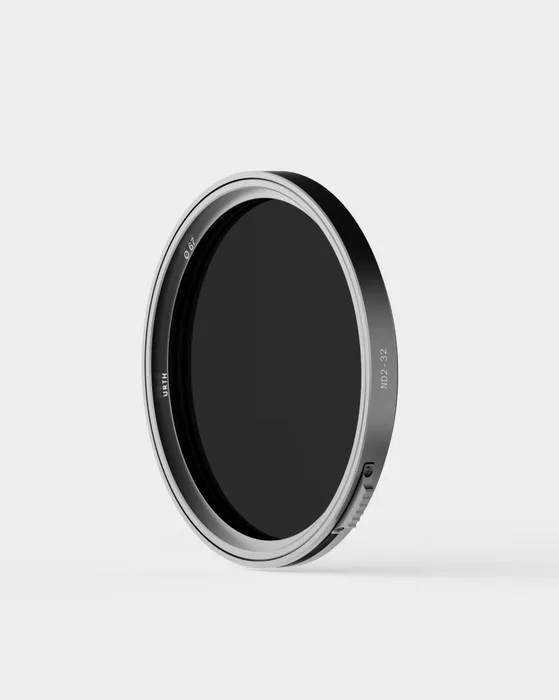
- Buy Urth Variable ND2-32 Filter Pro The only filter here that publishes its reflectance, and the only one with a lifetime warranty.
- Buy Freewell Hard Stop Variable ND Hard stops, two ranges, and a coating designed for being carried around outdoors.
- It depends Breakthrough Photography X4 Neutral Density The best-documented optics here, in a fixed filter you buy one strength at a time.
- Skip PolarPro PMVND Edition II The highest price in this comparison and the least published about what is in it.
What actually matters
- Stop value - how much light is removed, where each stop halves it. Three stops is one eighth, six is one sixty-fourth, ten is roughly one thousandth.
- Variable or fixed - variable filters rotate through a range using two polarising layers; fixed filters are a single density with no moving parts and cleaner optics.
- Hard stops - physical limits at each end of a variable ND's range, preventing rotation into the cross-polarisation zone.
- Glass substrate - the optical glass used, such as SCHOTT B270. A named glass type is a specification; a marketing name is not.
- Coating - multi-layer anti-reflection coatings applied to both faces, reducing flare and ghosting and often adding scratch and water resistance.
- Colour neutrality - how flat the transmission curve is across the spectrum, and whether infrared leaks through. This is what separates good ND glass from cheap grey glass.
- Frame and thread - brass or aluminium, the filter thread size in millimetres, and whether the frame is slim enough to avoid vignetting on wide lenses.
The specs, in plain English
Green flags vs red flags
Green flags
- A named glass substrate such as SCHOTT B270.
- Coating layer count given per side or in total.
- A reflectance percentage or a published transmission curve.
- Hard stops stated explicitly on a variable ND.
- A stated minimum focal length for vignetting-free use.
Red flags
- Glass described only by a marketing name or a resolution claim.
- No coating information at all.
- A variable ND with no mention of hard stops.
- No frame material and no warranty terms.
- Neutrality asserted with no measurement of any kind.
Who's who: the brands
- Urth - Publishes named SCHOTT glass, coating layer counts and reflectance figures across its filter range, with a lifetime warranty and a tree-planting programme.
- Freewell - Value-focused filter maker known for hard stop variable NDs, magnetic systems and drone-specific kits, with two stop ranges on most designs.
- Breakthrough Photography - Optics-first American brand publishing transmission curves and coating rationale, using SCHOTT Superwhite B270 in brass traction frames.
- PolarPro - Video-oriented filter brand with hard stop VNDs, magnetic Helix systems and Defender cases, strong on handling and light on published optics.
- NiSi - Widely used for square filter systems and graduated NDs in landscape work, alongside circular variable and fixed filters.
How to read a listing without getting fooled
Start with the glass. If the page names an optical glass type you can look up, the maker is telling you something; if it names a series and a resolution claim, it is telling you nothing. Then count coatings, and note whether the figure is per side or total, since eight per side and sixteen total are the same thing. Look for any measurement of neutrality, a reflectance percentage or a transmission curve, because that is the only published evidence that the filter does the one thing its name promises. If the filter is variable, check for hard stops and treat their absence as a defect rather than an omission. Check the stated minimum focal length for vignetting against your widest lens. Then look at frame material and thread size, and remember to buy for your largest lens and step down. Finally read the warranty, which in this category ranges from lifetime to nothing at all and does not track price.
How much should you spend?
Filters are one of the few accessories where cheap glass visibly degrades an expensive lens, so the bottom of the market is a false economy. The mid-range now buys a genuinely good variable ND with hard stops, 18-layer coatings and a durable outer coating, which is enough for almost all video work and is where most people should buy. The premium tier buys named SCHOTT glass, higher coating counts, published reflectance and in one case a lifetime warranty, which is a rational upgrade if the filter lives on a lens you use constantly. Fixed NDs from optics-led makers cost about the same per filter but you need several, so a full set is a serious outlay justified by long exposure work rather than by video. At the flagship end you are increasingly paying for handling, cases and brand, and the published optical specification does not necessarily improve.
Questions, answered
What thread size should I buy?
Buy for your largest filter thread and use step-up rings for everything smaller. Filter threads are marked in millimetres on the front of the lens or inside the cap, commonly 49, 52, 67, 77 and 82. Buying one 82mm filter plus a few rings is far cheaper than buying the same filter four times, and it means your best glass goes on every lens. The downside is that a step-up ring stops you using the original lens hood, and on very wide lenses a larger filter sits further forward, which can reintroduce vignetting.
Why do my long exposures come out with a colour cast?
Because filter neutrality falls apart at high densities. A ten or fifteen stop ND is removing almost all visible light, so any small imbalance in what it transmits becomes the dominant colour in the frame, and infrared leakage adds a magenta or brown shift that white balance cannot fully remove. Shooting raw and correcting is the usual answer, and a custom white balance taken through the filter helps more than adjusting afterwards. Choosing a filter whose maker publishes a transmission curve is the real fix.
Does a variable ND affect autofocus or sharpness?
It can, in two ways. Any filter adds two air-to-glass surfaces and a thickness of glass in front of the lens, and cheap glass will cost you resolution and contrast. Beyond that, a strong ND cuts so much light that autofocus systems hunt or fail in dim conditions, which is why many people focus first and then fit a strong fixed ND, or switch to manual focus. Variable NDs at the light end of their range rarely cause focus problems; at eight or nine stops, expect to focus before fitting.
How do I clean an ND filter?
Blow the dust off first, then use a proper lens cloth with a little lens cleaning fluid, working from the centre outward. Never wipe a dry dusty filter, because you are dragging grit across a coated surface. Coatings on good filters are hard, and Breakthrough describes its MRC as harder than the glass itself, but they are still the first thing to wear. Keep the filter in a case when it is not on a lens, and avoid stacking filters face to face without something between them.
Or jump to the head-to-head: Urth Variable ND2-32 Filter Pro vs Freewell Hard Stop Variable ND.