Explained
Portable Monitors, Explained
After reading this you will understand how a portable monitor connects to your laptop, which specs actually affect your day, and how to avoid the two mistakes most first-time buyers make.
In this guide
A portable monitor is a thin, lightweight second screen you carry with a laptop or tablet, usually driven by a single cable. The category looks simple, but the one detail that decides whether it will even turn on, how your laptop sends video down that cable, is buried in the fine print. Get that wrong and an otherwise good screen stays black.
The 30-second version
- Check the cable before anything else. Most single-cable portable monitors rely on USB-C video output that not every laptop or handheld provides, so confirm your device supports it or buy a screen with HDMI.
- The stand matters as much as the panel. A rigid built-in kickstand stays put on a train tray or cramped desk, while the folding magnetic covers many models ship with fold flat the moment you nudge them.
- Brightness is what makes a screen usable near windows. Anything much under the mainstream range struggles in daylight, so treat brightness as a working requirement rather than a spec-sheet bragging point.
- Skip the built-in battery for most uses. It adds weight and cost and degrades over a few years, and it sits idle whenever your laptop is already plugged in.
- Touch and speakers are extras, not essentials. Unless you sketch or annotate, a brighter non-touch panel with a good stand is usually the better value.
The products this guide is about
Our verdict on each, with the full reasoning on the companion review.
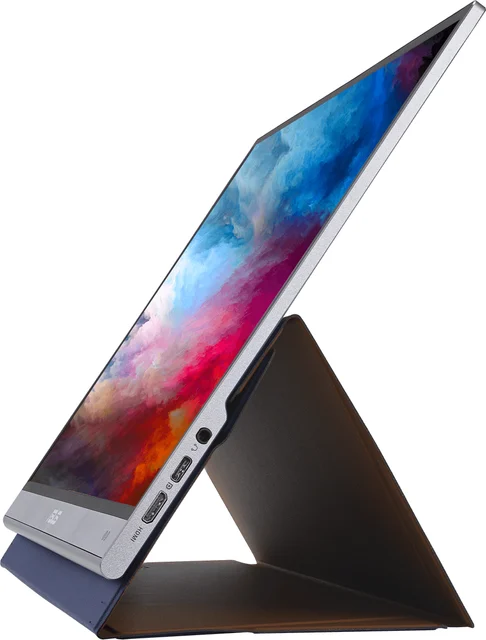
- Buy ASUS ZenScreen OLED MQ16AH The most convincing image in the group, held back by a fussy stand and a premium price.
- Buy Lenovo ThinkVision M14 The most practical travel panel here: light, stable and simple, if your laptop supports USB-C video.
- It depends espresso Display 15 A thin, touch-capable panel that asks you to accept software-only controls and glare.
- Skip ASUS ZenScreen Go MB16AHP You pay in weight and picture quality for a battery you probably will not need.
What actually matters
- Video connection decides whether the monitor works with your gear at all. Single-cable USB-C models need a host that outputs video over USB-C; if yours does not, you need HDMI or a bundled adapter.
- Stand design determines how steady the screen is in real use. A hinged built-in kickstand holds an angle far better than a folding cover on an uneven surface.
- Brightness governs whether you can read the screen in a bright room or outdoors. Dim panels wash out in daylight no matter how good the colors are.
- Panel type affects contrast, color and glare. OLED gives true blacks and rich color, IPS is accurate but flatter, and a glossy finish looks vivid indoors but reflects heavily under lights.
- Weight and thickness are the whole point of "portable". Extra grams from a battery or thick housing are what you feel in a bag every day.
- Power delivery shapes how many cables you carry. Some panels draw power over the same cable that carries video, while brighter screens or weaker laptop ports need a second cable to a charger or power bank.
- Resolution versus size sets how sharp text looks. A 1080p image spread across a larger panel can look soft up close, which matters if you work near the screen.
The specs, in plain English
Green flags vs red flags
Green flags
- A rigid built-in kickstand that tilts and adjusts height, not just a folding cover
- Clear statement of how it connects, including HDMI or a bundled adapter if you lack USB-C video
- Brightness in the mainstream range or above so it holds up in a lit room
- Two USB-C ports with power pass-through so one adapter runs the screen and charges the laptop
- A matte or anti-glare coating if you work near windows or overhead lighting
- Low weight and a slim metal or aluminium chassis for genuine everyday portability
Red flags
- USB-C video is required but the listing never confirms your device type is supported
- A built-in battery is the headline feature and pushes weight and price up
- Brightness sits well below the mainstream range, hinting it will look dim outdoors
- Controls are software-only with no physical buttons or on-screen menu
- The only stand is a flimsy folding cover that blocks a port in portrait orientation
- A glossy finish paired with no mention of how it handles reflections
Who's who: the brands
- ASUS - Makes the ZenScreen line, spanning premium OLED color panels and battery-equipped travel models.
- Lenovo - Its ThinkVision portable screens favor light weight, sturdy built-in stands and single-cable USB-C simplicity.
- espresso - A design-led maker known for very thin aluminium-and-glass panels, magnetic stands and optional touch input.
- Dell - Offers business-focused portable displays built around USB-C docking and reliable, understated design.
- ViewSonic - Broad range of value-oriented portable monitors covering many sizes and connection types.
How to read a listing without getting fooled
Start at the connection line, not the picture quality, because that is where listings hide the catch. If a screen is sold as single-cable USB-C, it almost always needs your laptop to output video over USB-C DisplayPort Alt Mode; a listing that stays vague here is a warning, so look for the words HDMI or DisplayLink as a fallback if your device cannot. Next, translate the stand: "foldable smart cover" or "magnetic case" usually means a flimsy prop, while "built-in kickstand" with tilt and height is the sturdy option. Read brightness in nits and be skeptical of anything well below the mainstream range, since marketing photos are always shot in flattering light. Treat "HDR" and vivid color claims as secondary to whether the panel is bright and matte enough to actually work on. Finally, notice what is missing: no speakers, no physical buttons or software-only brightness are common trade-offs that are fine if you expect them and annoying if you do not.
How much should you spend?
Spend according to what you will actually do with the screen. The value sweet spot is a mid-range panel with a rigid built-in stand and clean single-cable USB-C; that combination handles email, spreadsheets and browsing on the road without paying for extras you will not use. Paying more is worth it only when image quality is the point, for photo, video or media work where an OLED panel with true blacks and accurate color earns its premium. Paying more for a built-in battery is usually a poor trade, because the battery adds weight and cost, ages over a few years and sits idle whenever a laptop is plugged in, which is most of the time. Touch input is similarly a spend-up you should make only if you genuinely sketch or annotate. When in doubt, put your money into the stand, the brightness and the panel, and skip the gimmicks.
Questions, answered
Will a portable monitor work with my laptop?
Not always. Many run only on USB-C DisplayPort Alt Mode, which some laptops and handhelds do not provide. Check whether your USB-C port outputs video, or choose a monitor with HDMI or a bundled DisplayLink adapter, and confirm the port before you buy.
Do I need a separate power supply?
Often no. Many screens draw power over the same USB-C cable that carries video, so one cable from the laptop is enough. Brighter panels or weaker laptop ports may need a second cable to a charger or power bank to hold full brightness.
Is a built-in battery worth it?
Rarely. A battery adds weight and cost, degrades over a few years, and sits unused whenever your laptop is plugged in. Unless you regularly work where no outlet exists, a lighter monitor paired with a small USB-C power bank is more flexible.
Is OLED burn-in a real risk on a portable monitor?
For typical mixed use it is low. Burn-in comes from static elements shown bright for long stretches, so vary your content, use auto-dimming and screensavers, and avoid leaving fixed taskbars on screen for hours, and a modern OLED panel should hold up.
Is a touchscreen worth paying extra for?
For most laptop users, no. Touch helps if you sketch, annotate or run touch-first apps. For spreadsheets, email and browsing, a non-touch panel with a good stand and a brighter screen is usually the better value.
How big and how sharp should the screen be?
Most portable monitors are around the size of a laptop screen, which balances usable space against what fits in a bag. Watch resolution against size, since a 1080p image on a larger panel can look soft if you sit close, so a slightly smaller panel can look sharper.
Or jump to the head-to-head: ASUS ZenScreen OLED MQ16AH vs Lenovo ThinkVision M14.