Explained
Mirrorless Cameras, Explained
After reading this, you'll be able to look at any mirrorless camera listing and know exactly which specs matter for you, which are marketing noise, and which mistakes cost beginners the most.
In this guide
A mirrorless camera is simply an interchangeable-lens camera that skips the flip-up mirror of old DSLRs - light hits the sensor directly, and you compose on a screen or electronic viewfinder. That design makes them smaller, faster-focusing, and better at video than the cameras they replaced. What trips up first-time buyers isn't the cameras themselves - it's the wall of jargon (APS-C, IBIS, 10-bit, oversampled 4K) and the fact that you're really buying into a lens system, not just a body.
The 30-second version
- You're buying a lens mount, not just a camera - the body you choose locks you into one brand's lens ecosystem, and that matters more over the years than any single spec.
- Autofocus with subject detection is the biggest practical upgrade over phones and older cameras - modern AI tracking of eyes, pets, and vehicles is what makes your keeper rate jump.
- Sensor size sets the tier: APS-C is the sweet spot for beginners and enthusiasts, full-frame costs and weighs more for gains most people won't notice at first.
- Newer beats fancier: a current mid-range body routinely outperforms an older upper-tier one at the same price - always check the release year before you buy.
- The kit lens bundle is usually the right call for a first camera - bundled zooms are stabilized, compact, and usually cheaper bundled than bought separately.
The products this guide is about
Our verdict on each, with the full reasoning on the companion review.
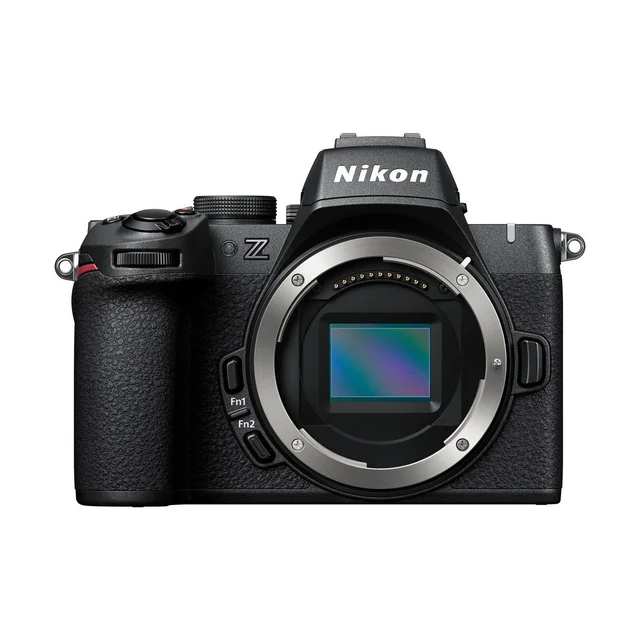
- Buy Nikon Z50 II Pro-grade autofocus and handling trickled down into a beginner body - a lot of camera for the class. Amazon
- Buy Canon EOS R50 The friendliest small camera you can buy - superb autofocus and a guided interface in a body that disappears in a bag. Amazon
- It depends Fujifilm X-M5 A gorgeous, video-forward compact with Fujifilm's famous color - as long as you can live without a viewfinder. Amazon
- Skip Sony a6400 Still on shelves and still competent, but this is 2019 hardware at a 2026 price - the newer rivals outclass it. Amazon
What actually matters
- Autofocus subject detection - the ability to recognize and track eyes, faces, animals, and vehicles automatically. This is the single spec that most changes real-world results, especially with kids, pets, and sports.
- Sensor size (APS-C vs full-frame vs Micro Four Thirds) - sets the ceiling for low-light quality and background blur, but also drives cost, size, and lens prices. APS-C is where most beginners get the most camera for the money.
- A viewfinder (EVF) - a small eye-level screen you compose through. Rear-screen-only cameras are fine indoors and for video, but genuinely frustrating in bright sunlight. Skipping the EVF is a trade-off many first-time buyers come to regret.
- The lens ecosystem - how many lenses exist for the mount, at what prices, and whether third-party makers are allowed to build autofocus lenses for it. Some brands welcome third parties; others restrict them.
- Stabilization - either in the body (IBIS) or in the lens (labeled VR, IS, OIS, or OSS depending on brand). Many entry-level bodies have no IBIS at all, which is fine as long as your lenses are stabilized.
- Screen articulation - a fully articulating (side-flip) screen matters if you'll ever film yourself or shoot at odd angles; a tilt-only screen is a real limitation for vlogging.
- Video capability - resolution and frame rates (4K30 vs 4K60), whether the 4K is oversampled (sharper), and whether it records 10-bit color (better for editing). Only relevant if you'll actually shoot video.
The specs, in plain English
Green flags vs red flags
Green flags
- Released within the last two to three years - recent bodies inherit autofocus and processing from flagship models
- Subject-detection autofocus covering people, animals, and vehicles is listed explicitly
- A real viewfinder plus a fully articulating touchscreen - covers both outdoor shooting and video
- The mount has a deep lens catalog with third-party autofocus lenses openly available
- Oversampled 4K and 10-bit options listed - signs the maker didn't treat video as an afterthought
- Kit bundle includes a stabilized lens (VR/IS/OIS/OSS in the lens name)
Red flags
- A model launched many years ago still selling near its original price - you're paying new-camera money for old hardware
- No viewfinder at all, unless you're certain you'll compose on the screen (bright sunlight is where this bites)
- Tilt-only, low-resolution rear screens and micro-USB ports - telltale signs of a dated platform
- No stabilization in either the body or the bundled lens
- A sparse native lens lineup where the maker blocks third-party autofocus lenses - your upgrade path narrows fast
- Spec sheets leading with megapixels - resolution differences in this class are marketing, not image quality
Who's who: the brands
- Nikon - Long-time camera stalwart whose recent Z-mount bodies trickle flagship autofocus down to beginner models; APS-C lens lineup is still growing but full-frame Z lenses mount natively.
- Canon - A major brand known for friendly guided interfaces and superb Dual Pixel autofocus - but it limits third-party autofocus lenses on its RF mount, so the native catalog is what you get.
- Sony - Mirrorless pioneer with the largest lens ecosystem (E-mount) and wide third-party support; its entry bodies are dependable but some long-running models are aging on shelves.
- Fujifilm - The style-and-color brand - beloved Film Simulation looks straight out of camera, a deep APS-C-first X-mount catalog, and strong video; some popular models skip the viewfinder.
- Panasonic / OM System - The Micro Four Thirds camp - smaller sensors in very compact, often weather-sealed bodies with excellent stabilization; a fine niche choice, though APS-C rivals dominate beginner recommendations.
How to read a listing without getting fooled
Start with the release year, not the headline specs - makers keep old models on shelves for years at prices that no longer make sense. Then check three lines: autofocus (does it explicitly list subject or eye detection for people and animals?), the viewfinder (is there one, and is it described as bright or high-resolution?), and stabilization (IBIS in the body, or VR/IS/OIS/OSS in the kit lens name - you need one of the two). Ignore megapixel counts; every current camera in this class has plenty. For video, 'oversampled 4K' and '10-bit' are quality markers, while a bare '4K30' with no details often hides cropped or soft footage. Finally, search the mount name plus 'lens roadmap' - a body with no lenses worth growing into is a dead end no spec sheet will admit.
How much should you spend?
In mirrorless, cost scales mainly with sensor size, autofocus generation, and build features like IBIS and weather sealing. The value sweet spot for beginners and enthusiasts is the mid-range APS-C tier: recent models there inherit flagship-grade autofocus and video while keeping bodies and lenses affordable. Spending up to full-frame buys better low light and shallower depth of field, but also pricier, heavier lenses - worth it only once you know photography is a lasting hobby. Spending down on the cheapest or oldest models is usually false economy: you give up the autofocus and screen quality that make a camera enjoyable, which is exactly what makes people abandon the hobby. Put any stretch in your budget toward the kit bundle with a stabilized lens, and keep a little aside for a spare battery - the near-universal first accessory.
Questions, answered
Is mirrorless better than a DSLR now?
For a new buyer, yes - the major makers have moved development to mirrorless. You get faster and smarter autofocus, a viewfinder that previews your exposure before you shoot, better video, and smaller bodies. DSLRs still work fine and are cheap used, but their lens systems and features are frozen in time, so a first camera today should be mirrorless.
Do I need full-frame, or is APS-C enough?
APS-C is enough for the vast majority of beginners and enthusiasts - it delivers most of the image quality at a fraction of the cost, size, and lens price of full-frame. Full-frame earns its premium in dim light and for very blurred backgrounds, but if you're asking the question, start with APS-C and let your shooting tell you whether you ever need more.
How much does the lens matter compared to the camera body?
More than beginners expect. The body determines autofocus and handling, but the lens determines sharpness, background blur, and what you can even attempt to shoot. That's why the mount's ecosystem matters so much: bodies get replaced every few years, lenses stay with you for decades. Start with the kit zoom, then add an inexpensive large-aperture prime - that upgrade transforms image quality more than any body swap.
Do I need in-body stabilization (IBIS) as a beginner?
No - it's a nice-to-have, not a requirement. Most entry and mid-range bodies skip IBIS, and stabilized kit lenses (marked VR, IS, OIS, or OSS) cover handheld shooting in most situations, with fast shutter speeds handling the rest. Treat IBIS as a reason to step up a tier only if you often shoot handheld in low light or film a lot of walking video.
Is a camera without a viewfinder a mistake?
It depends entirely on how you shoot. If you compose on screens anyway - video, vlogging, street photography from the hip - a viewfinder-less body buys you a smaller camera at a lower price. But if you picture yourself raising a camera to your eye, or you shoot outdoors in bright sun, owners often report that the missing viewfinder becomes a daily frustration. When in doubt, get one with an EVF.
Should I buy an older popular model at a discount?
Only if the discount is genuinely deep. Camera platforms age visibly - older menus, dimmer tilt-only screens, dated ports, weaker autofocus - and long-running favorites often sell near launch pricing years later, which makes them poor value against newer mid-range bodies at similar money. A model a generation or two old at a steep clearance price can be a smart buy; an old model at close to full price rarely is.
Or jump to the head-to-head: Nikon Z50 II vs Canon EOS R50.