Explained
Microphone Shock Mounts, Explained
After reading, you'll understand how to check that a shock mount fits your microphone, what its suspension is really doing, and which specs on a listing are worth trusting.
In this guide
Most disappointing shock mount purchases fail in one of two ways. Either the microphone does not fit properly, because the barrel is too fat, too thin, or meant to screw into a collar rather than drop into a cradle. Or the mount fits fine but does not fix the noise, because the noise was never travelling through the stand in the first place. Both are avoidable in about five minutes with a ruler and a careful read of the maker's specification.
The 30-second version
- Fit is a number, so measure your microphone's barrel in millimetres and check it against the maker's published range before anything else.
- A shock mount is a mechanical filter, it softens vibration coming up the stand and does nothing at all about noise arriving through the air.
- Elastic is a consumable, which is why serious microphone makers sell replacement bands and why a mount without spares is disposable.
- Lyre and moulded elastomer mounts do not sag, and makers of them say so plainly, which is a claim you can hold them to.
- Threads differ by region, so check whether the mount is 5/8 inch 27 or 3/8 inch and whether an adapter is actually in the box.
The products this guide is about
Our verdict on each, with the full reasoning on the companion review.
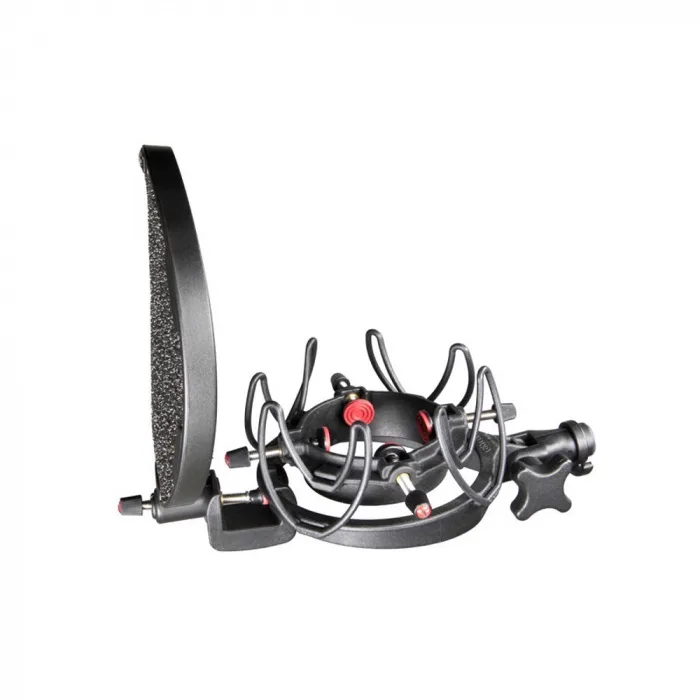
- Buy Rycote InVision USM Studio Kit A universal lyre mount with a pop filter and no elastic to perish.
- Buy RODE SMR A double Lyre mount with an integrated metal pop filter, built around RODE's own large diaphragm mics. Amazon
- It depends Neumann EA 1 The elastic cradle Neumann built around its own microphone bodies, with bands you can actually replace.
- Skip Neewer MS043 Microphone Shock Mount A cheap iron and plastic cradle on elastic rope, with a narrow fit window and no spare parts.
What actually matters
- Barrel diameter - this is the single spec that decides whether the mount physically works with your microphone. Makers that publish a range in millimetres are giving you something checkable; makers that only say universal are not.
- Microphone weight rating - a cradle sized correctly can still be overloaded by a heavy tube mic. Rycote publishes separate vertical and horizontal figures for its USM, which is the useful way to state it because a boom changes the load direction.
- Suspension material - stretched elastic creeps under constant load and perishes with heat and light, while moulded lyres and elastomer parts hold their shape. That difference shows up as the microphone slowly drooping over months.
- Attachment method - some microphones are designed to screw into a threaded collar and some are meant to be gripped around the barrel. Getting this wrong means the mic either will not mount or will not stay pointed where you left it.
- Stand thread and adapters - 5/8 inch 27 is the usual US stand fitting and 3/8 inch is common elsewhere. An included adapter turns a compatibility problem into a non issue, and its absence is worth spotting before you order.
- Replacement parts - a mount whose elastics can be bought separately can be brought back to new. One whose elastics cannot be replaced has a fixed lifespan whatever the metalwork looks like.
- What it cannot do - a suspension only touches structure borne vibration. Room reflections, computer fans and a keyboard heard through the air are untouched by it, and no mount will change that.
The specs, in plain English
Green flags vs red flags
Green flags
- A published barrel diameter range in millimetres rather than a claim of universal fit.
- A stated microphone weight limit, ideally split by vertical and horizontal mounting.
- Replacement elastics or spare parts listed by the maker as buyable items.
- A stated stand thread with an adapter included in the box.
- A named list of microphones the maker has actually verified the mount against.
Red flags
- Fits all microphones, with no diameter number anywhere in the listing.
- No weight capacity given at all, on a mount that hangs the mic on stretched cord.
- Marketing that promises room noise or echo reduction, which a suspension cannot deliver.
- Elastic suspension with no replacement bands sold anywhere by the maker.
- A diameter range so wide it covers pencil condensers and fat tube mics with the same clips.
Who's who: the brands
- Rycote - Maker of the Lyre suspension, which RODE's SMR also uses, and a brand that publishes an actual diameter range.
- RODE - Sells shock mounts matched to its own microphone families, including the lyre based SMR.
- Neumann - Makes premium elastic suspensions matched to its own bodies, and keeps replacement bands on the accessory list.
- Audio-Technica - Model specific studio mounts that state their stand thread compatibility clearly, such as the AT8449a.
- Neewer - High volume budget accessories, sometimes with honest diameter figures but rarely with spare parts.
How to read a listing without getting fooled
Start at the bottom of the listing, not the top. Find the barrel diameter range and the weight rating; if either is missing, you are being asked to trust rather than check. Then find the word that describes the suspension, because lyre, elastomer and elastic behave differently over years even when they measure similarly on day one. Look for the stand thread and whether an adapter is included, and look for a spare parts or accessories link, since a maker that sells replacement bands is telling you something true about how long the originals last. Treat a named compatibility list as stronger evidence than a broad range, and treat a broad range with no named microphones as weaker. Finally, ignore anything in the copy about reducing room noise or echo, which is a different product category entirely.
How much should you spend?
Budget mounts get you a metal or plastic yoke and an elastic cradle, usually with a stand adapter and usually with no published weight rating or spare parts, and they are best understood as items with a limited life. Mid range is where maker matched mounts sit, and it is the sweet spot if you own a microphone that has an official mount, because you get a guaranteed fit and often a pop filter thrown in. Premium buys you either a universal mount with published engineering figures and a suspension designed not to age, or a microphone maker's own high end suspension with long term parts support. The step from budget to mid range buys real durability; the step from mid range to premium mostly buys flexibility across future microphones and parts availability years from now.
Questions, answered
Can I use a shock mount with a USB microphone?
Sometimes, and it depends entirely on the body. If the microphone has a plain cylindrical barrel within a mount's stated diameter range, a cradle style mount will hold it. If it uses a proprietary yoke or a fixed desk stand, there may be no mounting point the shock mount can use at all. Check what the microphone's own maker sells as its stand accessory before assuming a third party mount will work.
Does a heavier mount isolate better?
Not by itself. What matters is the compliance of the suspension and how it is matched to the mass of the microphone, not the mass of the frame. A suspension that is too stiff for a light microphone barely moves and therefore barely isolates, and one that is too soft for a heavy microphone sags and lets it drift. This is why a weight rating, where a maker publishes one, matters more than the mount's own weight.
Why does my microphone slowly droop in its mount?
Because the elastic is creeping under constant load, which is normal behaviour for stretched rubber rather than a defect. It happens faster in a warm room and faster with a heavier microphone. If the maker sells replacement bands, fitting a fresh set restores it. If not, the only cure is a mount whose springy parts are moulded rather than stretched.
Do I need a pop filter as well as a shock mount?
They solve unrelated problems, so yes if you record close vocals. A shock mount handles vibration coming through the stand, while a pop filter handles the blast of air from plosive consonants hitting the capsule. Some mounts bundle a filter, such as the Rycote InVision USM Studio Kit and the RODE SMR, which saves a separate clamp cluttering the stand. If yours does not, a separate filter is inexpensive and does not interfere with the suspension.
Or jump to the head-to-head: Rycote InVision USM Studio Kit vs RODE SMR.