Explained
Open-Ear Headphones, Explained
After reading, you will understand how open-ear earbuds keep your ears aware, which specs actually matter, and how to avoid overpaying for features you will not use.
In this guide
Open-ear earbuds let you hear your music and your surroundings at the same time, which is why runners, cyclists and commuters like them. They use small air-conduction speakers that sit just outside the ear canal and aim sound in, without sealing the ear. Bone-conduction headphones, which rest on the cheekbone instead, are a separate product with their own guide. This one decodes the open-ear labels so you can tell a genuinely useful feature from a spec-sheet flourish.
The 30-second version
- Awareness is the whole point. These leave your ear canal open so you can hear traffic and voices while you listen, which is a safety feature, not an audio compromise you accidentally made.
- Open-ear is not bone conduction. Open-ear earbuds use small speakers just outside the ear; bone conduction vibrates your cheekbones. Some listings blur the two, so check which one you are buying.
- Fit security matters more than sound purity. A pair that slips during a sprint is useless, so ear hooks and clip-on cuffs earn their keep before audiophile detail does.
- Bass will never thump. Open designs cannot seal the ear, so set expectations; bigger drivers and hooks that sit the speaker closer to the ear canal help.
- A missing spec is a spec. If a workout earbud's own page states no water rating, weight or mic details, treat that silence as part of the decision.
The products this guide is about
Our verdict on each, with the full reasoning on the companion review.
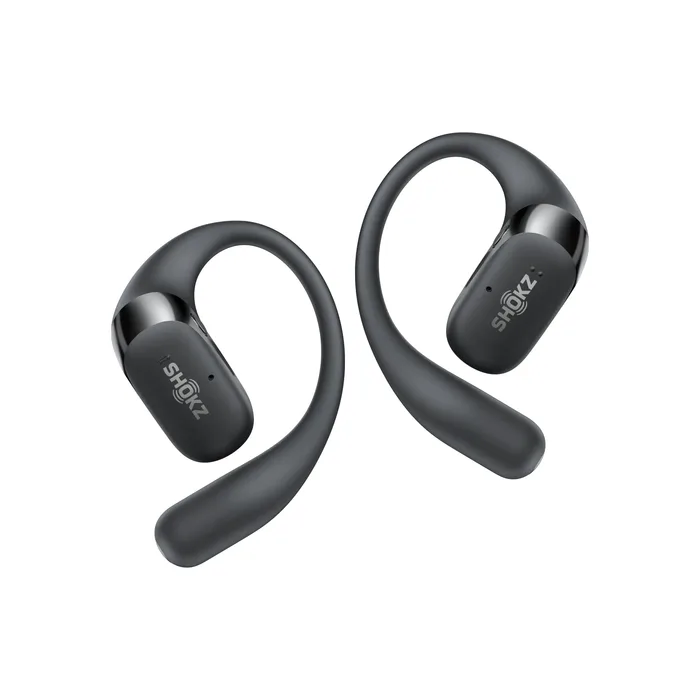
- Buy Shokz OpenFit 2 Light ear-hook earbuds with physical buttons, two mics per bud and the most complete spec sheet for workouts and calls. Amazon
- Buy Baseus Bowie MC1 Pro A budget clip-on open-ear pair with an IP67 rating, multipoint and Bluetooth 6.0, the value pick of the group.
- It depends Cleer ARC 5 The most feature-packed pair here, with IPX7, 60 hours with the case and a touchscreen case, but heavier buds and a bulky case.
- Skip soundcore AeroFit 2 Adjustable ear hooks and big drivers, but a product page that publishes no water rating, weight or call-mic details.
What actually matters
- Situational awareness is the reason to buy open-ear at all, so check that the speaker sits outside the ear canal rather than in it.
- Fit security determines whether the pair survives hours of movement and sweat; ear hooks wrap over the top of the ear, while clip-on cuffs grip its edge.
- Water and sweat rating decides whether you can train in rain, since IP55 covers sweat and light rain while IP67 and IPX7 handle much more.
- Battery per charge and with the case should comfortably cover your longest session, and quick charge matters most on busy days.
- Calls and connection, meaning a stated mic count and multipoint, matter if you switch between a phone and a laptop.
- Weight of buds and case adds up over hours of wear and in a running pocket.
The specs, in plain English
Green flags vs red flags
Green flags
- An ear hook or clip-on design the maker describes with clear fit details, such as adjustable positions or soft silicone
- A stated water rating suited to your climate, with IP67 or IPX7 if you train in heavy rain
- Battery per charge that clears your longest session, plus a quoted quick charge
- Physical buttons rather than touch-only controls if you work out
- A stated mic count and multipoint if you take calls
Red flags
- A workout earbud whose product page states no water rating at all
- A large case-total battery figure with no single-charge number, or one measured only at low volume with features switched off
- Vague awareness claims paired with a design that clearly plugs the ear
- Touch-only controls with no physical buttons, which can misfire when your fingers are sweaty
- A price near the top of the range justified only by extras you will never use
Who's who: the brands
- Shokz - Best known for bone conduction, it also makes air-conduction ear-hook earbuds with physical buttons and multipoint aimed at runners.
- Baseus - A consumer-electronics brand selling budget clip-on open-ear earbuds with strong water ratings and multipoint.
- Cleer - An audio brand whose open-ear earbuds lean into features, with spatial audio, a wide codec list and a touchscreen charging case.
- soundcore - Anker's audio brand, with adjustable ear-hook open-ear earbuds; check the product page for the water rating before buying for workouts.
How to read a listing without getting fooled
Start by confirming it is an air-conduction open-ear bud, because some listings mix the label with bone conduction; if a small speaker points into your ear from a hook or cuff, it is air conduction. Next, separate the single-charge battery number from the with-case total, and read the conditions it was measured under, since a figure at half volume with features off is a best case. Treat the IP rating as sweat-and-rain insurance, never a swimming permit, and treat a missing rating as a reason to look elsewhere for workouts. Look for a stated mic count and multipoint if you take calls. Finally, discount branded audio names until you can match them to something concrete, such as a driver size or a stated feature.
How much should you spend?
At the budget tier you can now get a clip-on pair with a strong water rating and multipoint, which covers most commuters and casual runners. The premium tier buys lighter or better-equipped buds, physical buttons, stronger call hardware, quick charge and longer battery, and at the top, extras such as spatial audio and a touchscreen case. Those extras only pay off if you will use them; for workouts, a stated water rating, secure fit and battery that clears your longest session matter more than any headline feature.
Questions, answered
Are open-ear earbuds safe for running and cycling near traffic?
Yes, that is their main advantage. Because the speaker sits outside your ear canal, you can hear cars, cyclists and warnings while still listening. Keep the volume moderate so awareness stays sharp.
Do open-ear earbuds have good bass?
They will never thump like sealed earbuds, but the gap has narrowed. Larger drivers and hooks that position the speaker closer to the ear canal produce the most usable low end.
How are open-ear earbuds different from bone conduction?
Open-ear earbuds use tiny speakers just outside the ear to beam sound in. Bone conduction vibrates sound through your cheekbones to the inner ear, leaving the ear fully uncovered. They are separate product types with separate guides.
Can I swim with them?
Open-ear earbuds are not swim-rated. Even IP67 and IPX7 ratings cover sweat, rain and brief immersion, not swimming, so look for a purpose-built waterproof model if you want to swim.
Will other people hear my music?
At moderate volume, leakage is limited. At higher volumes it becomes audible, so they are not ideal for quiet shared spaces like libraries or small offices.
Ear hook or clip-on with glasses or a helmet?
Ear hooks wrap over the top of the ear, where glasses arms and helmet straps also sit, which suits most people but crowds some. A clip-on cuff grips the outer edge of the ear and leaves the area behind it free. Fit varies by ear shape, so buy from a seller with easy returns.
Or jump to the head-to-head: Shokz OpenFit 2 vs Baseus Bowie MC1 Pro.