Explained
Pop Filters and Windscreens, Explained
After reading, you'll understand why a plosive is an airflow problem rather than a loudness problem, what nylon, metal and foam each cost you, and which two numbers on a listing decide whether a filter will physically fit your rig.
In this guide
First time buyers almost always shop for a pop filter the way they shop for a cable: pick one, it works. Two things trip them up. The first is the mechanism, because a plosive is a burst of moving air rather than a loud sound, which means the screen and the distance behind it are doing the work, not the thickness of the fabric. The second is fitment, because a clamp that will not close on your boom arm turns a good filter into a returned one. Everything else is a smaller decision than these two.
The 30-second version
- A plosive is airflow, not volume, so a pop filter works by disrupting and slowing moving air rather than by reducing level.
- Distance does as much as material, because the air burst loses energy as it spreads, and Stedman advises at least two inches between screen and microphone.
- Every material costs you something, with nylon mesh taking a little top end, perforated metal putting less in the path, and foam absorbing the most.
- Clamp jaw capacity is the real compatibility spec, and it is the one buyers skip most often before ordering.
- Technique beats hardware, since speaking slightly off axis fixes plosives more reliably than any screen can.
The products this guide is about
Our verdict on each, with the full reasoning on the companion review.
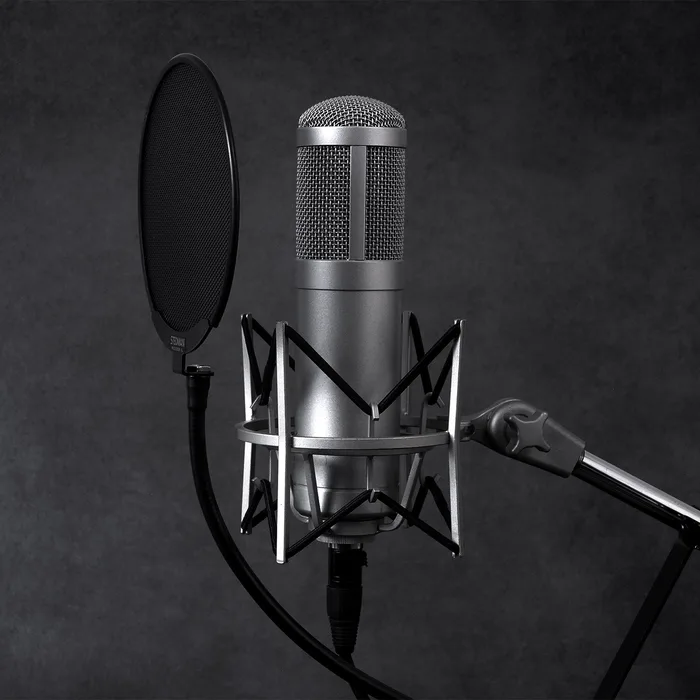
- Buy Stedman Proscreen XL V2 A louvered metal screen that diverts the air burst downward, on a gooseneck long enough to put it where it belongs. Amazon
- Buy Aokeo O-pop A large dual layer nylon screen with a proper gooseneck and clamp, at the price of an accessory rather than a tool.
- It depends Neewer MS020 Microphone Pop Filter A three layer screen that straps straight to the microphone with elastic bands, which solves a mounting problem and creates an acoustic one.
- Skip Rode WS2 Windshield A well made foam windshield that a lot of people buy as their pop filter, which is not the job foam is best at. Amazon
What actually matters
- Plosive - the burst of air produced by consonants like P and B, which hits the diaphragm as moving air rather than as sound. This is why lowering your gain does nothing and why the fix has to be aerodynamic.
- Screen to capsule distance - the gap between the filter and the microphone element. It gives the disrupted air burst room to spread and lose energy, and it is the variable most buyers never think about.
- Clamp jaw capacity - the maximum thickness the clamp will close on, usually stated in millimetres or inches. Check it against your boom arm or desk edge before anything else, because nothing else matters if it will not attach.
- Gooseneck length - how far the flexible arm reaches. A short neck cannot get around a shock mount and still sit in front of your mouth, which is the failure mode of most compact filters.
- Layer count - how many screens the air has to cross. Two layers with an air gap between them work better than two layers pressed together, because the gap is where the remaining burst slows down.
- Off axis speaking - angling your mouth so the air stream passes across the capsule rather than into it. It is free, it works, and it is more effective than upgrading the filter.
- Windscreen versus pop filter - a windscreen is a foam or fur cover for moving air outdoors, and a pop filter is a screen held off the microphone for close range speech. They are related but not interchangeable, and the foam sock in your microphone box is usually the former.
The specs, in plain English
Green flags vs red flags
Green flags
- The clamp jaw capacity is published as an actual number rather than described as universal.
- The gooseneck length is stated, and it is long enough to reach around a shock mount.
- The screen is metal, or nylon in two layers with a stated air gap between them.
- The manufacturer publishes cleaning instructions, which implies the screen is meant to survive them.
- The mount is a gooseneck rather than an elastic band, so you control the gap to the capsule.
Red flags
- It is a foam sock described as a pop filter with no mention of distance or mounting.
- No clamp capacity anywhere in the listing, only a claim that it fits most stands.
- A single thin layer of mesh on a short stub of a neck.
- Dimensions given only as a product box size, with no screen diameter or gooseneck length.
- Marketing that talks about blocking noise or improving sound quality rather than about airflow.
Who's who: the brands
- Stedman - An American maker whose patented louvered metal Proscreen redirects the air burst downward instead of absorbing it, and who publishes clamp and gooseneck figures for its clamp-mounted models.
- Aokeo - A budget accessory brand that covers the whole range from clip on screens to large dual layer nylon filters with real goosenecks and stated clamp limits.
- Neewer - A high volume accessories maker whose pop filters lean toward multi layer clip on designs that mount directly to the microphone body.
- Rode - An Australian microphone manufacturer whose accessory line includes model specific foam windshields such as the WS2, sold as fitment matched covers rather than as gooseneck screens.
- Schoeps - A German precision microphone maker whose pop shields are built around keeping the screen sonically neutral, and whose published guidance explains the trade between wind protection and sound quality.
How to read a listing without getting fooled
Read a pop filter listing from the hardware backwards. Find the clamp jaw capacity and compare it to the bar or edge you intend to clamp to, because that single number kills more purchases than any acoustic property. Then find the gooseneck length and picture it reaching from that mounting point, around whatever shock mount your microphone sits in, to a spot a couple of inches in front of the capsule. Only then look at the screen: the material family, the layer count, and whether there is a stated air gap between layers. Treat any listing that describes fit as universal, or that gives you a box size instead of a screen diameter, as a listing that is hiding the numbers. And notice what is absent: if a manufacturer says nothing about cleaning, assume the screen is not meant to be washed.
How much should you spend?
This is a category where the budget tier genuinely works. A dual layer nylon screen on a steel gooseneck with a metal clamp sits at the budget tier and delivers the mechanism that matters, which is a screen held at a distance you control. The mid tier mostly buys you build quality, a longer neck, and a wider clamp rather than a different physical principle. The premium tier is where louvered metal screens and published cleaning procedures live, and it is worth it if you record voice often enough that a screen catching breath every week is a real consideration. Clip on screens and foam windshields both sit at the budget tier, which is fair, but cheapness is not the reason to skip a foam sock as your pop solution. The reason is that it sits flush against the grille.
Questions, answered
Can I just use a cheap foam sock instead of a pop filter?
You can, and it will help a little, but it is the weakest of the options. Foam sits directly on the microphone grille, so the air burst gets no distance in which to spread out and lose energy. Foam is also the most high frequency absorbent of the common materials. Use it for wind outdoors, where it is the right tool, and use a mesh screen on a gooseneck for close range speech.
Do I still need a pop filter if I have a dynamic broadcast microphone?
Often less, but not never. Broadcast dynamics tend to have deep internal grilles and built in windscreens that already put some distance between your mouth and the element, which is why they cope better with close speech. If you work very close or you have naturally strong plosives, a screen still earns its place. Test it by recording a few hard P words at your normal distance and listening on headphones.
Does a bigger screen work better?
Not in terms of stopping any single plosive, but it is more forgiving in practice. A larger face covers a wider arc, so you stay behind it as you move your head and lean in during a take. That consistency is worth more over a session than any small difference in mesh performance. The cost is that a six inch screen is a lot of hardware in a cramped desk setup.
How do I clean a pop filter?
Check what the manufacturer says before you do anything, because guidance varies and most say nothing at all. Stedman publishes a procedure for its metal screens that involves immersing the screen in a mild detergent solution and rinsing it with warm water. Nylon screens are more delicate and can go slack or distort if you soak them, so treat them as unwashable unless told otherwise. Either way, the screen collects breath and saliva, so plan on replacing an uncleanable one periodically.
Or jump to the head-to-head: Stedman Proscreen XL V2 vs Aokeo O-pop.