Explained
Portable Audio Recorders, Explained
After reading this you will know which four specs decide whether a portable recorder brings back a clean file, and which ones are just numbers on a box.
In this guide
A portable audio recorder is a small box with microphones built in, a card slot, and usually some way to plug in better microphones later. The category looks confusing because spec sheets lead with track counts and sample rates, which almost never decide whether a recording is usable. What actually decides it is how quiet the recorder's own electronics are, whether it records in 32-bit float, how good the built-in capsules are, and whether it has XLR inputs so it can grow with you.
The 30-second version
- 32-bit float is the real advance. It gives a file so much headroom that clipping stops being possible in practice, so you can hit record without setting a gain knob and fix the level afterwards with nothing lost.
- Preamp noise floor separates usable from hissy. Every recorder sounds fine on a loud source; on a quiet one you have to raise the gain, and a noisy input stage raises its own hiss right along with your signal.
- Built-in microphone quality varies far more than track count. A directional XY pair rated for high sound pressure produces finished-quality audio, while a basic omnidirectional pair picks up the room and never recovers in editing.
- XLR inputs with phantom power decide the recorder's lifespan. Without them you are locked to the built-in capsules forever; with two of them you can add a shotgun mic, a studio condenser, or a wireless receiver whenever you need one.
- More inputs is not better, it is heavier. Four XLR inputs only pay for themselves if you genuinely record three or four microphones at the same time, otherwise you are carrying bulk and paying for sockets you never use.
The products this guide is about
Our verdict on each, with the full reasoning on the companion review.
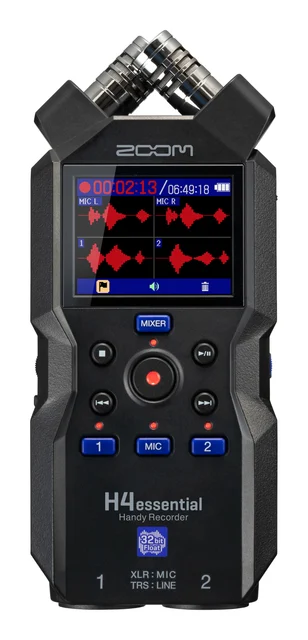
- Buy Zoom H4essential Two XLR inputs with phantom power, 32-bit float, and built-in mics good enough to finish with, in a pocketable body. Amazon
- Buy Zoom H1essential Pocket-sized stereo recording with full 32-bit float, at a price that used to buy you far less. Amazon
- It depends Tascam Portacapture X8 Four XLR inputs, eight tracks, and reconfigurable detachable mics: superb if you need all of it, overkill if you do not. Amazon
- Skip Tascam DR-05X A capable previous-generation recorder still priced like a current one, minus the feature that matters most. Amazon
What actually matters
- Preamp noise floor (self-noise). The hiss the recorder's own electronics add before your microphone signal even arrives. It sets a floor under how quiet a source you are allowed to record, because the only way to hear something faint is to turn the gain up, which turns the hiss up too. This is the single biggest quality divider in the category and the one spec sheets bury.
- 32-bit float recording. The format that removes gain setting as a way to ruin a take. Assume it on anything you buy new. It is insurance against the most common mistake, not a fix for a noisy preamp or bad microphone placement.
- Built-in microphone type and SPL rating. A directional XY pair rated for high sound pressure levels handles loud sources without breaking up and points at what you want. A basic omnidirectional pair takes in everything, including the room. Most people use the built-ins for most recordings, so this matters more than the input count.
- XLR combo inputs with switchable phantom power. The dividing line between a recorder you keep and one you replace in a year. Two covers the large majority of real use. Four is for multi-microphone sessions and nothing else.
- Controls: physical buttons versus touchscreen. Buttons are faster and more certain outdoors, in gloves, or in a hurry. Touchscreens are better for complex routing and preset-driven setups. Pick for how you actually work, not for which looks more modern.
- Battery type and runtime. Common AA cells can be replaced anywhere in the world in a minute. Sealed internal batteries and unusual cell sizes are a liability on a long day away from power.
- Card support and file handling. Check the maximum card size the recorder accepts and whether long recordings split into chunks your editor can rejoin cleanly. An older model with a low card ceiling limits how long you can run in high-resolution modes.
The specs, in plain English
Green flags vs red flags
Green flags
- 32-bit float recording listed plainly in the specs, on every track rather than one special mode
- Two or more combo XLR/TRS inputs with switchable phantom power, described as switchable rather than always on
- A directional XY built-in microphone pair with a stated maximum SPL rating
- Wording about low self-noise or quiet preamps, backed up by owner recordings of quiet material rather than loud material
- Runs on common AA cells, with USB power as an alternative
- Physical record and stop buttons you can find without looking, plus a screen that shows waveform or level at a glance
Red flags
- 16-bit and 24-bit only at a price similar to current 32-bit float models, which is the clearest sign of previous-generation stock
- Built-in microphones described only as stereo, with no polar pattern or SPL figure given
- Track count and sample rate pushed hard in the marketing while noise, preamps, and microphone type go unmentioned
- No XLR inputs on a model being sold as a step-up or professional unit
- A card size ceiling well below what current models accept, which caps how long you can record in high-resolution modes
- Sealed internal battery or an unusual cell size with no field-swappable option
Who's who: the brands
- Zoom - The default name in portable recording, and the brand that pushed 32-bit float down to the cheapest models; strong built-in XY microphone pairs and button-driven controls.
- Tascam - Long-running rival with a deep catalogue, from simple pocket units to touchscreen multi-input machines with low published preamp noise ratings.
- Sony - Known for compact stereo recorders aimed at music and lecture capture, with clean sound and a more consumer-oriented feature set than the field-recording specialists.
- Sound Devices - The professional film and broadcast end, with excellent preamps, timecode, and build quality at prices that only make sense if recording is your job.
- Roland - Recorders aimed squarely at musicians, often bundling rehearsal-friendly features such as tuners, metronomes, and overdub layering.
- Zaxcom and Marantz Professional - Smaller specialist names you will meet at the edges: Zaxcom in high-end location sound, Marantz Professional in podcast and institutional recording.
How to read a listing without getting fooled
Product listings lead with the numbers that are cheapest to print, so read them in reverse order of prominence. Track count and sample rate go first in most marketing and matter least; if a page shouts about eight tracks or 192 kHz and says nothing about microphone type or self-noise, that is the shape of the compromise. Find the recording format next and confirm 32-bit float is available on every track, not as a niche mode. Then look at the input list and read it literally: a 3.5mm microphone jack with plug-in power is not an XLR input, and mic input is not the same phrase as phantom power. Next find how the built-in capsules are described. XY or directional plus a maximum SPL figure is a real answer; built-in stereo microphones with no further detail usually means an omnidirectional pair. Noise performance is the hardest thing to verify from a listing, because manufacturers do not always publish self-noise in a comparable way, so treat the spec sheet as a shortlist tool and settle it with owner recordings of genuinely quiet material. Loud sources make every recorder sound the same, which is exactly why demo clips are full of them.
How much should you spend?
The good news is that the feature that matters most stopped being a premium feature. 32-bit float now reaches the bottom of the range, so the cheapest current pocket recorder gives you the same protection against a ruined take as a much dearer one. What extra money buys, in rough order, is XLR inputs with phantom power, better built-in capsules, a quieter input stage, and more simultaneous tracks. The value sweet spot for most buyers sits at the first model with two XLR inputs and switchable phantom power, because that is the point where the recorder stops being a fixed-purpose gadget and starts being something you can build a microphone collection around. Below that, a pocket stereo unit is genuinely good value if you are certain you will never plug in a phantom-powered microphone, and buying one to save money before discovering you need XLR is the most common way people end up paying twice. Above that sweet spot, spending more mostly buys inputs, so it only pays off if you actually record three or four sources at once; if your ceiling is two microphones, the extra cost buys weight rather than quality. The one thing not worth paying for at any level is a previous-generation recorder without 32-bit float that is still priced against current models, and the one thing worth paying for even on a tight budget is a quiet input stage, since no amount of editing removes hiss that was baked in at the source.
Questions, answered
Is 32-bit float genuinely useful or just marketing?
Genuinely useful, and it is the main reason to buy a current recorder over an older one at the same price. The file holds so much headroom that clipping stops being possible in practice, so you press record without setting a gain knob and adjust the level in your editor afterwards with nothing lost. That matters most for material you only get one shot at: interviews that suddenly get loud, live events, and any time you are recording while also doing something else. What it does not do is make a noisy preamp quiet or rescue bad microphone placement. Treat it as insurance against the most common mistake, not as a substitute for a good input stage.
Do I really need XLR inputs?
You need them if there is any chance you will use a microphone other than the ones built into the recorder. XLR with switchable phantom power is what lets you plug in a shotgun mic for video, a studio condenser for voiceover, a pair of small condensers for music, or a wireless lavalier receiver. Without XLR you are limited to the built-in capsules plus whatever runs off a 3.5mm jack on plug-in power, which rules out most serious microphones. Two XLR inputs cover the large majority of real use; four is only worth paying for if you regularly record three or more people or instruments at once.
Why does preamp noise floor matter so much?
Because it sets a limit on how quiet a thing you are allowed to record. On a loud source every recorder sounds acceptable, since the signal swamps whatever hiss the electronics add. On a quiet source you have to raise the gain, and raising the gain raises the recorder's own noise along with the signal. A recorder with a noisy input stage gives you a fine recording of a band and an unusable one of a soft-spoken interviewee or distant birdsong. When you compare models, listen to owner recordings of quiet material rather than loud material, because loud material hides the difference completely.
Are the built-in microphones good enough, or should I budget for external mics?
On current models the built-ins are much better than most people expect, and built-in microphone quality varies far more between recorders than track count does. The directional XY pairs on current units get used for finished work, not just as reference tracks, and they handle loud sources without breaking up. External microphones still win when you need to get close to one source in a noisy place, when you need a specific polar pattern, or when the recorder has to sit somewhere the microphone cannot. Start with the built-ins and buy an external microphone when you hit a problem they cannot solve.
Can I just record on my phone instead?
For a voice memo, yes. For anything you plan to edit or publish, no. Phone microphones are tiny, tuned for speech intelligibility rather than accuracy, badly positioned for anything except talking straight at the handset, and they sit behind automatic gain control you cannot switch off, which pumps the level up and down as the source changes. Phones also have no 32-bit float safety net, no XLR inputs, and they are busy doing other things that can interrupt a recording. Even an inexpensive current dedicated recorder produces audibly cleaner and more controllable stereo files.
How many tracks do I actually need?
Two if you only ever record stereo with the built-in microphones. Four is the practical sweet spot, because it lets the built-in stereo pair and two external microphones run at once, which covers a two-person interview with lavaliers plus a room capture, or a shotgun mic on a boom plus ambience. Eight tracks exists for roundtable podcasts and multi-microphone music sessions. Track count is the spec most likely to tempt you into overbuying, since it is cheap to print and expensive to carry.
Or jump to the head-to-head: Zoom H4essential vs Zoom H1essential.