

Audio & Headphones
The Best Portable Audio Recorders: 4 Compared (and One to Skip)
We compared four current portable field recorders on preamp noise floor, 32-bit float recording, built-in mic quality, and XLR inputs.
The short version
32-bit float recording is the real advance in this category, because it removes gain-setting as a way to ruin a take, and every recorder worth buying now has it. Underneath that, preamp noise floor decides whether quiet sources come back clean or buried in hiss, and built-in microphone quality varies far more between models than track count does. The Zoom H4essential is the best all-round buy (two XLR inputs with phantom power, four tracks, strong XY microphones, a quiet input stage, pocketable body), while the Zoom H1essential brings the same recording insurance to a much lower price if you accept that it will never take a studio or shotgun microphone. The Tascam Portacapture X8 is superb and has the quietest rated preamps here, but four XLR inputs, a touchscreen workflow, and real bulk only make sense if you actually record three or four microphones at once. Skip the Tascam DR-05X: it charges current prices for 24-bit recording, weaker omnidirectional mics, and no path to external microphones. Best for: buy the H4essential if you want one recorder that will still be right in three years, the H1essential if you need clean stereo in a pocket, and the Portacapture X8 only if four XLR inputs are a requirement rather than a wish.
Our picks at a glance
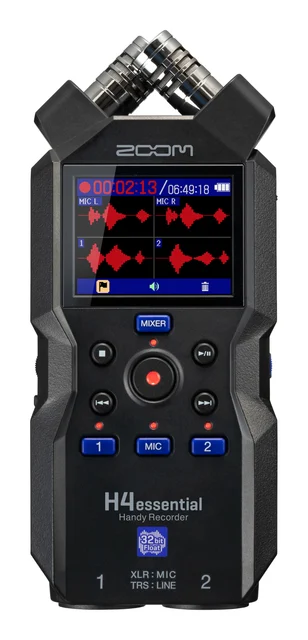
- Zoom H4essential - Buy. Two XLR inputs with phantom power, 32-bit float, and built-in mics good enough to finish with, in a pocketable body.
- Zoom H1essential - Buy. Pocket-sized stereo recording with full 32-bit float, at a price that used to buy you far less.
- Tascam Portacapture X8 - It depends. Four XLR inputs, eight tracks, and reconfigurable detachable mics: superb if you need all of it, overkill if you do not.
- Tascam DR-05X - Skip. A capable previous-generation recorder still priced like a current one, minus the feature that matters most.
The verdict in 30 seconds
What mattered most
- 32-bit float recording
- XLR inputs with phantom power
- Built-in microphones
- Maximum simultaneous tracks
- Preamp noise floor
- Portability
Portable recorders finally changed in a way that matters: 32-bit float recording means you no longer have to set gain correctly to get a usable take. Underneath that, the thing that still separates a good recorder from a hissy one is preamp noise floor, and the thing that decides whether it lasts is XLR inputs with phantom power. We looked at four current models across the price range. Two are clear buys, one is excellent but more machine than most people need, and one is a previous-generation unit still selling at a price it no longer deserves.
Two XLR inputs with phantom power, 32-bit float, and built-in mics good enough to finish with, in a pocketable body.
Best for: Anyone who records one or two sources and wants a recorder that will still be right in three years: interviewers, video shooters, podcasters, musicians capturing rehearsals.
- Two combo XLR/TRS inputs with switchable phantom power, so it grows with your microphone collection
- 32-bit float on all four tracks removes gain-setting mistakes entirely
- 130 dB SPL XY built-in microphones that hold up for finished work, not just a scratch track
- Quiet input stage that holds up on soft-spoken interviews and quiet ambience
- Runs on common AA cells and doubles as a USB audio interface
- Two XLR inputs is the ceiling, so multi-mic roundtables need something bigger
- Light body feels less rugged than the price suggests and benefits from a case
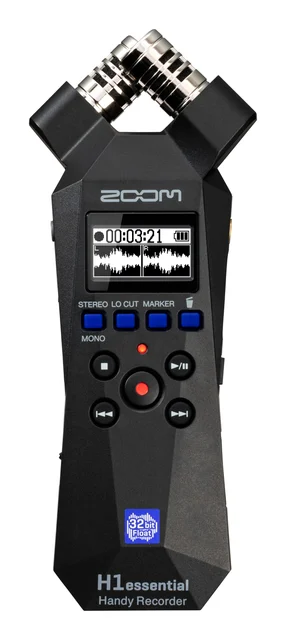
Pocket-sized stereo recording with full 32-bit float, at a price that used to buy you far less.
Best for: Students, songwriters, journalists, and video shooters who need clean stereo audio in a pocket and know they will never plug in a phantom-powered microphone.
- 32-bit float recording at the bottom of the price range, so takes are effectively clip-proof
- 120 dB SPL XY microphone pair that outclasses older budget units and any phone
- Genuinely pocketable and light enough to clip on a bag and forget
- Works as a USB microphone over USB-C for calls and voiceover
- 3.5mm mic/line input with plug-in power accepts a lavalier or small external mic
- No XLR inputs and no phantom power, so it cannot take a shotgun or studio condenser
- Runs on two AAA cells rather than AA, and the small 128 x 64 OLED screen is minimal
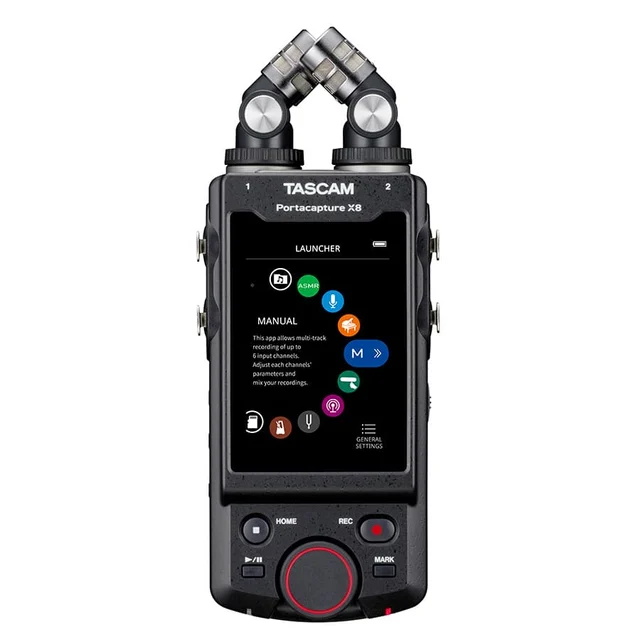
Four XLR inputs, eight tracks, and reconfigurable detachable mics: superb if you need all of it, overkill if you do not.
Best for: People who genuinely record three or four microphones at once: roundtable podcasts, multi-mic music sessions, field work with a stereo bed plus spot mics.
- Four combo XLR/TRS inputs with phantom power, six inputs and eight tracks total
- Detachable stereo microphones that physically reconfigure between A-B and X-Y patterns
- HDDA mic preamps rated by Tascam at -126 dBu EIN or less on the XLR inputs
- 32-bit float throughout with sample rates up to 192 kHz
- Touchscreen mode presets set up podcast, field, voice, and music sessions for you
- Touchscreen workflow is slower and less certain than buttons in cold, gloved, or hurried situations
- Noticeably bigger and heavier than the Zoom units, and runs through four AA cells
- Premium price buys inputs that two-microphone users will never use
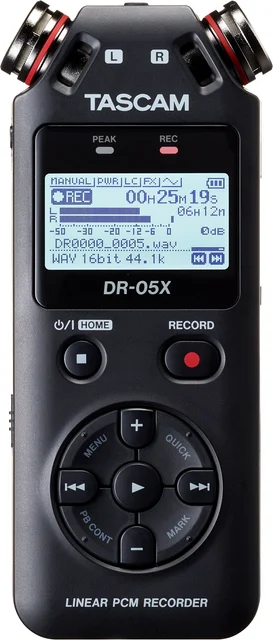
A capable previous-generation recorder still priced like a current one, minus the feature that matters most.
Best for: Existing owners who are happy with it. As a new purchase, the same money buys a 32-bit float recorder.
- Long runtime on two AA cells and simple, button-driven controls
- Works as a USB audio interface as well as a standalone recorder
- Compact and light, with a straightforward file structure
- 16-bit and 24-bit only, so you are back to setting gain correctly on every take
- Basic omnidirectional built-in microphones pick up more room and more hiss than a directional XY pair
- No XLR inputs and no phantom power, so it cannot grow with you
- Card capacity ceiling is well below what current models accept
| Criteria | Zoom H4essential Top pick | Zoom H1essential | Tascam Portacapture X8 | Tascam DR-05X |
|---|---|---|---|---|
| Verdict | Buy it | Buy it | It depends | Skip it |
| Best for | Anyone who records one or two sources and wants a recorder that will still be right in three years: interviewers, video shooters, podcasters, musicians capturing rehearsals. | Students, songwriters, journalists, and video shooters who need clean stereo audio in a pocket and know they will never plug in a phantom-powered microphone. | People who genuinely record three or four microphones at once: roundtable podcasts, multi-mic music sessions, field work with a stereo bed plus spot mics. | Existing owners who are happy with it. As a new purchase, the same money buys a 32-bit float recorder. |
| Price tier | $ · mid-range | $ · budget | $$ · premium | $ · budget |
| 32-bit float recording | Yes | Yes | Yes | No, 16/24-bit only |
| XLR inputs with phantom power | 2 combo XLR/TRS | None | 4 combo XLR/TRS | None |
| Built-in microphones | XY pair, 130 dB SPL | XY pair, 120 dB SPL | Detachable pair, switchable A-B or X-Y | Basic omnidirectional pair |
| Maximum simultaneous tracks | 4 | 2 | 8 (6 inputs) | 2 |
| Preamp noise floor | Low, usable on quiet sources | Low for the price | Lowest here on paper (-126 dBu EIN rating) | Audible hiss on quiet sources |
| Portability | Jacket pocket | Shirt pocket | Bag only | Jacket pocket |
| Power | 2 AA cells or USB | 2 AAA cells or USB | 4 AA cells or USB | 2 AA cells or USB |
| Price tier | $ · mid-range | $ · budget | $$ · premium | $ · budget |
Which one is right for you?
- Anyone who records one or two sources and wants a recorder that will still be right in three years: interviewers, video shooters, podcasters, musicians capturing rehearsals. Buy it Zoom H4essential
- Students, songwriters, journalists, and video shooters who need clean stereo audio in a pocket and know they will never plug in a phantom-powered microphone. Buy it Zoom H1essential
- People who genuinely record three or four microphones at once: roundtable podcasts, multi-mic music sessions, field work with a stereo bed plus spot mics. It depends Tascam Portacapture X8
- Existing owners who are happy with it. As a new purchase, the same money buys a 32-bit float recorder. Skip it Tascam DR-05X
How we judged the field
We do not run a lab. What we do is pool independent bench testing, published manufacturer specifications, and the pattern that shows up across long-run owner reports, then weigh the handful of things that actually decide whether a recording comes back usable.
Four criteria did most of the sorting.
Preamp noise floor. This is the single biggest divider in the category and the one spec sheets bury. Every recorder in this list sounds fine on a loud source. Point one at room tone, a soft-spoken interviewee across a table, or a bird two gardens away, and the gap between a quiet input stage and a hissy one is obvious within seconds. A noisy preamp does not just add hiss. It sets a floor under how quiet a source you are allowed to record at all, because the only fix is turning the gain up, which raises the hiss along with the signal. Both makers now publish equivalent input noise ratings for their current 32-bit float models (-120 dBu or less on the H4essential’s XLR inputs, -126 dBu or less on the Portacapture X8’s), and owners recording nature, ADR, and quiet interviews often cite quieter inputs as the reason they upgraded.
32-bit float recording. This is the genuine recent advance, and it is not marketing. A 32-bit float file has enough headroom that clipping stops being a category of mistake. You record without setting a gain knob, and if the source turns out twenty decibels louder or quieter than you guessed, you pull the level back in your editor with nothing lost. For one-take material, live events, interviews that suddenly get loud, and anyone recording alone while also doing something else, this removes the most common way recordings get ruined. It does not fix a noisy preamp and it does not fix bad mic placement, so treat it as insurance rather than magic.
Built-in microphone quality. Track count gets printed on the box. Mic quality does not, and it varies far more. The capsules on the current models handle high sound pressure levels without breaking up and have a usable stereo image straight out of the bag, which matters because most people use the built-ins for most recordings. Older budget units often pair a decent recording engine with mediocre omnidirectional capsules, and no amount of post-processing rescues that.
XLR inputs with phantom power. This decides whether the recorder grows with you or gets replaced in a year. XLR with switchable phantom power means you can plug in a shotgun mic, a pair of small-diaphragm condensers, a lavalier system receiver, or a dynamic broadcast mic. Without it you are locked to the built-ins plus whatever runs off a 3.5mm jack forever. The recorders that separate serious buyers from casual ones are almost always the ones with XLR.
We also weighed the boring things that quietly decide whether a recorder gets used: battery life on common cells, whether the controls work without reading a manual, how fast it starts recording from cold, and whether the files land in a sane folder structure.
This is the recorder that gets the balance right, and it is our top pick for most people.
Two combo XLR/TRS inputs with switchable phantom power sit on the bottom edge, so on day one you can record with the built-in microphones and on day two plug in a shotgun or a pair of condensers without buying a different machine. Above them is a 130 dB SPL XY pair that is usable for finished work rather than as a scratch track, which is not something you could say about the built-ins on most recorders at this level. Four tracks means the XY pair and the two XLR inputs can all run at once, which covers a two-person interview with lavaliers plus a room capture.
Everything records in 32-bit float. In practice that means you press record and stop thinking about gain, which is the whole point. Zoom rates the XLR inputs at -120 dBu EIN or less, and owner reports agree the input stage is quiet enough to work on soft sources without an audible hiss bed, which is the actual reason to buy this generation over the previous one.
The rest is sensible rather than exciting. It runs on two AA cells, takes microSD cards, works as a USB audio interface, and has a color screen with waveform display that makes checking a take fast. There is an accessibility voice guide built in, which is genuinely rare and useful. The body feels light rather than rugged, so a case is worth having. Two XLR inputs is the ceiling, so if you know you need four, look higher.
The cheap one that is not a compromise, as long as you understand what it does not have.
It is a pocket-sized stereo recorder with a 120 dB SPL XY pair and 32-bit float recording. That combination used to cost several times as much. You clip it on a bag or stand it on a table, hit record, and get a clean stereo file with no gain decision to get wrong. For lectures, rehearsals, songwriting demos, ambience gathering, meeting notes, and backup audio for video, it does the job with room to spare, and owners consistently say the recordings are noticeably cleaner than what they got from older budget units or from a phone.
There are no XLR inputs. There is a 3.5mm mic/line jack with plug-in power, so a lavalier or a small external stereo mic works, but a shotgun mic with phantom power does not. If you expect to be plugging in real microphones within a year, buy the H4essential instead and save yourself the second purchase.
Small practical notes: it runs on two AAA cells rather than AA, so battery life is decent but not marathon, and it works as a USB microphone over USB-C, which makes it a reasonable desk mic for calls and voiceover in a pinch. The 128 x 64 OLED screen is small. None of that matters much for what this thing is for.
The most capable recorder here, and the one most likely to be more machine than you need.
Four combo XLR/TRS inputs with phantom power, six inputs total, eight tracks, 32-bit float throughout, sample rates up to 192 kHz, and detachable stereo microphones you can physically reconfigure between A-B and X-Y patterns depending on whether you want a wide ambient image or a tighter, mono-safe one. That last feature is unusual and genuinely useful for field recording. The whole thing is driven from a color touchscreen with mode presets for podcast, field, music, voice, and ASMR work, each of which sets up routing and processing for you.
If you record roundtable podcasts, multi-mic music sessions, or field work where you want a stereo bed plus two or three spot mics on the same timecode-free take, this is the one that does it in a single box, and Tascam rates its HDDA preamps at -126 dBu EIN or less, the quietest published figure here.
Where it depends: the touchscreen workflow divides people. Some owners love that everything is two taps away; others find it slower and less certain than physical buttons when they are working in the cold, in gloves, or in a hurry, and there is a real learning curve on the mode presets. It is also considerably bigger and heavier than the Zoom units, runs on four AA cells, and costs premium money. If your real ceiling is two microphones, the extra inputs are weight you carry and money you spent for nothing. Buy it because you need four XLR inputs, not because it is the fanciest option.
A competent recorder from the previous era that is still on shelves at a price that makes it look tempting. It is not, in 2026.
It records 16-bit or 24-bit only. No 32-bit float, which means you are back to setting gain correctly before every take and living with the consequences when you guess wrong. The built-in microphones are a basic omnidirectional pair rather than a directional XY array, so they pick up more of the room and less of the thing you are pointing at, and owner recordings show noticeably more hiss on quiet sources than the current generation. There are no XLR inputs and no phantom power, so it cannot grow. The card slot tops out well below what current models accept.
None of this makes it broken. It runs a long time on two AA cells, the controls are simple, and it works as a USB interface. If you already own one and it does what you need, there is no urgency to replace it. But as a new purchase it costs roughly what a current 32-bit float recorder costs while giving up the one feature that most changes the odds of coming home with a usable file. Put the same money on the H1essential.
Zoom H4essential vs Tascam Portacapture X8: which should you buy?
These two are the serious options, and the choice comes down to one question: how many microphones will you plug in?
The H4essential gives you two XLR inputs, four tracks, a strong built-in XY pair, 32-bit float, AA power, and a body that fits in a jacket pocket. It handles a solo voiceover, a two-person interview with lavaliers, a shotgun mic on a boom for video, or ambient stereo capture, which is the overwhelming majority of what people actually record. It is meaningfully smaller, lighter, cheaper, and faster to operate with physical buttons.
The Portacapture X8 gives you four XLR inputs, six inputs and eight tracks, reconfigurable detachable microphones, higher sample rates, and mode presets that set up complex sessions for you. Its preamps are excellent. It is also larger, heavier, hungrier on batteries, driven through a touchscreen that takes time to learn, and priced in a different bracket.
If you are recording one or two sources, the H4essential is the better buy and the difference in quality on those sources is small enough that the Portacapture X8 does not justify itself. If you regularly record three or four microphones at once, or you want to switch stereo patterns in the field, the X8 is the only one here that does it and the extra outlay is real value rather than a spec-sheet upsell. There is no version of this comparison where a two-microphone user should buy the X8.
What to look for
- 32-bit float recording. Assume it. Anything new without it in this price range is a step backward, and it is the feature that most reduces the chance of an unrecoverable take.
- Preamp noise floor. Look for wording about low self-noise and check owner recordings of quiet sources rather than loud ones. Loud sources hide everything.
- XLR combo inputs with switchable phantom power. The dividing line between a recorder you keep and one you replace. Two is enough for most people. Four is for multi-mic sessions.
- Built-in microphone type and SPL rating. A directional XY pair rated for high sound pressure levels beats an omnidirectional pair for almost everything except pure ambience.
- Physical controls versus touchscreen. Buttons are faster and more certain in the field. Touchscreens are better for complex routing. Pick for how you actually work.
- Battery type and runtime. AA cells are easy to replace anywhere. Sealed internal batteries and unusual cells are a liability on a long day.
- Card capacity and file handling. Check the maximum supported card size and whether long recordings split into files your editor can rejoin cleanly.
- USB audio interface mode. Useful bonus that turns the recorder into a desk microphone or a computer input, and it costs nothing extra when present.
Our final take
The category has genuinely improved, and the improvement has a name. 32-bit float recording removes the most common cause of ruined takes, and the current generation pairs it with input stages quiet enough to record soft sources without a hiss bed underneath. That combination is why a current recorder beats a previous-generation one that costs the same.
For most people the Zoom H4essential is the right purchase: two XLR inputs with phantom power so it grows with you, built-in microphones good enough to finish with, four tracks, and a size you will actually carry. If your budget is tight or you only ever need stereo, the Zoom H1essential delivers the same recording insurance in a pocket, with the clear understanding that you will never plug a phantom-powered microphone into it. The Tascam Portacapture X8 is the right answer only if you need four XLR inputs and are willing to accept the bulk and the touchscreen to get them. The Tascam DR-05X should be left alone at current prices, not because it is bad, but because the money buys a better machine now.
Questions, answered
Is 32-bit float recording actually useful, or is it a marketing feature?
It is genuinely useful and it is the main reason to buy a current recorder over a previous-generation one. A 32-bit float file holds so much headroom that clipping stops being possible in practice, so you can record without setting a gain knob and pull the level back in your editor afterwards with nothing lost. That matters most for one-take material: interviews that suddenly get loud, live events, and any situation where you are recording and doing something else at the same time. What it does not do is make a noisy preamp quiet or fix bad microphone placement. Treat it as insurance against the most common mistake, not as a substitute for a good input stage.
Do I really need XLR inputs?
You need them if there is any chance you will use a microphone other than the one built into the recorder. XLR with switchable phantom power is what lets you plug in a shotgun mic for video, a studio condenser for voiceover, a pair of small-diaphragm condensers for music, or a wireless lavalier receiver. Without XLR you are limited to the built-in capsules plus whatever runs from a 3.5mm jack on plug-in power, which rules out most serious microphones. Two XLR inputs cover the large majority of real use. Four is only worth paying for if you regularly record three or more people or instruments at once.
Why does preamp noise floor matter so much?
Because it sets a floor under how quiet a thing you are allowed to record. On a loud source, every recorder sounds acceptable, since the signal swamps whatever hiss the electronics add. On a quiet source you have to raise the gain, and raising the gain raises the recorder's own noise along with the signal. A recorder with a noisy input stage will give you a usable recording of a band and an unusable one of a soft-spoken interviewee or distant birdsong. When you are comparing models, listen to owner recordings of quiet material rather than loud material, since loud material hides the difference completely.
Are the built-in microphones good enough, or do I need to buy external mics?
On the current models the built-ins are much better than most people expect, and built-in mic quality varies far more between recorders than track count does. The directional XY pairs on current units are used for finished work, not just as reference tracks, and they handle loud sources without breaking up. External microphones still win when you need to get close to one specific source in a noisy environment, when you need a particular polar pattern, or when the recorder has to sit somewhere the microphone cannot. Start with the built-ins, and buy an external microphone when you hit a specific problem they cannot solve.
Can I just record on my phone instead?
For a voice memo, yes. For anything you plan to publish or edit, no. Phone microphones are small, tuned for speech intelligibility rather than accuracy, positioned badly for anything except talking directly at the handset, and they sit behind automatic gain control that you cannot switch off, which pumps the level up and down as the source changes. Phones also have no 32-bit float safety net, no XLR inputs, and they are busy doing other things that can interrupt a recording. Even the cheapest current dedicated recorder here produces audibly cleaner, more controllable stereo files.
Deciding between the top two? See our head-to-head: Zoom H4essential vs Zoom H1essential.
More Audio & Headphones reviews
 The Best Portable Bluetooth Speakers: 4 Compared, 1 We'd Skip
  The Best Portable Headphone Amps: 4 Compared (and One to Skip)
  The Best Power Conditioners and Surge Protectors: 4 Compared (and One to Skip)
  The Best Premium Wireless Earbuds: 4 Compared (and One to Skip)
  The Best Record Cleaning Kits: 4 Compared (and One to Skip)
  The Best Replacement Headphone Earpads: 4 Compared (and One to Skip)