Explained
Phono Preamps, Explained
After reading this you will know whether you already own a phono stage, and if you do need one, exactly which gain and loading numbers to match to your cartridge.
In this guide
A phono preamp (also called a phono stage) does two jobs and nothing else: it boosts a record cartridge's tiny signal up to the level your amplifier expects, and it reverses the RIAA equalization curve that was deliberately baked into the record when it was cut. What trips people up is that this box is often already inside gear they own, hidden behind a small switch on the back of a turntable or an input labelled PHONO on a receiver. The second thing that trips people up is buying a stage whose gain and loading do not match the cartridge, which no amount of component quality can fix.
The 30-second version
- Check what you already own first. A PHONO/LINE switch on the back of your turntable, or an input marked PHONO with a small ground screw on your amplifier, means the phono stage is already there and an external one is an upgrade to evaluate rather than a missing part to buy.
- Cartridge type decides everything else. Moving magnet cartridges want roughly 40dB of gain and a 47k ohm load, while low-output moving coil cartridges want 60dB or more and a load usually between 100 and 1000 ohms, so match the cartridge before you compare anything else.
- Loading is a real specification, not audiophile decoration. Capacitance shifts the treble balance of a moving magnet cartridge and resistive loading changes how damped a moving coil's highs are, which is why cartridge makers publish recommended values and why adjustable stages are worth more than fixed ones.
- Never run two phono stages in series. Doubling the RIAA curve and the gain gives you a loud, thin, bass-light, distorted mess, and it is the single most common setup mistake in this category.
- In a modest system the cartridge outranks the preamp. The stylus is physically tracing the groove and sets the ceiling for everything downstream, so a worn stylus or bad alignment is where your money and attention belong before you shop for electronics.
The products this guide is about
Our verdict on each, with the full reasoning on the companion review.
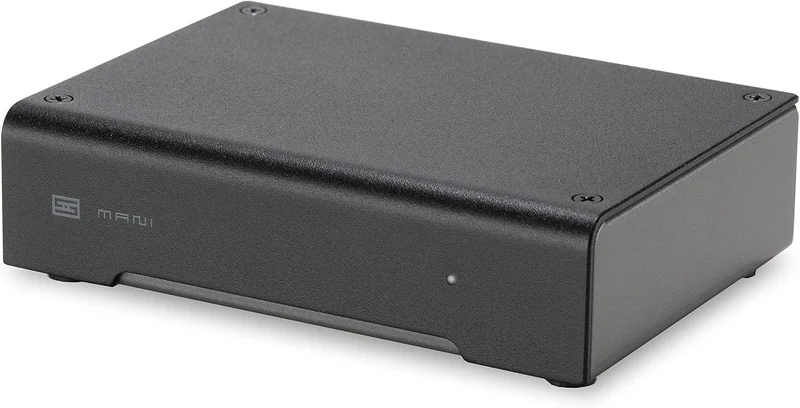
- Buy Schiit Audio Schiit Mani 2 Four gain settings, four resistive loads and four capacitance settings, at a price where rivals give you a single fixed option. Amazon
- Buy iFi Audio iFi ZEN Phono 3 The one to buy if moving coil is in your plans, thanks to a much higher gain ceiling and selectable MC loading. Amazon
- It depends Rega Fono MM Mk5 A superb moving magnet stage that does one thing perfectly and refuses to do anything else, for more money than the rivals that do both.
- Skip Behringer Microphono PP400 Competent for the money, but almost everyone who buys it already has a phono stage built into gear they own.
What actually matters
- Whether you need one at all. This is the criterion nobody prints on a spec sheet and the one that decides most purchases here. Turntables and receivers have shipped with competent built-in phono stages for years, so the correct first move is to read the back panels of gear you already own before you shop.
- Cartridge support (MM, MI, MC). A moving-magnet-only stage is not defective, it is just narrower. What matters is whether it covers the cartridge you own now and the one you might buy next, because outgrowing a phono stage means buying the category twice.
- Gain range and how many steps. Gain that stops too low is the most common mismatch owners report. Too little and you run out of volume control travel while hiss rises relative to the music; several selectable steps beat one fixed figure because they let you re-match when the cartridge changes.
- Resistive loading options. Moving coil cartridges are sensitive to the resistive load they see, and manufacturers publish a recommended value. A stage that claims MC support but offers one fixed load is doing MC badly rather than doing it well.
- Capacitance loading for MM. Your cartridge maker specifies a total load capacitance that includes your tonearm cable, and hitting near that figure is the difference between a natural top end and a peaky, glassy one. Adjustable capacitance is rare and disproportionately useful.
- Rumble or subsonic filtering. Warped records and turntable rumble push energy below the audible band into your amplifier, eating headroom and visibly flapping woofers. The filter costs a manufacturer almost nothing, and its absence is a genuine mark against anything above budget level.
- Noise floor, hum immunity and grounding. The whole point of an external stage is being quieter than the one already in your system, so look for a proper ground terminal, a sensible power arrangement, and owner reports about hum in real rooms rather than only published numbers.
The specs, in plain English
Green flags vs red flags
Green flags
- Several selectable gain settings rather than one fixed figure, so the stage can follow you to a different cartridge
- Resistive loading options that actually span what cartridge makers recommend, not one token low value labelled MC
- Adjustable capacitance for moving magnet, which is uncommon and directly affects treble balance
- Gain and loading selectable independently instead of being welded into fixed MM and MC modes
- A subsonic or rumble filter, ideally one that targets warp energy rather than rolling off musical bass
- A proper ground terminal and a power supply arrangement that lets you keep the adapter away from the turntable
Red flags
- Claims of moving coil support with a single fixed load value and no gain choice
- No loading information published at all, only adjectives about component quality
- No rumble or subsonic filter on anything priced above the budget tier
- A gain figure quoted without saying which cartridge type it is for, or a noise figure quoted without stating the gain setting
- Marketing that leans on tube glow, exotic capacitors or chassis machining while the specification sheet stays vague
- A stage sold as an upgrade when your turntable already has a PHONO/LINE switch and your amplifier already has a PHONO input
Who's who: the brands
- Schiit Audio - American direct-sale brand known for putting unusually flexible gain and loading options into affordable, plainly styled boxes.
- iFi Audio - British designer of compact audio components, notable in phono for high gain ceilings suited to low-output moving coil and for well-implemented subsonic filtering.
- Rega - Long-established British turntable and electronics maker that sells separate MM and MC phono stages; its Fono MM uses fixed values chosen by the designer rather than switches for the owner.
- Behringer - Budget pro-audio manufacturer whose tiny phono boxes are the classic add-to-cart item next to a turntable, competent for the money but redundant if you already have a phono input.
- Pro-Ject - Austrian turntable specialist with a broad ladder of phono stages, from simple MM boxes up to adjustable MM/MC units and outboard power supplies.
- Cambridge Audio - British brand offering straightforward, well-reviewed entry and mid-level phono stages, often the first step up from a receiver's built-in input.
How to read a listing without getting fooled
Start at the bottom of the listing, not the top. Find the cartridge types supported and the gain figure attached to each one, because a headline like "MM and MC" means nothing until you see how much gain the MC setting actually delivers. Next find the loading section: for moving magnet you want to see 47k ohms plus a capacitance value, ideally more than one; for moving coil you want a spread of resistive options rather than a single number. If a listing gives you adjectives instead of ohms and picofarads, treat that as an answer in itself. Check whether gain and loading are chosen independently or bundled into fixed MM and MC modes, since bundled modes stop you from running, say, a high-output moving coil at moderate gain with a correct load. Look for a subsonic or rumble filter and for a ground terminal in the connection list. Read noise specifications only alongside the gain setting they were measured at, since the same unit will always look quieter on its low-gain setting. Finally, ignore chassis material, tube imagery and capacitor brand names entirely until the gain and loading numbers line up with your cartridge, because nothing further down the sheet can rescue a mismatch there.
How much should you spend?
The first and cheapest decision is free: go and look at the back of your turntable and your amplifier, because if a phono stage is already in there, the best value move may be spending nothing. Below that, budget stages exist for one genuine situation, a bare turntable plus an amplifier with no phono input, and they will get music playing without embarrassing themselves. What they will not do is beat the stage already living inside a modern turntable or receiver, which is why so much money in this category gets spent for no audible gain. The value sweet spot sits in the mid tier, where you start getting several gain steps, a real spread of resistive loads, adjustable capacitance for moving magnet, and a rumble filter, all of which are features you can hear rather than specifications you can only admire. Going above that tier buys refinement rather than capability, and it only pays back once the front end is already sorted, meaning a good cartridge, a fresh stylus and correct alignment. Spending premium money on a stage that does less, such as a moving-magnet-only design with fixed loading, only makes sense as a considered destination for a system that is genuinely settled and never changing. The general rule: in a modest system, money moved from the phono stage to the stylus buys more improvement, and money spent on features that match your specific cartridge buys more than money spent on component pedigree.
Questions, answered
How do I know whether I already have a phono preamp?
Look at the back of your turntable for a switch marked PHONO/LINE or PHONO/AUX. If it is there, the turntable has a built-in stage and you can set it to LINE to bypass it or leave it on and skip the external box entirely. Then look at your amplifier or receiver for an input labelled PHONO, usually with a small ground screw beside it. If you find one, that is a phono stage too. Many powered speakers aimed at vinyl buyers have one as well. If both exist, use one and switch the other off. Only if neither exists do you genuinely need to buy something.
What happens if I accidentally use two phono stages at once?
The RIAA curve gets applied twice and so does the gain, and the result is loud, thin, bass-light and distorted. It usually happens when someone leaves their turntable's built-in stage switched on and then plugs it into an amplifier input marked PHONO. Fix it by setting the turntable switch to LINE, or by moving the cable to a line-level input such as AUX. Nothing is damaged, it just sounds wrong.
MM or MC: how does my cartridge type change which preamp I buy?
Moving magnet cartridges put out roughly 3 to 6 millivolts and want a 47k ohm load plus a specified amount of capacitance, so they need around 40dB of gain. Low-output moving coil cartridges put out a fraction of that, often a few tenths of a millivolt, want a much lower resistive load usually between 100 and 1000 ohms, and need 60dB or more. If the stage's gain stops short of what your cartridge needs, you run out of volume control travel and hear more hiss relative to the music. Match the cartridge first; everything else is secondary.
Does loading really make an audible difference, or is that folklore?
It is both measurable and audible, though how big the effect is depends on the cartridge. For moving magnet, the capacitance of the preamp plus your tonearm cable interacts with the cartridge coil and shifts the treble response, which is exactly why manufacturers publish a recommended total figure. For moving coil, the resistive load changes how damped the highs are, and the difference between 100 ohms and 1000 ohms on the same cartridge is easy to hear. That is why adjustable loading is worth more than marketing language about component quality.
Will a better phono preamp improve my sound more than a better cartridge?
Usually not, if you are starting from a modest system with a working phono stage. The stylus is physically tracing the groove, and its condition and alignment set the ceiling for everything downstream. A worn stylus or a badly aligned cartridge cannot be rescued by better electronics. The sensible order is to check stylus wear and tracking force, get the alignment right, upgrade the cartridge if it is a basic one, and only then look at the phono stage. Preamp upgrades pay off clearly once the front end is already good, and much less clearly before that.
I hear a hum through my turntable. Is the preamp faulty?
Usually not. Start with the thin ground wire from the turntable and make sure it is attached to the ground screw on the preamp or amplifier. Then look at placement: the preamp and its power adapter sitting near the turntable's motor or a mains cable is the most common cause of induced hum in owner reports, and moving them a foot or two often solves it completely. Also check you are not accidentally running two phono stages in series, and that the cartridge tags are firmly seated. Only after all of that is a fault worth suspecting.
Or jump to the head-to-head: Schiit Audio Schiit Mani 2 vs iFi Audio iFi ZEN Phono 3.