

Audio & Headphones
The Best Phono Preamps: 4 Compared (and One to Skip)
Four phono stages compared on cartridge support, gain, loading flexibility, rumble filtering and noise, plus who should not buy one.
The short version
Before you buy anything, check the back of your turntable for a PHONO/LINE switch and your amplifier for a PHONO input, because most people already own a phono stage and a second one adds nothing. If you genuinely need an external stage, the Schiit Mani 2 is the pick: moving magnet, moving iron and moving coil support, four gain settings up to 60dB, four resistive loads and, rarest of all at this price, adjustable load capacitance for MM cartridges. The iFi ZEN Phono 3 is the one to take instead if you run a low-output moving coil cartridge, because its gain reaches much higher (72dB) and its MC settings offer three resistive loads. The Rega Fono MM Mk5 sounds excellent but is moving magnet only with fixed loading and no rumble filter, so it suits a settled system rather than a first purchase. The Behringer Microphono PP400 is not bad for the money, it is simply redundant for most of the people who buy it. Best for: anyone who has confirmed they actually need an external phono stage and wants gain and loading that match their cartridge.
Our picks at a glance
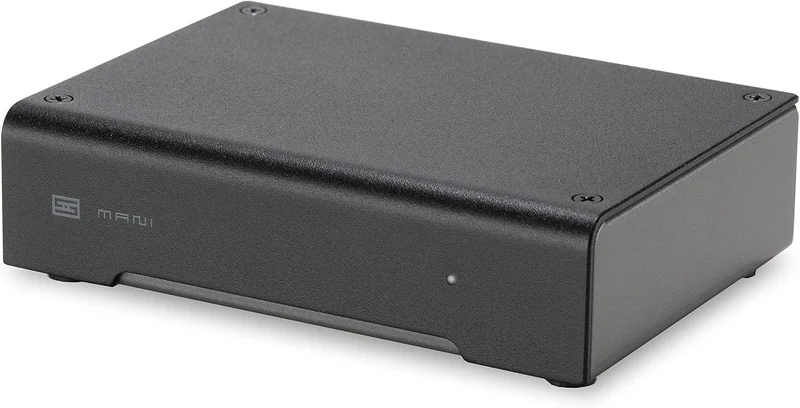
- Schiit Audio Schiit Mani 2 - Buy. Four gain settings, four resistive loads and four capacitance settings, at a price where rivals give you a single fixed option.
- iFi Audio iFi ZEN Phono 3 - Buy. The one to buy if moving coil is in your plans, thanks to a much higher gain ceiling and selectable MC loading.
- Rega Fono MM Mk5 - It depends. A superb moving magnet stage that does one thing perfectly and refuses to do anything else, for more money than the rivals that do both.
- Behringer Microphono PP400 - Skip. Competent for the money, but almost everyone who buys it already has a phono stage built into gear they own.
The verdict in 30 seconds
What mattered most
- Cartridge support
- Gain range
- Resistive loading
- Capacitance loading
- Rumble / subsonic filter
- Outputs
A phono preamp boosts a cartridge's tiny output and reverses the RIAA curve cut into the record. Before you shop, check the back of your turntable for a PHONO/LINE switch and your amplifier for a PHONO input, because most people already own one and the second box adds nothing. If you genuinely need an external stage, the real separators are cartridge type support, how much gain you can get, and whether you can set the loading your cartridge asks for. Two of these four are easy recommendations, one is a narrow specialist, and one is the purchase this category is famous for wasting money on.
Four gain settings, four resistive loads and four capacitance settings, at a price where rivals give you a single fixed option.
Best for: Almost anyone stepping up from a built-in phono stage, and especially moving magnet owners who want to dial in load capacitance properly.
- Handles moving magnet, moving iron and moving coil, with gain settings of 33, 42, 48 and 60dB
- Adjustable load capacitance for MM cartridges, a genuinely rare feature at this price and one that changes treble balance audibly
- Four resistive loading options down to the low values low-output moving coil cartridges want
- Two-slope low-frequency filter for warped records and turntable rumble
- Independent testing reports a low noise floor and accurate RIAA equalization; passive RIAA network in a DC-coupled design
- Settings are on small switches rather than front-panel controls, so changing loading means reaching around the unit
- Unbalanced output; no balanced option listed
- Top gain setting is generous but not limitless, so the very quietest exotic moving coil cartridges will push it
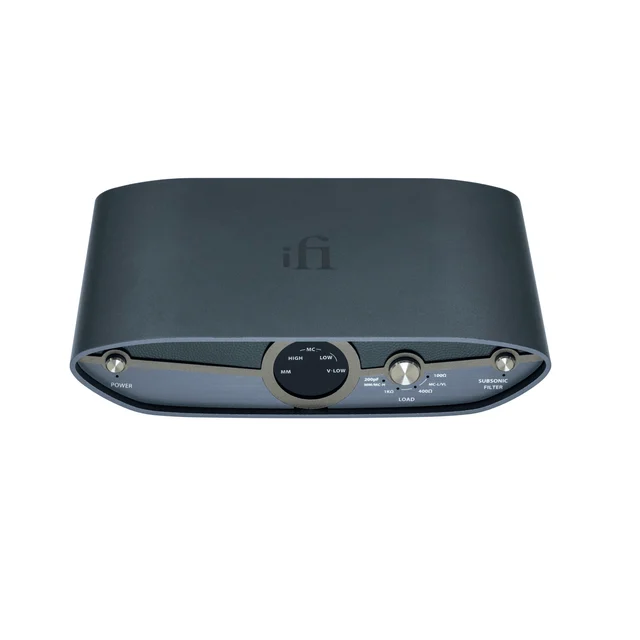
The one to buy if moving coil is in your plans, thanks to a much higher gain ceiling and selectable MC loading.
Best for: Owners of low-output moving coil cartridges, and anyone building toward one who does not want to buy a phono stage twice.
- Four gain settings (36, 48, 60 and 72dB), enough headroom for genuinely low-output moving coil cartridges
- The two highest MC gain settings each offer a choice of three resistive loads
- MC loading at 100, 400 and 1000 ohms covers most published cartridge recommendations; MM and MC High get 47k ohms with a 100 or 200pF choice
- Subsonic filter targets warp-rate energy rather than blanket-rolling the bass, and adds no group delay
- Published noise specification is excellent, and owner reports back it up on quiet grooves
- Costs meaningfully more than the Mani 2 for an advantage that only shows up at the moving coil end
- Balanced output uses a connector many integrated amplifiers do not have
- Curved chassis does not stack with rectangular components and divides opinion
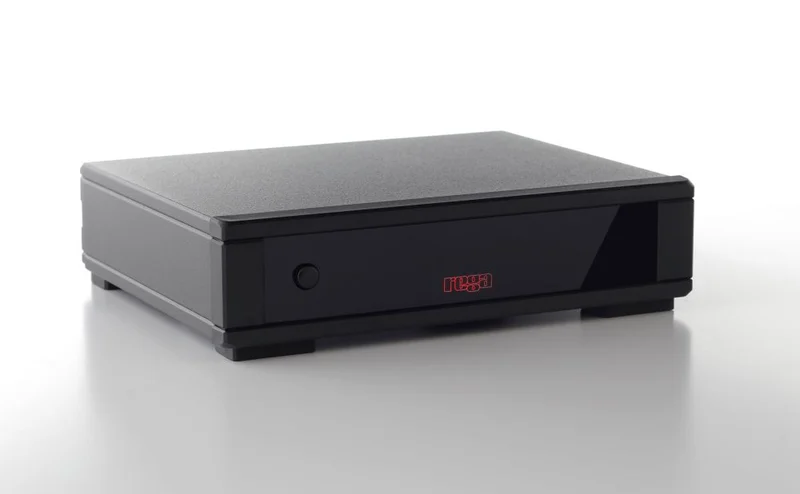
A superb moving magnet stage that does one thing perfectly and refuses to do anything else, for more money than the rivals that do both.
Best for: A settled moving magnet system whose owner has no intention of ever going moving coil and wants sound quality over switches.
- Fully discrete cascaded input stage with the RIAA equalization split across two stages to stop the sections interacting
- Reviewers consistently report very low noise, clean transients and a lively sense of timing
- About 41dB of gain, which is right for a normal moving magnet cartridge
- Aluminium case, with repeated recognition in independent award roundups at its level
- Moving magnet only, with no MC mode at all
- Fixed loading: no resistive switch, no capacitance switch, so your cartridge has to be happy with Rega's chosen values
- No rumble or subsonic filter, which is a real omission at this price if your records are less than flat
- Costs more than both picks above while doing strictly less
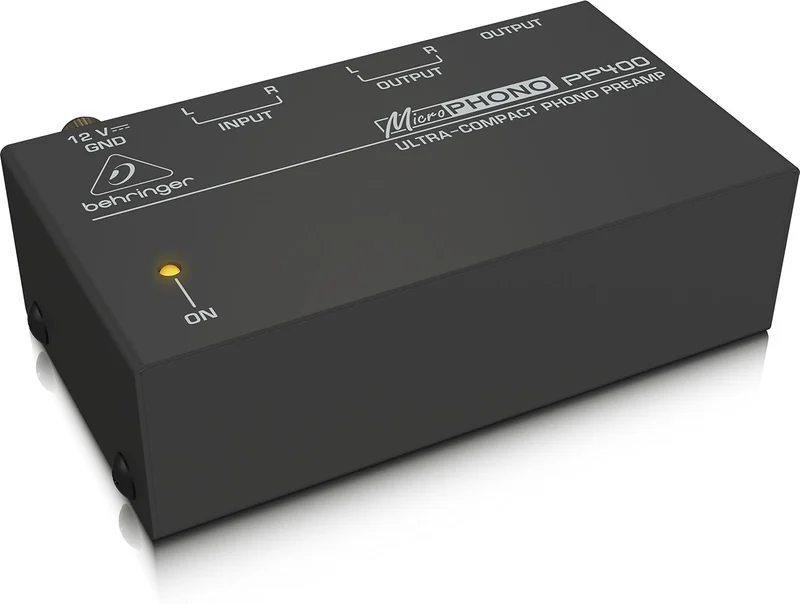
Competent for the money, but almost everyone who buys it already has a phono stage built into gear they own.
Best for: The narrow case of a vintage or bare turntable plus an amplifier with no phono input and a hard budget ceiling.
- Genuinely cheap, and it does work if you have a bare turntable and an amplifier with no phono input
- Tiny footprint with RCA in and out plus a quarter-inch output
- Ground terminal included, which cheap competitors sometimes omit
- Independent listening comparisons have found it competent rather than broken
- Moving magnet only, fixed gain into a fixed load, with no MC support at all
- No loading adjustment, no capacitance adjustment and no rumble filter
- Published signal-to-noise figure is modest next to everything else here
- Redundant for most buyers, since their turntable or receiver already contains a phono stage that this does not beat
Amazon had no buyable listing for this when we last checked. The link still works if it returns.
Check price on Amazon Read our detailed assessment| Criteria | Schiit Mani 2 Top pick | iFi ZEN Phono 3 | Rega Fono MM Mk5 | Behringer Microphono PP400 |
|---|---|---|---|---|
| Verdict | Buy it | Buy it | It depends | Skip it |
| Best for | Almost anyone stepping up from a built-in phono stage, and especially moving magnet owners who want to dial in load capacitance properly. | Owners of low-output moving coil cartridges, and anyone building toward one who does not want to buy a phono stage twice. | A settled moving magnet system whose owner has no intention of ever going moving coil and wants sound quality over switches. | The narrow case of a vintage or bare turntable plus an amplifier with no phono input and a hard budget ceiling. |
| Price tier | $ · mid-range | $ · mid-range | $$ · premium | $ · budget |
| Cartridge support | MM, MI and MC | MM and MC | MM only | MM only |
| Gain range | 33dB to 60dB, four steps | 36dB to 72dB, four steps | About 41dB, fixed | Fixed |
| Resistive loading | Four options, 47k ohms down to 38 ohms | 47k ohms for MM and MC High; 100, 400 and 1000 ohms for MC Low and Very Low | Fixed, not user adjustable | Fixed, not user adjustable |
| Capacitance loading | Four options across a useful MM range | Two options (100 or 200pF) for MM | Fixed | Fixed |
| Rumble / subsonic filter | Yes, two slopes | Yes, warp-targeted with no group delay | None | None |
| Outputs | Unbalanced | Unbalanced plus balanced | Unbalanced RCA | Unbalanced RCA plus quarter-inch |
| Who it is really for | Most upgraders, MM owners especially | Low-output MC owners | Settled MM systems only | Bare turntable with no phono input anywhere |
| Price tier | $ · mid-range | $ · mid-range | $$ · premium | $ · budget |
Which one is right for you?
- Almost anyone stepping up from a built-in phono stage, and especially moving magnet owners who want to dial in load capacitance properly. Buy it Schiit Audio Schiit Mani 2
- Owners of low-output moving coil cartridges, and anyone building toward one who does not want to buy a phono stage twice. Buy it iFi Audio iFi ZEN Phono 3
- A settled moving magnet system whose owner has no intention of ever going moving coil and wants sound quality over switches. It depends Rega Fono MM Mk5
- The narrow case of a vintage or bare turntable plus an amplifier with no phono input and a hard budget ceiling. Skip it Behringer Microphono PP400
How we judged the field
A phono preamp does two jobs and nothing else. It boosts a cartridge signal that arrives thousands of times quieter than a line-level source, and it reverses the RIAA equalization curve that was baked into the record when it was cut. Everything else (chassis, knobs, tube glow) is packaging around those two jobs.
Because we do not run a lab, we work the way a careful shopper would if they had unlimited time: we read published independent bench testing for noise floor, RIAA curve accuracy, gain accuracy and overload headroom, then we cross-check that against a large volume of owner reports covering hum, hiss, rumble on warped records and cartridge matching problems that only show up after months of use. Where measurements and owners disagree, we say so.
The criteria that actually separated these four:
Cartridge support. Moving magnet (MM) cartridges output roughly 3 to 6 millivolts and want about 47k ohms of resistive loading, plus a capacitance figure the cartridge maker specifies. Moving coil (MC) cartridges output a tenth of that or less and want a much lower resistive load, often between 100 and 1000 ohms. A stage that only does MM is not defective, it is just narrower. A stage that claims MC but offers one fixed load is doing MC badly.
Gain range and steps. An MM cartridge needs roughly 40dB of gain. A high-output MC needs a bit more. A genuinely low-output MC, the kind that puts out a few tenths of a millivolt, needs 60dB or more before your amplifier volume control stops running out of travel. Gain that stops too low is the single most common mismatch we saw in owner reports.
Loading flexibility. Resistive loading changes MC treble balance audibly. Capacitive loading changes MM treble balance audibly. Cartridge manufacturers publish recommended values. A preamp that lets you hit them is worth more than one that sounds slightly prettier on a fixed setting.
Noise floor and rumble handling. Vinyl carries subsonic energy from warps and from turntable rumble. Without a subsonic or rumble filter, that energy eats amplifier headroom and can make woofers visibly flap. This is a feature that costs a manufacturer almost nothing and that owners notice immediately when it is missing.
Whether you need the box at all. This is the criterion nobody puts in a spec sheet, and it is the one that decides most purchases in this category. Most turntables sold in the last decade have a built-in phono stage with a PHONO/LINE switch on the back. Most receivers and integrated amplifiers with an input labeled PHONO have one too. Powered speakers aimed at vinyl buyers frequently have one. Buying an external stage that is no better than the one already in your system is the most common wasted purchase here, and no amount of enthusiasm about component quality changes that.
The Mani 2 is the rare product where the feature list reads like a much more expensive item and the performance does not fall over when you check. It handles moving magnet, moving iron and moving coil cartridges, with four gain positions: 33, 42, 48 and 60dB. That top setting is the important one: it is where low-output moving coil cartridges become usable without you pinning the volume control.
Loading is where it separates from cheaper competition. You get four resistive settings, from the standard 47k ohms for MM down through 200, 47 and 38 ohms for various moving coil designs, and four capacitance settings from 47pF up to 200pF for MM. That last part matters more than most buyers realize. MM cartridges specify a total load capacitance including your tonearm cable, and getting close to the specified figure is the difference between a natural top end and a peaky, glassy one. Very few affordable stages let you change it at all.
There is also a genuine low-frequency filter with two slopes, one gentle and one steeper. Independent testing consistently reports a low noise floor and an accurate RIAA curve, and the circuit uses a passive RIAA network in a DC-coupled design. Owner reports skew heavily toward “quieter than the phono input in my receiver,” which is the entire reason to buy an external stage in the first place.
Where it gives ground: the settings live on switches rather than front-panel controls, so changing loading means reaching around the unit and working with small switches that are hard to read in dim light. Output is unbalanced, with no balanced option listed. And the top gain setting, while generous, is not unlimited, so the very quietest exotic moving coil cartridges will still push it. For the overwhelming majority of buyers stepping up from a built-in stage, none of that will ever come up.
The ZEN Phono 3 is the one to pick if moving coil is your present or your near future. Its four gain settings run from 36dB to 72dB, and that upper figure is meaningfully higher than what most affordable stages offer. If you own or plan to own a low-output MC cartridge, this is the practical difference between a system that plays at a normal volume setting and one that does not.
The loading arrangement is sensible. MM and the high-output MC setting run at 47k ohms with a choice of 100 or 200pF, while the two low-output MC gain settings (60 and 72dB) each let you pick 100, 400 or 1000 ohms, which covers the great majority of published manufacturer recommendations.
The subsonic filter deserves a specific mention because it is implemented better than the usual approach. Rather than a blanket low-frequency rolloff that thins out real bass, it targets warp-rate energy while leaving musical bass alone and without introducing group delay. Owners with warped records or a springy floor consistently report this as the feature they did not know they needed. Published noise specifications are excellent, and listener reports back that up: with a moving coil cartridge and a quiet groove, you should be hearing the record, not the electronics.
It also offers a balanced output alongside RCA, which is useful if your amplifier accepts it and irrelevant if it does not. The reservations are aesthetic and practical rather than sonic. The curved chassis is divisive and does not stack neatly with rectangular gear, the balanced output uses a connector that many integrated amplifiers simply do not have, and it costs meaningfully more than the Mani 2 for an advantage that only materializes at the moving coil end. If you own an MM cartridge and intend to keep owning one, you are paying for range you will not use.
This one is easy to describe and hard to place. It is a moving magnet stage, full stop. There is no MC mode, no loading switch, no capacitance switch, no rumble filter. Rega picked one set of values, built a fully discrete cascaded input stage around them, split the RIAA equalization into two stages to keep the sections from interacting, and put it in an aluminium case. Gain sits at about 41dB, which is right for a normal MM cartridge and useless for anything quieter.
Reviewers describe it in consistent terms: very low noise, clean transient attack, and a sense of timing and drive that makes the presentation feel alive rather than merely accurate. It has collected repeated recognition in independent award roundups at its price level, which is not the same as a measurement but does say something about how it holds up against fresh competition year after year.
So why is it a “depends” rather than a “buy”? Because it costs more than the two picks above while doing strictly less. If you own a good MM cartridge, have no intention of ever going moving coil, and your cartridge is happy at Rega’s fixed loading, this is a genuinely lovely piece of electronics and the lack of switches is a feature rather than a limitation. If any of those conditions might change, you are paying a premium for a box you will outgrow. The missing rumble filter is also a real omission at this price if your records are less than perfectly flat.
Buy it as a considered destination for an MM system. Do not buy it as a first external phono stage while you are still working out what cartridge you want.
Behringer Microphono PP400
Skip itThe PP400 is the box that appears in the “customers also bought” slot next to every turntable, and it is the reason this category has a reputation for wasted money. It is a moving magnet stage offering fixed gain into a fixed load, with RCA in and out plus a quarter-inch output, powered by a small external adapter. There is no MC support, no loading choice, no capacitance choice and no rumble filter. Its published signal-to-noise figure is modest by the standards of the rest of this group.
To be fair to it: it is not junk. Independent listening comparisons have found it competent for the money, and if you genuinely have a bare turntable with no built-in stage and an amplifier with no phono input, it will get music playing. That is a real use case.
The problem is that it is almost never the use case of the person buying it. Check the back of your turntable for a PHONO/LINE switch, and check your amplifier or receiver for an input labeled PHONO. If either exists, you already have a phono stage, and this one is not an upgrade over it. Adding it will not improve anything and, if you accidentally run it into a phono input that is already active, you will get a distorted, wildly over-equalized mess.
There is a second trap here. The performance ceiling of a vinyl front end is set overwhelmingly by the cartridge, the stylus condition and the tonearm setup, not by the last inch of the electronics. Money spent on this box is money not spent on the stylus that is actually touching the record. If your current sound disappoints you and you already have a working phono stage, replace the cartridge before you replace the preamp.
Schiit Mani 2 vs iFi ZEN Phono 3: which should you buy?
These two solve the same problem from opposite ends, and the deciding factor is your cartridge, present and future.
The Mani 2 wins on capacitance. It is one of very few stages at any accessible price that lets you set MM load capacitance across a useful range. If you run moving magnet cartridges and care about getting the treble balance right, that single feature is worth more than everything else on either spec sheet. It also costs less, it is compact, and its noise floor is low enough that most owners describe the upgrade from a built-in stage as immediately obvious.
The ZEN Phono 3 wins on moving coil. Its top gain setting is substantially higher, and its resistive loading options for MC (100, 400 and 1000 ohms) are better spread across what cartridge makers actually recommend. Its subsonic filter is the smarter design of the two, targeting warp energy rather than blanket-rolling the bass. It also gives you a balanced output if your amplifier has the matching input.
Practical decision rule. If you own a moving magnet cartridge and expect to stay there, take the Mani 2 and put the difference toward a better stylus. If you own a low-output moving coil cartridge, or you are building toward one, take the ZEN Phono 3, because the Mani 2’s gain ceiling will eventually become the thing you are working around. If you are somewhere in between with a high-output moving coil, either works, and the Mani 2’s price advantage makes it the sensible default.
What to look for
- First, check whether you already have one. Look for a PHONO/LINE or PHONO/AUX switch on the back of your turntable. Look for an input marked PHONO on your amplifier or receiver. If you find either, you have a phono stage, and an external one is an upgrade to evaluate, not a missing part to buy.
- Never run two in series. Turntable built-in stage into an amplifier phono input gives you double equalization and double gain: loud, thin and distorted. Switch one of them off, or use a line-level input.
- Match the cartridge type before anything else. MM cartridges need around 40dB of gain and 47k ohms. Low-output MC cartridges need 60dB or more and a load usually between 100 and 1000 ohms. A stage that cannot reach your cartridge’s requirements will never sound right no matter how good its components are.
- Treat capacitance as a real specification, not a footnote. Your MM cartridge maker publishes a recommended total load capacitance, and your tonearm cable already contributes some of it. Adjustable capacitance lets you land near the target instead of hoping.
- Want a rumble or subsonic filter. Warped records and turntable rumble put energy below the audible band into your amplifier. A filter costs the manufacturer almost nothing and saves headroom. Its absence is a genuine mark against a stage at any price above budget.
- Check the output type against your amplifier. A balanced output is only an advantage if you have a balanced input to plug it into. Otherwise it is a spec you paid for and cannot use.
- Look at the power supply and placement. Most of these run from an external adapter. Keep that adapter and the preamp away from the turntable’s motor and from mains cables, because induced hum is the most common complaint in owner reports and it is usually a placement problem rather than a product fault.
- Spend on the cartridge first. In a modest system, a better stylus changes more than a better phono stage. Preamp upgrades pay off once the cartridge and setup are already good.
Our final take
The most useful thing we can tell you about this category is that a large share of the people shopping in it do not need to be. Turntables and receivers have shipped with competent built-in phono stages for years, and the correct first move is to go look at the back panel of the gear you already own.
If you look and find you genuinely need a stage, or you have listened to your built-in one and want better, the Schiit Mani 2 is the pick. It offers gain and loading flexibility that many pricier competitors do not, including the adjustable capacitance that moving magnet cartridges actually respond to, and independent testing and owner reports agree on its low noise floor.
Choose the iFi ZEN Phono 3 instead if moving coil is in your plans. Its higher gain ceiling, better spread of MC loading options and smarter subsonic filter are exactly what a low-output cartridge needs, and none of that is available on the Mani 2 at the same level.
The Rega Fono MM Mk5 is a specialist. It does moving magnet beautifully and does nothing else, so buy it as a destination for a settled MM system rather than as a starting point.
The Behringer Microphono PP400 is the skip. Not because it is bad at what it does, but because what it does is almost certainly already happening inside a component you own. If your vinyl sounds disappointing and you already have a working phono stage, the stylus is where your money belongs.
Questions, answered
How do I know if I even need a phono preamp?
Look at the back of your turntable for a switch marked PHONO/LINE or PHONO/AUX. If it exists, your turntable has a built-in stage and you can set it to LINE to bypass it or leave it on and skip the external box entirely. Then look at your amplifier or receiver for an input labeled PHONO, usually with a small ground screw next to it. If you find one, that is a phono stage too. If both exist, use one and switch the other off. Only if neither exists do you actually need to buy something, and if both exist you should buy an external stage only after listening to what you already have and deciding it is not good enough.
What is the practical difference between MM and MC, and why does it change which preamp I buy?
Moving magnet cartridges put out roughly 3 to 6 millivolts and want a 47k ohm load plus a specified amount of capacitance. Moving coil cartridges put out far less, often a few tenths of a millivolt, and want a much lower resistive load, usually somewhere between 100 and 1000 ohms. That means an MM cartridge needs about 40dB of gain while a low-output MC needs 60dB or more. If you buy a stage whose gain stops short of what your cartridge needs, you will run out of volume control travel and hear more hiss relative to the music. Match the cartridge first and worry about everything else second.
What actually happens if I use two phono preamps at once?
You get the RIAA equalization curve applied twice and the gain applied twice. The result is loud, thin, bass-light and distorted, and it is the single most common setup mistake in this category. It happens when someone leaves their turntable's built-in stage switched on and then plugs it into an amplifier input marked PHONO. Fix it by setting the turntable switch to LINE, or by moving the cable to a line-level input such as AUX. Nothing gets damaged, it just sounds wrong.
Does loading really make an audible difference, or is that audiophile folklore?
It is measurable and audible, though the size of the effect depends on the cartridge. For moving magnet cartridges, the total capacitance of the load plus your tonearm cable interacts with the cartridge coil and shifts the treble response, which is why manufacturers publish a recommended figure. For moving coil cartridges, the resistive load changes how damped the high frequencies are, and the difference between 100 ohms and 1000 ohms on the same cartridge is easy to hear. This is why adjustable loading is worth more than marketing language about component quality.
Will a better phono preamp improve my sound more than a better cartridge?
Usually not, if you are starting from a modest system with a working phono stage. The cartridge and stylus are physically tracing the groove, and their condition and alignment set the ceiling for everything downstream. A worn stylus or a badly aligned cartridge cannot be rescued by better electronics. The sensible order is: check stylus wear and tracking force, get the alignment right, upgrade the cartridge if it is a basic one, and only then look at the phono stage. Preamp upgrades pay off clearly once the front end is already good, and much less clearly before that.
Deciding between the top two? See our head-to-head: Schiit Audio Schiit Mani 2 vs iFi Audio iFi ZEN Phono 3.
More Audio & Headphones reviews
 The Best Pop Filters: 4 Compared (and One to Skip)
  The Best Portable Audio Recorders: 4 Compared (and One to Skip)
  The Best Portable Bluetooth Speakers: 4 Compared, 1 We'd Skip
  The Best Portable Headphone Amps: 4 Compared (and One to Skip)
  The Best Power Conditioners and Surge Protectors: 4 Compared (and One to Skip)
  The Best Premium Wireless Earbuds: 4 Compared (and One to Skip)