

Audio
The Best Microphone Shock Mounts: 4 Compared (and One to Skip)
We compared four shock mounts on the two things that decide whether one works for you: whether it actually fits your microphone's barrel, and whether the suspension stays taut for years. Fit leads, because that is where most buyers get burned.
The short version
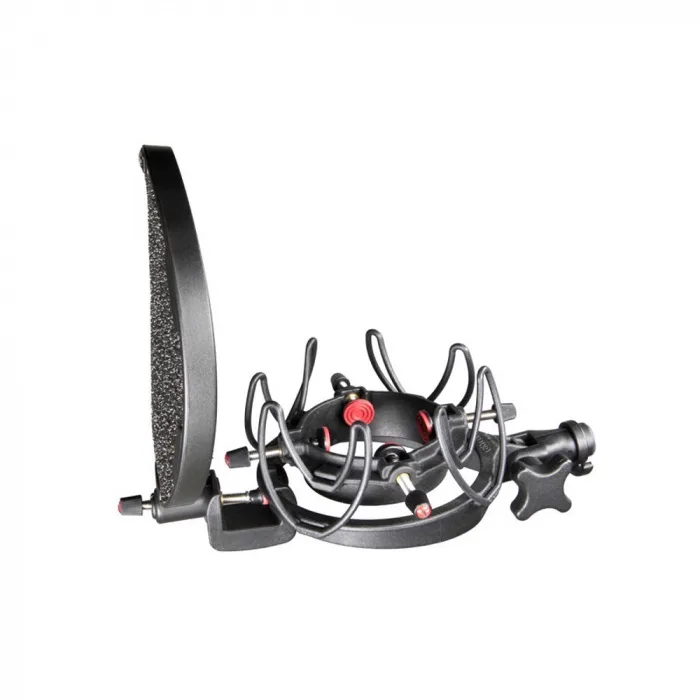
The Rycote InVision USM Studio Kit is our pick. Rycote's product page lists it for large-diaphragm microphones from 18 to 68 mm in diameter, and its Lyre clips replace elastic cord, so there is no cord to rethread. The RODE SMR is the value choice if you own one of the RODE mics on its compatibility list: 266 g, a double Lyre suspension, an integrated metal pop filter and a base nut in the box. The Neumann EA 1 is the right answer mainly for Neumann owners, because the microphone screws into a threaded collar rather than dropping into a cradle, and its elastic bands are a consumable that Neumann sells separately. Skip the Neewer MS043 unless your barrel really is 60 to 65 mm, because Neewer publishes no weight capacity and lists no replacement elastic. Measure your microphone before you buy anything else. Best for: anyone whose recordings pick up desk thumps, floor vibration or keyboard noise coming through the stand.
Our picks at a glance
- Rycote InVision USM Studio Kit - Buy. A universal lyre mount with a pop filter and no elastic to perish.
- RODE SMR - Buy. A double Lyre mount with an integrated metal pop filter, built around RODE's own large diaphragm mics.
- Neumann EA 1 - It depends. The elastic cradle Neumann built around its own microphone bodies, with bands you can actually replace.
- Neewer MS043 Microphone Shock Mount - Skip. A cheap iron and plastic cradle on elastic rope, with a narrow fit window and no spare parts.
The verdict in 30 seconds
What mattered most
- Suspension type
- Published mic diameter
- Published mic weight limit
- How the mic attaches
- Pop filter included
- Stand thread
A shock mount is a mechanical isolator. It sits between the microphone and the stand and softens the low frequency energy that travels up the stand from desk thumps, keyboard strikes and footsteps. It does nothing about airborne noise in the room, and it will not rescue a boom arm clamped rigidly to the desk you keep hitting. We picked four mounts that cover the real decision points: a universal lyre mount, a maker matched lyre mount, a classic elastic cradle from a microphone company, and a budget elastic mount most people should walk past.
A universal lyre mount with a pop filter and no elastic to perish.
Best for: Anyone with a side address condenser between 18 and 68 mm who wants one mount that will outlive several microphones.
- Rycote publishes a real fit spec: large-diaphragm microphones from 18 to 68 mm in diameter.
- The Lyre clips replace elastic cord, and Rycote says the kit has proved harder-wearing than traditional elasticated mounts.
- The universal pop filter locks onto the mount's outer support ring and can stay there while you swap microphones in and out.
- Rycote's product page publishes no maximum microphone weight, so a heavy tube mic on a boom is a judgment call.
- The 18 to 68 mm range is broad, so measure your barrel and confirm the fit with Rycote before ordering for an unusual microphone.
- Rycote does not publish a stand thread size for the USM, which matters if you are buying outside the US.
- You pay for the pop filter in this bundle; Rycote also sells the same USM mount on its own.
Amazon had no buyable listing for this when we last checked. The link still works if it returns.
Check price on Amazon Read our detailed assessment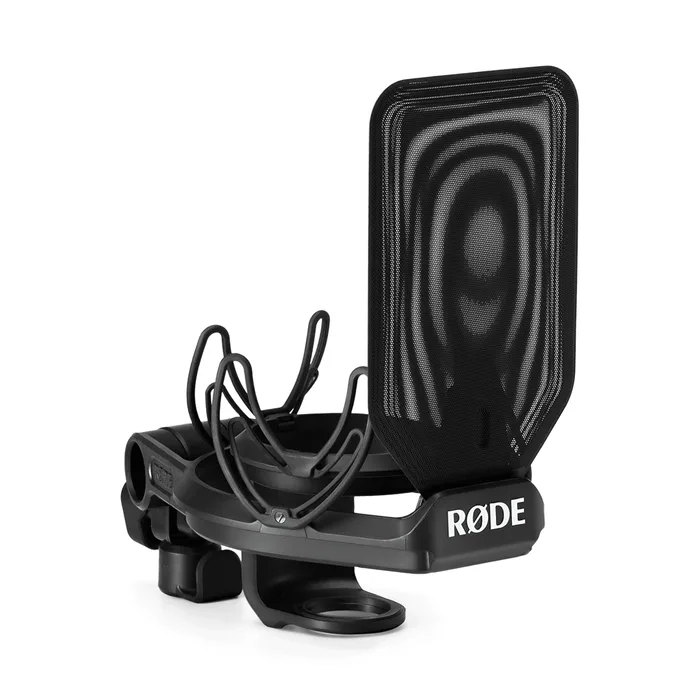
A double Lyre mount with an integrated metal pop filter, built around RODE's own large diaphragm mics.
Best for: RODE owners who want lyre style isolation and a pop filter as a single part.
- The double Lyre suspension uses no elastic cord, and at 266 g the whole assembly is light on a boom arm.
- The microphone is held by a clamping collar and locking nut that spreads load over a large surface area, so it does not need over tightening.
- A base nut is included, and the integrated metal pop filter is easily washable.
- RODE lists compatibility only with its own microphones: NT1, NT1-A, NT2-A, NT2000, NTK, K2, Procaster and Podcaster.
- No barrel diameter range is published, so there is no number to check an unlisted microphone against.
- The frame is a reinforced polymer rather than metal, which reads as less premium next to a machined mount.
- RODE does not publish a maximum microphone weight for it.
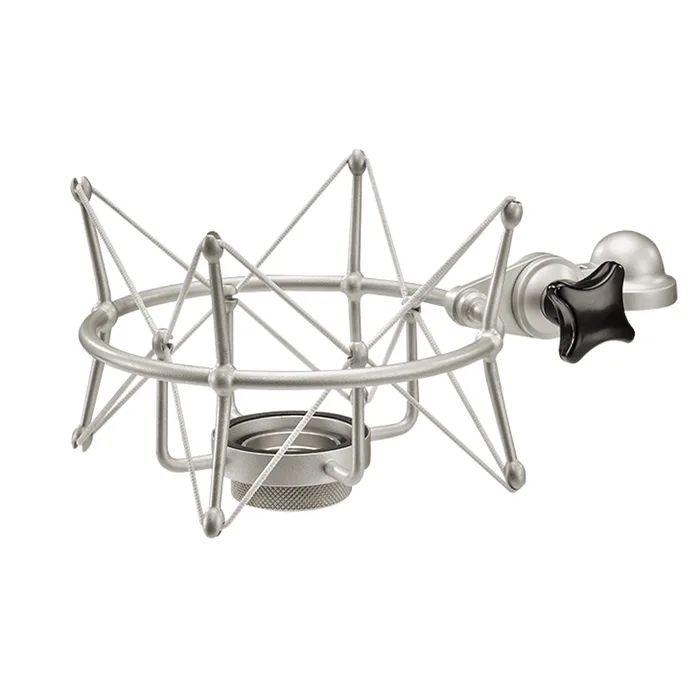
The elastic cradle Neumann built around its own microphone bodies, with bands you can actually replace.
Best for: Owners of the Neumann microphones this mount is listed against, who want the factory fit and long term parts availability.
- The microphone screws into a threaded collar carried on the elastic bands, which is the correct attachment for the Neumann bodies it is listed against.
- The swivel mount has a 5/8 inch 27 female thread plus a thread adapter for 1/2 inch and 3/8 inch stands, so it fits stands on either side of the Atlantic.
- Neumann sells Replacement Elastic Bands for the EA 1, so a tired suspension is a repair rather than a write off.
- Elastic suspension sags and perishes with time, so the bands are a running cost rather than a one off purchase.
- It is a premium price for a part with no pop filter and no published weight rating.
- Neumann publishes no barrel diameter range, because the mount is matched to its own microphones rather than sold as universal.
- It is the wrong buy if your microphone does not use the threaded base this collar expects.
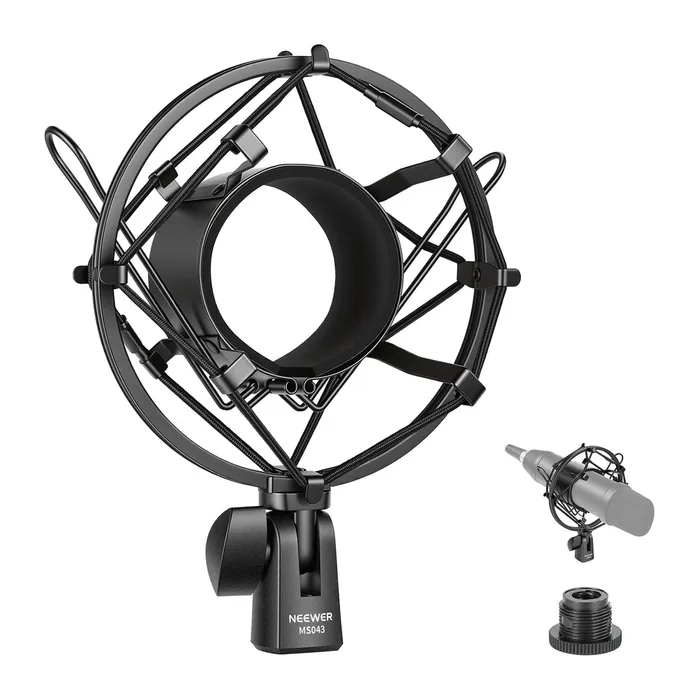
A cheap iron and plastic cradle on elastic rope, with a narrow fit window and no spare parts.
Best for: Someone whose barrel really is 60 to 65 mm, who needs a stopgap and accepts replacing the whole mount later.
- Neewer does publish a real number: it fits microphones of 2.4 to 2.6 inches, which is 60 to 65 mm in diameter.
- A 3/8 inch to 5/8 inch screw adapter is in the box, and the yoke offers both 3/8 inch and 5/8 inch mounting points.
- At 141 g it adds very little load to a light boom arm.
- The 60 to 65 mm window is narrow, and plenty of popular condensers sit outside it in either direction.
- Neewer publishes no microphone weight capacity, so loading it with a heavy mic is guesswork.
- Neewer lists no replacement elastic rope, which makes the mount disposable once the cord takes a set.
- Elastic rope relaxes over time, and a relaxed cradle lets the microphone droop out of position.
| Criteria | InVision USM Studio Kit Top pick | SMR | EA 1 | MS043 Microphone Shock Mount |
|---|---|---|---|---|
| Verdict | Buy it | Buy it | It depends | Skip it |
| Best for | Anyone with a side address condenser between 18 and 68 mm who wants one mount that will outlive several microphones. | RODE owners who want lyre style isolation and a pop filter as a single part. | Owners of the Neumann microphones this mount is listed against, who want the factory fit and long term parts availability. | Someone whose barrel really is 60 to 65 mm, who needs a stopgap and accepts replacing the whole mount later. |
| Price tier | $$$ · premium | $$ · mid-range | $$$ · premium | $ · budget |
| Suspension type | Lyre clips, no elastic | Double Lyre, no elastic | Elastic bands | Elastic ropes |
| Published mic diameter | 18 to 68 mm (Rycote product page) | Not published, RODE lists models | Not published, matched to Neumann bodies | 60 to 65 mm |
| Published mic weight limit | Not published | Not published | Not published | Not published |
| How the mic attaches | Adjustable Lyre clips around the barrel | Clamping collar with locking nut | Screws into a threaded collar | Barrel clamp slung on elastic rope |
| Pop filter included | Yes, universal pop filter | Yes, integrated metal filter | No | No |
| Stand thread | Not published by Rycote | Not published; base nut included | 5/8 inch 27 female, adapter for 1/2 and 3/8 inch | 3/8 inch and 5/8 inch, adapter included |
| Replacement suspension parts | Lyres are structural, not a consumable | Not listed by RODE | Yes, Replacement Elastic Bands (EA 1) | Not listed by Neewer |
| Mount weight | 0.2 kg | 266 g | Not published | 141 g |
Which one is right for you?
- Anyone with a side address condenser between 18 and 68 mm who wants one mount that will outlive several microphones. Buy it Rycote InVision USM Studio Kit
- RODE owners who want lyre style isolation and a pop filter as a single part. Buy it RODE SMR
- Owners of the Neumann microphones this mount is listed against, who want the factory fit and long term parts availability. It depends Neumann EA 1
- Someone whose barrel really is 60 to 65 mm, who needs a stopgap and accepts replacing the whole mount later. Skip it Neewer MS043 Microphone Shock Mount
How we judged the field
Five things decide whether a shock mount is right, and four of them are checkable before you spend anything. Fit comes first: the barrel diameter the mount is built for, the microphone weight it is rated to carry, and whether your microphone is meant to drop into a cradle or screw into a threaded collar. Second is what the suspension is made of, because moulded lyre and elastomer designs do not creep while stretched elastic does. Third is what the mount is actually for, which is structure borne vibration coming up the stand and nothing else. Fourth is the stand thread and whether an adapter is in the box, since 5/8 inch 27 and 3/8 inch fittings both exist and the wrong one stops you dead. Fifth is serviceability: can you buy replacement elastics, or is the whole mount a consumable?
The field splits cleanly along those lines. At one end are universal lyre mounts, which publish a diameter range and have no elastic to fail, and Rycote is the obvious representative. Next are maker matched mounts sold as the correct part for a particular family of microphones, which trade a published range for a guaranteed fit; RODE’s SMR does that with lyres, Neumann’s EA 1 does it with a threaded collar on elastic bands. At the far end sit budget generic cradles, which are cheap, occasionally honest about diameter, and almost never sold with spare parts. We picked one of each so you can find yourself in the list rather than reading four versions of the same product.
Rycote InVision USM Studio Kit
Buy itRycote’s InVision USM Studio Kit is the mount we would buy without knowing which microphone you own, because it is the one that tells you enough to check. Rycote’s product page lists the kit for large-diaphragm microphones from 18 to 68 mm in diameter, which is more disclosure than most of this category manages. The clips are Lyres rather than stretched cord, and Rycote says the kit has proved harder-wearing than traditional elasticated mounts. The universal pop filter locks onto the outer support ring, so it stays put while microphones come and go. Two caveats: Rycote publishes no maximum microphone weight on the product page, and no stand thread size is published anywhere we could find. Buy it if you want one mount that outlasts several microphones.
RODE SMR
Buy itThe RODE SMR is the same anti elastic idea at a friendlier price, provided you own the right microphone. It uses a double Lyre suspension, where a smaller inner Lyre acts as a tensioning element, and the whole mount weighs 266 g in a frame of reinforced polymer. The microphone is held by a clamping collar tightened with a locking nut, which RODE says spreads load over enough surface area that you do not need to over tighten it, and a base nut is in the box. The integrated metal pop filter is easily washable, which is a genuine advantage over fabric. The catch is compatibility: RODE lists the NT1, NT1-A, NT2-A, NT2000, NTK, K2, Procaster and Podcaster, and publishes no barrel diameter range, so an unlisted microphone is a gamble. For a RODE owner it is close to the perfect answer.
Neumann EA 1
It dependsNeumann’s EA 1 is a good mount that only makes sense for a specific buyer. It is a classic elastic suspension, and Neumann’s own product photo shows the important detail: the microphone screws into a knurled threaded collar slung on the bands, rather than dropping into a cradle sized by barrel diameter. That is why Neumann publishes no diameter range, and why the mount is right for the Neumann bodies it is listed against and wrong for anything else. The swivel has a 5/8 inch 27 female thread with an adapter for 1/2 inch and 3/8 inch stands, so travel is easy, and it comes in nickel or black. Neumann also sells Replacement Elastic Bands for it, which is the honest admission that elastic is a consumable and the reason the mount stays serviceable for decades. No pop filter, no published weight rating, premium price.
Neewer MS043 Microphone Shock Mount
Skip itThe Neewer MS043 is the one to walk past, and not because it is cheap. Credit where it is due: Neewer states a real fit window of 2.4 to 2.6 inches, which is 60 to 65 mm, and includes a 3/8 inch to 5/8 inch screw adapter with 3/8 inch and 5/8 inch mounting points on the yoke. The frame is iron and plastic and the whole thing weighs 141 g. The problems are what is missing. There is no published microphone weight capacity, so hanging a heavy condenser off elastic rope is guesswork. The 60 to 65 mm range is narrow enough that many popular mics simply will not sit in it. And Neewer lists no replacement rope, so when the cord relaxes and the microphone starts drooping toward the pop filter, the mount is rubbish rather than a repair. Buy it only as a knowing stopgap.
Sources
Specs in this review come from these pages.
Rycote InVision USM Studio Kit vs RODE SMR: which should you buy?
Both of our buy picks reject elastic, which is the single most useful thing to know about them. The difference is what they ask of you in return. The Rycote InVision USM Studio Kit is sold to fit a range, so it publishes a number you can check against your own microphone: 18 to 68 mm of diameter. The RODE SMR is sold to fit a list, so it publishes microphone model names instead: NT1, NT1-A, NT2-A, NT2000, NTK, K2, Procaster, Podcaster. If your mic is on that list, the SMR is the cheaper route to a lyre suspension and it throws in a washable metal pop filter.
So the choice is mostly about what you own now and what you expect to own later. If you already have a RODE from that list and you do not plan to change microphones soon, buy the SMR and stop reading. If you have anything else, or you swap microphones, or you want the mount to survive three or four bodies, the Rycote is the safer money because it fits by measurement rather than by permission. One practical tiebreaker: Rycote does not publish a stand thread for the USM, so if you are buying outside the US and cannot confirm it with the seller, check the SMR’s thread with the seller too, since RODE’s datasheet lists only a base nut.
What to look for
- Measure first: get calipers on the widest part of your microphone barrel and compare that number in millimetres against the maker’s stated range, not against a claim of universal fit.
- Check the weight rating, and the orientation: none of the mounts here publishes a maximum microphone weight, and a heavy mic hanging horizontally from a boom stresses any suspension more than one standing upright.
- Know how your mic attaches: some microphones are designed to screw into a threaded collar, and those will never sit correctly in a cradle sized only by barrel diameter.
- Prefer lyre or moulded elastomer if you want it to last: stretched elastic creeps under constant load, which is why elastic mounts droop after a year or two of hanging.
- Confirm the thread and the adapter: 5/8 inch 27 and 3/8 inch fittings both exist, Neumann ships an adapter for 1/2 inch and 3/8 inch stands with the EA 1, and not every mount does.
- Ask whether spares exist: a mount whose elastics can be bought separately is repairable, and one whose elastics cannot be is a consumable dressed up as hardware.
Our final take
Buy the mount that fits, then worry about everything else. The Rycote InVision USM Studio Kit is our pick because it publishes a diameter range you can check, and because Lyre clips are structure rather than a wear part. RODE’s SMR is the better value if your microphone is on RODE’s list, and it bundles a washable metal pop filter. Neumann’s EA 1 earns its place for Neumann owners specifically, and its replaceable bands are the reason it stays useful for years. Skip the Neewer MS043 unless your barrel really is 60 to 65 mm. And remember what none of them do: airborne room noise is a different problem entirely.
Questions, answered
Will a shock mount stop my keyboard, desk and floor noise?
It will help with the part of that noise which travels as vibration through the desk, the stand and the mount. That is structure borne noise, and softening it is exactly what a suspension does. It will do nothing about the same keyboard heard through the air, because sound arriving at the capsule as a pressure wave never touches the suspension. If your recordings have clatter you can still hear when you lift the microphone off the desk entirely, the problem is airborne and you need distance, a directional pattern or a quieter keyboard. Treat the mount as one link in a chain that also includes a decoupled boom arm and where you put the stand.
How do I work out which mount fits my microphone?
Measure the barrel with calipers at the widest point that will sit inside the mount, and write the number down in millimetres. Then check that number against the maker's published range rather than a marketing line about universal fit. Also check length and where the microphone balances, because a long mic whose mass sits high will tip in a cradle sized only by diameter. Finally check how the mount grips: some microphones are designed to screw into a threaded collar, and those will not sit properly in an elastic cradle meant for a plain barrel. If a listing gives no diameter range at all, treat that as missing information rather than as broad compatibility.
Do elastic bands really wear out?
Yes, and the clearest evidence is that microphone makers sell replacements. Neumann lists Replacement Elastic Bands for the EA 1 and for the EA 4 as catalogue accessories, which only makes sense if the originals are expected to go. Elastic under constant load creeps, so the cradle slowly droops and the microphone drifts toward the pop filter, and the rubber also perishes with heat and light. A mount whose bands cannot be bought separately is effectively disposable once that happens. Lyre and moulded elastomer designs avoid the problem by making the springy part a structural moulding instead of a stretched cord.
What is the difference between a 5/8 inch 27 and a 3/8 inch stand thread?
They are the two common microphone stand threads, and the wrong one is a genuine compatibility problem. The 5/8 inch 27 thread is the usual fitting on stands sold in the US, while 3/8 inch is common on stands sold elsewhere, and plenty of mounts ship with a small adapter to bridge the two. Neumann's EA 1 has a 5/8 inch 27 female thread plus an adapter for 1/2 inch and 3/8 inch stands. Audio-Technica's AT8449a has a 5/8 inch thread and ships with a 3/8 to 5/8 inch adapter. Check whether the adapter is included rather than assuming, because losing one is easy and buying one for a single mount is annoying.
Do I still need a boom arm if I have a shock mount?
The two solve different halves of the same problem. A shock mount reduces the vibration that reaches the microphone once it has already travelled up the stand. A boom arm changes where that vibration comes from in the first place, and a clamp bolted straight to your desk feeds every keystroke and elbow knock into the stand. If the arm is clamped to the same surface you type on, add isolation at the clamp or move the stand to the floor. A shock mount on a rigid desk clamp is doing damage control rather than prevention.
Deciding between the top two? See our head-to-head: Rycote InVision USM Studio Kit vs RODE SMR.
More Audio reviews
 The Best MIDI Keyboard Controllers: 4 Compared (and One to Skip)
  The Best Music Streamers: 4 Compared (and One to Skip)
  The Best Premium Noise-Cancelling Headphones: 4 Compared (and One to Skip)
  The Best Open-Back Headphones: 4 Compared (and One to Skip)
  The Best Open-Ear Headphones: 4 Compared (and One to Skip)
  The Best Outdoor Speakers: 4 Compared (and One to Skip)