

Audio & Headphones
The Best Music Streamers: 4 Compared (and One to Skip)
We compared four network music streamers on the DAC inside, published audio specs, inputs and outputs, casting protocols and room correction, using only what each maker states.
The short version
The Bluesound NODE is the best overall: an ESS ES9039Q2M DAC, HDMI eARC, a headphone amp, a subwoofer output, Gigabit Ethernet and AirPlay 2, Spotify Connect, TIDAL Connect, Qobuz Connect and Roon Ready in one compact box. The WiiM Pro Plus is the value pick, with an AKM DAC that WiiM rates at 121 dB SNR, both AirPlay 2 and Google Cast, RoomFit room correction and a remote in the box for a much smaller spend. The Eversolo DMP-A6 Gen 2 depends on how you listen: its 6-inch touchscreen, M.2 SSD slot and XLR outputs suit people with a big local library, but AirPlay and Google Cast are not on its protocol list. Skip the Sonos Port for a hi-fi system: Sonos publishes no DAC, sample rate or distortion figure, its digital output is coax only, and it sits in the same premium tier as the far better equipped NODE. Best for: anyone adding modern streaming to a stereo amplifier or powered speakers without replacing them.
Our picks at a glance
- Bluesound NODE - Buy. The most complete streamer here, with HDMI eARC, a THX AAA headphone amp and almost every casting protocol that matters.
- WiiM Pro Plus - Buy. A small streamer with a strong built-in DAC, both AirPlay 2 and Google Cast, and room correction for a fraction of the premium spend.
- Eversolo DMP-A6 Gen 2 - It depends. A full-size touchscreen player built around a local music library, with balanced outputs and an internal SSD slot.
- Sonos Port - Skip. A tidy way to add a stereo to a Sonos system, but a weak buy as a hi-fi streamer.
The verdict in 30 seconds
What mattered most
- DAC chip
- Stated resolution
- Analog outputs
- Digital outputs
- Inputs
- Casting and protocols
A music streamer is the box that adds Spotify, TIDAL, Qobuz, AirPlay and your own music files to an amplifier or powered speakers you already own. The useful differences are not the logos on the box but which casting protocols it supports, whether its built-in DAC is good enough to skip a separate one, and what it lets you plug in. We compared a long-running premium streamer, a value pick, a touchscreen library player and a popular multiroom box. Every spec below comes from the maker's own page.
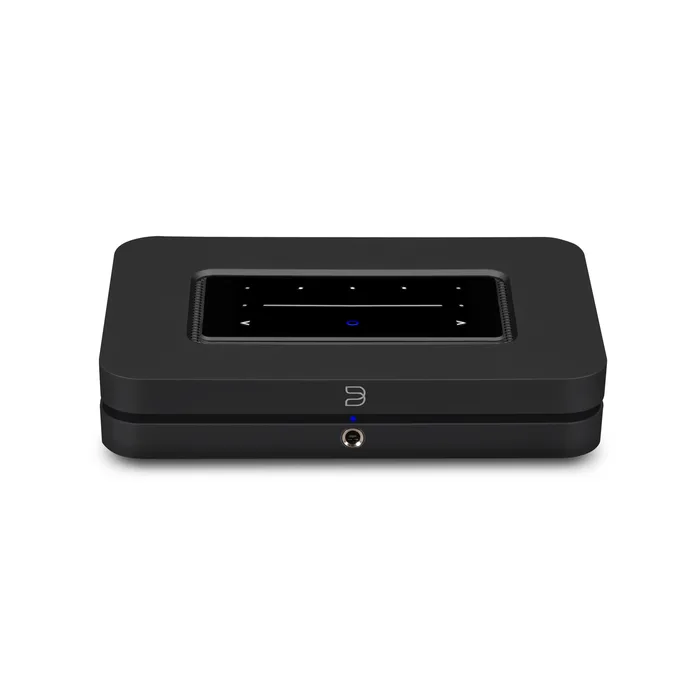
The most complete streamer here, with HDMI eARC, a THX AAA headphone amp and almost every casting protocol that matters.
Best for: Buyers who want one streamer to handle music services, a TV, a subwoofer and headphones without extra boxes.
- Bluesound lists AirPlay 2, Spotify Connect with Spotify Lossless, TIDAL Connect, Qobuz Connect and Roon Ready support.
- HDMI eARC input with Dolby Digital decoding means a TV can play through the same stereo.
- Outputs cover RCA, optical, coax, USB Audio 2.0, a subwoofer RCA and a 6.3 mm headphone jack, plus Gigabit Ethernet and a 12V trigger.
- It is the priciest of the two buy picks by a wide margin.
- Google Cast is not on Bluesound's list of integrations.
- Room correction is Dirac Live Ready rather than built in, and Dirac does not work over the USB output.
- The product description says aptX Adaptive arrives in a future software update.
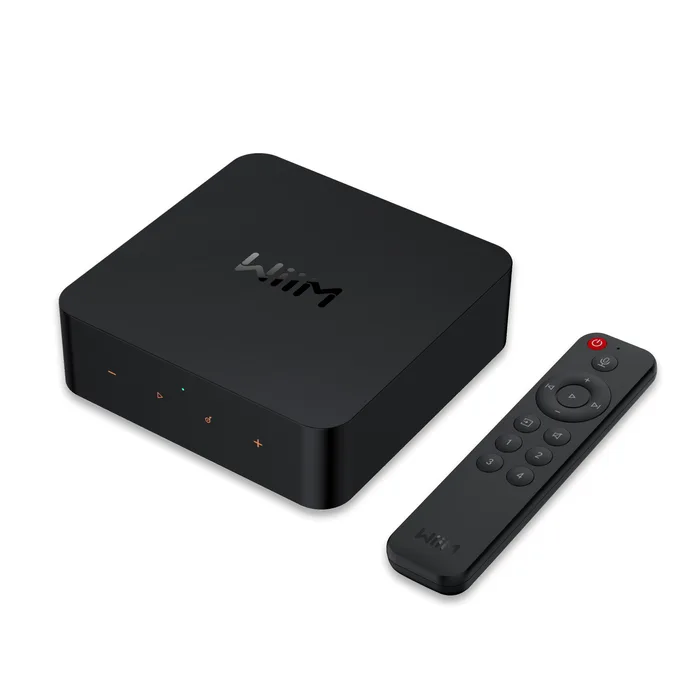
A small streamer with a strong built-in DAC, both AirPlay 2 and Google Cast, and room correction for a fraction of the premium spend.
Best for: Anyone who wants to add streaming to an existing amp or powered speakers at a sensible spend.
- WiiM rates the AKM AK4493SEQ line output at 121 dB SNR and -113 dB THD+N.
- It supports AirPlay 2, Google Cast, Spotify Connect, TIDAL Connect and Roon Ready, so most phones and apps can cast to it.
- RoomFit auto-correction, 10-band graphic and parametric EQ, a voice remote and RCA and optical cables come in the box.
- There is no HDMI input, headphone output or wired subwoofer output; WiiM points buyers to the WiiM Ultra for those.
- The optical input takes stereo PCM only, so Dolby Digital and DTS from a TV are not supported.
- Ethernet is 10/100 rather than Gigabit, and DSD is not in its listed codecs.
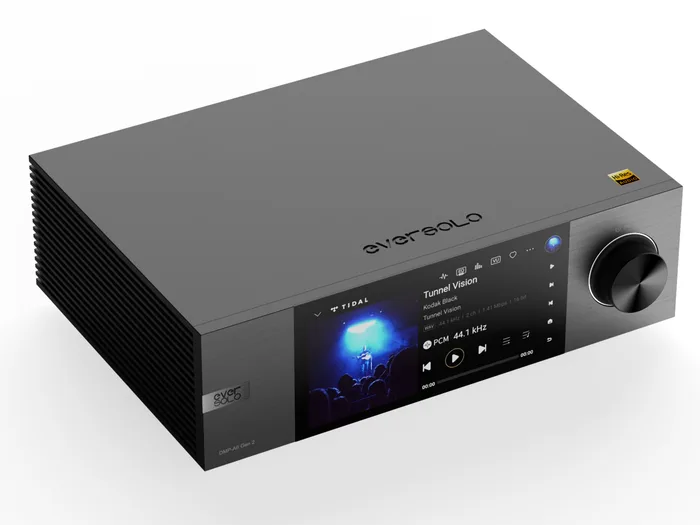
A full-size touchscreen player built around a local music library, with balanced outputs and an internal SSD slot.
Best for: Listeners with a large file library or CD collection who want a screen and balanced outputs on the rack.
- A 6-inch touchscreen and an M.2 NVMe slot for up to 8TB turn it into a self-contained library player.
- Dual ES9038Q2M DACs feed XLR balanced and RCA outputs, with Eversolo stating over 128 dB SNR from XLR.
- Inputs include HDMI ARC, USB-B from a computer, optical, coax and Bluetooth, and Eversolo says it can play and rip CDs from an external USB drive.
- AirPlay and Google Cast are not on Eversolo's streaming protocol list, which names Roon Ready, Spotify Connect, DLNA and TIDAL Connect.
- At 270 mm wide and 90 mm tall it is a full component, not a box you hide behind a speaker.
- Eversolo does not state its weight on the product page.
- Most of what you pay for is wasted if you only stream from a phone.
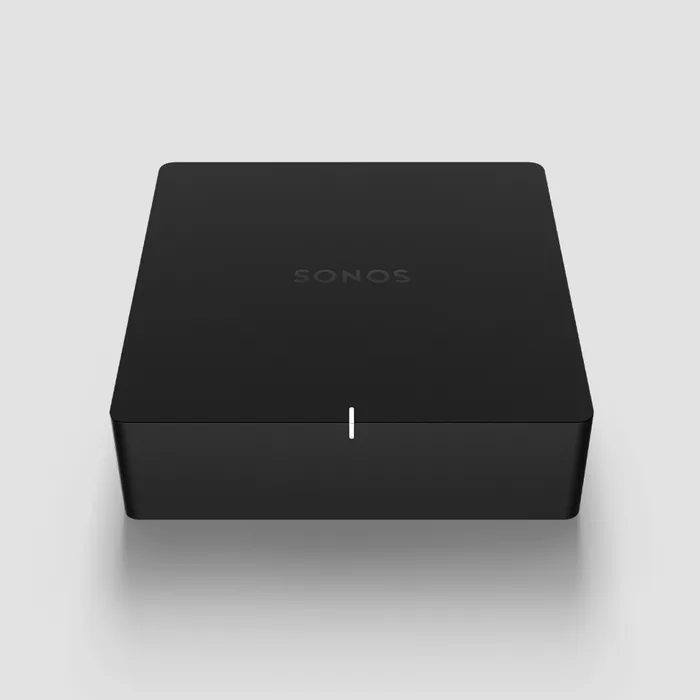
A tidy way to add a stereo to a Sonos system, but a weak buy as a hi-fi streamer.
Best for: Only households already built on Sonos that need to bring one existing stereo into that system.
- It joins a Sonos multiroom system and works with AirPlay 2 on Apple devices.
- An automatic 12V trigger turns a connected amplifier on and off.
- RCA line-in lets a turntable or CD player be shared to other Sonos rooms.
- Sonos publishes no DAC chip, sample rate, bit depth, SNR or distortion figure on the Port page.
- Digital output is coax only, with no optical, USB, HDMI or headphone connection.
- Wi-Fi is listed as 802.11a/b/g/n with 10/100 Ethernet, and EQ is limited to bass, treble and loudness.
- It needs the Sonos app and sits in the same premium tier as the NODE while doing much less.
| Criteria | Bluesound NODE Top pick | WiiM Pro Plus | Eversolo DMP-A6 Gen 2 | Sonos Port |
|---|---|---|---|---|
| Verdict | Buy it | Buy it | It depends | Skip it |
| Best for | Buyers who want one streamer to handle music services, a TV, a subwoofer and headphones without extra boxes. | Anyone who wants to add streaming to an existing amp or powered speakers at a sensible spend. | Listeners with a large file library or CD collection who want a screen and balanced outputs on the rack. | Only households already built on Sonos that need to bring one existing stereo into that system. |
| Price tier | $$$ · premium | $$ · mid-range | $$$ · premium | $$$ · premium |
| DAC chip | ESS ES9039Q2M | AKM AK4493SEQ | Dual ESS ES9038Q2M | Not published |
| Stated resolution | Up to 192 kHz, 16-24 bit; DSD256 | Up to 24-bit/192 kHz | PCM 768 kHz/32-bit; DSD512 | Not published |
| Analog outputs | RCA (fixed option), sub out, 6.3 mm headphone | RCA line out | XLR balanced and RCA | Analog via included RCA cable |
| Digital outputs | Optical, coax, USB Audio 2.0 | Optical, coax | Optical, coax, USB, HDMI multichannel | Coax only |
| Inputs | HDMI eARC, optical/3.5 mm combo, USB storage | RCA line in, optical | HDMI ARC, USB-B, optical, coax, Bluetooth | RCA line in |
| Casting and protocols | AirPlay 2, Spotify, TIDAL and Qobuz Connect, Roon Ready | AirPlay 2, Google Cast, Spotify and TIDAL Connect, Roon Ready | Roon Ready, Spotify and TIDAL Connect, DLNA | AirPlay 2, Sonos app |
| Room correction and EQ | Dirac Live Ready | RoomFit plus 10-band graphic and parametric EQ | 10-band EQ | Bass, treble, loudness |
| Network | Wi-Fi 5, Gigabit Ethernet | Wi-Fi 5, 10/100 Ethernet | Dual-band Wi-Fi, Gigabit Ethernet | 802.11a/b/g/n, 10/100 Ethernet |
Which one is right for you?
- Buyers who want one streamer to handle music services, a TV, a subwoofer and headphones without extra boxes. Buy it Bluesound NODE
- Anyone who wants to add streaming to an existing amp or powered speakers at a sensible spend. Buy it WiiM Pro Plus
- Listeners with a large file library or CD collection who want a screen and balanced outputs on the rack. It depends Eversolo DMP-A6 Gen 2
- Only households already built on Sonos that need to bring one existing stereo into that system. Skip it Sonos Port
How we judged the field
Five things decide whether a streamer is right for a system. First, protocol support: AirPlay 2, Google Cast, Spotify Connect, TIDAL Connect, Qobuz Connect and Roon Ready decide which phones and apps can send music without workarounds. Second, the built-in DAC and its published figures, because a good one saves you buying a separate converter. Third, the input and output list, which decides whether a TV, turntable, subwoofer or headphones can join in. Fourth, room correction and EQ, which can do more for sound than any chip. Fifth, the network side: Wi-Fi standard and Ethernet speed affect reliability with large hi-res files.
The field splits into compact casting boxes, full-size library players with screens, and ecosystem bridges that exist to connect one stereo to a multiroom brand. We picked a current example of each from four different makers: Bluesound’s newest NODE as the premium all-rounder, the WiiM Pro Plus as the value choice, the Eversolo DMP-A6 Gen 2 as the library player, and the Sonos Port as the popular bridge that most people building a hi-fi system should pass on. Our stereo amplifier review covers streamer-amps if you need amplification too.
The Bluesound NODE is the streamer to buy if you want one box to cover everything. Bluesound lists an ESS ES9039Q2M DAC, native playback up to 192 kHz with 16 to 24 bit depth, DSD256 and a distortion figure of 0.0007% THD+N. The connection list is the longest of the compact boxes here: HDMI eARC with Dolby Digital decoding, a combined optical and 3.5 mm analog input, RCA output with a fixed level option, optical, coax and USB Audio 2.0 outputs, an RCA subwoofer output, a 6.3 mm headphone jack driven by THX AAA circuitry, Gigabit Ethernet and a 12V trigger. Service support is just as wide: AirPlay 2, Spotify Connect with Spotify Lossless, TIDAL Connect, Qobuz Connect and Roon Ready. The trade-offs are cost, the absence of Google Cast from Bluesound’s integration list, and room correction that is Dirac Live Ready rather than built in. The product description also notes that aptX Adaptive Bluetooth arrives in a future software update. It is for buyers who want a TV, a subwoofer and headphones handled by the streamer itself.
The WiiM Pro Plus is the value pick and the easiest recommendation for most stereos. WiiM uses an AKM AK4493SEQ DAC and rates the RCA line output at 121 dB SNR and -113 dB THD+N, so most people can connect it straight to an amplifier or powered speakers without a separate converter. It casts from almost anything: AirPlay 2, Google Cast, Spotify Connect, TIDAL Connect and Roon Ready are all listed. RoomFit auto-correction plus 10-band graphic and parametric EQ give it more tuning than the NODE has out of the box, and a voice remote, RCA cable and optical cable come with it. The limits are clear on WiiM’s own page. There is no HDMI, headphone output or wired subwoofer output, the optical input takes stereo PCM only, and Ethernet is 10/100. WiiM itself points to its larger Ultra model for HDMI ARC, phono and a sub output. For a turntable-and-speakers setup that just needs streaming, it is all you need.
The Eversolo DMP-A6 Gen 2 is a different kind of streamer: a full-width component with a 6-inch touchscreen, built for people who own their music. Eversolo lists dual ES9038Q2M DACs, PCM up to 768 kHz/32-bit and DSD512, XLR balanced and RCA outputs, and figures above 128 dB SNR from the XLR side. An M.2 NVMe slot takes an SSD of up to 8TB, two USB 3.0 ports read drives, and Eversolo says an external USB CD drive can be used for both playback and ripping. It also accepts HDMI ARC from a TV and USB audio from a computer, and it can send multichannel audio over HDMI up to 5.1. The catch is the protocol list: Roon Ready, Spotify Connect, DLNA and TIDAL Connect are named, but AirPlay and Google Cast are not. It is also 270 mm wide and 90 mm tall. Buy it if you have a large library and want to browse it on the rack; skip it if your music lives in a phone app.
The Sonos Port is popular because it joins a stereo to a Sonos multiroom system, and for that one job it works. It has RCA line-in to share a turntable to other rooms, an automatic 12V trigger, AirPlay 2 support and Sonos’s app for grouping. As a hi-fi streamer it falls short. Sonos publishes no DAC chip, sample rate, bit depth, SNR or distortion figure on the Port page, while every other maker here does. Digital output is coax only, with no optical, USB, HDMI or headphone connection. Wi-Fi is listed as 802.11a/b/g/n, Ethernet is 10/100, and EQ stops at bass, treble and loudness, with no room correction listed. It requires the Sonos app, and it sits in the same premium tier as the NODE, which adds HDMI eARC, a headphone amp, a sub output and Roon Ready. Unless your house already runs on Sonos and you need one more stereo in the group, put the money toward the NODE or keep most of it with the WiiM.
Bluesound NODE vs WiiM Pro Plus: which should you buy?
The NODE and the WiiM Pro Plus overlap more than their price gap suggests. Both have strong published DAC figures, AirPlay 2, Spotify Connect, TIDAL Connect, Roon Ready, optical and coax outputs and a 12V trigger. The NODE pulls ahead on connections: HDMI eARC with Dolby Digital decoding, a USB audio output, a subwoofer output, a THX AAA headphone jack, Gigabit Ethernet and Qobuz Connect. The WiiM answers with Google Cast, RoomFit room correction and parametric EQ in the box, and a remote included.
Choose by what else needs to connect. If the stereo also serves a TV, a subwoofer or headphones, the NODE saves you buying extra boxes and is worth the premium. If the streamer only has to feed an amplifier or powered speakers, and maybe take a turntable through line-in, the WiiM Pro Plus does that job at a far smaller spend, and the money saved goes further on speakers.
What to look for
- Protocols first: check for AirPlay 2, Google Cast, Spotify Connect and TIDAL or Qobuz Connect depending on the phones and services in your house.
- Published DAC figures: a maker that lists the DAC chip, SNR and THD+N is giving you something to compare; a blank spec sheet is a warning.
- The right outputs: RCA for most amps, XLR for balanced gear, optical or coax if you will keep an external DAC.
- TV and phono needs: HDMI ARC or eARC handles TV sound cleanly; a turntable needs a phono preamp before any line input.
- Room correction: built-in tools like RoomFit or support for Dirac Live can tame bass problems that no DAC can fix.
- Wired networking: Ethernet, ideally Gigabit, keeps large hi-res files from dropping out on a busy Wi-Fi network.
Our final take
For most people adding streaming to a stereo, the WiiM Pro Plus is the smart buy: a strong DAC, AirPlay 2 and Google Cast, room correction and a remote, at a modest spend. Step up to the Bluesound NODE when the streamer also has to handle a TV over HDMI eARC, a subwoofer or headphones, or when you want Qobuz Connect. Consider the Eversolo DMP-A6 Gen 2 only if your music lives on drives and you want a screen to browse it. The Sonos Port makes sense only inside an existing Sonos home; as a hi-fi streamer, it asks a premium price for unpublished specs and a coax-only digital output.
Questions, answered
Do I need a music streamer if my amplifier already has Bluetooth?
Not strictly, but a network streamer does a different job. Bluetooth plays whatever your phone sends and stops when the phone leaves the room, while a streamer pulls the music from the service itself over Wi-Fi or Ethernet. With Spotify Connect, TIDAL Connect or AirPlay 2, the phone becomes a remote and can take calls without interrupting the music. Streamers also add multiroom grouping, presets and room correction. If you only play the odd podcast, Bluetooth is fine; for a main stereo, a streamer is a clear step up.
Should I use the streamer's built-in DAC or my own external DAC?
If your streamer's DAC is good, you can skip the extra box. The WiiM Pro Plus and Bluesound NODE both publish strong figures for their analog outputs, and WiiM says the Pro Plus is the model to pick if you plan to use RCA line out. If you already own a DAC you like, use the optical, coax or USB output and let the DAC do the conversion. WiiM notes that for bit-perfect digital output you should set fixed volume and turn off EQ. Either way, the streaming features stay the same.
What does Roon Ready mean, and do I need it?
Roon is a paid music library and playback system that runs on a computer or server and sends audio to endpoints around the house. A Roon Ready device can receive that stream directly without extra software. The NODE, WiiM Pro Plus and Eversolo DMP-A6 Gen 2 all list Roon Ready; the Sonos Port page does not. If you do not use Roon, the label makes no difference to you. If you do, it is close to a must-have.
Will a streamer that supports 768 kHz or DSD512 sound better?
Only if you own files at those resolutions, and most streaming services deliver far less than that. Higher numbers on a spec sheet show what the hardware can decode, not how the music was recorded. For most libraries, 24-bit/192 kHz support already covers everything you will play. Published SNR and distortion figures, room correction and good speaker placement tend to matter more than headline sample rates. The Eversolo's high ceiling is useful mainly for people with large hi-res and DSD collections.
Can I connect my TV to a music streamer?
Some streamers handle TV sound and some do not. The Bluesound NODE has HDMI eARC with Dolby Digital decoding, and the Eversolo DMP-A6 Gen 2 has HDMI ARC input. The WiiM Pro Plus accepts TV sound only over optical and only as stereo PCM, so you must set the TV to PCM output. The Sonos Port has no HDMI or optical input at all. If TV sound through your stereo matters, check the input list before anything else.
Deciding between the top two? See our head-to-head: Bluesound NODE vs WiiM Pro Plus.
More Audio & Headphones reviews
 The Best Premium Noise-Cancelling Headphones: 4 Compared (and One to Skip)
  The Best Open-Back Headphones: 4 Compared (and One to Skip)
  The Best Open-Ear Headphones: 4 Compared (and One to Skip)
  The Best Outdoor Speakers: 4 Compared (and One to Skip)
  The Best Large Party Speakers: 4 Compared (and One to Skip)
  The Best Phono Preamps: 4 Compared (and One to Skip)