Explained
LED Face Masks, Explained
After reading, you'll know how to convert a spec sheet into an actual dose, which wavelengths match your concern, and what FDA cleared does and does not mean.
In this guide
Light therapy for skin is a dose-response treatment, which makes it one of the more measurable things in beauty. A given wavelength at a given intensity for a given time delivers a specific amount of energy per square centimetre of skin, and the research is written in those units. The difficulty is that most home devices publish only one of the three numbers you need.
The 30-second version
- Dose is irradiance times time, so a session length without an intensity figure tells you nothing.
- Wavelength decides the concern, red and near-infrared for lines, blue for acne.
- Contact matters, because an air gap between LEDs and skin reduces the light delivered.
- FDA cleared means safety-equivalent, not proven as effective as the marketing claims.
- Consistency beats intensity, and a maker who publishes a weekly regimen has thought about it.
The products this guide is about
Our verdict on each, with the full reasoning on the companion review.
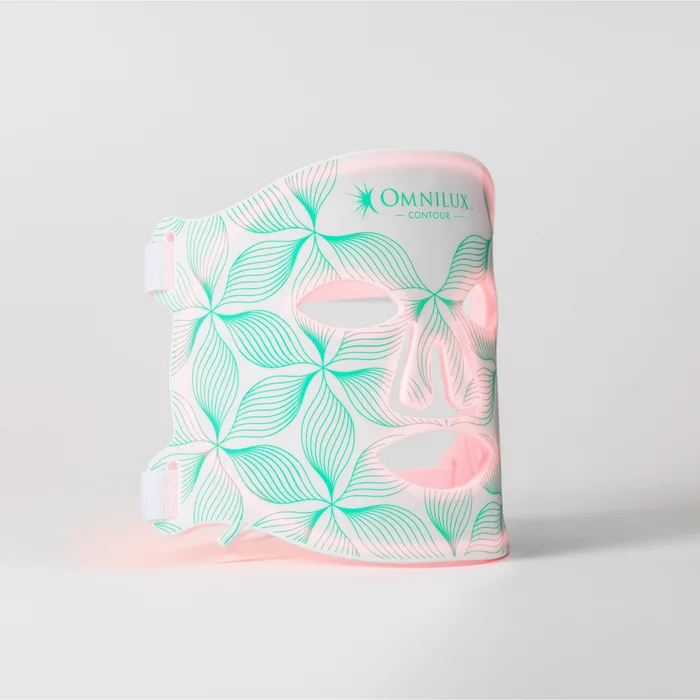
- Buy Omnilux Contour Face The only mask here that tells you its output, which is the only way to know what you are getting.
- Buy CurrentBody Skin LED Red Light Therapy Face Mask: Series 3 Six wavelengths and individual control of every LED, which is more capability than anything else here.
- It depends Therabody TheraFace Mask The most lights, the most disclosed hardware, and a rigid shell that sits on your face rather than against it.
- Skip Solawave Wrinkle Retreat Pro LED Face Mask A three minute treatment from a maker that will not tell you how bright the lights are.
What actually matters
- Wavelength - given in nanometres. Around 415nm is blue for acne bacteria, 590 to 660nm is the red range for tone and fine lines, 830nm is near-infrared for deeper collagen stimulation, and 1072nm is deep near-infrared.
- Irradiance - the light power reaching the skin, in milliwatts per square centimetre. It is the single most informative specification and the one most often absent.
- Dose - irradiance multiplied by session time, expressed in joules per square centimetre. This is the unit the clinical literature uses.
- LED count and arrangement - how many emitters and whether wavelengths are combined in dual-chip bulbs or spread across separate bulbs.
- Construction and fit - flexible silicone conforms to the face and keeps LEDs close to the skin; a rigid shell holds its shape and leaves gaps.
- Regimen - sessions per week and how many weeks before results are expected. Devices without a published protocol are harder to use properly.
- Regulatory status - FDA clearance for home use, which speaks to safety and to substantial equivalence rather than to efficacy.
The specs, in plain English
Green flags vs red flags
Green flags
- Irradiance published in mW/cm2 alongside a session length.
- Wavelengths given in nanometres for every colour offered.
- A stated treatment regimen in sessions per week and total weeks.
- Weight, battery life and warranty published.
- An explicit statement of what the device will not treat.
Red flags
- A treatment time with no intensity figure behind it.
- Colours named without nanometre values.
- Percentage improvement claims with an asterisk and no study details.
- No warranty terms anywhere on the page.
- A session dramatically shorter than competitors with no explanation.
Who's who: the brands
- Omnilux - Derived from clinical Omnilux Medical systems, with separate devices for face, neck, hands and acne, and the rare practice of publishing an irradiance figure.
- CurrentBody - UK brand whose Series masks add wavelengths with each generation, now six including 1072nm deep near-infrared, with app control over individual LEDs.
- Therabody - Recovery equipment company whose TheraFace range combines LED with vibration, and which discloses weight, battery and materials unusually fully.
- Solawave - Value-focused light therapy brand known for its skincare wand, with flexible silicone masks, short treatment times and HSA and FSA eligibility.
- Dr. Dennis Gross - Dermatologist-founded brand with rigid-shell LED masks for face and neck, widely sold and priced at the premium end.
How to read a listing without getting fooled
Find the irradiance first, in milliwatts per square centimetre, and if it is not there treat every other claim as unverifiable. If it is there, multiply it by the session length in seconds and divide by a thousand to get joules per square centimetre, which is what the research uses and what lets you compare two devices honestly. Then check the wavelengths are given in nanometres rather than as colour names, and match them to your concern: blue for acne, red and near-infrared for lines and firmness. Look at how the LEDs are arranged, because dual-chip bulbs deliver two wavelengths to the same point. Check whether the mask is flexible silicone or a rigid shell, since contact with the skin determines how much light actually arrives. Then read the boring parts, weight, battery life and warranty, which are absent from three of the four pages here and which determine whether you keep using it. Finally, read the asterisks on any percentage claim.
How much should you spend?
LED masks are expensive relative to what they contain, and price correlates poorly with disclosure. The mid-range now buys a flexible silicone mask with four wavelengths and FDA clearance, which is a reasonable entry point provided you accept that the intensity is unstated. The premium tier is where the established names sit, and it buys either a published irradiance figure and a clinically derived protocol, or a much wider set of wavelengths with app-level control, which are two different things worth paying for. Paying more does not reliably buy more information: one of the most expensive masks here publishes no weight, battery life or warranty. The honest way to think about cost is per treatment over a year of consistent use, at which point all of these are cheaper than a course of in-clinic sessions, and none of them is as powerful.
Questions, answered
How long before I see anything?
Weeks, not days, and the published protocols say so. Omnilux asks for three to five ten-minute treatments a week for four to six weeks before assessing results, and the Therabody study ran for twelve weeks with daily use. Skin remodelling is slow because collagen turnover is slow. If a device promises visible change after a single session, that is either temporary flushing from increased circulation or marketing. The corollary is that consistency matters more than intensity, so choose a mask you will actually put on.
Can I use it with my skincare products?
Use it on clean, dry skin in most cases, and apply actives afterwards rather than before, unless the maker specifically says otherwise. Omnilux pairs its treatments with applying a serum first and letting it dry, so follow whatever the manufacturer specifies. What you should avoid beforehand is anything that increases light sensitivity, including retinoids applied immediately before, strong acids, and benzoyl peroxide, all of which are better used at a different time of day. Sunscreen underneath is pointless and will block the light.
Can I use one after a facial or a procedure?
Sometimes, and it depends entirely on the procedure. Omnilux says the Contour line is complementary to microneedling and can speed healing afterwards. Other procedures, particularly anything involving photosensitising agents, lasers or active peeling, are a different question and the only safe answer comes from whoever performed the treatment. Ask them, and ask specifically about wavelengths and timing rather than about LED masks in general.
Do I need eye protection?
Do not look directly at the LEDs, and use whatever the mask provides. Most designs include eye cutouts or built-in shields, and the Therabody uses medical-grade silicone eye shields. The light is not ultraviolet and the risk is not the same as sun exposure, but sustained bright light at close range is unpleasant and unnecessary. Keep your eyes closed during treatment, and if you have any retinal condition or take medication affecting the eyes, ask an ophthalmologist before using one.
Or jump to the head-to-head: Omnilux Contour Face vs CurrentBody Skin LED Red Light Therapy Face Mask: Series 3.