Explained
Safety Razors, Explained
After reading, you'll understand blade gap, exposure and adjustability, and how to pick a safety razor for your skin and hair.
In this guide
Most first-time safety razor buyers pick on looks and get a razor that is either too aggressive or too mild for their skin. The terms that decide this, like blade gap and exposure, are often missing from listings. Weight and blade type also change how the razor feels and what it costs to run. Knowing a few terms makes it easy to tell a well-specified razor from a well-marketed one.
The 30-second version
- Blade gap and exposure decide aggressiveness, so a razor that publishes them is easier to judge.
- Adjustable razors let you start mild, then step up as your technique improves.
- Weight changes technique, with heavy razors shaving under their own weight and light ones steered by hand.
- Standard double-edge blades are cheap and widely sold, while half blades and two-blade loads cost more per shave.
- A long return window matters, because the first few weeks with a safety razor are a learning period.
The products this guide is about
Our verdict on each, with the full reasoning on the companion review.
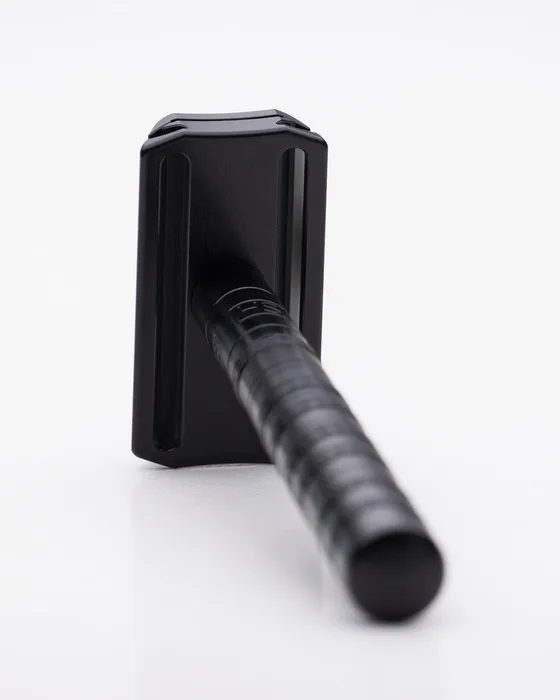
- Buy Henson Shaving Henson AL13 (Jet Black) A 37g Canadian-made razor that clamps a standard double-edge blade at a fixed 30° to aerospace-style tolerances.
- Buy Rockwell Razors Rockwell 6C Adjustable Safety Razor A chromed zinc alloy razor with six settings from interchangeable base plates, with every blade gap published.
- It depends Leaf Shave Leaf Two Razor A pivoting all-metal razor that runs one or two guarded half double-edge blades, built for face, head and body.
- Skip Bevel Safety Razor A brass-weighted fixed razor sold on razor bumps, with no settings and few published specs.
What actually matters
- Blade gap - The space between the blade edge and the safety bar. A bigger gap lets more hair and skin reach the blade, so it shaves closer but is less forgiving.
- Blade exposure - How far the edge sits beyond the line between cap and safety bar. Higher exposure feels more aggressive, and precise exposure makes the shave more consistent.
- Adjustability - Plates or settings that change the gap. They let one razor suit a coarse beard and sensitive skin.
- Weight - Heavier razors let gravity supply the pressure. Lighter razors give more control but need a steady hand.
- Head type - Fixed heads hold one angle; pivoting heads follow curves. Pivoting designs are easier for beginners and body shaving.
- Blade type - Standard double-edge blades fit most razors and cost little. Half blades and multi-blade loads change running cost.
- Return window and warranty - A long trial period covers the learning curve. Read what the warranty excludes, such as drops or worn finishes.
The specs, in plain English
Green flags vs red flags
Green flags
- Blade gap or exposure published in millimeters
- Takes standard double-edge blades
- A return window of 100 days or more
- A written warranty with clear exclusions
- Several settings or plates to start mild
Red flags
- Heavy skin-condition marketing with no specs
- No weight, gap or warranty published
- A return window of 30 days or less
- Proprietary blades with no standard alternative
- Instructions that call for several blades per shave
Who's who: the brands
- Henson Shaving - Canadian maker of precision-machined fixed razors built at an aerospace facility.
- Rockwell Razors - Known for adjustable razors with interchangeable plates and published blade gaps.
- Leaf Shave - Makes pivoting metal razors that use half double-edge blades and are designed for body shaving.
- Bevel - A grooming brand that markets shaving products at people who get razor bumps.
How to read a listing without getting fooled
Look first for the blade gap or exposure in millimeters, or a list of settings with their gaps; if it is missing, you are buying on adjectives. Next, check whether the head is fixed, adjustable or pivoting, and what blade it takes, since standard double-edge blades are the cheapest to run. Find the weight, then read the material and finish. Finally, read the return window and warranty together, and look at the exclusions. Treat clinical percentages and bump-prevention claims as the maker's own claims unless the method is explained.
How much should you spend?
Budget razors ($ · budget) can be excellent: an adjustable razor with published gaps at this tier is the best first purchase for most people, but a budget fixed razor with no specs gives you little to go on. Mid-range razors ($$ · mid-range) buy tighter machining, better finishes, pivoting designs and longer warranties. Above that, you are mostly paying for materials such as stainless steel or titanium and for finish, not for a better shave. Blades cost little at every tier, so the razor is a one-time cost.
Questions, answered
Is a safety razor hard to learn?
There is a short learning curve. Use light pressure, short strokes and hold the blade near the angle the maker suggests, often about 30°. Starting on a mild setting or a pivoting head makes the first weeks easier.
Can I take a safety razor on a plane?
Check your airline and security agency's current rules before you fly. Loose razor blades are commonly restricted in carry-on bags, so many travelers pack blades in checked luggage. The razor handle without a blade is usually less of a concern.
How do I dispose of used blades safely?
Keep used blades in a closed container, such as a blade bank or a sealed tin, rather than loose in the trash. Leaf includes a recycling tin in its kit. Check local rules on recycling sharps or scrap steel.
Do I need a special shaving cream?
No, but a cream or soap that gives a slick lather helps the blade glide. Thin gels and foams work less well with a single blade. Pre-shave oil can help on coarse beards.
Or jump to the head-to-head: Henson Shaving Henson AL13 (Jet Black) vs Rockwell Razors Rockwell 6C Adjustable Safety Razor.