Explained
Kids Kick Scooters, Explained
After reading this you will know whether your child needs three wheels or two, and which three specs decide how many years the scooter lasts.
In this guide
Kids kick scooters look nearly identical in a product photo, which is why so many get bought wrong. The real decision is age fit: three-wheel lean-to-steer scooters suit children under about five because steering happens by leaning instead of balancing, while two-wheel handlebar steering suits older children who already have balance. Everything else on the spec sheet matters less than getting that one call right, and a helmet is required no matter which scooter you choose.
The 30-second version
- Age fit decides this category, not brand. Three-wheel lean-to-steer for roughly two to five, two-wheel handlebar steering from roughly six to eight upward. Buying the wrong steering style is the most common reason a scooter ends up abandoned in the garage.
- The T-bar adjustment range is the lifespan spec. A published range of six inches or more usually covers several years of growth. A fixed handlebar fits properly for about one season, then becomes a crouch or a stretch.
- Wheel material outranks wheel branding. Polyurethane flexes and damps vibration on cracked pavement, while hard polymer chatters over the same surface and stops dead on gaps. Larger diameter generally rolls better over rough ground.
- Maximum rider weight is reached sooner than parents expect. Check it against what your child weighs now rather than the age printed on the box, because a low ceiling can retire a scooter while it still looks the right size.
- A helmet is required regardless of which product you buy. No feature on any scooter substitutes for one, and falls on a scooter tend to go forward or sideways onto pavement.
The products this guide is about
Our verdict on each, with the full reasoning on the companion review.
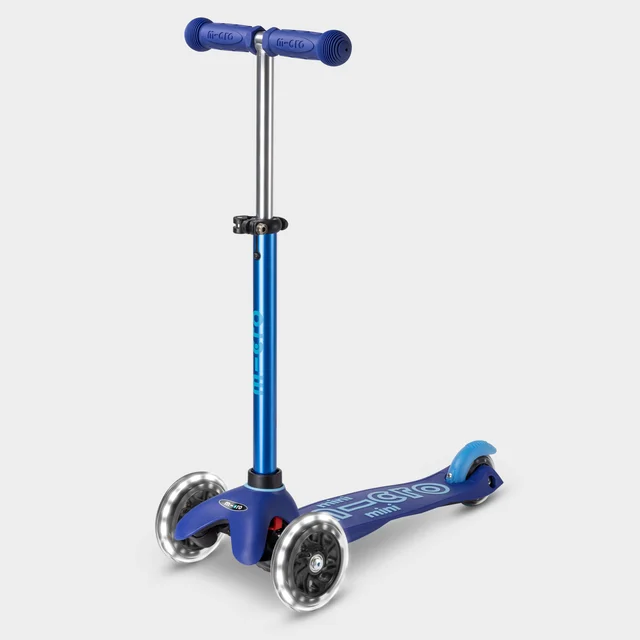
- Buy Micro Kickboard Micro Mini LED Scooter The three-wheel lean-to-steer scooter that a two-year-old can ride within minutes, with a T-bar that keeps fitting until school age. Amazon
- Buy Razor A5 Lux Eight-inch urethane wheels turn rough sidewalk into a smooth ride, and the rider weight limit means it lasts into the teens. Amazon
- It depends Micro Kickboard Micro Maxi Foldable LED Scooter The right bridge for a five-to-seven-year-old who is not ready for two wheels, and an expensive detour for one who is. Amazon
- Skip Razor Lil' Kick Scooter A fixed handlebar and a 44 pound rider limit mean you are buying one season, not a scooter. Amazon
What actually matters
- Steering style versus your child's balance. Lean-to-steer means the child shifts weight and the deck tilts, which matches how a toddler naturally moves and removes the balance problem entirely. Handlebar steering is faster and more agile but demands balance most children do not have before roughly five or six. The practical test is whether they already ride a balance bike or bicycle confidently.
- T-bar adjustment range, stated in inches. The word adjustable on a listing tells you nothing. A published range from ground to grip tells you how many growth spurts the scooter covers.
- Wheel material and diameter. Polyurethane absorbs vibration; hard plastic transmits it. Bigger wheels roll over sidewalk cracks, driveway lips, and small gravel that stop small wheels.
- Deck height and width. A low deck means less effort to push off and a shorter distance to fall. A wide deck gives a small foot somewhere confident to land and allows a two-footed stance while balance is still developing.
- Maximum rider weight. This is a hard ceiling on usable life and often bites earlier than the age guidance suggests.
- Replacement parts availability. Decks, wheels, T-bars, and brakes are the parts that wear out. A scooter with a spares catalogue gets handed down to a sibling; one without gets thrown away.
- Folding and carry weight. Folding matters for car trunks and school runs and matters not at all if the scooter lives by the front door. Weight matters because a parent ends up carrying it more often than expected.
The specs, in plain English
Green flags vs red flags
Green flags
- A published T-bar adjustment range in inches or centimetres, ideally spanning six inches or more
- Polyurethane wheels named explicitly, with diameters given in millimetres
- A replacement parts catalogue covering decks, wheels, T-bars, and brakes
- A maximum rider weight comfortably above what your child weighs today
- A wide, low, grip-surfaced deck rather than a narrow plank
- A stated warranty against manufacturing defects on the frame
Red flags
- A fixed handlebar height, or the word adjustable with no range given
- Wheels described only as durable or high quality with no material named
- A maximum rider weight in the low double digits, which many four-year-olds already exceed
- Battery-powered light-up wheels sold as the headline feature
- No mention of spare parts anywhere on the listing or the maker's site
- Age guidance stretched implausibly wide, such as three to twelve on a single fixed frame
Who's who: the brands
- Micro Kickboard - Three-wheel specialists. Known for lean-to-steer geometry, published T-bar ranges, battery-free LED wheels, and a modular design Micro says makes virtually every part replaceable.
- Razor - The mass-market name in two-wheel folding scooters. Aluminium frames and large urethane wheels on models such as the A5 Lux, wide availability, and a range that runs from toddler toys to older-rider scooters.
- Globber - Makes three-wheel scooters for young riders; check each model's listing for steering features and age range.
- Radio Flyer - Familiar toy-aisle brand at the affordable end. Check the listing for T-bar range and wheel material before assuming it suits real sidewalks.
- Supermarket and unbranded three-wheelers - Low cost, often plastic wheels, fixed bars and no spares. Workable for a brief trial at home, not for a purchase meant to last more than a season.
How to read a listing without getting fooled
Start with the steering style, because it decides everything else. If the listing shows two wheels at the front of a tilting deck, that is lean-to-steer and it is aimed at younger riders. Then hunt for numbers rather than adjectives. Adjustable handlebar means nothing on its own; a range such as roughly nineteen to twenty-seven inches from the ground tells you the scooter covers years rather than a season. Wheels described as durable or premium mean nothing; polyurethane at a stated diameter means something. Age guidance on the box is a marketing range, not a fitting, so cross-check it against the maximum rider weight and the T-bar range, and be sceptical whenever a fixed-height frame claims to fit a nine-year span. Check the scooter's own weight, since a parent carries it home more often than you expect. Finally, look for whether the maker sells replacement decks, wheels, T-bars, and brakes, because that is the difference between a scooter that gets handed down and one that gets binned. Photographs are the least reliable part of a listing here: a cheap toy and a scooter that lasts five years look almost identical head-on.
How much should you spend?
The budget end buys you a fixed handlebar, hard plastic wheels, and no spare parts, which is why those scooters tend to be a one-season purchase rather than a cheap one. Stepping up to the middle of the market buys the three things that determine lifespan: an adjustable T-bar with a published range, polyurethane wheels of a useful diameter, and a frame rated well above your child's current weight. That is where the value sits, and most families never need to go further. Paying premium money gets you the specialist three-wheel geometry, battery-free lights, a full replacement parts catalogue, and build quality that genuinely survives to a younger sibling, which is worth it if you expect more than one child to ride it or the scooter will see daily use on rough pavement. It is not worth it if the child is likely to ride twice and lose interest, or if you are buying a bridge product for a child who is nearly ready for two wheels anyway. Whatever you spend on the scooter, budget for a helmet at the same time rather than treating it as an optional extra.
Questions, answered
Three wheels or two wheels: which does my child need?
Go by the child, not the age printed on the box. Three-wheel lean-to-steer scooters let a child steer by shifting weight, so no balance is required, and they suit riders from roughly two to five. Two-wheel scooters steer from the handlebar and demand balance, which most children develop somewhere between five and eight. The practical test: if your child rides a balance bike or a bicycle confidently, they are ready for two wheels. If not, stay on three. The five-to-seven zone is genuinely ambiguous and worth watching your child on a bike before deciding.
Does my child really need a helmet on a kick scooter?
Yes. A helmet is required regardless of which scooter you buy and regardless of speed or surface. Falls on a scooter can go forward or sideways onto pavement with the head unprotected. Fit it level on the head with the strap snug under the chin, recheck the fit as the child grows, and replace it after any real impact. Knee and elbow pads are worth adding for beginners, but the helmet is not the optional part.
What is durometer and do I need to care about it?
Durometer is a wheel hardness number, written like 78A or 88A, borrowed from skateboarding. Softer wheels grip and absorb bumps; harder wheels roll faster and feel harsher. Kids scooter makers rarely publish the figure, so in practice you judge by material and size instead: polyurethane rather than hard polymer, and the largest diameter sensible for the rider. On smooth indoor floors the difference barely registers. On typical neighbourhood pavement it is the difference between a scooter that gets ridden and one that does not.
How do I stop my child outgrowing the scooter in a year?
Two numbers do the work. First, the T-bar adjustment range: look for a published span in inches from the ground to the grip, and treat six inches or more as covering several years. A fixed handlebar covers roughly one season. Second, the maximum rider weight: compare it to what your child weighs now, not at the age the box suggests, because a low ceiling is reached far sooner than most parents expect. Replacement parts availability is the third factor, since a worn deck or wheel should not end the scooter's life.
How low should the deck be, and how wide?
Low enough that your child's pushing foot reaches the ground without a big drop, which keeps pushing off easy and shortens any fall. Wide enough that a small foot lands without aiming, and ideally wide enough for both feet side by side while balance is still developing. Grip tape or a moulded slip-resistant surface matters more than any published number here. Very young riders benefit most from a low deck; older riders benefit more from length and stiffness.
Are light-up wheels worth paying for?
They are a motivation feature rather than a safety feature, and children love them, which is a real benefit if it gets the scooter ridden. The distinction that matters is how they are powered. Wheels lit by rotation have no batteries, nothing to replace, and nothing to fail. Battery-powered light-up wheels depend on a battery that eventually needs replacing. Neither type substitutes for reflective clothing or lights if a child is riding near dusk.
Or jump to the head-to-head: Micro Kickboard Micro Mini LED Scooter vs Razor A5 Lux.