Explained
Kids' Water Bottles, Explained
After reading this you will be able to tell a bottle that survives a school year from one that dies at the first torn spout, just by reading the listing.
In this guide
Kids' water bottles are sold on capacity, colour and insulation, and almost none of those things are what goes wrong. The body outlasts the school year without much drama; the lid tears, leaks, loses its straw, or grows a black film in a channel no brush reaches. Once you learn to read a listing for how the lid comes apart, what the dishwasher claim actually covers, and whether spare parts exist, the category gets simple fast.
The 30-second version
- The lid is the product. Bodies rarely fail, so judge a bottle by whether its cap separates into spout, straw, gasket and body, because a sealed assembly cannot be properly cleaned or repaired.
- "Dishwasher safe" often stops at the bottle. Plenty of listings advertise the claim on the headline and then bury a hand-wash-the-cap line in the care instructions, so read the care notes, not the bullet points.
- Weigh it full, not empty. Water adds roughly 30 g per ounce of capacity, so an insulated steel bottle and a big tumbler can differ by more than double once filled, and a heavy bottle gets left in the locker.
- Leak-proof and spill-proof are different promises. Leak-proof means it can lie sideways in a backpack; spill-proof only means a knocked-over cup will not empty across the table.
- Replacement parts are the best predictor of lifespan. A brand that sells lids, spouts, straws and gaskets individually is offering a bottle you can keep in service for years; one that does not is offering a bottle that ends with the first lost straw.
The products this guide is about
Our verdict on each, with the full reasoning on the companion review.
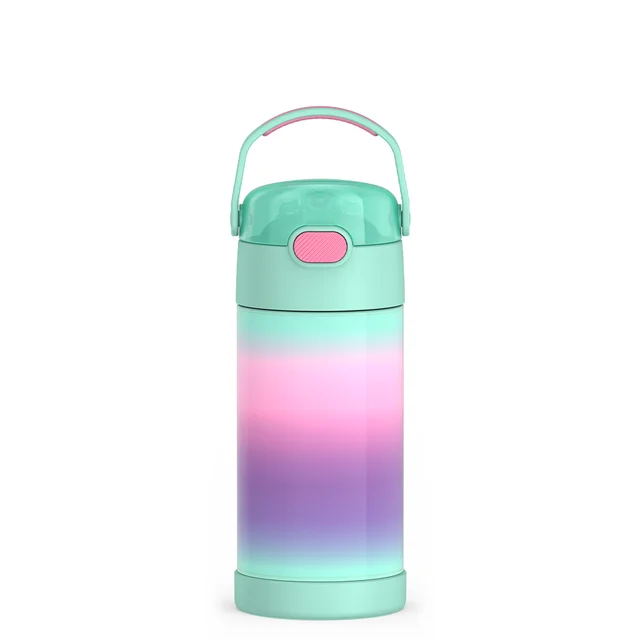
- Buy Thermos FUNtainer 12 oz Vacuum Insulated Stainless Steel Water Bottle with Straw Lid The default school bottle, and the one whose lid, straw top and straw stem you can all buy separately. Amazon
- Buy CamelBak Thrive Flip Straw Kids 14 oz Bottle with Tritan Renew The lightest bottle here by a wide margin, with a dishwasher claim that covers the whole bottle including the cap. Amazon
- It depends Klean Kanteen 12 oz Kid's Classic Insulated with Flip Seal Sport Cap A cap built from few parts with interchangeable replacements, wrapped around a premium-tier bottle. Amazon
- Skip Simple Modern Trek Kids Tumbler with Silicone Straw Lid A genuinely good tumbler and a genuinely bad school bottle: a press-on lid does not belong in a backpack. Amazon
What actually matters
- How far the lid comes apart. Look for photos or care instructions showing the cap in pieces. Spout, straw stem, gasket and cap body should all separate. Residue is more likely in one-piece sealed mechanisms, because the wet parts stay damp and nothing scrubs them.
- What the dishwasher claim covers. The useful version says the whole bottle including the cap is dishwasher safe with no exception. The weaker version says top rack only, lid open, or quietly specifies hand washing for the cap. That difference decides whether cleaning is a routine you will actually keep up.
- Filled weight. Empty weight is what gets listed; filled weight is what your child carries. Add about 30 g per ounce of capacity. For a child under roughly seven who carries a bag all day, staying well under a kilogram matters more than extra capacity.
- Whether the seal is real. A locking or push-button lid that seals the drinking hole survives a backpack. A press-on lid with an open straw port belongs on a desk. Check for the words leak-proof, and for a lock or cover, not just a snug fit.
- Replacement part availability. Before buying, open the brand's parts or accessories page. Lids, spouts, straw stems, gaskets and dust covers sold individually mean a lost or chewed part costs a fraction of a new bottle.
- Insulated or single-wall. Vacuum insulation keeps water cold through a school day, and cold water gets drunk. It also adds empty weight and costs more. It is a real trade, not a free upgrade.
- A cover over the mouthpiece. A flip cover or push-button lid keeps the spout off desk trays, floors and lunchbox crumbs. It is the cheapest hygiene feature in the category and the easiest to check in a product photo.
The specs, in plain English
Green flags vs red flags
Green flags
- Product photos show the cap exploded into separate pieces: spout, straw, gasket, cap body.
- The care instructions say the whole bottle including the cap is dishwasher safe, with no hand-wash exception.
- The brand has a parts or accessories page listing lids, spouts, straw stems and gaskets as separate items.
- A flip cover or push-button lid closes over the mouthpiece, so the part your child drinks from is not exposed in a bag.
- The listing says leak-proof and shows or describes a lock, rather than just calling the lid snug.
- Empty weight is published, so you can work out the filled weight before you commit.
Red flags
- The lid is described as spill-proof rather than leak-proof, especially on anything with an open straw port.
- "Dishwasher safe" appears in the headline bullets but the care instructions specify hand washing the cap.
- The cap is a sealed assembly with no visible way to remove the spout or gasket for cleaning.
- No parts page anywhere on the brand's site, or lids sold only as part of a whole new bottle.
- Empty weight is not listed at all, which usually means it is heavy for the capacity.
- The appeal is mostly a licensed character with no plain colourway available, since the character dates faster than the bottle wears out.
Who's who: the brands
- Thermos - The default school bottle in most bags, known for vacuum insulated steel with covered push-button straw lids and listed replacement lids, spout lids and straws.
- CamelBak - Light single-wall Tritan bottles with flip-straw caps, aimed at younger children; the kids' cap is sold on its own and the Thrive Flip Straw Kids 14 oz is listed as dishwasher safe as a whole bottle.
- Klean Kanteen - Premium insulated steel with interchangeable caps across its classic bottles, a Replacement Parts section, and a Klean Coat finish the maker calls chip-resistant.
- Simple Modern - Insulated tumblers and bottles with simple straw lids, though the Trek Kids Tumbler is described by the maker as spill-proof, so it is drinkware rather than a sealed sport bottle.
- Hydro Flask - Insulated steel bottles with a range of lid options; check the maker's page for kids' sizes, weights and parts.
- Contigo - Mass-market kids' bottles built around autospout and autoseal mechanisms; convenient and widely stocked, but mechanisms with more internal parts can be harder to keep clean.
How to read a listing without getting fooled
Start at the bottom of the listing, not the top. The headline bullets sell insulation hours, capacity and colours; the care instructions section is where the useful information hides. Find the dishwasher line and check whether it names the cap or only the bottle, and whether it adds top rack or lid open. Then look at the images for a shot of the lid taken apart, because a brand that shows the cap in pieces is telling you it comes apart, and a brand that only shows the assembled lid usually has nothing to show. Next, find the empty weight, which is often in a specifications table rather than the description, and add roughly 30 g for each ounce of capacity to get the number that actually matters. Read the seal language literally: leak-proof and spill-proof are not synonyms and a manufacturer that chose the weaker word chose it on purpose. Finally, leave the listing and search the brand's own site for replacement parts. If lids, spouts, straws and gaskets appear as buyable items, the bottle can survive several years. If the only thing for sale is another whole bottle, that is the plan.
How much should you spend?
Three things drive the price of a kids' bottle: vacuum insulation, the quality of the steel and finish, and how much engineering went into the cap. Budget bottles are almost always single-wall plastic, and the good ones in that band are genuinely good buys, since they are light, easy to clean, and cheap enough to replace when the inevitable happens. The value sweet spot sits in the mid range, where you get insulated stainless steel with a covered straw lid and, more importantly, a brand large enough to stock spare lids and straws. Paying premium money buys a better finish, a more repairable cap and a deeper parts catalogue, which is worth it if you are buying one bottle to last several school years, and poor value if your child loses bottles twice a term. The cheapest real upgrade in the category is not a more expensive bottle at all: it is buying a spare lid or straw pack up front, which costs a small fraction of the bottle and removes the most common reason a bottle gets thrown away. Beware paying a premium purely for a licensed character, since that money buys nothing that survives the year.
Questions, answered
Why do kids' bottle lids grow mould so often?
Because the wet parts are narrow and hidden. A straw stem, the channel underneath a spout, and the groove a gasket sits in all stay damp between uses, and none of them get scrubbed by a dishwasher jet. Lids that separate into individual pieces can be cleaned, dried and reassembled; sealed assemblies are harder to clean, so residue is more likely there. A narrow straw brush and drying the lid in pieces rather than assembled helps a lot.
Is "dishwasher safe" the same as "the lid is dishwasher safe"?
Often not. Many listings advertise a dishwasher-safe bottle and then specify hand washing for the cap in the care instructions, or require the lid to go in on the top rack in the open position. Check the care instructions rather than the headline claim. Even when the lid is covered, a straw channel usually still needs a brush, because dishwasher jets do not reach inside a narrow tube.
How heavy is too heavy for a child to carry?
Water weighs roughly 30 g per ounce, so filled weight is the empty weight plus about 30 g per ounce of capacity. A small insulated steel bottle lands somewhere over 600 g, a similar-sized single-wall plastic bottle comes in well under that while holding more, and a large insulated tumbler can approach 1.1 kg. For a child under about seven carrying a bag all day, staying well under a kilogram matters more than extra capacity, and a smaller bottle that comes home empty beats a big one that comes home half full.
Should I buy insulated or plastic for school?
It depends on whether your child will drink lukewarm water. Vacuum insulation keeps water cold through a school day, and cold water gets drunk. It also adds empty weight and costs more. Single-wall plastic is far lighter and easier to clean, but the water is at room temperature by lunch. If refusal to drink warm water is a real problem in your house, pay the weight penalty. If it is not, the lighter bottle is the better buy.
Straw, spout or bite valve: which lid type should I pick?
Straws suit younger children and anyone who sips while doing something else, and they let a child drink without tipping the bottle. The trade is a stem and a channel that need brushing. Spouts have fewer parts and clean more easily, but drinking is slower and the bottle has to be tipped. Soft bite valves are convenient and are the first thing a chewer destroys, so if your child chews, buy a design whose spout is sold as a spare. Whichever you pick, prefer one with a cover over the mouthpiece.
Are replacement lids and straws really worth checking before buying?
Yes, and it is a strong predictor of how long a bottle lasts. The lid is what fails, so a brand that sells lids, spouts, straws and gaskets individually is offering a bottle you can keep in service for years for a small fraction of the cost of a new one. A useful habit is buying a spare lid with the bottle, so a morning when the first lid is still in the dishwasher does not turn into a day without water. Check the brand's parts or accessories page before you commit.
Or jump to the head-to-head: Thermos FUNtainer 12 oz Vacuum Insulated Stainless Steel Water Bottle with Straw Lid vs CamelBak Thrive Flip Straw Kids 14 oz Bottle with Tritan Renew.