Explained
Marble Runs, Explained
After reading, you'll understand how to read a marble run listing, spot a padded piece count and pick a set that fits your child's age.
In this guide
Marble run listings are full of big numbers and loose terms. A headline piece count can include marbles or activity cards, an age grade can span years of different abilities, and similar boxes can differ in material and compatibility. This guide explains the terms and what each means for what you actually get.
The 30-second version
- Read the age grade first, because it ranges from 2 years to 8 and up across the sets here.
- Check what the piece count includes, since marbles and cards can inflate it.
- Marbles are small parts, so the maker's warning matters in a house with a child under 3.
- Expansion needs a stated compatibility, which only some makers publish.
- Material changes the feel, from wood and plastic to magnetic foam.
The products this guide is about
Our verdict on each, with the full reasoning on the companion review.
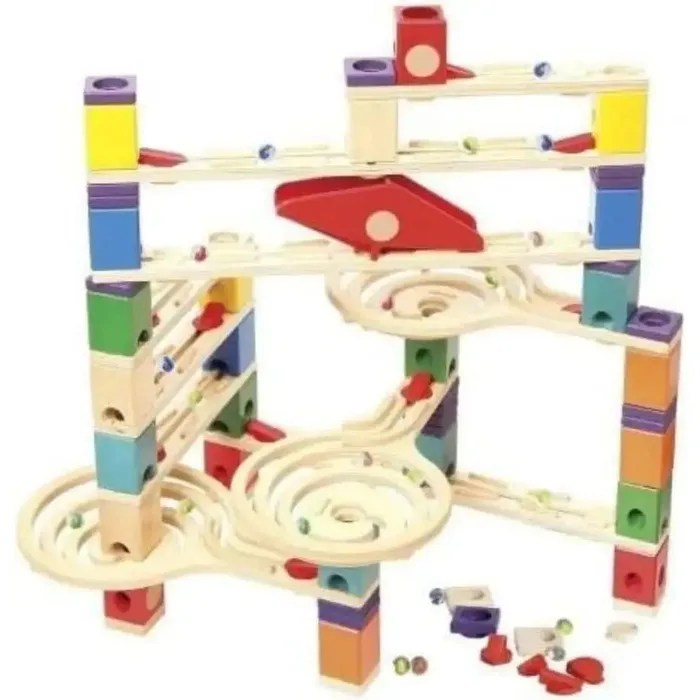
- Buy Hape Quadrilla Vertigo (E6009) A 134-piece wooden set with 50 marbles, three spiral funnels and a seesaw that starts at age 4 and grows through expansion sets. Amazon
- Buy Quercetti Migoga Marble Run (6546) A transparent plastic tube-and-pillar set with 10 marbles that lets kids watch every turn, at the lowest cost of the group.
- Buy Ravensburger GraviTrax Starter Set (22410) A 124-piece system built around magnets, a cannon and interchangeable base tiles, rated for ages 8 and up. Amazon
- It depends Cuboro Standard 32 A Swiss beech wood cube set with 32 elements and 5 glass marbles, aimed at ages 5 and up.
- It depends HABA Kullerbu Spiral 26-Piece Starter Track Set A toddler ball track with large wooden and plastic pieces and 1 3/4 inch balls, made for ages two and up.
- Skip Learning Resources Tumble Trax Magnetic Marble Run (LER2821) A 29-piece headline count that includes 10 activity cards, leaving 14 foam tracks and 4 marbles.
What actually matters
- Age grade - The maker's recommended age. It reflects both safety and how hard the build is, so a higher grade usually means a more complex set.
- Piece count - The total number of items in the box. Read the breakdown, because it may include marbles or cards that are not track.
- Marble count - How many marbles come in the box. More lets several runs go at once and covers lost marbles.
- Material - Wood, plastic or foam. It affects durability, look and whether you can see the marble.
- Expandability - Whether the set connects to add-ons. It decides whether a set becomes a hobby or stays a one-off.
- Compatibility - Which other sets work with it. Some lines say certain older sets do not connect.
- Safety note - The maker's small-parts warning. It tells you who the set is not for.
The specs, in plain English
Green flags vs red flags
Green flags
- A contents list that itemizes every part.
- A stated age grade and a stated marble count.
- A published compatibility note for expansions.
- A named material, such as birch or beech.
- A stated safety standard or warning.
Red flags
- A piece count that includes cards or accessories without saying so.
- No stated age grade.
- A marble count that is missing.
- Claims of compatibility with no named sets.
- No contents list on the maker page.
Who's who: the brands
- Hape - Maker of the Quadrilla wooden marble run system, with an app and expansion sets.
- Ravensburger - Publisher of GraviTrax, a track system with magnetic and tile-based elements.
- Quercetti - Italian maker of Migoga transparent marble runs, including a toddler line.
- Cuboro - Swiss maker of beech wood cube marble runs sold as a growing system.
- HABA - German toy maker whose Kullerbu line is a toddler ball track.
How to read a listing without getting fooled
Start with the age grade, then open the contents list and add up what is actually track, not marbles or cards. Next, find the marble count and the material. Then look for an expansion or compatibility line and the maker's safety warning. If a listing hides any of these, treat that as a sign to check the maker's own page.
How much should you spend?
Marble runs span all three tiers. Small foam and plastic starter sets sit at the budget end, larger wooden and track-system sets are mid-range, and premium wooden cube systems cost the most. A higher tier buys wood, a bigger build or an expansion path, not necessarily more fun for a younger child, so match the tier to age and how long you expect the set to last.
Questions, answered
Do marble runs need batteries?
Most do not. The Hape Vertigo listing says no batteries are required and that it works through gravity and mechanical movement. Check each set's page for any battery mention before buying.
Can a toddler use a marble run?
Only a set made for toddlers. The HABA Kullerbu page rates its larger balls and parts for children from two years of age. Standard marble sets carry small-parts warnings, so follow the maker's age guidance.
Why do some sets have an app?
Hape provides the Quadrilla app with step-by-step instructions for its sets. It is meant as a build guide and does not replace the box instructions.
How do I know a set will grow with my child?
Look for a stated expansion line and a compatibility note. Cuboro describes Extra Sets, Ravensburger describes track packs and add-ons, and Hape says its sets combine with other Quadrilla sets.
Or jump to the head-to-head: Hape Quadrilla Vertigo (E6009) vs Quercetti Migoga Marble Run (6546).