Explained
Kids' Luggage, Explained
After reading, you'll understand how to measure a kids' case against a real airline rule, tell a genuine shell material from a marketing phrase, and read a luggage warranty for what it excludes rather than what it promises.
In this guide
First-time buyers get caught by three things. They buy on the print, so the case ages out before it wears out. They trust the size on the label instead of measuring the case with its wheels, and then meet a gate sizer. And they assume a long warranty means a broken wheel gets fixed, when most policies quietly rule out the two most common causes of failure: airline handling and ordinary wear. None of this is hard to check, but almost none of it is in the headline copy.
The 30-second version
- Wheels and handles count, so measure the case as it sits on the floor, not the body of the shell.
- Empty weight is the real constraint, because capacity is rarely the limit for a small child's clothes.
- A named polymer beats a mood word, and composite, hard plastic and durable shell all name nothing.
- The exclusions are the warranty, so read what is not covered before you read the number of years.
- Ride-on cases have a short window, and the makers themselves usually publish an age range that proves it.
The products this guide is about
Our verdict on each, with the full reasoning on the companion review.
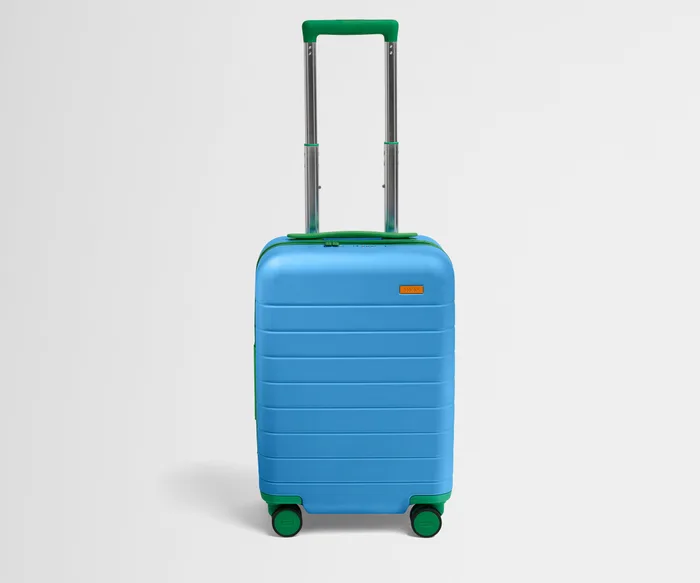
- Buy Away The Kids' Carry-On A properly built kid-sized carry-on that clears every major airline size rule and comes with repair support that covers airline damage.
- Buy JanSport Driver 8 Rolling Backpack A 36 litre wheeled backpack that doubles as a school bag and still fits the overhead bin, backed by a limited lifetime warranty. Amazon
- It depends Stokke JetKids BedBox The ride-on case that folds out into a flat sleeping surface, which is either the best money you will spend on a long-haul flight or an expensive box you push through an airport. Amazon
- Skip Heys Peppa Pig Kids Spinner Luggage (18 inch) A light, cheap character spinner whose shell material is described only as a composite and whose warranty excludes the exact thing that breaks kids' luggage. Amazon
What actually matters
- Exterior dimensions with wheels - Airlines measure the whole object, so a wheel housing or a protruding handle can push a case over an axis limit. Delta states that its 22 by 14 by 9 inch and 45 linear inch limits include handles and wheels.
- Empty weight - This is the number that decides whether a child pulls their own case or you do. Every pound of empty case is a pound of clothes the child is not carrying.
- Shell material - Polycarbonate flexes under impact and returns to shape; ABS is stiffer and cracks sooner at corners. A listing that names neither is telling you something.
- Warranty exclusions - Coverage for manufacturing defects is common and cheap to offer. Coverage for damage caused by an airline is rare, and it is the difference that matters for a case that gets gate-checked.
- Stated age range - Makers of ride-on cases publish one because the product genuinely stops working when the child grows. It is the fastest way to estimate how long you will own the thing.
- Rider weight limit - Any case designed to be sat on should publish a maximum rider weight. If it does not, you have no basis for judging whether it is safe under your child.
- Handle height and adjustment - A trolley handle set for an adult makes a small child walk with their arm raised and the case tipping into their heels. Two-position handles solve this and are worth looking for.
The specs, in plain English
Green flags vs red flags
Green flags
- The listing gives exterior dimensions and says the measurement includes the wheels.
- The shell material is named outright, for example 100 percent polycarbonate, rather than described as a composite.
- Empty weight is published in pounds or kilograms, not just as lightweight.
- A ride-on case states both an age range and a maximum rider weight.
- The warranty page is public, names what is covered, and says clearly whether airline damage is included.
Red flags
- The size is given as an inch number, such as 18 inch, with no three-axis dimensions anywhere on the page.
- The shell is described only as hard plastic, durable ABS-style or a composite with no ratio.
- The maker advertises a case as airline-approved without publishing dimensions you can check against your carrier.
- The warranty headline is a long number of years but the terms exclude normal wear and tear and carrier damage.
- A ride-on or sit-on case gives no rider weight limit at all.
Who's who: the brands
- Away - Direct-to-consumer luggage brand whose kids' carry-on uses a stated 100 percent polycarbonate shell and the same LifetimeCare repair coverage as its adult line.
- Stokke (JetKids by Stokke) - Norwegian nursery brand behind the JetKids BedBox, the ride-on case with a fold-out mattress and a published 35 kilogram rider limit.
- Trunki - The UK maker that created the ride-on kids' case, and one of the few that publishes its own airline acceptance list alongside volume, weight and rider limit.
- JanSport - Backpack maker since 1967 whose wheeled packs carry a limited lifetime warranty on manufacturing defects in the United States and Canada.
- Heys - Toronto luggage maker with a large licensed-character kids' range and two published warranty tiers that both exclude damage caused by airlines.
How to read a listing without getting fooled
Start at the specification block, not the description. Find three numbers separated by an x and check whether the page says the measurement includes wheels; if it does not say, assume it does not and add an inch. Add the three together and compare the total against 45 linear inches, then compare each number individually against 22, 14 and 9 inches, because a case can pass the total and fail an axis. Next find the empty weight and the material. If the material is a phrase rather than a polymer, that is your answer about the price you are paying for the shell. Then leave the product page entirely and open the warranty page, and search it for the words wear, carrier, airline and cosmetic. Whatever those sentences say is the real coverage. Finally, look for a stated age range and, on anything designed to be sat on, a rider weight limit. A listing that gives you all of these is usually a listing from a maker who expects the case to be measured.
How much should you spend?
Budget kids' cases get you a light shell, four wheels and a character print, and that is a fair trade if you have accepted a two- or three-year life and you are not relying on the warranty. Mid-range is where soft wheeled backpacks live, and it is the best value in the category for a child roughly eight and up, because you are buying a bag that works all year rather than one that sits in a cupboard between holidays. Premium buys two things worth having: a named polycarbonate shell and coverage that pays for repairs when travel, rather than the factory, breaks the case. Ride-on cases with an in-flight bed function sit at the premium end too, but you are paying for one specific use case on long-haul flights, so price it against how many of those flights you actually take. The cheapest real mistake is paying premium money for a licensed print on an unnamed shell.
Questions, answered
At what age can a child manage their own suitcase?
Most children can pull a light case on smooth floors from around three or four, but they cannot lift it, get it over a kerb or manage it in a crowd. Realistically a child takes genuine responsibility for their own bag somewhere between six and eight. Empty weight is the deciding factor rather than age, since a four pound case loaded to nine pounds is manageable and a seven pound case loaded to fifteen is not.
Do I have to buy kids' luggage at all, or will a small adult case do?
A small adult carry-on works if the trolley handle adjusts low enough, which is the one thing most adult cases get wrong for a child. A handle fixed at adult height forces a child to walk with a raised arm and the case tips into their heels. Cases with two or more handle positions solve this and are worth seeking out. Otherwise a wheeled backpack sidesteps the problem entirely.
Are hardside or softside cases better for children?
Hardside protects contents and cleans easily, which suits younger children and anything fragile, but it adds weight and cannot be squashed into a full overhead bin. Softside is lighter, more forgiving on capacity, and often converts to a backpack, which matters on stairs and rough ground. For a child under about eight, hardside is usually the better call; for older children, a soft wheeled backpack is generally more useful.
Is it worth registering a kids' case for warranty?
It is, where the maker offers it, because some brands extend coverage only on registration and most require dated proof of purchase for any claim. Keep the receipt, since several policies state explicitly that bank statements are not acceptable evidence. Note too that most kids' luggage warranties are non-transferable and cover only the original owner, so a case bought second-hand or passed to a younger sibling usually has no coverage at all.
Or jump to the head-to-head: Away The Kids' Carry-On vs JanSport Driver 8 Rolling Backpack.