

Baby & Family
The Best Kids' Luggage: 4 Compared (and One to Skip)
We measured four very different kids' cases against published airline carry-on limits, checked what each shell is actually made of, and read every warranty line by line.
The short version
Away's Kids' Carry-On is the best overall: a 100 percent polycarbonate shell, 19.1 by 12.8 by 8.9 inches with wheels, 26 litres, and repair coverage that explicitly includes damage from airline mishandling rather than manufacturing defects alone. The JanSport Driver 8 is the value pick and the one most eight-to-twelve-year-olds will actually use, at 36 litres, 4 pounds 7 ounces, and a limited lifetime warranty. The Stokke JetKids BedBox suits one specific buyer, the family flying long-haul with a two-to-seven-year-old, and it is the only case here that gives a small child a flat surface to sleep on. It is also ABS rather than polycarbonate, weighs 6.6 pounds empty, and stands 15.4 inches tall, which is over the 14 inch axis Delta publishes. Skip the Heys Peppa Pig spinner and its licensed siblings: the shell is described only as polycarbonate composite, there is no TSA lock, and Heys' own warranty tiers exclude damage caused by airlines. Best for: parents who want one case that still works when the child is twelve.
Our picks at a glance
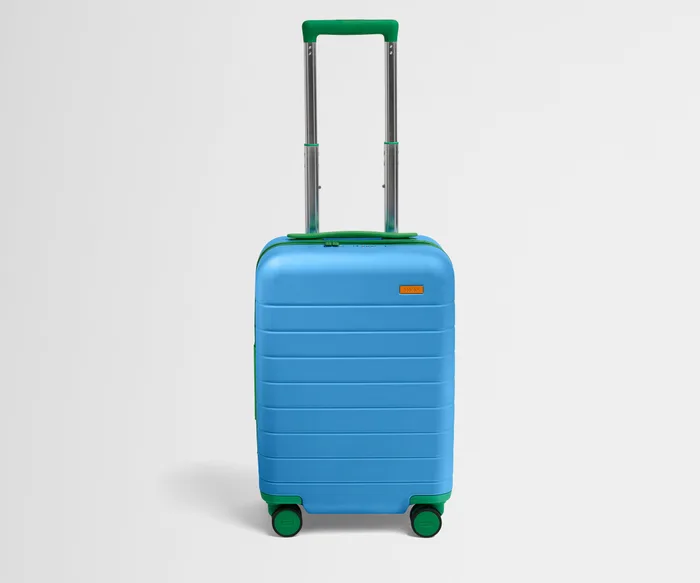
- Away The Kids' Carry-On - Buy. A properly built kid-sized carry-on that clears every major airline size rule and comes with repair support that covers airline damage.
- JanSport Driver 8 Rolling Backpack - Buy. A 36 litre wheeled backpack that doubles as a school bag and still fits the overhead bin, backed by a limited lifetime warranty.
- Stokke JetKids BedBox - It depends. The ride-on case that folds out into a flat sleeping surface, which is either the best money you will spend on a long-haul flight or an expensive box you push through an airport.
- Heys Peppa Pig Kids Spinner Luggage (18 inch) - Skip. A light, cheap character spinner whose shell material is described only as a composite and whose warranty excludes the exact thing that breaks kids' luggage.
The verdict in 30 seconds
What mattered most
- Format
- Exterior size (with wheels)
- Against a 22 x 14 x 9 in limit
- Empty weight
- Stated capacity
- Shell or fabric as stated
Kids' luggage is sold on cartoon prints and ride-on video clips, which is why so much of it disappoints on the second trip. The things that decide whether a case survives are boring: exterior dimensions measured with the wheels, empty weight before anything goes in, what polymer the shell really is, and what the warranty covers in writing. We picked four cases that represent genuinely different formats - a full kid-sized carry-on, a soft wheeled backpack, a ride-on that converts into an in-flight bed, and a licensed-character spinner. Every number below comes off the maker's own spec sheet.
A properly built kid-sized carry-on that clears every major airline size rule and comes with repair support that covers airline damage.
Best for: A family buying one case that has to survive from about age six until the child is a teenager.
- Away states the shell is 100 percent polycarbonate rather than a vague composite.
- At 19.1 by 12.8 by 8.9 inches with the wheels, it sits inside the 22 by 14 by 9 inch limit Delta publishes with room on every axis.
- The trolley handle has two height settings, so a small child rolls it low and an adult can extend it to match a full-size case.
- 6.4 pounds empty is the second heaviest here before you pack anything.
- 26 litres is 10 litres less than the soft JanSport for a lot more money.
- After the first five years, Away describes ongoing repairs as complimentary in Away stores, which is worth less if you do not live near one.
- A TSA combination lock is fine for adults but one more thing a nine-year-old can lock themselves out of.
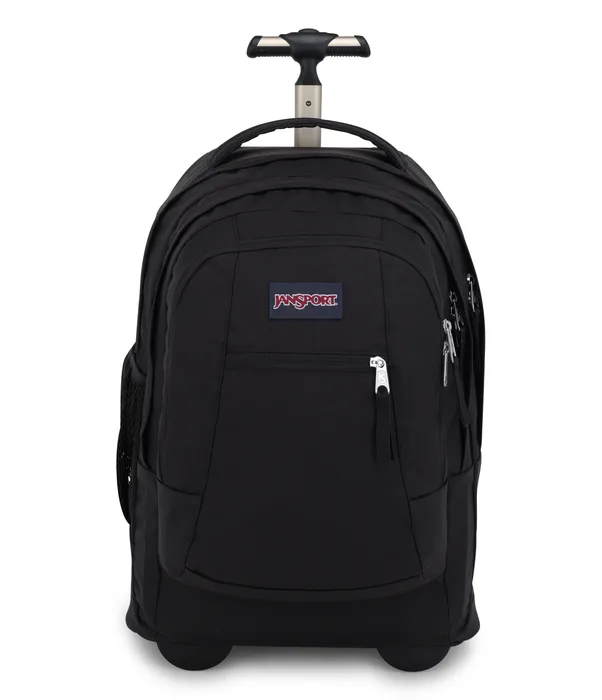
A 36 litre wheeled backpack that doubles as a school bag and still fits the overhead bin, backed by a limited lifetime warranty.
Best for: A child roughly eight and up who wants one bag for school, sleepovers and flights.
- 36 litres in a 20 by 14 by 8 inch body is the most usable space in this group.
- 4 pounds 7 ounces empty, and the shoulder straps tuck away so a child can carry it up stairs when the wheels are useless.
- JanSport warrants it for the lifetime of the product against manufacturing defects in materials and workmanship.
- JanSport states that if a major component such as a handle, wheel or zipper fails through extended use, it may treat the product as having reached the end of its life cycle.
- The warranty is available only in the United States and Canada and only for products bought from authorised dealers.
- A soft 600 denier polyester body offers no crush protection, so anything fragile needs padding.
- At 14 inches wide it sits exactly on the airline limit, so an overstuffed bag can fail a gate sizer.
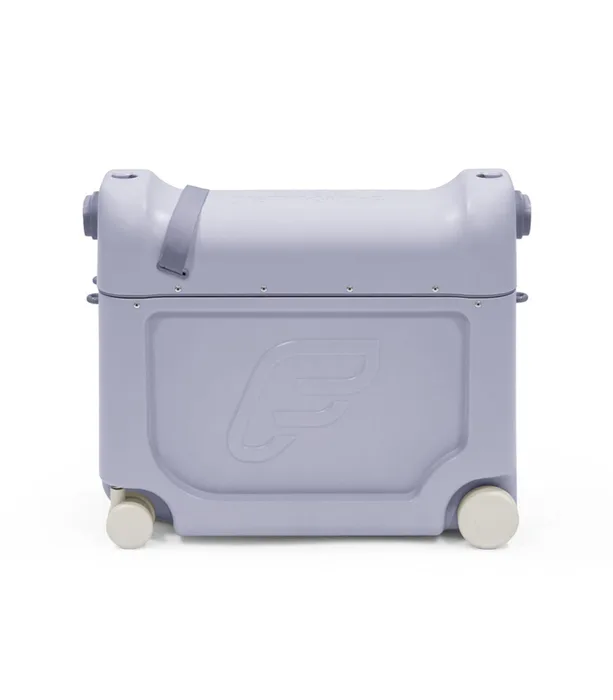
The ride-on case that folds out into a flat sleeping surface, which is either the best money you will spend on a long-haul flight or an expensive box you push through an airport.
Best for: Families flying long-haul with a two- to seven-year-old who cannot sleep sitting upright.
- It is the only case here that turns a window or middle seat into a flat surface a small child can lie on.
- Stokke publishes the numbers you actually need: a 35 kilogram (77 pound) rider limit and a stated 2 to 7 year age range.
- The mattress is machine washable at 86 degrees Fahrenheit and the case ships with the mattress, an adjustable shoulder strap and sticker sheets.
- Stokke lists the materials as ABS and nylon, not polycarbonate, and ABS is the less impact-tolerant of the two.
- 6.6 pounds empty is a lot for a two- or three-year-old to manage before anything is packed.
- It stands 15.4 inches tall, which exceeds the 14 inch individual dimension Delta publishes even though its 41.8 linear inches is inside the 45 inch total.
- The bed function is not a guarantee. It needs the crew's agreement, it depends on your seat, and carry-on items have to be stowed for taxi, take-off and landing.
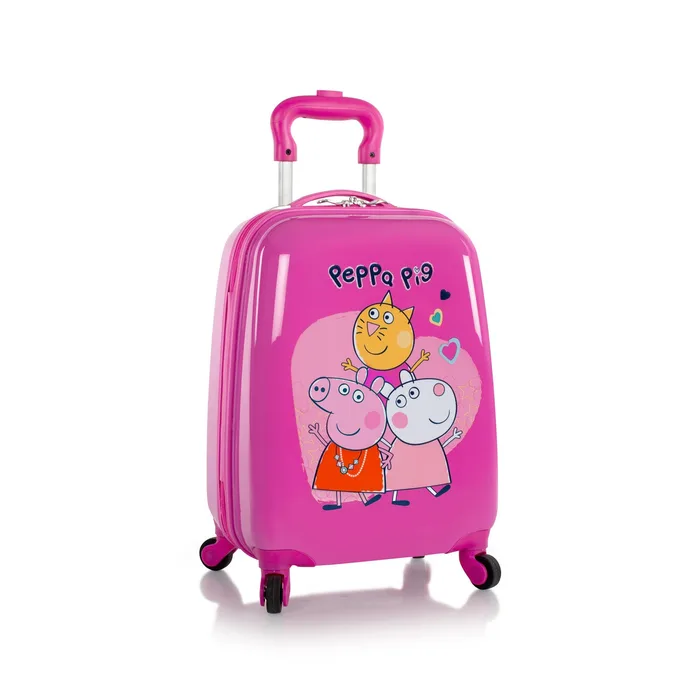
A light, cheap character spinner whose shell material is described only as a composite and whose warranty excludes the exact thing that breaks kids' luggage.
Best for: Almost nobody, unless the child specifically wants the character and you accept it as a two- or three-year purchase.
- 4.1 pounds empty makes it genuinely easy for a small child to handle.
- 18 by 12 by 9 inches including the wheels clears the 22 by 14 by 9 inch rule on every axis.
- You get four spinner wheels, a telescopic handle and 26 litres for budget money.
- Heys describes the shell as polycarbonate composite, which tells you nothing about the blend or how much polycarbonate is in it.
- Heys' published warranty tiers cover defects in workmanship only, exclude normal wear and tear, and state plainly that they do not cover damage caused by public carriers, which is how most kids' cases die.
- The kids' listing does not say which warranty tier applies, and there is no TSA lock.
- You are paying for a character licence with a short shelf life; the case may outlast your child's interest in it by years.
| Criteria | The Kids' Carry-On Top pick | Driver 8 Rolling Backpack | JetKids BedBox | Peppa Pig Kids Spinner Luggage (18 inch) |
|---|---|---|---|---|
| Verdict | Buy it | Buy it | It depends | Skip it |
| Best for | A family buying one case that has to survive from about age six until the child is a teenager. | A child roughly eight and up who wants one bag for school, sleepovers and flights. | Families flying long-haul with a two- to seven-year-old who cannot sleep sitting upright. | Almost nobody, unless the child specifically wants the character and you accept it as a two- or three-year purchase. |
| Price tier | $$$ · premium | $$ · mid-range | $$$ · premium | $ · budget |
| Format | Hardside kid-sized carry-on | Soft wheeled backpack | Ride-on case with in-flight bed | Small hardside spinner |
| Exterior size (with wheels) | 19.1 x 12.8 x 8.9 in | 20 x 14 x 8 in | 18.5 x 7.9 x 15.4 in | 18 x 12 x 9 in |
| Against a 22 x 14 x 9 in limit | Clears it, 40.8 linear in | Clears it, exactly 14 in on one axis | Over on one axis at 15.4 in | Clears it, 39 linear in |
| Empty weight | 6.4 lb | 4 lb 7 oz | 6.6 lb | 4.1 lb |
| Stated capacity | 26 L | 36 L | 20 L plus 3 L lid | 26 L |
| Shell or fabric as stated | 100% polycarbonate | 100% recycled 600D polyester | ABS and nylon | Polycarbonate composite |
| Ride-on rating | Not a ride-on | Not a ride-on | 35 kg (77 lb) rider limit | Not a ride-on |
| Warranty as published | Repair for life; 5 years free repairs plus one replacement, covers airline mishandling | Limited lifetime on defects; wear-out of handle or wheel may end coverage | Extended warranty by product registration; term not stated on the listing | 10-year or 5-year tier, workmanship only, airline damage excluded |
Which one is right for you?
- A family buying one case that has to survive from about age six until the child is a teenager. Buy it Away The Kids' Carry-On
- A child roughly eight and up who wants one bag for school, sleepovers and flights. Buy it JanSport Driver 8 Rolling Backpack
- Families flying long-haul with a two- to seven-year-old who cannot sleep sitting upright. It depends Stokke JetKids BedBox
- Almost nobody, unless the child specifically wants the character and you accept it as a two- or three-year purchase. Skip it Heys Peppa Pig Kids Spinner Luggage (18 inch)
How we judged the field
Five things decide whether a kid’s case is worth owning. First, exterior dimensions measured with the wheels and handle included, because that is how airlines measure and because ride-on cases in particular are often taller than the published limit. Second, empty weight, since a case a child cannot lift is a case a parent carries. Third, what the shell is actually made of, stated as a material and not as a mood: polycarbonate flexes and recovers, ABS cracks sooner, and vague phrases like composite are doing work. Fourth, what the warranty says in writing, because the failure that kills kids’ luggage is a wheel or a handle after a baggage handler has had a go, and a lot of policies exclude exactly that. Fifth, how many years the thing stays useful, which is a function of the maker’s stated age range, the handle height and whether the case is tied to a cartoon.
The field splits into four formats that barely compete with each other. Ride-on and scooter cases sell on the airport walk and age out fast. Small licensed-character spinners are cheap and everywhere. Soft wheeled backpacks are the format an older child will actually pick up. And a proper kid-sized carry-on is the only one that is still a suitcase when the child is twelve. We took one of each: Away’s Kids’ Carry-On, the JanSport Driver 8 rolling backpack, Stokke’s JetKids BedBox, and a Heys licensed spinner as the representative of the category most families default to.
Away The Kids’ Carry-On
Buy itAway’s Kids’ Carry-On is the case that behaves like adult luggage. The shell is stated as 100 percent polycarbonate, not a composite, and the exterior measures 19.1 by 12.8 by 8.9 inches including wheels, which leaves headroom on all three axes against the 22 by 14 by 9 inch rule Delta publishes. It holds 26 litres and weighs 6.4 pounds empty. The detail that earns its keep is the trolley handle with two height settings: a small child rolls it low without the case tipping into their heels, and an adult can extend it to match a full-size case at the gate. It also nests inside Away’s checked suitcases (not the Carry-On sizes) for storage, has a TSA combination lock, and ships with a silicone tag and a drawstring laundry bag. The coverage is the other reason to buy it, and it is unusual: Away’s LifetimeCare pays for repairs to functional damage caused by manufacturing defects or by travel itself, airline mishandling included, with free round-trip shipping. It is the priciest small case here and 6.4 pounds is not light. Buy it for a child who will still be flying in six years.
JanSport Driver 8 Rolling Backpack
Buy itThe JanSport Driver 8 is the one most eight-to-twelve-year-olds will actually use, because it is a school bag that happens to have wheels. It is 20 by 14 by 8 inches, which clears a 22 by 14 by 9 inch sizer, and it holds 36 litres, the most in this group by a wide margin. It weighs 4 pounds 7 ounces empty. The main body is 100 percent recycled 600 denier polyester, with a padded 15 inch laptop sleeve, a front organiser and a side water bottle pocket. The shoulder straps tuck away, which matters more than it sounds: kerbs and stairs are where small wheels give up, and being able to shoulder the bag saves the trip. JanSport warrants it for the lifetime of the product against manufacturing defects, though the policy is explicit that damage from accident, negligence or normal wear is not covered, and that a handle, wheel or zipper failing through extended use may be treated as the end of the product’s life. There is no shell, so nothing fragile should travel unpadded. Buy it for an older child who wants one bag for everything.
Stokke JetKids BedBox
It dependsThe Stokke JetKids BedBox is a genuinely different product, and it is worth being precise about it. It is a ride-on case measuring 18.5 by 7.9 by 15.4 inches, weighing 3 kilograms (6.6 pounds) empty and holding 20 litres in the main case plus 3 litres in the lid. Stokke states a 2 to 7 year age range and a rider limit of 35 kilograms (77 pounds), one of the few ride-on ratings any maker publishes clearly. The lid opens and a mattress folds out to bridge the footwell, giving a small child a flat surface to sleep on in a window or middle seat. On a night flight that can be the difference between a rested child and a wrecked one. The caveats are real. The materials are listed as ABS and nylon, not polycarbonate. At 15.4 inches tall it is over the 14 inch axis Delta publishes, even though 41.8 linear inches is inside the 45 inch total. And the bed depends on the airline, the aircraft and the crew, and cannot be deployed for taxi, take-off or landing. Buy it for long-haul with a small child, not for weekend trips.
Heys Peppa Pig Kids Spinner Luggage (18 inch)
Skip itHeys’ Peppa Pig spinner stands in here for the whole licensed-character category, and the specs are not the problem. It is 18 by 12 by 9 inches including wheels, weighs 4.1 pounds, holds 26 litres, and rolls on four spinner wheels with a telescopic handle. That is a light, correctly sized case for a small child. The problems are what is not said. Heys describes the shell as polycarbonate composite, a phrase that names no ratio and no second polymer, and it is a materially weaker claim than Away’s 100 percent polycarbonate. There is no TSA lock. And the warranty is where it comes apart: Heys publishes a 10 year Executive Class tier and a 5 year Prestige Class tier, both limited to defects in workmanship, both excluding normal wear and tear, and both stating outright that they do not cover damage caused by public carriers. Airline handling is how kids’ cases die. The kids’ listing also does not say which tier applies. Skip it unless the child specifically wants the character and you have priced it as a two- or three-year purchase.
Sources
Specs in this review come from these pages.
- Away - The Kids' Carry-On product page (specifications and features) (awaytravel.com)
- Away - LifetimeCare coverage terms (awaytravel.com)
- Stokke - JetKids BedBox product page (dimensions, materials, rider limit, age range) (stokke.com)
- JanSport - Limited lifetime warranty policy and guidelines (jansport.com)
- Heys - Warranty service tiers and exclusions (us.heys.com)
- Trunki - Airline checklist for ride-on suitcases (trunki.co.uk)
- Delta Air Lines - Carry-on baggage size limits (delta.com)
Away The Kids’ Carry-On vs JanSport Driver 8 Rolling Backpack: which should you buy?
The two buys solve different problems and the deciding factor is the child’s age, not the budget. Away’s Kids’ Carry-On is a real suitcase: a hard polycarbonate shell that protects what is inside, a lock, a two-height handle, and coverage that pays for repairs when an airline crushes a corner. It is 6.4 pounds empty and holds 26 litres. The JanSport Driver 8 is a 36 litre soft bag on wheels that a child can also wear, weighs 4 pounds 7 ounces, and is warranted for the lifetime of the product against manufacturing defects. If you want one item that is still a suitcase in six years and you are willing to carry it up the stairs yourself, Away is the answer.
If your child is roughly eight or older, the JanSport is probably the smarter buy and not just the cheaper one. It holds ten more litres, weighs almost two pounds less, doubles as the school bag so it is not sitting in a cupboard for eleven months of the year, and the tuck-away straps rescue you the moment the wheels meet a kerb. The trade-offs are honest: soft sides give no crush protection, the 14 inch width sits exactly on the airline limit so it must not be overstuffed, and JanSport reserves the right to call a worn-out wheel the end of the product’s life rather than a warranty claim. For a younger child, or for anyone flying often enough that a hard shell earns its weight, pay the premium for the Away.
What to look for
- Measure with the wheels on: airlines including Delta state that handles and wheels count toward the 22 by 14 by 9 inch limit and the 45 linear inch total, so a case advertised as 18 inch can still fail on a second axis.
- Weigh it empty first: a case that is 6 pounds before packing will be 12 or more when loaded, and a five-year-old will hand it to you within a hundred yards.
- Demand a named polymer: 100 percent polycarbonate is a claim; composite, hard plastic and durable shell are not, and the difference shows up as a cracked corner in year two.
- Read the warranty exclusions, not the headline: several makers cover manufacturing defects for years while explicitly excluding damage caused by airlines and normal wear, which is what actually breaks kids’ luggage.
- Check the maker’s own age range and rider limit: a ride-on case should publish both, and if a listing gives you neither you are guessing at whether your child can safely sit on it.
- Buy for the age they will be, not the age they are: licensed prints and 18 litre ride-ons have a two- or three-year window, while a plain carry-on or a wheeled backpack lasts into the teens.
Our final take
Buy the Away Kids’ Carry-On if you want one case that stops being a kids’ product and simply becomes the child’s suitcase, with a stated polycarbonate shell and repair coverage that includes airline mishandling. Buy the JanSport Driver 8 if the child is old enough to wear a backpack, because it holds more, weighs less, and earns its place all year. Buy the Stokke JetKids BedBox only if you are flying long-haul with a two- to seven-year-old, and confirm with your carrier first, because the bed is a permission and not a feature. Skip the licensed character spinner: the shell is unnamed, the lock is absent, and the warranty excludes the one thing most likely to destroy it.
Questions, answered
Will a ride-on suitcase be accepted as carry-on baggage?
Usually, but not always, and the answer is per airline rather than universal. Delta, for example, publishes a hard rule: total dimensions must not exceed 45 linear inches, and no single length, width or height may exceed 22 by 14 by 9 inches, with handles and wheels included in the measurement. The Stokke JetKids BedBox is 18.5 by 7.9 by 15.4 inches, which is 41.8 linear inches and therefore inside the total, but its 15.4 inch height is over the 14 inch axis. Trunki publishes its own airline checklist and lists Icelandair and TAP Air Portugal as not accepting its ride-on cases, with several other carriers accepting them only with caveats or fees. Measure the case yourself with the wheels on, then check your specific carrier before you fly.
Can my child actually use the JetKids BedBox as a bed on the plane?
Stokke markets it as airline-approved ride-on luggage that turns a seat into a bed, but whether you can deploy it in the footwell is the airline's call and it varies by carrier, aircraft and seat position. Practically it works in a window or middle seat, because the case fills the gap in front of the seat and cannot block an aisle. It cannot be set up during taxi, take-off or landing, since carry-on items have to be stowed under a seat or in an enclosed compartment for those phases. Some carriers permit it in cruise without comment and some do not permit it at all. Treat the bed as a bonus you confirm with your airline first, not as the reason you buy it.
Does polycarbonate versus ABS actually matter for a kid's suitcase?
Yes, and it is the spec most likely to be fudged. Polycarbonate flexes under impact and springs back, which is why it tends to survive being dropped or crushed in a bin; ABS is stiffer and cheaper and is more likely to crack at a corner. The problem is that plenty of listings use hedged phrases. Away states 100 percent polycarbonate for the Kids' Carry-On. Stokke states ABS and nylon for the BedBox. Heys states polycarbonate composite for its kids' spinner, which is not the same claim and does not tell you the ratio. If a listing will not name the polymer outright, assume the cheaper answer.
What size case should I buy for a five-year-old?
Smaller than you think, and weigh the empty case before you fall in love with the print. A five-year-old can realistically pull something in the 3 to 5 pound range when it is loaded; a 6.4 pound case that is empty becomes a 12 pound case that a parent ends up carrying. Capacity is rarely the constraint at that age because a five-year-old's clothes are tiny, so 18 to 26 litres is plenty for a week. What matters more is handle height and wheel quality, since a low trolley handle and free-rolling wheels are what let a child manage it without help. If the child is going to hand it off to an adult after fifty yards, buy the lighter case.
Is a Trunki still worth buying, or should we go straight to a real suitcase?
Trunki publishes honest numbers, and they explain the trade-off. The Original holds 18 litres, measures 46 by 20.5 by 31 centimetres, weighs 1.7 kilograms (3.8 pounds), takes a rider up to 50 kilograms (110 pounds) and is recommended for ages 3 to 6. That is a three-year window on a case that holds less than a school backpack. Trunki's five-year guarantee is real but it covers suitcases only, is non-transferable, is valid only in the country of purchase, and excludes accidental damage such as dropping or overloading along with normal wear and tear. If your child is already four or five, a light wheeled backpack or a small carry-on will serve for a decade instead of two summers.
Deciding between the top two? See our head-to-head: Away The Kids' Carry-On vs JanSport Driver 8 Rolling Backpack.
More Baby & Family reviews
 The Best Kids Microscopes: 4 Compared (and One to Skip)
  The Best Kids Night Lights: 4 Compared (and One to Skip)
  The Best Kids Science Kits: 4 Compared (and One to Skip)
  The Best Kids Kick Scooters: 4 Compared (and One to Skip)
  The Best Kids Tablets: 4 Compared (and One to Skip)
  The Best Kids Water Bottles: 4 Compared (and One to Skip)