

Baby & Family
The Best Kids Microscopes: 4 Compared (and One to Skip)
We compared the AmScope M30 starter kit, My First Lab's Duo-Scope and WOW Scope, and a preschool viewer on real magnification, optics and what a kid can actually see.
The short version
The AmScope M30-ABS-KT1 is the buy: a real compound microscope with six magnifications to 1200x, a metal frame and a 48-piece kit for $40. My First Lab's Duo-Scope covers slides and solid objects at up to 400x for $50; their WOW Scope is the it-depends stereo pick for rocks and bugs at $85. Skip the GeoSafari Jr. viewer: 8x is a magnifying glass, not a microscope, and the AmScope costs barely more.
Our picks at a glance
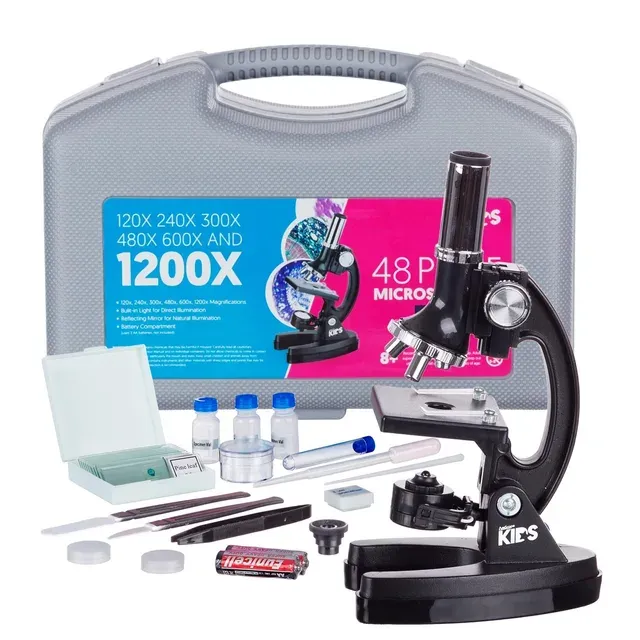
- AmScope M30-ABS-KT1 - Buy. A real compound microscope for $40: metal framework, six magnifications to 1200x, LED illumination and a 48-piece kit.
- My First Lab Duo-Scope Starter Kit - Buy. The dual-purpose kids' scope: 40x, 100x and 400x through coated optics, with top and bottom lights for slides or solid objects.
- My First Lab WOW Scope - It depends. A stereo microscope for 3D objects - 20x and 50x on rocks, bugs, coins and leaves, with no slides required.
- Educational Insights GeoSafari Jr. My First Microscope - Skip. A chunky preschool viewer that tops out at 8x - a magnifying glass in a microscope costume for $30.
The verdict in 30 seconds
What mattered most
- Type
- Magnification
- Optics
- Illumination
- Accessories
- Power
A kids microscope is the gift that can turn a backyard bug into a life interest - if it actually magnifies. The category is full of toys that look like microscopes and resolve like magnifying glasses, alongside real optical instruments that happen to be sized for kids. We compared two genuine scopes, a stereo scope and a preschool viewer that tops out at 8x.
A real compound microscope for $40: metal framework, six magnifications to 1200x, LED illumination and a 48-piece kit.
Best for: Kids 8 and up (and parents) who want a real microscope with room to grow - the kit that turns "what does a cell look like" into a Saturday project.
- Real optics: six magnifications at 120x, 240x, 300x, 480x, 600x and 1200x with a durable metal framework and glass eyepieces.
- Rack-and-pinion focusing and a specimen stage with clips - the same controls a lab scope uses, sized for kids.
- Built-in LED plus a mirror for natural illumination; powered by two AA batteries.
- 48-piece kit with prepared slides, blank slides, cover slips, tweezers, scalpel and specimen vials in a hard case - a complete gift in one box, with a 5-year warranty.
- The 1200x top setting outruns the optics' useful resolution - expect mushy images at the top and clear ones through 600x.
- Plastic head, turret and stage sit on the metal frame - it is a beginner instrument, not a lab scope.
- Single coaxial coarse focus only; no fine-focus knob, which limits precision at higher powers.
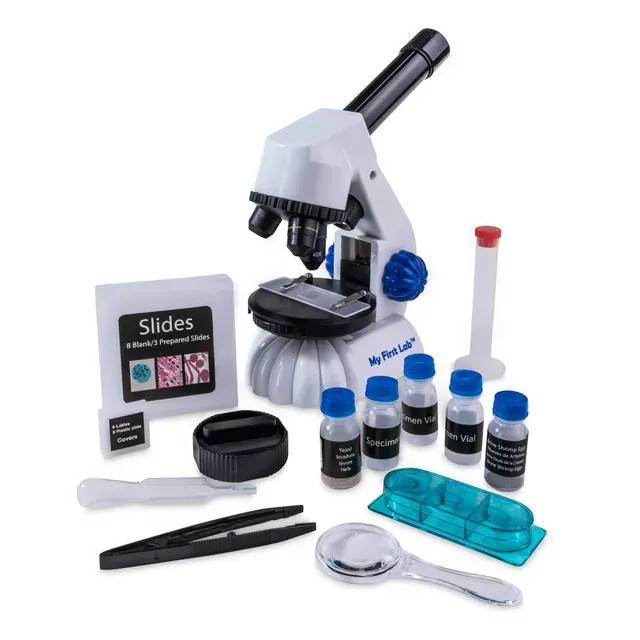
The dual-purpose kids' scope: 40x, 100x and 400x through coated optics, with top and bottom lights for slides or solid objects.
Best for: Kids 6 to 12 who want to look at everything - slides one day, a rock or a coin the next - with lights above and below.
- Lab-grade coated lenses at 40x, 100x and 400x - the useful magnification range for pond water, onion skin and hair.
- Top and bottom LED lights let it work as a compound scope for slides and a dissecting scope for solid objects - two microscopes in one.
- Dual focusing knobs and a compact, durable body built for kids rather than shrunken lab gear.
- Starter kit includes slides and supplies; runs cordless on three AA batteries for tabletop or field use.
- Batteries not included - it needs three AAs before Christmas morning works.
- Tops out at 400x, below the AmScope's nominal 1200x - fine for biology, limiting for tiny specimens.
- $50 with a lighter accessory load than the AmScope's 48-piece kit; extra slide sets cost more.
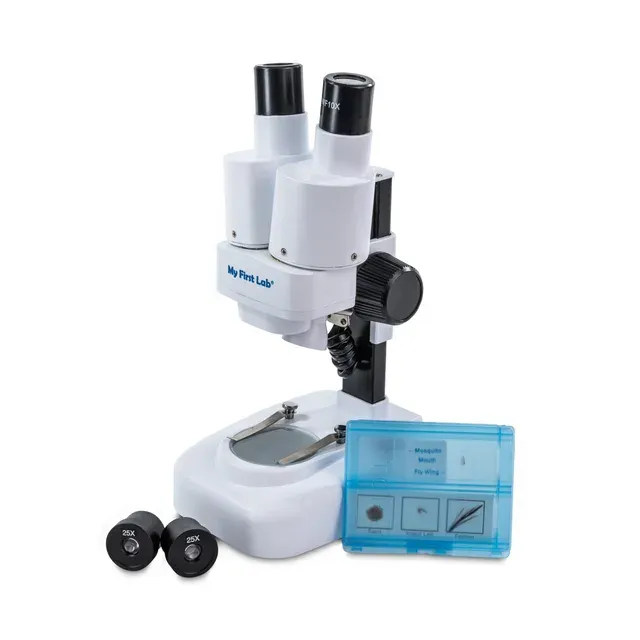
A stereo microscope for 3D objects - 20x and 50x on rocks, bugs, coins and leaves, with no slides required.
Best for: The collector kid - rocks, bugs, coins, shells - who wants to see texture and detail without preparing a single slide.
- True stereo optics: 10x and 25x lab-grade glass eyepieces giving 20x and 50x total magnification with depth perception.
- No slides needed - put a whole insect, rock or coin under it. The lowest-friction way to start.
- Top and bottom LED lights, cordless on two AA batteries, and five specimens included for day-one use.
- Portable design meant for home, classroom or field - the scope a kid carries to the bug, not the other way around.
- $85 is the highest price here and buys less magnification than the cheaper compound scopes.
- 20x to 50x cannot show cells - it reveals surfaces, not microscopic life.
- Two AA batteries not included.
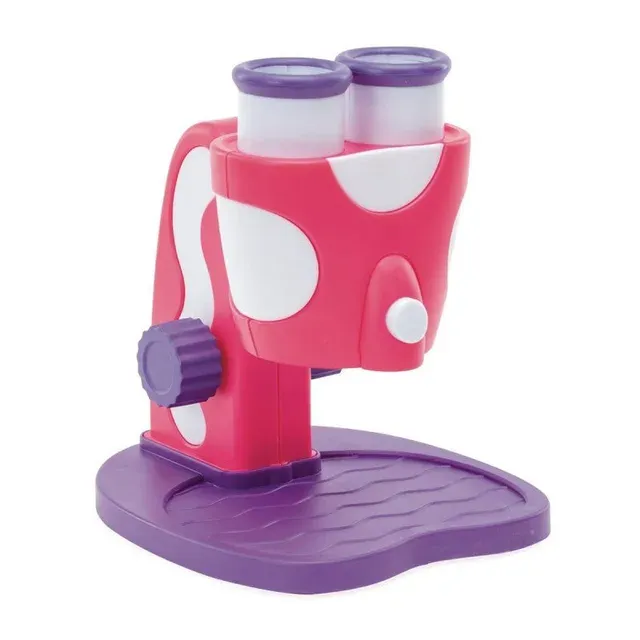
A chunky preschool viewer that tops out at 8x - a magnifying glass in a microscope costume for $30.
Best for: Only for a 3-year-old's very first "science toy." For any kid 5 or older, the AmScope is a real microscope at nearly the same price.
- Chunky, kid-sized focusing knob and two extra-large eyepieces - genuinely usable by a 3-year-old.
- Bright LED with a push-button a toddler can work.
- Solid, drop-tolerant build for the preschool crowd.
- 8x maximum magnification is less than a decent hand lens - it shows things bigger, not smaller worlds.
- Kids outgrow it fast; by 5 or 6 the same $30 buys the AmScope's real optics and room to grow.
- Sold as a microscope but resolves nothing micro - it teaches the posture of science without the view.
- The pink-and-chunky styling locks it to the youngest ages; it's a one-phase toy.
| Criteria | AmScope M30-ABS-KT1 Top pick | My First Lab Duo-Scope Starter Kit | My First Lab WOW Scope | GeoSafari Jr. My First Microscope |
|---|---|---|---|---|
| Verdict | Buy it | Buy it | It depends | Skip it |
| Best for | Kids 8 and up (and parents) who want a real microscope with room to grow - the kit that turns "what does a cell look like" into a Saturday project. | Kids 6 to 12 who want to look at everything - slides one day, a rock or a coin the next - with lights above and below. | The collector kid - rocks, bugs, coins, shells - who wants to see texture and detail without preparing a single slide. | Only for a 3-year-old's very first "science toy." For any kid 5 or older, the AmScope is a real microscope at nearly the same price. |
| Price tier | $ · budget | $$ · mid-range | $$$ · premium | $ · budget |
| Type | Compound (slides) | Compound + dissecting | Stereo (3D objects) | Preschool viewer |
| Magnification | 120x to 1200x | 40x / 100x / 400x | 20x / 50x | 8x max |
| Optics | Glass eyepieces, metal frame | Lab-grade coated lenses | Lab-grade glass eyepieces | Toy lenses |
| Illumination | LED + mirror | Top + bottom LED | Top + bottom LED | Single LED |
| Accessories | 48-pc kit, hard case | Slides + supplies | 5 specimens included | None |
| Power | 2 AA (not incl.) | 3 AA (not incl.) | 2 AA (not incl.) | Batteries for LED |
| Best age | 8 and up | 6 to 12 | 5 and up | 3 to 4 |
| Price class | $40 | $50 | $85 | $30 |
Which one is right for you?
- Kids 8 and up (and parents) who want a real microscope with room to grow - the kit that turns "what does a cell look like" into a Saturday project. Buy it AmScope M30-ABS-KT1
- Kids 6 to 12 who want to look at everything - slides one day, a rock or a coin the next - with lights above and below. Buy it My First Lab Duo-Scope Starter Kit
- The collector kid - rocks, bugs, coins, shells - who wants to see texture and detail without preparing a single slide. It depends My First Lab WOW Scope
- Only for a 3-year-old's very first "science toy." For any kid 5 or older, the AmScope is a real microscope at nearly the same price. Skip it Educational Insights GeoSafari Jr. My First Microscope
How we judged the field
The kids microscope aisle has two kinds of products: real optical instruments shrunk for kids, and toys shaped like microscopes. The difference is optics - real scopes have glass lenses and honest magnification numbers, while toy scopes use plastic lenses that resolve like a hand lens. We compared two genuine compound scopes, a stereo scope for solid objects, and a preschool viewer, on magnification, optics, accessories and what a kid can actually see.
The AmScope M30-ABS is a real compound microscope for $40: a metal framework, glass eyepieces and six magnifications - 120x, 240x, 300x, 480x, 600x and 1200x. It uses the same controls a lab scope does - rack-and-pinion focusing, a specimen stage with clips, built-in LED plus a mirror for natural light - so a kid learns the real tool, not a toy version of it.
The 48-piece kit makes it a complete gift: prepared slides, blank slides, cover slips, tweezers, a scalpel, specimen vials and a hard case, backed by a 5-year warranty. Be honest about the ceiling: 1200x outruns the optics’ useful resolution, so the clear views live through about 600x. For an 8-year-old’s first real scope, nothing here beats it.
The Duo-Scope’s trick is two microscopes in one: top and bottom LED lights let it work as a compound scope for slides and a dissecting scope for solid objects. Lab-grade coated lenses give 40x, 100x and 400x total magnification - the useful range for onion skin, pond water and hair - with dual focusing knobs in a body built for kids.
At $50 it costs more than the AmScope and tops out at 400x, but the dual-view design means a kid who runs out of slides can put a rock or a coin under it instead. It needs three AA batteries (not included). For ages 6 to 12, it’s the most flexible scope here.
The WOW Scope is a stereo microscope - binocular eyepieces for depth perception, built to examine whole 3D objects rather than slides. Lab-grade 10x and 25x glass eyepieces give 20x and 50x magnification; put a bug, a rock or a coin on the stage and look. Top and bottom LEDs, cordless on two AAs, five specimens included, and a portable design meant to travel to the specimen.
Whether $85 is right depends on the kid. A collector of rocks, bugs, coins and shells gets the lowest-friction scope experience there is - no slide prep, instant gratification. But 20x to 50x cannot show a cell; a kid who wants microscopic life needs the compound scopes. For the surface-of-things kid, it’s the best fit here.
The GeoSafari Jr. viewer is built for preschoolers: a chunky focusing knob, two extra-large eyepieces, a push-button LED, a drop-tolerant body. It maxes out at 8x - less than a decent hand magnifier. It shows things bigger, not smaller worlds.
That’s the honest case against it. At $30 it costs within reach of the AmScope, which is a real microscope a kid grows into rather than out of; the GeoSafari is outgrown by about age 5 and teaches the posture of science without the view. For a 3-year-old’s first science toy it has a place - as a “kids microscope” gift for anyone older, it doesn’t.
AmScope M30 vs Duo-Scope: which should you buy?
The AmScope is the better instrument per dollar: real glass optics, more magnifications, a bigger kit and a hard case for $40. The Duo-Scope is the more flexible experience: view slides or whole objects, at $50 with less included.
For a kid 8 or older who will do slide work - pond water, plant cells, prepared specimens - buy the AmScope. For a younger kid or one who wants to put whatever’s in their hand under the lens, the Duo-Scope’s dual lights are worth the extra $10.
What to look for
- Real optics, not toys: glass lenses and honest magnification numbers beat plastic “microscopes” that resolve like a magnifier.
- Compound vs stereo: compound scopes show cells and slide specimens at 100x+; stereo scopes show the surface of whole objects at 20x-50x. Buy for what the kid wants to see.
- Slides in the box: a scope with no prepared slides won’t get used on day one. Kits matter.
- Useful magnification is not the top number: on budget scopes, clear views end around 400x-600x; the 1200x label is headroom.
- Power: every option here runs on AA batteries not included - pack them in the gift.
- Age match: under 5, a magnifier beats a fake microscope; 6+ wants dual-purpose; 8+ can handle a real compound scope.
Our final take
The AmScope M30-ABS-KT1 is the kids microscope to buy: real optics, real controls, a 48-piece kit and a 5-year warranty for $40. The My First Lab Duo-Scope earns its $50 by viewing slides and solid objects alike. The WOW Scope is the it-depends stereo pick for the collector kid who wants to look at rocks and bugs at $85. Skip the GeoSafari Jr. viewer - at 8x it’s a magnifying glass dressed as a microscope, and the AmScope is right there at nearly the same price. Buy the real optics, and the backyard becomes a lab.
Questions, answered
What age is a kids microscope good for?
Real compound scopes work from about age 7 or 8 up, when a kid can handle slides and focus knobs. Stereo scopes like the WOW Scope work younger - no slides needed, just objects. Preschoolers are better served by a hand magnifier than a toy that calls itself a microscope but can't resolve anything.
What's the difference between a compound and a stereo microscope?
A compound microscope shines light through a thin specimen on a slide to show cells and tiny structures at high power (100x to 1200x). A stereo scope looks at the surface of a whole object - a bug, a coin, a leaf - at low power (20x to 50x) with depth. Kids who want pond water want compound; kids who want rocks and insects want stereo.
Is 1200x magnification on a kids scope real?
The lenses reach 1200x, but useful resolution runs out around 400x to 600x on a $40 scope - beyond that you're magnifying blur. Treat the top number as headroom, not the working spec; the mid-range magnifications are where the clear views live.
Do kids microscopes need prepared slides?
They help enormously on day one - a scope with no slides is a scope that stays in the box. The AmScope kit includes prepared slides plus blanks for making your own. Stereo scopes skip this entirely by examining whole objects.
Toy-store microscope or a real brand?
Buy the real brand. AmScope and My First Lab sell actual optical instruments downsized for kids, with glass optics and honest magnification. The $20-30 toy versions use plastic lenses that resolve like a magnifying glass - the kid sees a blurry blob and loses interest, which is the worst outcome a science gift can have.
Deciding between the top two? See our head-to-head: AmScope M30-ABS-KT1 vs My First Lab Duo-Scope Starter Kit.
More Baby & Family reviews
 The Best Kids Night Lights: 4 Compared (and One to Skip)
  The Best Kids Science Kits: 4 Compared (and One to Skip)
  The Best Kids Kick Scooters: 4 Compared (and One to Skip)
  The Best Kids Tablets: 4 Compared (and One to Skip)
  The Best Kids Water Bottles: 4 Compared (and One to Skip)
  The Best Magnetic Tiles: 4 Compared (and One to Skip)