Explained
Keycaps, Explained
After reading, you'll understand what the plastic and the legend method actually change, why profiles feel different, and how to check in two minutes whether a set will fit your keyboard.
In this guide
Most first-time keycap buyers pick on looks, order, and then discover that the spacebar is the wrong length or the right shift does not exist in the box. The vocabulary is the barrier: sets are described in units, profiles and moulding processes, and almost none of it is explained on the listing. The good news is that three ideas cover nearly all of it, and once you have them, a keycap listing becomes readable in about thirty seconds.
The 30-second version
- The legend method decides longevity, because double-shot and dye-sublimation put the letter inside the plastic while pad printing, UV printing and laser marking sit on top of it.
- PBT resists shine and ABS develops it, but a thick, well-made double-shot ABS set beats a thin PBT one, so the plastic alone is not the verdict.
- Profile is height and row shaping, and the practical split is between sculptured sets where each row is angled differently and non-sculptured sets where every row is identical.
- Kitting is where money gets wasted, because a set that omits your spacebar width or your right shift width leaves holes in the keyboard you cannot fill.
- The stem has to match, since Cherry MX cross stems are the common standard and low-profile switches need keycaps made specifically for them.
The products this guide is about
Our verdict on each, with the full reasoning on the companion review.
- Buy Keychron Cherry Profile Double-Shot PBT Full Set Keycaps (Black on White) A 218-key double-shot PBT set that covers more layouts than almost anything else at this price, with a published 1.5 mm wall thickness. Amazon
- Buy Glorious GPBT Backlit Keycaps The cheap way to get double-shot PBT and shine-through legends in the same set, which is a combination most budget caps do not manage. Amazon
- It depends Signature Plastics DSA Granite Dye-sublimated PBT in a uniform profile, made to order in the US, and sold as a pile of separate kits you have to assemble yourself.
- Skip Razer Phantom Keycap Upgrade Set ABS pudding caps with laser-marked legends from a brand that sells a double-shot PBT set alongside them.
What actually matters
- Double-shot - Two plastics are moulded together so the legend is a physical part of the cap that runs down through it. GMK, which makes many of the reference sets, lists two-shot moulding as a labelling option, and it is the most durable of the common legend methods.
- Dye-sublimation - Dye is diffused into the surface of the plastic rather than laid on top of it, which makes it very hard to wear off. Because dye can only darken the cap it goes into, it cannot produce a light legend on a dark cap or a translucent one for backlighting.
- Pad printing, UV printing and laser marking - All three put the legend onto a finished cap. GMK lists pad printing and laser marking alongside two-shot moulding as legend options, and they are cheaper, but a surface layer is a surface layer and fingers eventually take it off.
- PBT - A crystalline plastic that RTP Company describes as having excellent resistance to a broad range of chemicals at room temperature, including oils, fats and alcohols. That resistance is why PBT keeps its texture and resists the polished look that develops on heavily used caps.
- ABS - An amorphous plastic without PBT's chemical resistance. It takes fine detail and colour beautifully, which is why premium double-shot sets are still made from it, but it is the plastic that goes shiny under sustained finger contact.
- Profile - The height and shape of the caps. Signature Plastics classes its families by ride height, by whether the side profile is sculptured or non-sculptured, and by whether the top is spherical, cylindrical or flat, which is a cleaner way to think about it than brand names.
- Kitting - Which specific key sizes are in the box. This is the difference between a set that populates your keyboard and a set that populates most of it, and it is the one thing worth checking before you look at anything else.
The specs, in plain English
Green flags vs red flags
Green flags
- The listing names the legend method explicitly as double-shot or dye-sublimated.
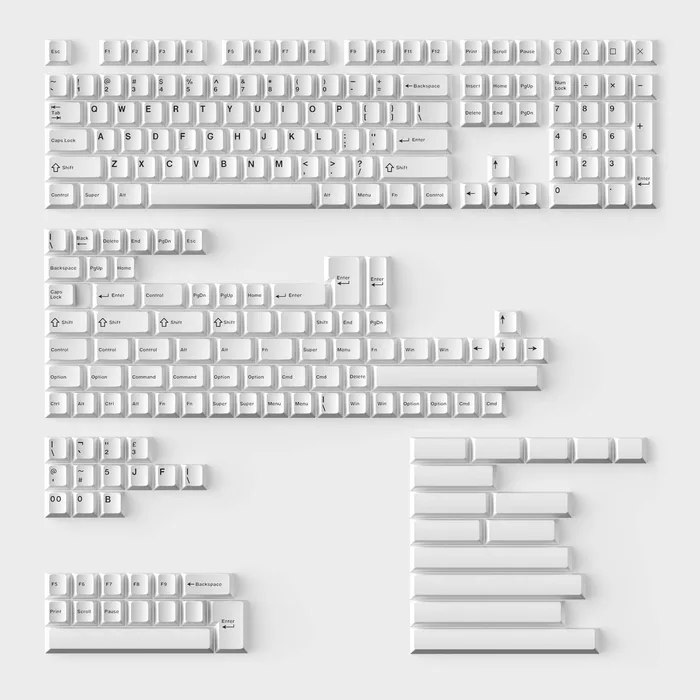
- There is a kit diagram showing every key with its width labelled in units.
- The spec table gives material, profile, stem and key count rather than adjectives.
- The set includes more than one spacebar width and more than one right shift width.
- ISO and ANSI options are both offered, which usually indicates a properly tooled set.
Red flags
- The printing method is described only as fade-resistant or long-lasting with no process named.
- No profile and no stem type appear anywhere on the product page.
- Compatibility is limited to boards with a standard bottom row and your board does not have one.
- The set is sold as a small accent kit of a handful of keys but presented as an upgrade.
- Photos show only mounted renders and never a flat-lay of the actual kit contents.
Who's who: the brands
- GMK - German maker of the reference double-shot sets, listing two-shot moulding, pad printing and laser marking as its labelling options.
- Signature Plastics - US manufacturer behind the SA, DSA, DCS and DSS profile families, which publishes full technical drawings for each including row angles and available key sizes.
- Keychron - Keyboard brand whose keycap listings publish material, profile, thickness, stem, legend behaviour and layout coverage, which is unusually complete for the price.
- Glorious - Gaming brand with a spec-table habit, best known for affordable double-shot PBT sets in OEM profile including shine-through versions.
- Akko - High-volume maker offering a wide range of profiles and colourways in one-box sets.
How to read a listing without getting fooled
Work through a listing in a fixed order and it stops being confusing. First find the legend method: you want the words double-shot or dye-sublimated, and if the page only says the legends are durable, assume they are printed. Second find the material, remembering that PBT resists shine while thick double-shot ABS is still excellent. Third find the profile and decide whether you want sculptured rows or one uniform shape. Fourth, and most importantly, find the kit contents or the kitting diagram and check three specific things against your own keyboard: the spacebar width, the right shift width, and whether your Enter key is the ANSI rectangle or the ISO L. Fifth, confirm the stem is MX style unless you own a low-profile board, in which case you need caps sold for that board specifically. If any of those five answers is missing from the page, that absence is itself information.
How much should you spend?
Budget sets buy you a complete one-box kit, usually in OEM or Cherry profile, and increasingly with double-shot PBT rather than printed legends, which is a genuine improvement on where this category was a few years ago. Mid-range money buys wider layout coverage, published wall thickness, and kits that include the awkward spacebar and shift widths rather than just the standard ones. Premium sets are mostly enthusiast group-buy and made-to-order products where you are paying for tighter tolerances, a specific profile family, and the ability to specify exactly which kits you want. Spending more does not automatically buy durability, because a budget double-shot set and a premium double-shot set both keep their legends for years. What extra money reliably buys is fit, finish and the freedom to cover an unusual layout.
Questions, answered
How do I work out what 1u means on my own keyboard?
Look at any letter key: that is 1u. Every other key is described relative to it, so a 1.75u Caps Lock is one and three quarter letter keys wide and a 6.25u spacebar is six and a quarter. Hold a ruler across your bottom row and compare the spacebar to the letters above it. That one measurement answers the question that causes most keycap returns.
Will keycaps from a normal keyboard fit a low-profile one?
No. Keychron states that its low-profile boards use a different stem and need low-profile keycaps that are not interchangeable with regular MX-compatible profiles. Low-profile caps are also much thinner and shorter to keep the overall height down. Check which family your keyboard belongs to before you shop, because the two ranges are not cross-compatible in either direction.
Do thicker keycaps really change the sound?
Manufacturers certainly treat it as a selling point: Keychron publishes a 1.5 mm wall figure and calls the thickened caps comfortable to type on. Thicker plastic has more mass and less air behind it, so the change is real, though it is smaller than the change from swapping switches or adding foam.
What if my keyboard needs a stepped Caps Lock or an ISO Enter?
Then you have to buy a set that says so, because neither is included by default. Signature Plastics lists stepped keys as a separate category on its family drawings and sells ISO and UK kits separately from the main modifier kits. Mainstream one-box sets vary: some include both an ANSI and an ISO Enter, some are ANSI only. If your Enter key is tall and L-shaped, search the listing for the word ISO before anything else.
Or jump to the head-to-head: Keychron Cherry Profile Double-Shot PBT Full Set Keycaps (Black on White) vs Glorious GPBT Backlit Keycaps.