

Office
The Best Keycap Sets: 4 Compared (and One to Skip)
We compared four mechanical keyboard keycap sets on the three things that actually decide whether you are happy in a year: the plastic, how the legends are made, and whether the kit includes the modifier sizes your board needs.
The short version
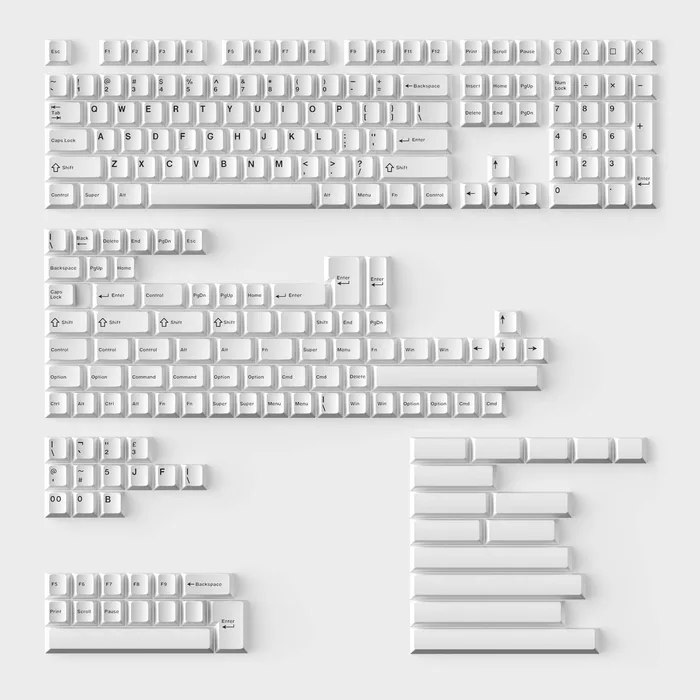
Keychron's Cherry Profile Double-Shot PBT Full Set is the pick for most people, because 218 keys covers HHKB, WKL, ANSI and ISO-UK layouts and the legends are moulded through the cap rather than printed on it. If you want RGB to shine through the letters, the Glorious GPBT Backlit set is the value answer: double-shot PBT with translucent legends, though Glorious only promises a fit on boards with a standard bottom row. Signature Plastics DSA Granite is the one for a specific kind of buyer, made to order in the US in a uniform profile with every row the same shape, sold as separate kits you assemble yourself. Skip the Razer Phantom Keycap Upgrade Set: it is ABS with laser-marked legends rather than moulded ones, Razer's listing did not state the profile or the stem, and the company's own PBT set is double-shot. Before you buy anything, look at your bottom row and count the spacebar. Best for: anyone who wants keycaps that still read clearly and fit properly after a year of daily typing.
Our picks at a glance
- Keychron Cherry Profile Double-Shot PBT Full Set Keycaps (Black on White) - Buy. A 218-key double-shot PBT set that covers more layouts than almost anything else at this price, with a published 1.5 mm wall thickness.
- Glorious GPBT Backlit Keycaps - Buy. The cheap way to get double-shot PBT and shine-through legends in the same set, which is a combination most budget caps do not manage.
- Signature Plastics DSA Granite - It depends. Dye-sublimated PBT in a uniform profile, made to order in the US, and sold as a pile of separate kits you have to assemble yourself.
- Razer Phantom Keycap Upgrade Set - Skip. ABS pudding caps with laser-marked legends from a brand that sells a double-shot PBT set alongside them.
The verdict in 30 seconds
What mattered most
- Plastic
- Legend method
- Profile and row shape
- Stem
- Published wall thickness
- Backlight shine-through
Keycaps are the one keyboard upgrade you touch every second you type, and the one most likely to arrive and not fit. The specs that matter are unglamorous: what plastic the caps are moulded from, how the letters got onto them, and which key widths are in the box. Get the third one wrong and you own a beautiful set with a spacebar that will not seat. We looked at four sets that are on sale now, read the makers' own spec tables and kit diagrams, and picked on evidence rather than colourway.
A 218-key double-shot PBT set that covers more layouts than almost anything else at this price, with a published 1.5 mm wall thickness.
Best for: Someone who wants one box to cover a compact board now and a full-size board later without a second order.
- Double-shot PBT, so the legend is a second piece of plastic moulded through the cap rather than a coating.
- Keychron lists compatibility with HHKB, WKL, 60, 65, 70, 75, 80, 96 and 100 percent layouts, ANSI and ISO-UK.
- The spec table publishes material, Cherry profile, 1.5 mm thickness, MX style stem and key count, which most brands leave blank.
- Keychron states the backlight does not shine through, so this is the wrong set for an RGB build.
- Keychron warns of minor interference with north-facing LED keyboards.
- One colourway per listing, so you are buying a look as much as a set.
- 218 keys means a lot of spares you will never fit, which is the price of the wide layout coverage.
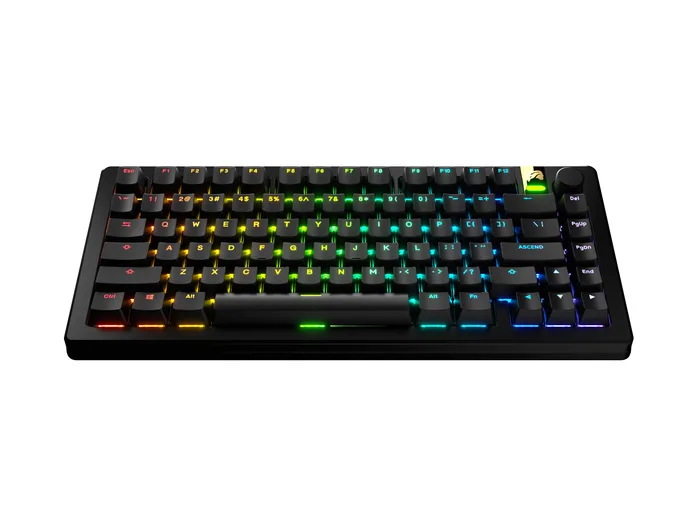
The cheap way to get double-shot PBT and shine-through legends in the same set, which is a combination most budget caps do not manage.
Best for: An RGB build where you want the lighting to come through the letters and you are not paying enthusiast money for it.
- Glorious lists the legends as Doubleshot on PBT, so the translucent letters are moulded in rather than printed.
- 130 keys (131 for ISO) covering ANSI and ISO layouts, with both macOS and Windows modifiers in the box.
- The spec table names the profile (OEM) and the stem (MX-style cross), which makes the fit question answerable before you order.
- Glorious only promises a fit on its own boards and on boards with a standard bottom row, so a 7u spacebar layout is not promised.
- Wall thickness is not published anywhere on the page.
- One year warranty.
- OEM profile only, so check that you want that shape.
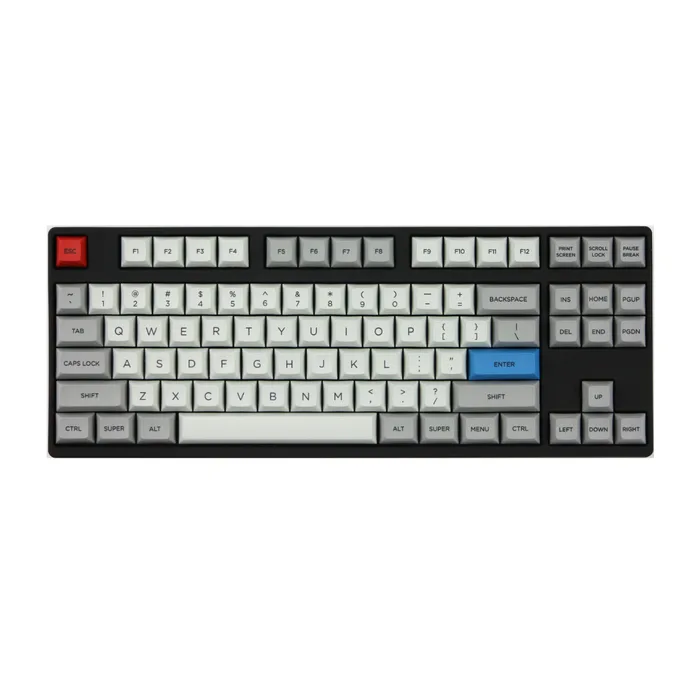
Dye-sublimated PBT in a uniform profile, made to order in the US, and sold as a pile of separate kits you have to assemble yourself.
Best for: A custom or ortholinear build where you want to specify exactly which keys you get and you actively prefer one flat row shape.
- Dye-sublimated legends are diffused into the plastic rather than sitting on top of it, so there is no printed layer to rub off.
- DSA is non-sculptured: Signature Plastics' own family drawing gives every row the same zero degree top angle, which suits ortholinear and unusual layouts.
- Kits exist for ANSI, ISO, UK, Apple, Windows, Ergo, numpad, homing and secondary legends, so odd boards can be covered exactly.
- The alphas and the modifiers are separate purchases, so an Alphas kit on its own will not populate a keyboard.
- Signature Plastics states sublimated sets are printed on demand and will not ship same day.
- A uniform profile removes the row-to-row shaping most touch typists have spent years learning.
- Dye-sublimation cannot put a light legend on a dark cap, so the palette is limited by the process.
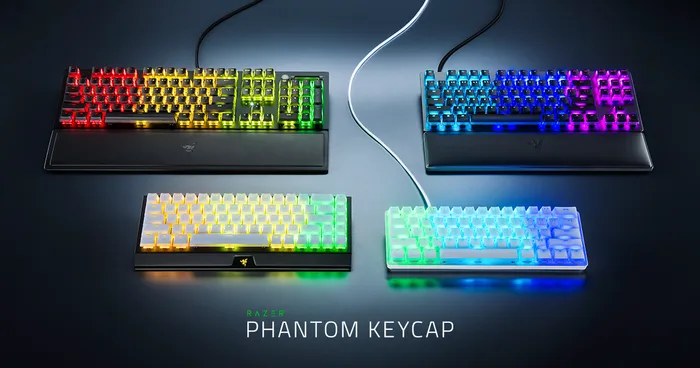
ABS pudding caps with laser-marked legends from a brand that sells a double-shot PBT set alongside them.
Best for: Almost nobody outside a Razer BlackWidow build who specifically wants the legendless pudding look.
- Listed as covering US ANSI and UK ISO keys, legacy Razer bottom row keys and keys for a 65 percent board.
- The blacked-out legendless tops genuinely do look clean with the lighting off.
- Stabilisers for a full-size board are included in the package.
- Razer listed the material as ABS, while its PBT set is PBT, and ABS is the plastic that polishes up under finger oils.
- The legends are laser marked rather than moulded through, and Razer's own copy concedes that lasered legends are susceptible to wearing off before claiming its underside process avoids that.
- Razer's listing did not state the profile or the stem type, so you cannot check fit from the spec sheet.
- Razer says the set works best on its own boards with transparent switch housings, and tells non-Razer owners to check the supplied stabilisers themselves.
Amazon had no buyable listing for this when we last checked. The link still works if it returns.
Check price on Amazon Read our detailed assessment| Criteria | Cherry Profile Double-Shot PBT Full Set Keycaps (Black on White) Top pick | GPBT Backlit Keycaps | DSA Granite | Phantom Keycap Upgrade Set |
|---|---|---|---|---|
| Verdict | Buy it | Buy it | It depends | Skip it |
| Best for | Someone who wants one box to cover a compact board now and a full-size board later without a second order. | An RGB build where you want the lighting to come through the letters and you are not paying enthusiast money for it. | A custom or ortholinear build where you want to specify exactly which keys you get and you actively prefer one flat row shape. | Almost nobody outside a Razer BlackWidow build who specifically wants the legendless pudding look. |
| Price tier | $$ · mid-range | $ · budget | $$$ · premium | $$ · mid-range |
| Plastic | Double-shot PBT | PBT | PBT | ABS |
| Legend method | Double-shot, moulded through | Double-shot, moulded through | Dye-sublimated into the cap | Laser marked from the underside |
| Profile and row shape | Cherry, sculpted rows | OEM, sculpted rows | DSA, uniform rows | Not published |
| Stem | MX style | MX-style cross | Cherry MX | Not published |
| Published wall thickness | 1.5 mm | Not published | Not published | Not published |
| Backlight shine-through | No, maker states so | Yes, translucent legends | Not offered | Yes, pudding style |
| Layout coverage as stated | HHKB, WKL, 60 to 100 percent, ANSI and ISO-UK | Standard bottom rows, ANSI and ISO | Separate kits for ANSI, ISO, UK, Apple, Windows, Ergo, numpad | ANSI, UK ISO, legacy Razer bottom row and 65 percent keys |
| How it is sold | One 218-key box | One 130-key box, 131 for ISO | Kit by kit, made to order | One box |
Which one is right for you?
- Someone who wants one box to cover a compact board now and a full-size board later without a second order. Buy it Keychron Cherry Profile Double-Shot PBT Full Set Keycaps (Black on White)
- An RGB build where you want the lighting to come through the letters and you are not paying enthusiast money for it. Buy it Glorious GPBT Backlit Keycaps
- A custom or ortholinear build where you want to specify exactly which keys you get and you actively prefer one flat row shape. It depends Signature Plastics DSA Granite
- Almost nobody outside a Razer BlackWidow build who specifically wants the legendless pudding look. Skip it Razer Phantom Keycap Upgrade Set
How we judged the field
Five things decide whether a keycap set is worth owning. The plastic comes first, because PBT and ABS age differently: RTP Company describes PBT as a crystalline polymer with excellent resistance to a broad range of chemicals at room temperature, including oils, fats and alcohols. ABS lacks that resistance, which is the usual explanation for the shine that develops on well-used ABS caps. Second is how the legends were made, because that is what decides whether your letters are still there in two years. Third is the profile, meaning the height of the caps and whether each row is shaped differently. Fourth, and the one that actually costs people money, is kitting: whether the box contains the specific key widths your keyboard’s bottom row and right shift need. Fifth is the stem, because a cross stem set will not go anywhere near a low-profile board.
The field splits cleanly. On one side are one-box sets from keyboard brands, where you pay a fair price and everything arrives together, and the only question is how many layouts the kit covers. On the other are enthusiast sets sold kit by kit, where you can cover any layout you like but you have to know what you are doing and buy three or four things. We picked one strong example of each, added the cheap route to double-shot legends that still glow for RGB builds, and included one widely sold set that fails on the legend method to show what the failure looks like. Every spec quoted here came off the manufacturer’s own page or its own technical drawing.
Keychron Cherry Profile Double-Shot PBT Full Set Keycaps (Black on White)
Buy itKeychron’s Cherry Profile Double-Shot PBT Full Set is the most completely documented keycap set we looked at, which matters more than it sounds. The spec table names the material as double-shot PBT, the profile as Cherry, the wall thickness as 1.5 mm, the stem as MX style and the count as 218 keys, and Keychron states the set covers HHKB, WKL, 60, 65, 70, 75, 80, 96 and 100 percent layouts in both ANSI and ISO-UK. That HHKB and WKL line is the important one, because those are exactly the bottom rows that trip up cheaper sets. Double-shot means the legend is a second shot of plastic moulded through the cap, so there is nothing on the surface to wear away. The trade-off is spelled out on the same page: the backlight does not shine through, and Keychron warns of minor interference with north-facing LED keyboards. If you type more than you look at your RGB, that is a trade worth making. If you bought the board for the lighting, buy something else.
Glorious GPBT Backlit Keycaps
Buy itGlorious GPBT Backlit exists to solve one problem cheaply: getting double-shot legends that light up. Glorious lists the material as PBT and the legends as Doubleshot with RGB legend lighting, which means the translucent letters are moulded in rather than printed on, and that is genuinely rare at this price. The spec table also names the profile as OEM and the stem as MX-style cross, so you can check fit before ordering, and the box holds 130 keys, or 131 for ISO, with both macOS and Windows modifiers. The catch is written into the compatibility line: Glorious promises a fit on its own GMMK boards and on mechanical keyboards with standard bottom rows. Glorious does not define standard, but it usually means a 6.25u spacebar with 1.25u modifiers, so a board built around a 7u bottom row is not promised a fit. Wall thickness is not published and the warranty is one year. For a mainstream gaming board with RGB you want to actually see, it is the sensible answer.
Signature Plastics DSA Granite
It dependsSignature Plastics DSA Granite is a different kind of product and needs a different kind of buyer. It is dye-sublimated PBT, meaning the legends are diffused into the plastic rather than sitting on it, and the profile is DSA, which the company’s own family drawing describes as medium profile, spherical top, non-sculptured, with every row given the same zero degree top angle. Compare that to the same company’s DCS drawing, where the rows run at minus six, minus one, three, seven and sixteen degrees, and you can see exactly what uniform means. It suits ortholinear boards, split boards and anyone who genuinely prefers one flat shape. It will feel wrong if you rely on row shaping to find keys. The bigger commitment is how it is sold: alphas, TKL modifiers, pro modifiers, numpad, ISO, UK, Apple, Windows and ergo kits are all separate purchases, and Signature Plastics states sublimated sets are printed on demand and will not ship same day. Powerful, but you have to know your layout.
Razer Phantom Keycap Upgrade Set
Skip itThe Razer Phantom Keycap Upgrade Set is the one we would leave on the shelf, and Razer’s own pages explain why. Razer listed the Phantom caps as ABS while its other set is PBT, so this is the plastic that polishes to a shine under finger oils. The legends are laser marked, not moulded: Razer’s own marketing copy says that legends lasered from the top are susceptible to wearing off through constant use, then claims its own underside process avoids that. It may well be more durable than a top laser, but it is still a marking process on a finished cap rather than a second plastic moulded through it. Razer’s listing did not state the profile or the stem type, so you cannot check fit from the spec sheet. Razer also says the set works best on its own boards with transparent switch housings, and tells owners of other keyboards to confirm the supplied stabilisers fit. If you want the pudding look, Razer’s own double-shot PBT set answers the same brief better.
Sources
Specs in this review come from these pages.
- Signature Plastics - Keycap Family Specs (spkeyboards.com)
- Signature Plastics - DSA Family drawing (PDF) (pimpmykeyboard.com)
- Signature Plastics - DCS Family drawing (PDF) (pimpmykeyboard.com)
- GMK electronic design - Keycaps (gmk.net)
- Keychron - Are Keycaps Universal? Compatibility Guide (keychron.com)
- RTP Company - Polybutylene Terephthalate (PBT) product guide (rtpcompany.com)
Keychron Cherry Profile Double-Shot PBT Full Set Keycaps (Black on White) vs Glorious GPBT Backlit Keycaps: which should you buy?
The choice between the Keychron and the Glorious set comes down to one question: do you need light coming through the letters? Keychron states outright that its backlight does not shine through, and that is a deliberate design decision, not an oversight. In exchange you get 1.5 mm walls, a published Cherry profile, and a 218-key kit that Keychron says covers HHKB and WKL bottom rows as well as the standard ones, in ANSI and ISO-UK. That is the set that fits whatever board you buy next. Glorious gives you translucent double-shot legends on PBT for less money, but caps the promise at standard bottom rows and does not publish a thickness figure.
The secondary question is profile. Keychron’s Cherry profile sits lower than the OEM shape Glorious uses, which is the profile most prebuilt boards ship with. If your fingers are already trained on a stock gaming keyboard, the Glorious set will feel like nothing changed and the Keychron will feel slightly flatter for a week. Neither is better. If you are still deciding, go and look at your bottom row first: count the spacebar against the letter keys, and check whether your right shift is the long one or the short one next to an arrow key. If the answer is anything other than a plain 6.25u bottom row, take the Keychron.
What to look for
- Check the bottom row before the colourway: count your spacebar against the letter keys, note whether the modifiers beside it are 1.25u or 1.5u, and only then look at pictures.
- Insist on a stated legend method: double-shot and dye-sublimation both survive years of typing, while pad printing, UV printing and laser marking sit on the surface and eventually go.
- Read the right shift: full-size and TKL boards usually take a 2.75u right shift, but most 65 and 75 percent boards need a 1.75u one because an arrow key lives beside it.
- Match the stem, not the brand: Cherry MX cross stems are the common standard, and low-profile switches use a different stem entirely, so low-profile boards need keycaps sold specifically for them.
- Treat shine-through as a separate requirement: dye-sublimation cannot produce a translucent legend, so an RGB build needs a set that says double-shot and shine-through in the same sentence.
- Prefer makers who publish numbers: wall thickness, key count, profile and stem in a spec table is a decent proxy for a company that knows what it shipped.
Our final take
Keycaps are one of the few upgrades where the boring specification beats taste. A double-shot or dye-sublimated set keeps its legends for years, and a surface-printed one wears sooner, regardless of how good the render looks. The Keychron Cherry Profile Double-Shot PBT set wins because it publishes everything and covers the bottom rows that catch people out, and the Glorious GPBT Backlit set is the cheap answer when you need the RGB to come through. Signature Plastics DSA Granite rewards people who know exactly what layout they are building for and will frustrate everyone else. Whatever you choose, spend two minutes measuring your own bottom row first. That single check prevents most keycap regret.
Questions, answered
Will any keycap set fit my keyboard?
No, and this is one of the most common ways people waste money on keycaps. Keychron's own compatibility guide puts it plainly: most aftermarket sets are made for Cherry MX-style cross stems, but you still have to check your keyboard's size, layout and switch type. The guide singles out the bottom row as the most likely culprit, because Ctrl, Alt, the modifier keys and the spacebar are the keys where manufacturers deviate from the standard. Keychron's own low-profile boards are the clearest example: they use a different stem and standard keycap sets will not fit them at all. Read the compatibility line on the listing before you read the colourway.
What is the 6.25u versus 7u spacebar problem?
Key widths are measured in units, where 1u is one standard letter key. A standard ANSI bottom row uses a 6.25u spacebar with 1.25u modifiers either side, and Keychron's guide names exactly that as the default. A lot of enthusiast boards and some prebuilts instead use a 7u spacebar with 1.5u modifiers, and a set that only ships a 6.25u bar simply cannot fill that row. Good sets cover both bar widths and both modifier widths, while cheaper sets often list only the 6.25u. Count the keys on your bottom row and compare their widths to the letter keys before ordering.
Is PBT always better than ABS?
No, and the shorthand is lazier than it sounds. PBT is a crystalline plastic with, in RTP Company's words, excellent resistance to a broad range of chemicals at room temperature including oils, fats and alcohols, which is why it resists the polished shine that finger oils produce. ABS is the plastic that goes shiny under sustained finger contact. But Signature Plastics lists ABS as the standard material for its tall SA family, and premium double-shot sets are still made from it. Thick, well-moulded double-shot ABS is genuinely good; thin, badly moulded PBT is not.
Can I get white letters on black keycaps with dye-sublimation?
Not directly. Dye-sublimation works by diffusing dye into the plastic, so it can only darken the cap it is printed on. That is why dye-sub sets tend to be dark legends on light caps, and why makers reach for double-shot moulding when they want light-on-dark. Double-shot solves it by moulding two different plastics together, so the legend colour is a separate physical piece and can be lighter than the body. It is also the only one of the common methods that can produce a translucent legend for backlighting. If a listing shows white letters on a black cap, it is almost certainly double-shot rather than dye-sub.
Do I have to buy the numpad and spacebar as separate kits?
With enthusiast sets, often yes. Signature Plastics sells DSA Granite as twenty separate kits: Common and Alphas, TKL Modifiers, Pro Modifiers, Numpad, ISO, UK, Apple, Windows, Ergo, Homing and more. Buying the alphas alone leaves you with letters and no modifiers. Mainstream sets from Keychron, Glorious, Akko and the gaming brands are usually one box with everything in it, which is a real convenience advantage. Check whether the listing price is for a complete set or for one kit of a set.
Deciding between the top two? See our head-to-head: Keychron Cherry Profile Double-Shot PBT Full Set Keycaps (Black on White) vs Glorious GPBT Backlit Keycaps.
More Office reviews
 The Best KVM Switches for Multi-Computer Desks: 4 Compared (and One to Skip)
  The Best Label Printers: 4 Compared (and One to Skip)
  The Best Laminators: 4 Compared (and One to Skip)
  The Best Lap Desks: 4 Compared (and One to Skip)
  The Best Laptop Backpacks for Commuting: 4 Compared (and One to Skip)
  The Best Laptop Stands: 4 Compared (and One to Skip)