Explained
Honing Rods, Explained
After reading, you'll understand why honing is not sharpening, how blade hardness decides which rod can help you, and how to pick a rod length, surface and angle that match your knives.
In this guide
Most of the confusion in this category comes from the label on the box. The tool has been sold as a sharpening steel for over a century, so buyers reasonably assume it sharpens, then feel cheated when a truly worn knife will not come back. The second trap is quieter and more expensive: a rod that is not harder than your blade struggles to realign it, and a coarse rod can chip a hard edge. Once you know your knives' hardness and your longest blade length, the shopping decision takes about a minute.
The 30-second version
- Honing realigns, sharpening removes metal to cut a new edge, and no amount of honing substitutes for the second one.
- The rod must be harder than the knife, which is why a traditional steel rod does nothing useful on a 63 HRC Japanese blade.
- Ceramic is the safe default, because it is typically harder than kitchen knife steel and it removes very little metal.
- Buy a rod at least as long as your longest blade, so the whole edge crosses it in one stroke and the angle stays constant.
- Diamond rods sharpen rather than hone, so they belong in your occasional maintenance routine and not in your nightly one.
The products this guide is about
Our verdict on each, with the full reasoning on the companion review.
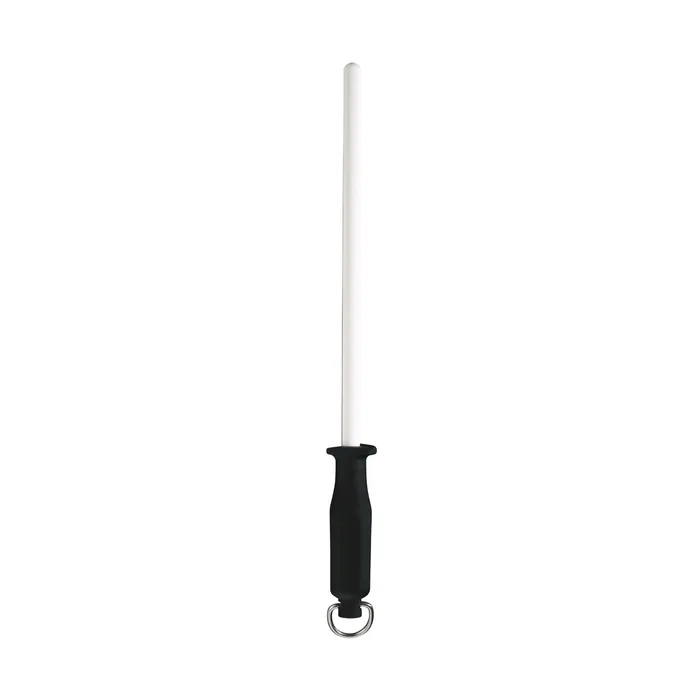
- Buy Messermeister 1200 Grit Ceramic Sharpening Rod - 12" A 12 inch fine ceramic rod that realigns edges on soft and hard knives alike without grinding them down. Amazon
- Buy MAC 8 1/2" White Ceramic Honing Rod (SR-85) The same 1200 grit ceramic idea in a shorter, cheaper rod that fits a home kitchen and most home knives. Amazon
- It depends Shun Classic 9" Combination Honing Steel (DM0790) A steel rod built around Shun's own 16 degree edge, with a smooth side for weekly use and a micro-ribbed side for monthly.
- Skip Wüsthof 10" Honing Steel The default German steel rod: fine on Wüsthof's own 58 HRC knives, and a poor default for everyone else. Amazon
What actually matters
- Blade hardness (HRC) - This is the number that decides which rods can help you. F. Dick states that the sharpening steel should always be harder than the knife it is used on, and knife makers publish figures that range from around 56 HRC on many European blades to 63 HRC on some Japanese powder steels.
- Rod material - Steel, ceramic and diamond are three different jobs. Steel realigns blades softer than itself, ceramic realigns and lightly polishes across the whole hardness range, and diamond abrades, which means it sharpens.
- Surface type - The pattern on the rod matters more than the material name. F. Dick grades its own surfaces from rough and standard, which it calls high abrasion, through fine cut at low abrasion, to polished, which it says removes nothing and only straightens and polishes.
- Rod length - The working length should cover your longest blade in one pass. A short rod forces you to hone in sections, and every join is a chance to change the angle without noticing.
- Angle guidance - A rod is only as good as the angle you hold. Some makers publish one, such as Shun's 16 degrees or Wüsthof's 14 degrees per side, and some build a guide into the handle.
- Handle and guard - You want a grip that returns to the same position every time and a guard that keeps the blade off your knuckles when a stroke slips.
- Honing frequency - This follows the steel. Shun points out that fine European knives can need honing after each use while their harder steel needs it about once a week, and MAC suggests daily in a restaurant and every few weeks at home.
The specs, in plain English
Green flags vs red flags
Green flags
- The maker publishes the rod's material and surface type, not just its length.
- The rod's working length is at least as long as your longest knife blade.
- A ceramic or fine surface, if what you want is realignment rather than metal removal.
- A published angle, or better, a guide built into the hand guard.
- The maker says clearly that the rod does not replace sharpening, which means they are describing the tool honestly.
Red flags
- A coarse ridged steel rod described as suitable for all knives, with no mention of blade hardness.
- No stated material, surface or hardness anywhere on the listing.
- A rod noticeably shorter than the knife you plan to use it on.
- Marketing that promises to restore a dull knife, which is a sharpening claim on a honing tool.
- A diamond rod sold as an everyday honing steel, since diamond abrades and will thin your blade with daily use.
Who's who: the brands
- F. Dick - A German maker whose sharpening steel range spans regular, fine, polished, ceramic, titanium and diamond surfaces, and whose published manual is one of the clearest explanations of what each one does.
- Idahone - A small American maker best known for its fine ceramic rods, which are well regarded among home cooks.
- Messermeister - Sells ceramic and diamond honing rods in a range of grits, so you can pick the abrasion level rather than guess it.
- MAC - A Japanese knife maker whose ceramic honing rods come with unusually blunt guidance about what honing does and does not replace.
- Wüsthof - The German maker whose steel, ceramic and diamond rods are the default accessory in a lot of knife blocks, and who publishes clear sharpening angles for its own blades.
How to read a listing without getting fooled
Start with the two numbers that decide compatibility: the hardness of your knives and the length of your longest blade. Then read the listing for material and surface, in that order. Ceramic or diamond means an abrasive surface with a grit or micron rating, and that rating tells you how much metal comes off. Steel means the rod is limited to blades softer than itself, so look for a cut description, and treat its absence as a gap rather than a detail. Check whether the maker publishes an angle or builds a guide into the guard. Finally, look at the overall length versus the working length, because a rod sold as a 14 inch product may only have 9 or 10 inches of usable surface once you subtract the handle.
How much should you spend?
This is a category where spending more buys you length, handle quality and a guide, not fundamentally better honing. Budget rods cover both short ceramic rods and plain steel rods from foodservice suppliers, and a short ceramic rod at this level is a better match for hard knives than a coarse steel rod. Mid-range is where the useful stuff lives: a 12 inch fine ceramic rod that suits most knives in a home kitchen sits here, and for many people that is the last honing rod they need to buy. Premium is mostly branded steels from knife makers, where you are paying for a matched handle, a built-in angle guide and a warranty. If your budget is tight, buy length and ceramic before you buy a brand name.
Questions, answered
How often should I hone?
It depends on your steel and how much you cook, and the makers disagree in a useful way. Shun says fine European knives can need honing after each use while their harder steel needs it about once a week. MAC suggests daily in a commercial kitchen and every few weeks at home. The practical rule is to hone when the knife starts sliding on a tomato skin rather than on a schedule.
My knife will not come back no matter how much I hone it. What now?
That is the signal that the edge is worn rather than rolled, and honing has nothing left to realign. At that point you need to remove metal and cut a new edge, which means a whetstone, a guided system or a sharpening service. Wüsthof makes the same point on its own site by pointing owners of particularly blunt knives towards a ceramic or diamond rod instead of the honing steel. A honing rod keeps a sharp knife sharp; it does not resurrect a dull one.
Do I need a ceramic rod if all my knives are German?
Not strictly. A steel rod matched to blades in the fifties will realign a German knife perfectly well, and that is what it was designed for. The argument for ceramic is that it is similarly priced, removes very little metal, and will still work if you add a hard Japanese knife to the block later. If you are confident your collection will stay in one hardness band, a fine or polished steel rod is a legitimate choice.
How do I clean a ceramic honing rod?
Ceramic rods pick up grey streaks of steel as they work, and that loading gradually makes them less effective. Many makers say the discolouration is normal and can be scrubbed off with warm water and a mild abrasive pad, and rubber cleaning blocks sold for the purpose work well too. Wash by hand rather than putting the rod in a dishwasher. Store it somewhere it cannot roll off a counter, because ceramic breaks when it lands on tile.
Or jump to the head-to-head: Messermeister 1200 Grit Ceramic Sharpening Rod - 12" vs MAC 8 1/2" White Ceramic Honing Rod (SR-85).