

Home & Kitchen
The Best Honing Rods: 4 Compared (and One to Skip)
We compared four honing rods on the thing that actually decides whether one works for you: whether the rod is hard enough for your knives, how much metal it takes off, and whether it is long enough for your longest blade.
The short version
The Messermeister 1200 Grit Ceramic Sharpening Rod is the pick for most kitchens: ceramic is typically harder than kitchen knife steel, so it works on a soft German blade and a hard Japanese one, and at 12 inches it covers a 10 inch chef's knife in one pass. The MAC 8 1/2 inch White Ceramic Honing Rod is the value version of the same idea, cheaper and easier to store, but too short for long blades. The Shun Classic 9 inch Combination Honing Steel makes sense if you own Shun knives, because the 16 degree guide moulded into the handle matches the edge they grind, but it is a steel rod and it costs the most here. The Wüsthof 10 inch Honing Steel is the one to skip for most people: it is a fine tool for Wüsthof's own 58 HRC blades, but Wüsthof publishes neither the rod's surface nor its hardness, and their own site tells you to reach for a ceramic or diamond rod once a knife is genuinely blunt. Buy ceramic unless your whole knife roll is one German brand. Best for: anyone who wants their knives to feel sharp between real sharpenings without grinding metal away every time they cook.
Our picks at a glance
- Messermeister 1200 Grit Ceramic Sharpening Rod - 12" - Buy. A 12 inch fine ceramic rod that realigns edges on soft and hard knives alike without grinding them down.
- MAC 8 1/2" White Ceramic Honing Rod (SR-85) - Buy. The same 1200 grit ceramic idea in a shorter, cheaper rod that fits a home kitchen and most home knives.
- Shun Classic 9" Combination Honing Steel (DM0790) - It depends. A steel rod built around Shun's own 16 degree edge, with a smooth side for weekly use and a micro-ribbed side for monthly.
- Wüsthof 10" Honing Steel - Skip. The default German steel rod: fine on Wüsthof's own 58 HRC knives, and a poor default for everyone else.
The verdict in 30 seconds
What mattered most
- Rod material
- Grit published by maker
- Rod length
- Surface
- Built-in angle guide
- Handle
A honing rod is the tool you reach for when a knife that was sharp last week suddenly feels lazy. It is not a sharpener, even though half the industry still calls it a sharpening steel. The useful question is not which brand is best but which rod is hard enough for the knives in your block, because a rod that cannot bite a hard Japanese blade does nothing, and a ridged rod can chip one. We looked at two ceramic rods, one combination steel from a Japanese knife maker, and the classic German steel rod that most people already own.
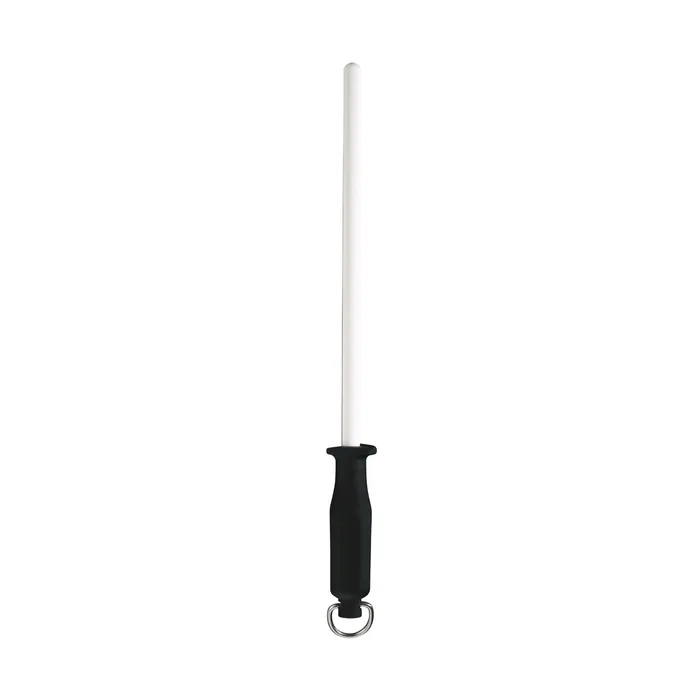
A 12 inch fine ceramic rod that realigns edges on soft and hard knives alike without grinding them down.
Best for: A mixed knife drawer where some blades are German and some are Japanese, and you want one rod for all of them.
- Ceramic is typically harder than kitchen knife steel, so it works on European and Japanese blades without the hardness guessing game.
- At 12 inches the rod covers a 10 inch chef's knife in a single stroke.
- Messermeister describes the 1200 grit surface as honing and polishing rather than grinding, which is what you want from a daily rod.
- No angle guide, so you supply the 15 to 20 degrees yourself.
- Ceramic loads up with grey steel swarf and needs an occasional scrub to keep working.
- Drop it on a tile floor and a ceramic rod can break in a way a steel rod will not.
- Messermeister does not publish a hardness figure for the rod, so you are trusting the material rather than a number.
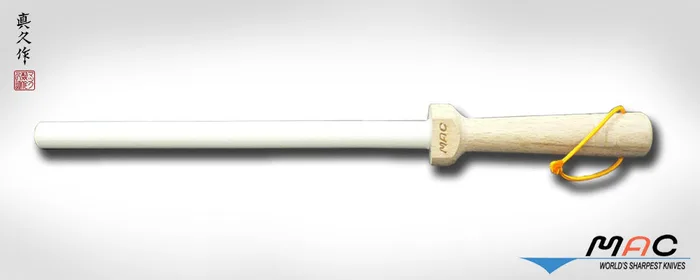
The same 1200 grit ceramic idea in a shorter, cheaper rod that fits a home kitchen and most home knives.
Best for: Home cooks whose longest knife is an 8 inch chef's knife and who want ceramic without paying for length they will not use.
- MAC states plainly that it hones and does not sharpen, and that it does not replace sharpening, which is the honest framing this category usually avoids.
- The 1200 grit white ceramic polishes the edge smooth rather than scraping it.
- Natural handle, and a lower price tier than the steel rods here.
- At 8.5 inches the rod is shorter than a 10 inch chef's knife, so long blades need two passes per side.
- MAC warns it is fragile and will shatter if it hits a hard surface.
- MAC recommends daily use in a commercial kitchen and only every few weeks at home, so it will feel underused by some buyers.
- No angle guide and no published guidance on which knives it suits.
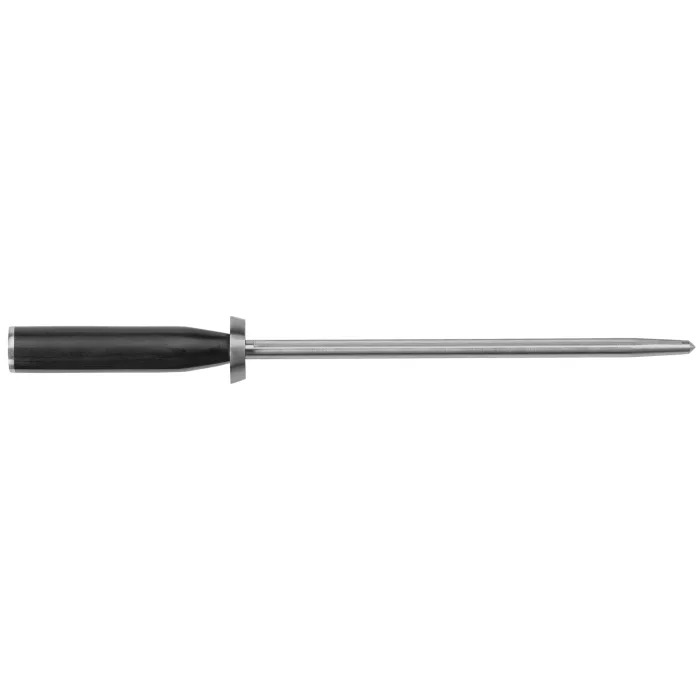
A steel rod built around Shun's own 16 degree edge, with a smooth side for weekly use and a micro-ribbed side for monthly.
Best for: Shun owners who want the angle decided for them and will follow Shun's smooth-side-weekly routine.
- The 16 degree angle guide is moulded into the hand guard, which removes the single biggest source of user error.
- Two surfaces on one rod: Shun says use the smooth side weekly and the micro-ribbed side monthly.
- D-shaped ebony PakkaWood handle, 14.5 inches overall, and a limited lifetime warranty.
- It is a steel rod, and steel rods only work on blades softer than the rod, which is exactly the compatibility question hard Japanese knives raise.
- The 9 inch rod is short for a 10 inch gyuto.
- It costs more than either ceramic rod here.
- The 16 degree guide is only useful if your knives are actually ground near 16 degrees per side.
Amazon had no buyable listing for this when we last checked. The link still works if it returns.
Check price on Amazon Read our detailed assessment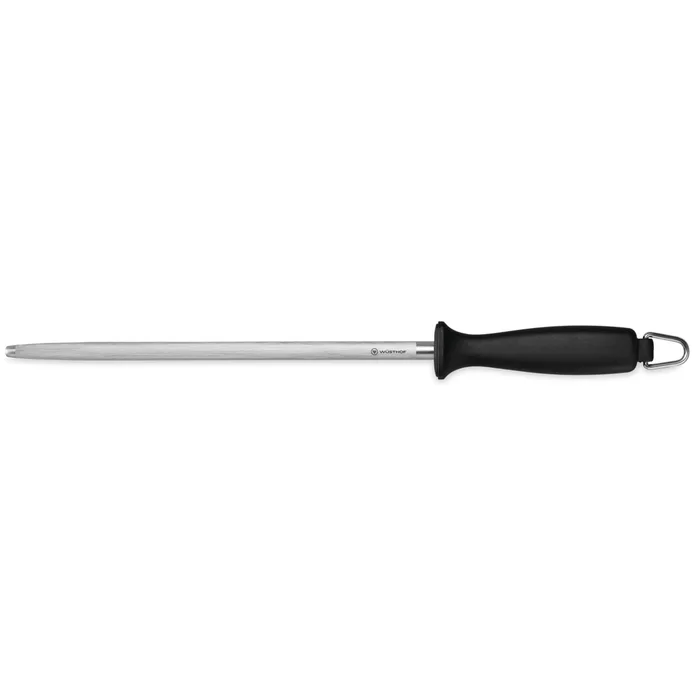
The default German steel rod: fine on Wüsthof's own 58 HRC knives, and a poor default for everyone else.
Best for: Someone whose entire knife collection is Wüsthof forged steel and who wants the matching accessory.
- Made in Germany, with a straightforward 10 inch rod.
- Correctly matched to Wüsthof's own forged blades, which the company lists at 58 HRC.
- Wüsthof publishes its sharpening angles, 14 degrees per side for standard blades and 10 degrees for Asian-style blades, so you at least know the target.
- Wüsthof does not publish the rod's surface type or its hardness, so you cannot check it against your knives.
- A steel rod can only work on blades softer than itself, which rules out the hard Japanese knives many people now own alongside their German ones.
- Wüsthof's own product page tells you to reach for a Diamond Steel or Ceramic Steel for particularly blunt knives, so this rod maintains only.
- It sits in the same price tier as the 12 inch ceramic rod, and the ceramic rod covers both hardness bands.
| Criteria | 1200 Grit Ceramic Sharpening Rod - 12" Top pick | 8 1/2" White Ceramic Honing Rod (SR-85) | Classic 9" Combination Honing Steel (DM0790) | 10" Honing Steel |
|---|---|---|---|---|
| Verdict | Buy it | Buy it | It depends | Skip it |
| Best for | A mixed knife drawer where some blades are German and some are Japanese, and you want one rod for all of them. | Home cooks whose longest knife is an 8 inch chef's knife and who want ceramic without paying for length they will not use. | Shun owners who want the angle decided for them and will follow Shun's smooth-side-weekly routine. | Someone whose entire knife collection is Wüsthof forged steel and who wants the matching accessory. |
| Price tier | $$ · mid-range | $ · budget | $$$ · premium | $$ · mid-range |
| Rod material | Ceramic | White ceramic | Stainless steel | Steel |
| Grit published by maker | 1200 | 1200 | Not published | Not published |
| Rod length | 12 in | 8.5 in | 9 in (14.5 in overall) | 10 in |
| Surface | Smooth ceramic | Smooth ceramic | Smooth side plus micro-ribbed side | Not published |
| Built-in angle guide | None | None | 16 degrees, in the hand guard | None |
| Handle | Rubberized TPE with hang ring | Natural handle | Ebony PakkaWood D-shape | Ergonomic |
| What the maker claims it does | Hones and polishes, does not grind | Hones only, does not sharpen | Realigns; Shun says honing removes no metal | Maintains; Wüsthof points to ceramic or diamond when blunt |
| Hardness range it suits | Soft and hard blades alike | Soft and hard blades alike | Shun's own hard blades at 16 degrees | Blades softer than the rod, such as Wüsthof at 58 HRC |
Which one is right for you?
- A mixed knife drawer where some blades are German and some are Japanese, and you want one rod for all of them. Buy it Messermeister 1200 Grit Ceramic Sharpening Rod - 12"
- Home cooks whose longest knife is an 8 inch chef's knife and who want ceramic without paying for length they will not use. Buy it MAC 8 1/2" White Ceramic Honing Rod (SR-85)
- Shun owners who want the angle decided for them and will follow Shun's smooth-side-weekly routine. It depends Shun Classic 9" Combination Honing Steel (DM0790)
- Someone whose entire knife collection is Wüsthof forged steel and who wants the matching accessory. Skip it Wüsthof 10" Honing Steel
How we judged the field
Five things decide whether a honing rod is right for you, and price is not one of them. First, material and hardness relative to your knives, because a rod only works on a blade softer than itself, and that single rule explains most disappointed buyers. Second, how much metal the surface removes: a polished or fine surface realigns a rolled edge and takes almost nothing, while a coarse ridged or diamond surface abrades, which is sharpening under another name. Third, rod length against your longest blade, since F. Dick’s own manual says the rod should be as long as the longest knife you use. Fourth, angle control, meaning a guard you can trust, a handle you can hold at a repeatable angle, and ideally a published angle from the maker. Fifth, durability and cleaning, because ceramic breaks if you drop it and steel loads up with swarf.
The field splits cleanly by material. Ceramic rods are typically harder than kitchen knife steel, so they cover both soft European blades and hard Japanese ones, which is why both of our buy picks are ceramic and differ mainly in length. Steel rods are the traditional answer and they are excellent within their hardness band, which is where the Shun combination steel sits: it is designed around Shun’s own 16 degree edge and tells you so on the handle. Diamond rods genuinely abrade and belong in the sharpening conversation, not the honing one. And then there is the default German steel rod that lands in most knife blocks, which we included because it is the one people already own and the one they most often put on the wrong knife.
Messermeister 1200 Grit Ceramic Sharpening Rod - 12”
Buy itThe Messermeister 1200 Grit Ceramic Sharpening Rod is the least complicated correct answer here. It is a 1200 grit ceramic rod, 12 inches long, with a rubberized TPE handle and a hang ring, and Messermeister describes it as honing and polishing rather than grinding down the edge. Because ceramic is typically harder than kitchen knife steel, the hardness compatibility question that torpedoes so many rod purchases simply does not arise: the same rod will realign a soft European blade and a hard Japanese one. The 12 inch length matters, since it lets a 10 inch chef’s knife cross the rod in one stroke instead of two, and one stroke is much easier to hold at a constant angle. The compromises are real but small: there is no angle guide, the surface greys as it collects steel and needs an occasional scrub, and ceramic can break if it hits a tile floor. For a drawer with mixed knives, this is the rod to buy.
MAC 8 1/2” White Ceramic Honing Rod (SR-85)
Buy itThe MAC 8 1/2 inch White Ceramic Honing Rod is the same concept at a smaller size and a lower price, and MAC deserves credit for the clearest language of any maker here. Their own page says the rod only hones and does not sharpen, and that it does not replace sharpening, which you should still do every couple of weeks in a restaurant or every couple of months at home. The 1200 grit white ceramic polishes the edge smooth, and the handle is natural wood. The catch is length. At 8.5 inches the rod is shorter than a 10 inch chef’s knife, so a long blade needs two overlapping passes per side, and that is where angle consistency goes wrong. MAC also flags that ceramic is fragile and will shatter on a hard surface, which is worth remembering if you hone over a stone countertop. If your longest knife is an 8 inch chef’s knife, this is the sensible buy.
Shun Classic 9” Combination Honing Steel (DM0790)
It dependsThe Shun Classic 9 inch Combination Honing Steel is the most thoughtful steel rod in this group and the most conditional recommendation. Shun moulds a 16 degree guide into the hand guard, which matches the edge they grind and removes the guesswork that ruins most honing. The rod carries two surfaces: Shun says use the smooth side for weekly maintenance and the micro-ribbed side monthly, and they note that fine European knives can need honing after every use while Shun’s harder steel lets you hone once a week. It is a well made object, 14.5 inches overall with a D-shaped ebony PakkaWood handle and a limited lifetime warranty. But it is still a steel rod, so it lives inside the hardness rule that F. Dick states plainly, and the 9 inch rod is short for a 10 inch gyuto. It also costs more than either ceramic here. Buy it if you own Shun knives and want the angle decided for you.
Wüsthof 10” Honing Steel
Skip itThe Wüsthof 10 inch Honing Steel is the rod that ends up in most knife blocks, and that is the problem. On Wüsthof’s own forged blades, which the company lists at 58 HRC, it does its job: a few passes down each side and a rolled edge comes back. But Wüsthof publishes neither the rod’s surface type nor its hardness, so there is no way to check it against a knife from another maker, and a steel rod only acts on blades softer than itself. If you have added a Japanese knife to the block, and Miyabi lists one of its lines at 63 HRC, this rod is the wrong tool for it. Wüsthof’s own page also tells you that particularly blunt knives need their Diamond Steel or Ceramic Steel instead, which is a fair admission that this rod maintains and nothing more. At a similar price tier to a 12 inch ceramic rod, that is a narrow purchase. It suits an all-Wüsthof kitchen and few others.
Sources
Specs in this review come from these pages.
- F. Dick - Sharpening steel manual (dick.de)
- Shun Cutlery - Sharpening vs honing (shun.kaiusa.com)
- Wüsthof - Classic 8" Cook's Knife (58 HRC, 14 degrees per side) (wusthof.com)
- Wüsthof - 10" Ceramic Sharpening Rod J800 (wusthof.com)
- MAC Knife - About MAC (57 to 61 HRC) (macknife.com)
- Zwilling - Miyabi Birchwood SG2 chef's knife (63 HRC) (zwilling.com)
Messermeister 1200 Grit Ceramic Sharpening Rod - 12” vs MAC 8 1/2” White Ceramic Honing Rod (SR-85): which should you buy?
Both buy picks are 1200 grit ceramic, and that is deliberate: ceramic is the material that stops you having to audit the hardness of every knife you own. The Messermeister rod and the MAC rod will feel similar in the hand for the first stroke. The difference is 12 inches versus 8.5 inches, and that turns into a real difference in how easy it is to hold one angle from heel to tip. On a 12 inch rod an 8 or 10 inch blade travels the whole edge in a single sweep. On an 8.5 inch rod a 10 inch chef’s knife does not fit, so you split the edge into two passes and hope you matched the angle between them.
So choose on your longest knife, not on brand. If the biggest thing you own is an 8 inch chef’s knife, the MAC is the better value and easier to store, and MAC’s own honest framing about what honing can and cannot do is a small bonus. If you own a 10 inch chef’s knife, a long slicer, or a brisket knife, buy the Messermeister and stop thinking about it. Handle preference is the tiebreaker after that: the MAC has a natural handle, the Messermeister has a grippier rubberized handle and a hang ring, which is the better choice if your hands are often wet.
What to look for
- Material before brand: ceramic is typically harder than kitchen knife steel, so it works across hardness bands, while a steel rod only acts on blades softer than itself.
- Check your knives’ hardness: Wüsthof lists its forged blades at 58 HRC, MAC lists 57 to 61 HRC, and Miyabi lists one line at 63 HRC, which is why one rod does not fit every block.
- Match rod length to your longest blade: F. Dick’s manual says the rod should be as long as the longest knife you use, so the edge crosses it in one stroke.
- Read the surface, not the name: F. Dick grades rough and standard cuts as high abrasion, fine cut as low abrasion, and polished as no abrasion, so a coarse ridged rod is grinding rather than honing.
- Treat diamond rods as sharpeners: diamond genuinely abrades, so a diamond rod belongs in the sharpening routine and should be used sparingly, not before every dinner.
- Look for a guard and a published angle: Shun builds a 16 degree guide into the handle, Wüsthof publishes 14 degrees per side, and F. Dick suggests 15 to 20 degrees, so pick a rod whose maker tells you something.
Our final take
Honing is maintenance, not repair, and buying the wrong rod usually comes down to one unasked question: is this thing harder than my knives? Ceramic answers it for you, which is why the Messermeister 12 inch rod is the pick for most people and the shorter MAC rod is the sensible cheaper version if your knives are small. The Shun combination steel is genuinely good inside its own lane, and the built-in 16 degree guide is a better idea than most of this category manages. The classic German steel rod is not a bad object, just a narrow one, and it is the rod people most often put on a knife it cannot touch. Whatever you buy, keep a stone as well, because no rod restores a worn edge.
Questions, answered
Is honing the same thing as sharpening?
No, and the naming is the reason so many people get this wrong. Shun states it directly: honing does not create a new edge, and it does not remove metal. What it does is push a thin edge that has rolled sideways back into line, which is why a knife can feel dull one minute and fine again after six passes. Sharpening is a different job that removes steel to cut a fresh edge, and it needs a stone or a machine. If a rod is the only tool you own, your knives will still eventually need sharpening.
Why did my German steel rod do nothing to my Japanese knife?
Because a steel rod can only act on a blade that is softer than the rod. F. Dick, which has been making sharpening steels for a very long time, states the rule plainly in its own manual: the sharpening steel should always be harder than the knife. Their standard steels are matched to knives around 56 HRC, and for their own 61 HRC line they tell you to use a titanium or diamond steel instead. Japanese kitchen knives sit high: Miyabi lists its Birchwood SG2 at 63 HRC and MAC lists its blades between 57 and 61 HRC. Ceramic sidesteps the problem because it is typically harder than those steels.
Can a grooved or ridged rod damage my knives?
It depends on how coarse the ridges are and how hard the blade is. F. Dick grades its own surfaces by abrasion: rough and standard cuts are high abrasion, a fine cut is low abrasion and mostly straightens the edge, and a polished rod removes nothing at all. So a coarse ridged rod is not really honing, it is light grinding, and every pass costs you steel. On a hard, brittle edge that grinding can also take small chips out rather than realigning the roll. If you want a rod that only realigns, a smooth or fine surface is the safer buy.
How long should the rod be?
F. Dick's guidance is simple and worth following: the sharpening steel should be as long as the longest knife blade you use, so the whole edge passes over it in one stroke. That is why a 12 inch rod earns its place if you own a 10 inch chef's knife, and why an 8.5 inch rod is fine if your longest blade is an 8 inch. Two-pass honing on a short rod is not ruinous, but it makes it much harder to keep the angle consistent from heel to tip. Measure your longest knife before you buy anything.
What angle should I hold the knife at, and how many strokes?
Follow the knife maker rather than a generic number. Shun tells you to hone its knives at 16 degrees and moulds that guide into its honing steel handle. Wüsthof lists a 14 degree per side sharpening angle for standard blades and Asian-style blades such as santoku and nakiri at 10 degrees per side. F. Dick's general instruction is 15 to 20 degrees against the steel, alternating sides with equal strokes and easing off the pressure as you finish. A handful of light passes per side is the whole job. Leaning hard on the rod does not hone faster, it just rolls the edge the other way.
Deciding between the top two? See our head-to-head: Messermeister 1200 Grit Ceramic Sharpening Rod - 12" vs MAC 8 1/2" White Ceramic Honing Rod (SR-85).
More Home & Kitchen reviews
 The Best Garden Hose Reels: 4 Compared (and One to Skip)
  The Best Ice Cream Makers: 4 Compared (and One to Skip)
  The Best Immersion Blenders: 4 Compared (and One to Skip)
  The Best Instant-Read Meat Thermometers: 4 Compared (and One to Skip)
  The Best 40 oz Insulated Tumblers: 4 Compared (and One to Skip)
  The Best Juicers: 4 Compared (and One to Skip)