Explained
Immersion Blenders, Explained
After reading this you will know which immersion blender specs actually matter, which are marketing noise, and how to spot a model that will last.
In this guide
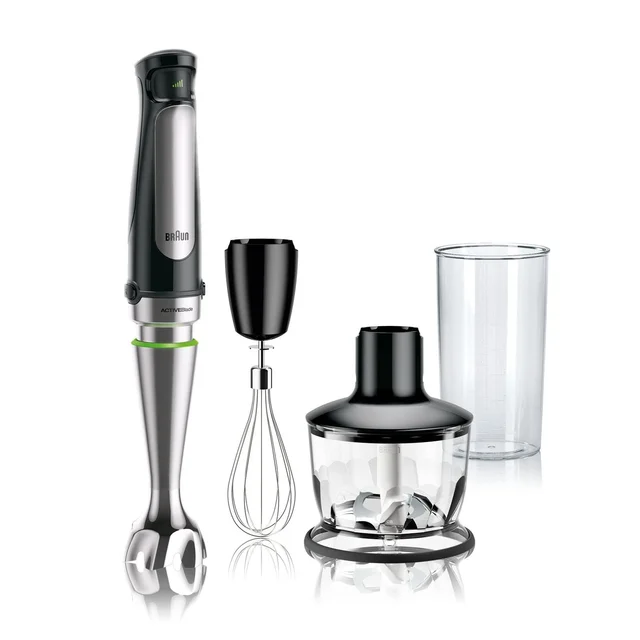
An immersion blender, also called a hand blender or stick blender, is a wand you dip straight into a pot, jar, or beaker to puree soup, whip up mayonnaise, or blend a smoothie without dirtying a countertop machine. First-time buyers usually fixate on wattage, but the number on the box tells you far less than the shape of the blending head and the quality of the part that connects the motor to the shaft. This guide decodes the specs so you can tell a genuinely good tool from a cheap one dressed up with accessories.
The 30-second version
- Head design beats wattage. so a well-vented bell-shaped foot that breaks suction can out-blend a higher-watt model with a basic fixed blade.
- The coupler is the weak link, and a plastic hub joining motor to shaft is a common reason cheap hand blenders die early.
- Comfort decides whether you use it, because grip style and weight matter far more once you are three minutes into a big batch of soup.
- Attachments add real value, since a bundled whisk and chopper turn one wand into three tools, but only if the core blender is worth keeping.
- Buy once by spending a little more, as the small saving on a budget unit can be lost to a replacement.
The products this guide is about
Our verdict on each, with the full reasoning on the companion review.
- Buy Braun MultiQuick 7 (MQ7035X) A versatile all-rounder with a pressure-sensitive trigger and a flexing blade shaft built to leave fewer unblended pieces. Amazon
- Buy Breville Control Grip (BSB510XL) The most comfortable to hold and the kindest to your pots, at a friendlier price than the premium rivals. Amazon
- It depends Vitamix 5-Speed Immersion Blender The power pick with a 625-watt motor, if you can accept the weight and the price. Amazon
- Skip Mueller Ultra-Stick Cheap and heavily bundled, but owner reports of an early-failing plastic coupler undermine the whole tool. Amazon
What actually matters
- Blending head and foot design - a bell-shaped or vented guard that breaks the vacuum against the pot bottom is what actually delivers a smooth, splash-free puree; this matters more than any single spec.
- Suction control - cheap heads clamp onto the pot and stall; a good foot lets liquid circulate so the blades keep cutting instead of sticking.
- Coupler and shaft material - a metal shaft and a robust motor-to-shaft connection help a tool last longer.
- Speed control style - a pressure-sensitive trigger feels intuitive and splash-free, while a numbered dial gives repeatable results; pick the one that suits how you cook.
- Comfort and weight - a soft grip and balanced weight decide whether long batches are pleasant or a strain, and more powerful motors can be heavier.
- Shaft length - a longer shaft reaches safely into tall stockpots without splashing, while a short one limits how much you can blend at once.
- Warranty and bundled tools - a longer warranty signals the maker's confidence, and an included whisk, chopper, or beaker extends what the tool can do.
The specs, in plain English
Green flags vs red flags
Green flags
- A bell-shaped or vented foot designed to reduce suction against the pot bottom
- A metal shaft and a solid, well-reviewed coupler rather than an all-plastic joint
- A comfortable grip and balanced weight you can hold through a full batch
- A shaft long enough for your tallest pot, plus a no-scratch ring if you use nonstick
- Owner reports describing years of reliable use, not just first-week impressions
- A solid warranty and useful bundled attachments like a whisk or chopper
Red flags
- A basic flat or fixed blade with no anti-suction guard, which stalls and splatters
- A plastic coupler or hub that owners report cracking or stripping
- Marketing that leans entirely on high wattage while ignoring head design
- A twist-lock or attachment that owners say works loose during blending
- A very short shaft that cannot reach into a normal stockpot
- A rock-bottom price paired with many bundled extras but a flimsy core unit
Who's who: the brands
- Braun - Premium hand blenders with a SmartSpeed pressure trigger and a flexing ACTIVEBlade shaft on the MultiQuick 7.
- Breville - Makes the Control Grip, with an ergonomic trigger grip, a non-scratch bell-shaped base, and a jug, chopper bowl, and whisk.
- Vitamix - Makes a 625-watt immersion blender with a 3-year limited warranty.
- Mueller - A budget brand that bundles accessories; some owner reports describe early coupler failures.
- KitchenAid - A mainstream option offering a broad range of mid-priced hand blenders with familiar styling and easy availability.
- Cuisinart - A widely sold everyday brand covering the affordable-to-mid range with straightforward, no-frills models.
How to read a listing without getting fooled
When you read an immersion blender listing, start below the headline wattage. Look at the blending head first: a bell-shaped or vented foot that breaks suction is worth more than an extra hundred watts, so photos of the tip tell you more than the spec table. Check whether the shaft is metal and how it attaches to the motor, since a cheap plastic coupler is the part most likely to fail; if the description is vague about the joint, treat that as a warning. Match the speed control to how you cook, a pressure trigger for intuitive feathering or a dial for repeatable settings, and confirm the shaft is long enough for your tallest pot. Finally, read past the glowing first-week reviews to the ones written months later, because durability complaints, especially about the coupler, tend to show up over time.
How much should you spend?
The cheapest hand blenders are tempting because they pile on accessories, but the money you save can be lost if a plastic coupler fails and the whole tool has to be replaced. Spending modestly more buys a metal shaft, a better anti-suction head, and a sturdier build, which is where the value sweet spot sits for most kitchens. Stepping up to a premium or flagship model is worth it only if you blend large or very thick batches often and want maximum power, the finest possible puree, and the strongest warranty. If you blend occasionally and gently, a solid mid-range unit is plenty; the extra cost of a flagship buys power and refinement you may rarely use. The guiding principle is to buy once: prioritize the core blender's durability over the length of the accessory list.
Questions, answered
Does higher wattage mean a better immersion blender?
Not on its own. Wattage is a rough proxy for power, but head and blade design matter more for smoothness. A well-vented bell foot that breaks suction can help more than extra watts, so treat wattage as one signal among several rather than the deciding number.
Why do cheap hand blenders fail so quickly?
The usual culprit is the coupler, the joint connecting the motor to the shaft. On budget models it is often plastic, and some owner reports describe it cracking or stripping, which disables the whole unit. Because that part cannot be worked around, a low price can quickly turn into the cost of a replacement.
Can an immersion blender replace a countertop blender?
For soups, sauces, emulsions, and small smoothies, yes, and it is far easier to clean and store. For large frozen drinks, nut butters, or crushing ice in volume, a full countertop blender still does a better job, though more powerful immersion models narrow that gap.
What is the difference between a trigger and a speed dial?
A pressure-sensitive trigger gives more speed the harder you press, which feels intuitive and helps control splashing. A numbered dial lets you lock in and return to an exact speed for repeatable results. Neither is better overall; the trigger suits improvised blending while the dial suits cooks who want consistency.
How do I keep an immersion blender from scratching my nonstick pots?
Look for a model with a no-scratch ring around the foot, a soft band that keeps the metal guard from touching the pan. It helps protect nonstick coatings. Keeping the blade slightly off the pot bottom while blending also helps.
What attachments are actually worth having?
A whisk and a chopper add the most everyday utility, turning one wand into three tools for emulsifying, whipping, and mincing small amounts. A beaker or lidded jug is handy for blending without splashing. Just make sure the core blender is durable first, since accessories are worthless if the motor or coupler fails early.
Or jump to the head-to-head: Braun MultiQuick 7 (MQ7035X) vs Breville Control Grip (BSB510XL).