Explained
Kitchen Shears, Explained
After reading, you'll understand why take-apart construction and pivot type matter more than blade steel, and how to tell a general kitchen shear from a poultry shear before you buy the wrong one.
In this guide
Almost nobody chooses kitchen shears deliberately. A pair arrives in a knife block, lives in a drawer, gets used on a chicken once, and then quietly becomes the pair you feel odd about. The specs that would have warned you are not the ones the packaging shouts about: not the steel, not the handle colour, but whether the two halves come apart and whether the pivot is a screw or a rivet. Those two details decide whether the tool can be cleaned and whether it can be kept.
The 30-second version
- Take-apart beats everything, because the pivot is the part of a pair of shears a sponge cannot reach and raw chicken residue reaches easily.
- A screw pivot is a serviceable tool, while a riveted pivot means the shears are finished the day the blades develop play.
- Micro-serration is a grip feature, trading easier cuts on slippery skin and stems for a much harder resharpening job later on.
- Dishwasher safe is a materials claim, telling you the steel and handle survive the cycle, not that detergent gets inside a closed joint.
- Poultry shears are a different tool, with curved blades and a spring that suit whole birds and get in the way of ordinary kitchen jobs.
The products this guide is about
Our verdict on each, with the full reasoning on the companion review.
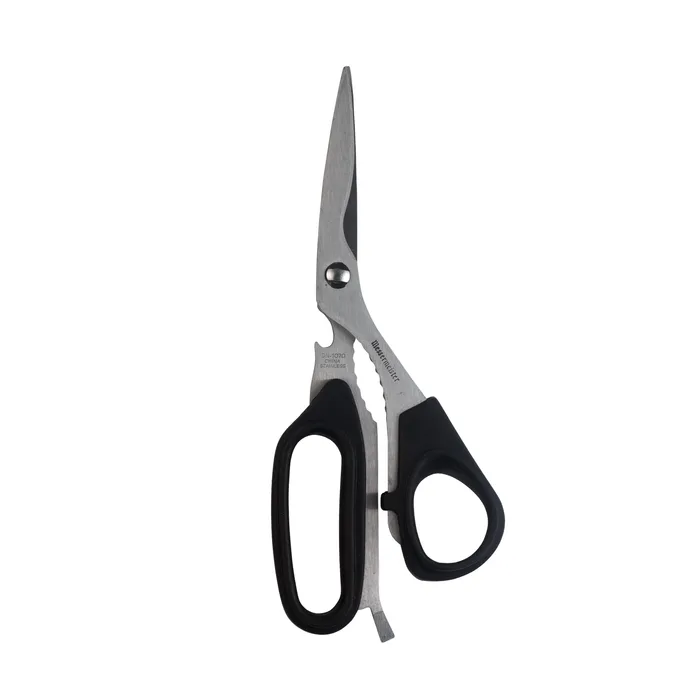
- Buy Messermeister Take-Apart Offset Kitchen Shears - 8.5" A cheap take-apart pair that gets the two things right that matter most, cleanability at the pivot and a gripping edge. Amazon
- Buy Shun Kitchen Shears (DM7240) The premium separating pair, made in Japan, with a notch on the blade for thin poultry bones and flower stems. Amazon
- It depends WÜSTHOF 10" Poultry Shears (1049595003) A spring-loaded, curved-blade bird tool that is excellent at jointing chicken and wrong for everything else. Amazon
- Skip Joyce Chen Original Unlimited Kitchen Scissors (J51-0220) A well-loved pair of scissors sold for meat and shellfish that the maker does not list as taking apart. Amazon
What actually matters
- Take-apart construction - The blades come fully apart so both faces and the inside of the pivot can be scrubbed and dried. This is the feature that separates shears you can safely use on raw meat from shears you cannot.
- Pivot type - A screw or bolt pivot can be tightened as the joint wears, and it usually signals a maker who expects the tool to have a long life. A rivet cannot be adjusted, so once the blades stop meeting cleanly the pair is done.
- Micro-serration - A fine sawtooth on one blade digs into slippery surfaces such as chicken skin, tomato skin and herb stems. It is the difference between cutting food and chasing it toward the blade tip.
- Blade steel - Shears usually use corrosion-resistant stainless in the 420 family, chosen for toughness and rust resistance rather than extreme sharpness. It is a sensible choice for a tool that meets bone and sits wet.
- Offset handles - The handles sit below the blade line so your knuckles clear the cutting board. It sounds cosmetic and turns out to matter a lot when you are spatchcocking on a flat surface.
- Handle material and shape - Soft overmoulded thermoplastic grips stay usable with wet hands, and looped or ambidextrous handles let both left and right handers work comfortably. This is where fatigue on a long prep session is won or lost.
- Blade length and leverage - Longer blades give more leverage near the pivot where the force is greatest, which is why poultry shears run around 10 inches while herb scissors are much shorter.
The specs, in plain English
Green flags vs red flags
Green flags
- The maker's own product page uses the words take apart, come apart, pull apart or blades separate.
- Adjustable tension or an adjustable pivot screw is named in the feature list.
- One blade is described as micro-serrated or partially serrated rather than plain.
- A specific steel grade is published rather than the vague phrase stainless steel.
- The handles are offset and made from a soft, non-slip overmoulded material.
Red flags
- The listing pitches raw meat, poultry or shellfish but says nothing about the blades separating.
- Dishwasher safe is the only cleaning claim on a pair with a fixed pivot.
- The pivot is a smooth domed pin with no slot or hex, meaning there is nothing to tighten.
- The description leads with a bundled bottle opener, screwdriver or nutcracker instead of the pivot and the edge.
- The pair came free inside a knife block set and the block maker publishes no shear specification at all.
Who's who: the brands
- Messermeister - A California cutlery company whose shears line leans hard on take-apart construction, with everything from a budget offset pair to push-button models that release at the touch of a button.
- Shun / Kai - Kai USA sells the Japanese-made Shun shears, and its product page states plainly that the blades separate.
- WÜSTHOF - The Solingen knife maker offers both come-apart general kitchen shears and traditional German spring-loaded poultry shears, which are two quite different tools from one catalogue.
- Victorinox - The Swiss maker best known for Swiss Army knives and Fibrox-handled kitchen knives, with a reputation built on tools that work hard rather than look expensive.
- Joyce Chen - Known for the looped-handle Unlimited scissors that generations of cooks keep in a drawer, now sold in both fixed and separating versions, so the model name matters.
How to read a listing without getting fooled
Read the maker's page from the bottom up. Skip the paragraph about how these will change your kitchen and go to the bulleted feature list and the specification table, because that is where the checkable claims live. Look for four words in particular: separate, adjustable, serrated, and the steel grade. Then read the care instruction, which is often the most honest line on the page. A pair that says take apart and dishwasher safe is telling you something different from a pair that says hand wash for best results and mentions lobster tails in the same breath. If a spec you care about is missing, do not assume it in the product's favour, because makers list the features they are proud of. And be aware that model names within one brand can differ on exactly this point, with a Deluxe or Multi-Use version separating while the Original does not.
How much should you spend?
This is a category where the useful feature is cheap. Budget shears from a serious cutlery brand routinely include take-apart blades, micro-serration and an adjustable pivot, which covers every functional requirement most kitchens have. Mid-range money buys better handle comfort, better finish, a bone notch, and sometimes a longer warranty, all of which are pleasant rather than necessary. Premium money mostly buys country of manufacture, brand, and the feeling of a well-made object, and it does not reliably buy a better-documented steel or a hardness figure. Spring-loaded poultry shears sit at their own price ladder and should be treated as a second, specialised purchase rather than an upgrade to your first pair. The one thing worth refusing at any tier is a fixed-pivot pair sold for cutting meat.
Questions, answered
How can I tell if my current shears have a bolt or a rivet?
Look at both faces of the pivot. A bolt or screw shows a slot, a cross, a hex socket or a knurled ring on at least one side, and often a nut on the other. A rivet is a smooth domed pin with no tool interface at all. If there is nothing to turn, there is nothing to tighten, and once the blades start folding food instead of cutting it the pair has reached the end of its life.
Are titanium-coated blades better?
The coating is a thin surface layer applied over the actual blade steel, usually for stain resistance and looks rather than for a fundamentally harder edge. It does not change the steel underneath, and the very edge is where the coating is thinnest and wears first. Treat it as a finish, not a specification. The take-apart design and the pivot type tell you far more about how the shears will hold up.
Do left-handed cooks need special kitchen shears?
Sometimes. Scissors are handed in two ways: the blade that sits on top when you squeeze, and the shape of the handle loops. Shears described as ambidextrous have symmetrical loops so both hands are comfortable, though the blade overlap may still favour one side. If you are left-handed and a pair feels like it is pushing food out of the cut rather than through it, that is usually the blade geometry rather than the sharpness.
How do I keep a good pair sharp?
Wash and dry them after every use, especially inside the pivot, because moisture there is what causes stiffness and corrosion. Keep them out of the drawer where the blades knock against other metal. If the pivot is adjustable, check the tension once in a while and snug it before the blades develop visible play. When the edge finally dulls, a plain edge can often be touched up on a stone, while a micro-serrated blade is a job for a sharpening service with a tapered rod.
Or jump to the head-to-head: Messermeister Take-Apart Offset Kitchen Shears - 8.5" vs Shun Kitchen Shears (DM7240).