Explained
Insulated Tumblers, Explained
After reading, you'll understand how to compare tumblers on sealing, temperature retention and real capacity.
In this guide
Handled 40 oz tumblers look almost identical, so buyers often choose by colour and discover the differences later. The important ones are in the lid and the specification table: whether the lid seals, how the brand measures cold retention, how much the cup holds with the lid on, and what the warranty covers.
The 30-second version
- Lid wording matters, because leakproof, leak-resistant and splash-resistant mean different things.
- Cold ratings depend on ice, so compare ratings tested the same way.
- Functional capacity is the real number, since the lid and straw take up space.
- Cupholder fit depends on the base, and most 40 oz tumblers taper to about 3 inches.
- Warranties vary on lids, which are the part most likely to break.
The products this guide is about
Our verdict on each, with the full reasoning on the companion review.
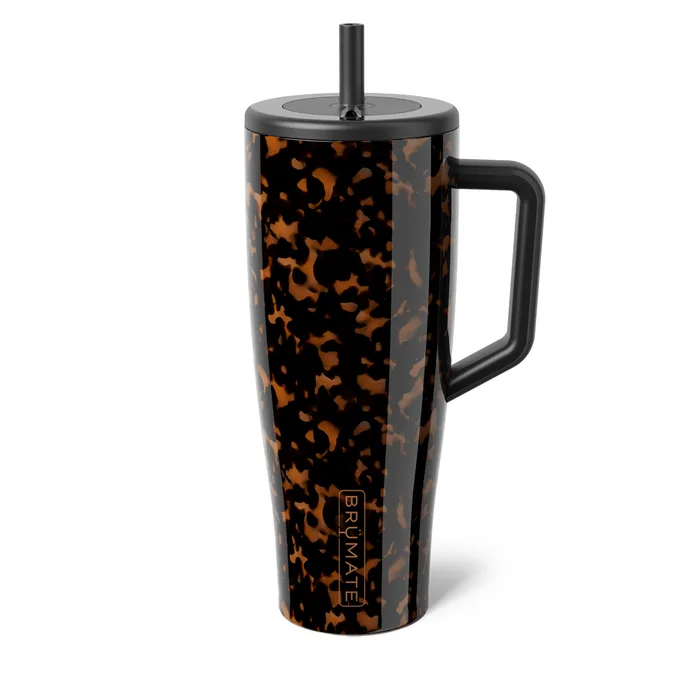
- Buy BrüMate Era 40oz A 40 oz tumbler that locks leakproof with cold drinks and keeps plastic out of the straw path.
- Buy Simple Modern Trek Tumbler A well-specified budget 40 oz tumbler with 24-hour cold retention and a warranty that covers lids.
- It depends Stanley Quencher H2.0 FlowState Tumbler 40 oz The tumbler that started the trend, with the longest ice claim here and a lid that resists splashes rather than sealing.
- Skip HydroJug Traveler 40oz A compact, leakproof-when-closed tumbler whose own page cannot agree on how it is insulated.
What actually matters
- Lid seal - a sealed lid can go in a bag; a splash-resistant lid should stay upright.
- Cold retention - usually quoted in hours, sometimes with ice. More ice and a closed lid extend it.
- Hot retention - often shorter, and straw lids are a scalding risk with hot drinks.
- Capacity - stated capacity may be measured without the lid; functional capacity is with it.
- Weight and size - empty weight, height and base width decide comfort and cupholder fit.
- Materials - 18/8 stainless steel bodies, BPA-free plastics and optional stainless straws.
- Warranty - look for coverage of lids and insulation, not just the steel body.
The specs, in plain English
Green flags vs red flags
Green flags
- Leakproof conditions stated clearly, such as with cold drinks when locked.
- Functional capacity published.
- Cold and hot ratings given separately.
- Weight, height and base width published.
- A warranty that covers lids and insulation.
Red flags
- Insulation described differently in different parts of the page.
- Leakproof claims with no conditions.
- No hot rating on a tumbler marketed for coffee.
- Warranty terms hidden behind a link only.
- Product names that are only a colour.
Who's who: the brands
- BrüMate - Drinkware brand known for leakproof lids and stainless steel straw systems.
- Simple Modern - Value drinkware brand with a limited lifetime warranty covering lids and insulation.
- Stanley - The century-old brand whose Quencher popularised the 40 oz handled tumbler.
- HydroJug - Hydration brand known for large water jugs and its Traveler tumbler range.
How to read a listing without getting fooled
Start with the lid: find exactly what the brand says about leaks and under what conditions. Then compare cold and hot ratings, noting whether ice was used. Check functional capacity, empty weight, height and base width. Look at what the straw and lid are made of. Finally read the warranty and whether it covers lids and loss of insulation.
How much should you spend?
Budget 40 oz tumblers now match the shape and core insulation of premium ones, and a good budget tumbler with a strong warranty is a sensible buy. The mid-range buys sealed lids, stainless straws and more polished finishes. Premium pricing often reflects the brand or limited colours rather than better insulation. Paying a little more makes sense mainly for a genuinely leakproof lid.
Questions, answered
How do I clean a straw tumbler?
Take the lid, straw and any seals apart, wash them in warm soapy water or on the top rack of the dishwasher if the maker allows it, and use a straw brush. Let everything dry fully before reassembling to prevent odours and mould.
Why does my tumbler sweat?
A properly insulated double-wall tumbler should not sweat on the outside. If it does, the vacuum seal may have failed, which many warranties cover as loss of insulation.
Can I put carbonated drinks in a tumbler?
Some tumblers are designed for it. BrüMate says the Era is leakproof with iced carbonated drinks when locked and recommends 50% ice. Others may leak or spray, so check the maker's guidance.
Is a 40 oz tumbler too big?
It depends on how you use it. A 40 oz tumbler reduces refills and suits all-day hydration, but it is heavy when full and tall in a car. Many ranges come in 20 or 30 oz versions with the same lid.
Or jump to the head-to-head: BrüMate Era 40oz vs Simple Modern Trek Tumbler.