Explained
Digital Kitchen Scales, Explained
After reading this you will know exactly which specs on a kitchen scale matter for your cooking and which are just marketing.
In this guide
A kitchen scale has one job it cannot get wrong: report weight accurately every time. Most buyers get distracted by extras like waterproofing, app connectivity, or unit conversions, and overlook whether the scale actually reads small weights reliably. This guide decodes the specs so you can tell a trustworthy scale from a feature-stuffed one.
The 30-second version
- Accuracy beats features. A scale that misses a 1-gram weight is useless no matter how many modes it has, so treat consistent low-end accuracy as the non-negotiable requirement.
- Match resolution to your cooking. 1-gram resolution covers general cooking and most baking; you only need 0.1-gram precision for coffee brewing or tiny quantities like yeast and spices.
- Readability is a real spec. A wide bowl can hide a front-mounted display, so backlighting and a pull-out or raised screen matter more than buyers expect.
- Around 11 pounds of capacity is the sweet spot. It handles bread dough and big bowls of batter, while coffee scales trade capacity for fine resolution.
- Cleaning and power fit your habits. A removable or sealed surface survives spills, and choosing between replaceable cells and USB-C rechargeable is about convenience, not accuracy.
The products this guide is about
Our verdict on each, with the full reasoning on the companion review.
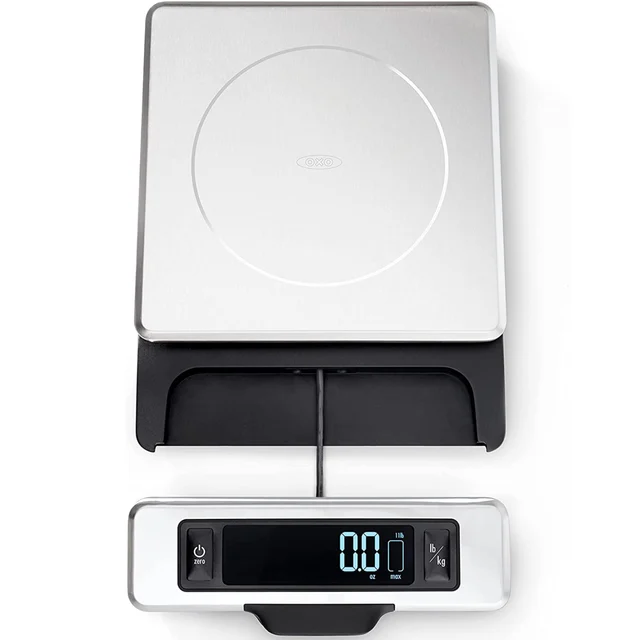
- Buy OXO Good Grips Stainless Steel Food Scale with Pull-Out Display (11 lb) The most usable everyday scale, with a pull-out display that solves the bowl-shadow problem. Amazon
- Buy Escali Primo P115 Digital Kitchen Scale A long-running budget scale with sealed controls and simple two-button operation. Amazon
- It depends Fellow Tally Pro Precision Scale A gorgeous 0.1-gram coffee scale with Brew Assist, but overkill for general cooking. Amazon
- Skip Ozeri Ultra Thin Professional Digital Kitchen Food Scale (Stainless Steel) Slim stainless scale with a clear spec sheet, but a 1-minute auto-off that can blank the display mid-recipe.
What actually matters
- Low-end accuracy - how reliably the scale registers small weights (1 to 5 grams), not just heavy loads, because that is where cheap scales fail and where baking precision lives.
- Resolution - the smallest increment the scale can show (1 gram versus 0.1 gram); pick based on whether you brew coffee or weigh tiny quantities rather than paying for precision you will not use.
- Capacity - the heaviest load the scale can weigh, ideally around 11 pounds (5 kg) for versatile kitchen use.
- Tare (zeroing) - the ability to reset to zero with a container on the platform so you weigh only what you add; a clean, responsive tare makes multi-ingredient work painless.
- Readability - display quality and placement, including backlighting and whether a bowl will block your view of the numbers.
- Platform size and cleaning - a deck big enough for your bowls, with a removable or sealed surface that wipes clean after inevitable spills.
- Power source - replaceable batteries versus a built-in USB-C rechargeable cell, a convenience trade-off rather than a quality one.
The specs, in plain English
Green flags vs red flags
Green flags
- Independent testing and owner reports agree it registers small weights (down to 1 gram) consistently
- Resolution that matches your use case rather than the highest number available
- A clean, responsive tare and the units you actually cook with
- A display you can read behind a bowl, ideally backlit or pull-out
- A removable or sealed platform that wipes clean, and a warranty that signals confidence
Red flags
- Reviews mention drifting readings, missed low weights, or inconsistency near the center of the platform
- A spec sheet that leads with waterproofing, apps, or unit modes but is vague about accuracy
- A platform too small for the bowls you own, or a front display a bowl will hide
- An aggressive auto-off that zeroes your measurement mid-recipe
- No stated capacity or resolution, or a warranty so short it hints at durability doubts
Who's who: the brands
- OXO - Known for thoughtful everyday kitchen tools; its Good Grips scales emphasize usability like pull-out displays and removable platforms.
- Escali - A long-running kitchen-scale specialist favored by home bakers for accurate, no-frills models at accessible prices.
- Fellow - A premium coffee-gear maker whose precision scales target pour-over and espresso enthusiasts with fine resolution and brew guidance.
- Ozeri - A budget kitchen-scale line with many slim and glass-top models; check each model's listed auto-off time and graduation, which vary across the range.
How to read a listing without getting fooled
Start with the two numbers that decide fitness for purpose: resolution and capacity. Confirm the resolution matches your use (1 gram for cooking and most baking, 0.1 gram only for coffee or tiny quantities) and that capacity covers your heaviest realistic load, around 11 pounds for versatile kitchens. Then treat everything else as secondary. Marketing copy loves to foreground waterproofing, rechargeable batteries, and long lists of units, but none of those tell you whether the scale reads a single gram reliably; only accuracy does, and that comes from aggregated owner reports rather than the box. Check that a tare function is listed, look for a backlit or pull-out display if bowls tend to shadow your screen, and note whether the platform detaches for cleaning. A generous warranty is a quiet tell that the maker trusts the mechanism.
How much should you spend?
You do not need to spend much to get a genuinely accurate everyday scale; the value sweet spot sits in the budget-to-mid range, where proven models deliver reliable 1-gram readings, a clean tare, and a capacity around 11 pounds. Paying a little more typically buys usability upgrades rather than better accuracy, such as a backlit or pull-out display, a larger removable platform, or a sealed surface that is easier to clean. Stepping up to the premium tier only makes sense if you will genuinely use fine 0.1-gram resolution and brew guidance for coffee, which is a specialist need rather than a general-cooking one. Beware paying a premium for features like waterproofing or app connectivity if the underlying accuracy is unproven, since a cheap scale that weighs correctly beats an expensive one that does not.
Questions, answered
Do I need 0.1-gram resolution or is 1 gram enough?
For general cooking and most baking, 1-gram resolution is plenty. You only need 0.1-gram resolution for espresso dosing, pour-over coffee, and small-quantity work like yeast, salt, or spices, where a single gram is a large percentage of the total. If you do not brew coffee seriously, save your money and buy a proven 1-gram scale.
What capacity should a kitchen scale have?
An 11-pound (5 kg) capacity comfortably covers bread doughs, large bowls of batter, and portioning meat, and it suits most kitchens. Coffee-focused scales trade capacity for precision, so their roughly 2,500-gram ceiling is fine for brewing but limiting for big batches. If you frequently weigh heavy items, favor a higher-capacity model.
Why does display placement matter so much?
A wide bowl or plate on the platform can hide a display mounted at the front, forcing you to lift the bowl to read the weight. Scales with a pull-out display on a cord, or a raised and backlit screen, solve this recurring annoyance. It is a small feature that noticeably improves daily use.
Are rechargeable scales better than battery-powered ones?
It comes down to preference, not accuracy. USB-C rechargeable models remove the need to buy disposable cells, which suits frequent users. Battery-powered scales are ready whenever you need them without waiting for a charge, and a fresh set of cells lasts a long time. Both are reliable when the underlying scale is accurate.
Does a waterproof rating mean a scale is high quality?
No. A water-resistance rating such as IPX6 tells you the scale survives splashes or a rinse, which is convenient in a messy kitchen, but it says nothing about measurement accuracy. Some water-resistant scales weigh inconsistently, so treat waterproofing as a bonus rather than proof of quality.
How can you judge accuracy without your own lab?
This is general product information, not a substitute for calibrating a scale in your own kitchen. Rather than running a laboratory, we synthesize maker specifications and aggregated owner reports, weighing how consistently owners say a model reads known weights, how it behaves at the low end, and how usable owners find it over time. Where sources report an accuracy problem, we flag it plainly.
Or jump to the head-to-head: OXO Good Grips Stainless Steel Food Scale with Pull-Out Display (11 lb) vs Escali Primo P115 Digital Kitchen Scale.