Explained
Turntable Headshells, Explained
After reading, you'll understand why headshell mass is a calculation rather than a taste, how to run that calculation with your own cartridge and arm, and which spec-sheet numbers are comparable and which are not.
In this guide
Most people arrive at headshells because something broke, or because a forum told them a heavier one sounds better. Then they discover that mass, compliance and resonance frequency are all tangled together, that two makers quote mass in two different ways, and that the compliance figure on their cartridge box may have been measured at a frequency the formula does not want. None of this is hard, but it is unforgiving: get the mass wrong and record warps start driving the arm. This guide takes the numbers one at a time.
The 30-second version
- Headshell mass is a tuning parameter, not a preference, because it adds to the arm's effective mass and moves the resonance frequency of the whole assembly.
- The target is roughly 7 to 12 Hz, which Ortofon publishes as optimal, sitting above record warp frequencies and below the audio band.
- High compliance wants light, low compliance wants heavy, so the right headshell mass depends entirely on which cartridge is going on it.
- Check the frequency next to the compliance figure, because a dynamic compliance quoted at 100 Hz is not the low-frequency number the resonance formula expects.
- A detachable headshell buys convenience, and pays for it with the connector's mass and one extra mechanical joint between cartridge and arm tube.
The products this guide is about
Our verdict on each, with the full reasoning on the companion review.
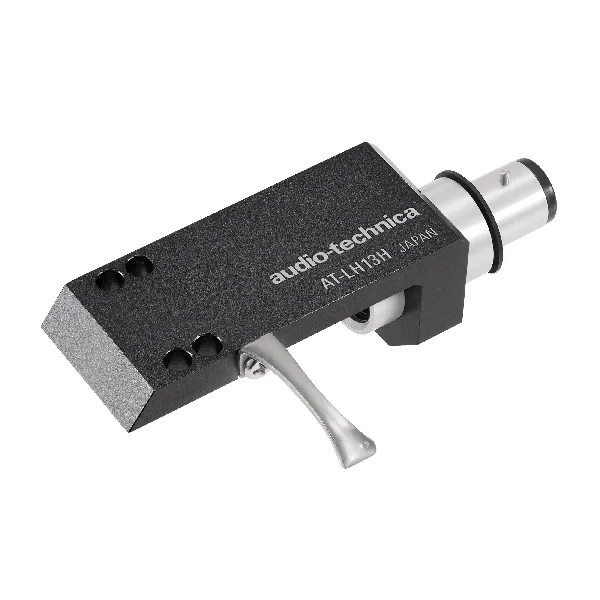
- Buy Audio-Technica AT-LH13H A hard-anodised aluminium shell with an adjustable cylinder for azimuth and overhang, sold in four published masses so you can match your arm instead of hoping. Amazon
- Buy Audio-Technica AT-HS6 A die-cast aluminium universal half-inch shell that weighs 9.3 g with its lead wires fitted and does the fundamentals without asking for much. Amazon
- It depends Ortofon LH-2000 A 15.5 g solid aluminium shell with a generous slot range, which is exactly right for a stiff low-compliance cartridge and exactly wrong for a springy one. Amazon
- Skip Ortofon LH-9000 Ortofon's flagship shell asks the highest price here for a magnesium and carbon fiber body whose resonance claim carries no published measurement, and it is the heaviest of the four. Amazon
What actually matters
- Effective mass - This is how much inertia the arm presents at the stylus, and it is what the cartridge's suspension has to work against. Ortofon treats arms at 10 g or below as low mass, 11 to 25 g as moderate and above 25 g as high, and your headshell adds straight onto whichever bracket your arm sits in.
- Compliance - This is how springy the cartridge's cantilever suspension is, quoted in micrometres per millinewton or in cm per dyne. Ortofon calls 5 to 10 micrometres per millinewton very low compliance and above 35 very high, and the number decides how much mass the cartridge wants in front of it.
- Resonance frequency - The mass and the springiness together form a resonant system, and where it resonates decides whether warps or bass notes set the arm bouncing. Ortofon publishes 7 to 12 Hz as optimal and warns that vibrations around 4 to 6 Hz are what record warps provoke.
- Overhang - This is how far the stylus sits past the platter spindle, and it is the main thing you set when mounting a cartridge. Rega, for example, publishes 14.5 mm for the RB330, so it is arm-specific and the headshell has to let you reach it.
- Azimuth - This is whether the stylus stands perpendicular to the record rather than leaning to one side. Most headshells fix it by construction; Audio-Technica's LH series states its adjustable cylinder lets you set it, which is unusual and useful if your arm is not perfectly square.
- Mounting distance range - The span between the shortest and longest position the slots allow, which Ortofon publishes for every shell. If your arm needs the cartridge further back than the shell's minimum, no amount of care with a protractor will fix it.
- Lead wires and pins - The four short wires connecting cartridge pins to headshell pins, supplied with all the shells here. Ortofon notes its cartridge pins are 1.2 mm and its headshell pins 1.0 mm, so the two ends of a lead are not gripping the same diameter.
The specs, in plain English
Green flags vs red flags
Green flags
- The maker publishes mass in grams and says whether lead wires and screws are included in that figure.
- A mounting distance minimum and maximum are printed, so you can check the shell reaches your arm's overhang before buying.
- The same design is offered in several masses, which means you can correct a bad match without changing brand.
- Lead wires, plastic washers and both screw lengths are in the box, along with any tool the shell needs.
- Any adjustment claim, such as azimuth, is stated in the specification rather than implied by a photo.
Red flags
- Mass is given as a round marketing number with no statement of what it includes.
- Resonance or damping claims are made for the body material with no measurement published anywhere.
- No mounting distance range is given and the product photos do not show whether the holes are slotted.
- The listing does not say whether lead wires are supplied, which usually means an extra order later.
- The seller recommends a heavier shell for better bass without asking which cartridge you own.
Who's who: the brands
- Audio-Technica - Makes both cartridges and headshells, and is unusual in publishing the same LH design at four masses, 11, 13, 15 and 18 grams, with an adjustable cylinder for azimuth and overhang.
- Ortofon - Danish maker whose site dates continuous development from 1918, and which publishes mass, mounting distance range and dimension charts for its headshells alongside a guide to resonance frequency.
- Technics - Maker of the SL-1200 series, a common home for bayonet headshells; check the applicable cartridge mass in its specifications before you add a heavier shell.
- Rega - Quotes a single effective mass figure for arms like the RB330, which are sold as complete arms rather than as a tube plus a detachable shell.
How to read a listing without getting fooled
Start at the mass line and find out what it includes, because that is where comparisons go wrong: Audio-Technica quotes the AT-HS6 twice, about 9.3 g with lead wires and about 8.4 g without, both excluding cartridge screws, while Ortofon quotes the LH-2000 as 15.5 g without screws. Next look for a mounting distance minimum and maximum, which is the only honest way to know whether the slots reach your arm's overhang. Then read the adjustment claims literally: if the page does not say azimuth, assume there is none. Check whether lead wires are included and what they are made of, and whether screws, washers and any required tool come in the box. Finally, ignore any sentence about the body material eliminating resonance unless there is a measurement attached to it, and treat material instead as a proxy for mass and stiffness.
How much should you spend?
Budget shells are die-cast aluminium in the sub-10 gram range, come with lead wires and slotted mounting holes, and do the job properly for a typical moving magnet cartridge. Mid-range buys you either machined construction and more mass, which matters if your cartridge needs it, or genuine adjustment such as azimuth control and a family of published masses to choose from, which is the more useful of the two if you swap cartridges. Premium shells move to magnesium, carbon composites and exotic finishes, and this is where claims start outrunning published evidence; the extra outlay is defensible if the mass and geometry are what your specific arm and cartridge need, and hard to defend otherwise. Because the right answer depends on a calculation rather than on quality, it is entirely normal for the cheapest shell here to be the correct one for your deck. Spend the difference on a better stylus or a proper alignment protractor and force gauge instead.
Questions, answered
Why do detachable headshells exist if a fixed one is simpler?
Because swapping cartridges takes seconds instead of an evening, which matters if you keep a mono cartridge, a 78 cartridge and a stereo one, or if you are a DJ. The cost is real: the bayonet connector adds mass out at the end of the arm, and it introduces one more mechanical joint between the cartridge body and the arm tube. That is why some makers integrate the headshell into the arm instead. Neither approach is wrong, they are answers to different priorities.
Can a headshell make my cartridge sound different?
It changes the system mass, and that demonstrably changes the resonance frequency, which you can hear as stability or instability at the bottom end. Beyond that, claims that a particular body material has a sound are common and rarely accompanied by published measurement, including on premium shells. The safe position is to treat mass, rigidity and correct alignment as the things you can verify, and to be sceptical of anything else until a maker shows data. If a shell moves your resonance from 6 Hz to 9 Hz you will notice; if it moves it from 9.1 to 9.0 you will not.
What tools do I need to fit one?
An alignment protractor, a stylus force gauge, a small screwdriver and patience. The cartridge screws are typically M2.6, and Audio-Technica's shells supply both an 8 mm and a 10 mm pair along with plastic washers, so you rarely need to buy hardware. Audio-Technica's LH series also includes a hex wrench for the adjustable cylinder. Connect the lead wires to the cartridge and headshell before you bolt the cartridge to the shell, which is what Ortofon recommends, because the clips are much easier to reach that way.
My arm has no effective mass figure published. What do I do?
Work backwards from what the maker does publish. Some turntable makers state an applicable cartridge mass window instead, which tells you the total the counterweight can balance even without an effective mass number. Failing that, use Ortofon's brackets as a sanity check, where 10 g or below counts as a low mass arm and 11 to 25 g as moderate. Then confirm the result with a test record that has a resonance sweep, which is the only way to measure rather than estimate.
Or jump to the head-to-head: Audio-Technica AT-LH13H vs Audio-Technica AT-HS6.