

Audio
The Best Turntable Headshells: 4 Compared (and One to Skip)
We compared four bayonet headshells on the number that actually decides the outcome: mass, and where it lands the arm and cartridge inside the 7 to 12 Hz resonance window Ortofon calls optimal. Adjustment range, supplied lead wires and build quality broke the ties.
The short version
The Audio-Technica AT-LH13H is the one to buy if you only buy one, because it is the only shell here with a published azimuth adjustment and because Audio-Technica sells the same design in 11, 13, 15 and 18 gram versions, so you can tune mass instead of guessing. The AT-HS6 is the value pick: die-cast aluminium, 9.3 g with its lead wires fitted, slotted mounting holes for overhang, and a finger lift, at the bottom of the price range. The Ortofon LH-2000 is the depends pick: 15.5 g of solid aluminium is genuinely right for a low-compliance moving coil on a low or medium mass arm, and genuinely wrong for a high-compliance moving magnet. Skip the Ortofon LH-9000 unless you own the high-end Ortofon moving coils it is aimed at, because you pay the top price for a magnesium and carbon fiber body whose resonance claim is not backed by any published measurement, and you get no published azimuth adjustment for the money. Before you buy anything, find your cartridge's compliance figure and check what frequency it was measured at, because Audio-Technica prints its dynamic compliance at 100 Hz and the resonance formula wants the low-frequency value. Weigh your cartridge, add the headshell mass, add your arm's effective mass, and run the numbers before you spend. Best for: anyone with a bayonet-arm turntable who wants the cartridge they already own to work properly rather than to sound different.
Our picks at a glance
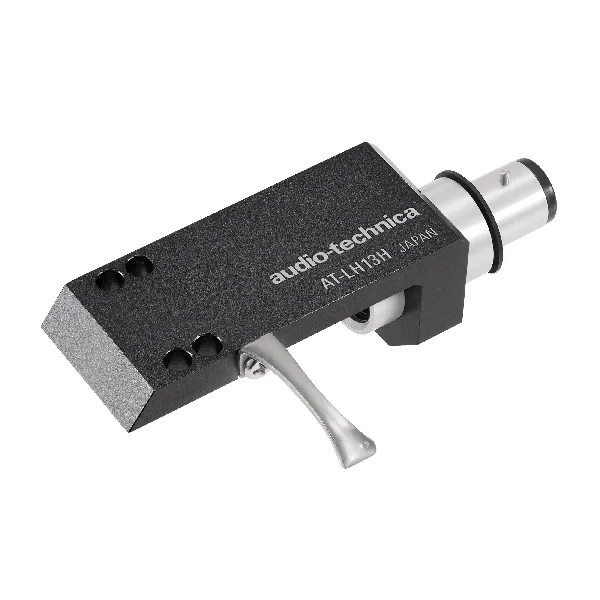
- Audio-Technica AT-LH13H - Buy. A hard-anodised aluminium shell with an adjustable cylinder for azimuth and overhang, sold in four published masses so you can match your arm instead of hoping.
- Audio-Technica AT-HS6 - Buy. A die-cast aluminium universal half-inch shell that weighs 9.3 g with its lead wires fitted and does the fundamentals without asking for much.
- Ortofon LH-2000 - It depends. A 15.5 g solid aluminium shell with a generous slot range, which is exactly right for a stiff low-compliance cartridge and exactly wrong for a springy one.
- Ortofon LH-9000 - Skip. Ortofon's flagship shell asks the highest price here for a magnesium and carbon fiber body whose resonance claim carries no published measurement, and it is the heaviest of the four.
The verdict in 30 seconds
What mattered most
- Published mass
- Body material
- Other masses in the range
- Azimuth adjustment
- Overhang adjustment
- Lead wires supplied
A headshell looks like a bracket, and most people shop for it like one. It is not. The headshell mass adds directly to the tonearm's effective mass, and that total, together with your cartridge's compliance, sets the frequency at which the whole arm and cartridge assembly wants to bounce. Ortofon publishes the formula and puts the optimal answer at 7 to 12 Hz, so picking a headshell is a tuning decision with a right answer for your particular arm and cartridge. We looked at four bayonet-mount shells you can buy now, from two makers who publish real numbers.
A hard-anodised aluminium shell with an adjustable cylinder for azimuth and overhang, sold in four published masses so you can match your arm instead of hoping.
Best for: Someone who swaps cartridges, or who wants to dial azimuth rather than trust the arm to be perfect.
- Audio-Technica states the adjustable cylinder sets both azimuth and overhang, which no other shell here publishes.
- The same design is sold at 11 g, 13 g, 15 g and 18 g, so mass becomes something you choose rather than accept.
- OFC lead wires, plastic washers, M2.6 cartridge screws and a hex wrench are all in the box.
- Audio-Technica's Japanese spec sheet lists about 13.4 g bare and about 14.2 g with lead wires, so the 13 gram name understates what actually lands on your arm.
- The cartridge screw holes are round rather than slotted in Audio-Technica's own product photo, so all fore and aft trim has to come from the cylinder.
- It costs several times what a plain die-cast shell costs, and a lot of that money buys adjustment you may only use once.
- The adjustable joint is one more thing to get properly tight, and a loose cylinder undoes the alignment you just set.
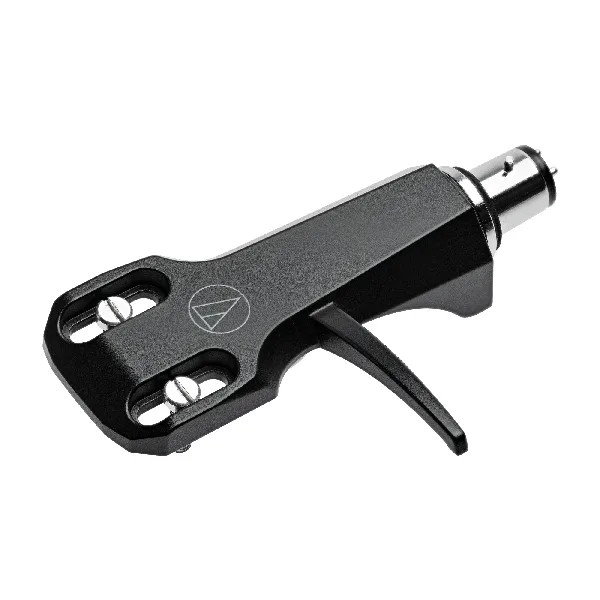
A die-cast aluminium universal half-inch shell that weighs 9.3 g with its lead wires fitted and does the fundamentals without asking for much.
Best for: A high-compliance moving magnet cartridge on a bayonet arm, where light is what you want anyway.
- Audio-Technica's manual puts it at about 9.3 g with lead wires and about 8.4 g without, both figures excluding the cartridge screws.
- Slotted mounting holes are clearly visible in Audio-Technica's product photo, and the manual tells you to leave the screws loose while you set overhang.
- Colour-coded lead wires, mounting screws, nuts and washers are supplied, and there is a moulded finger lift.
- No azimuth adjustment is published, so you are relying on the arm and the shell being square.
- At 9.3 g it is on the light side, which is the wrong direction if you are running a low-compliance moving coil.
- The finger lift is part of the casting, so you cannot remove it to shed mass or change its angle.
- Only one mass is offered, so if the number is wrong for your arm your only move is a different shell.
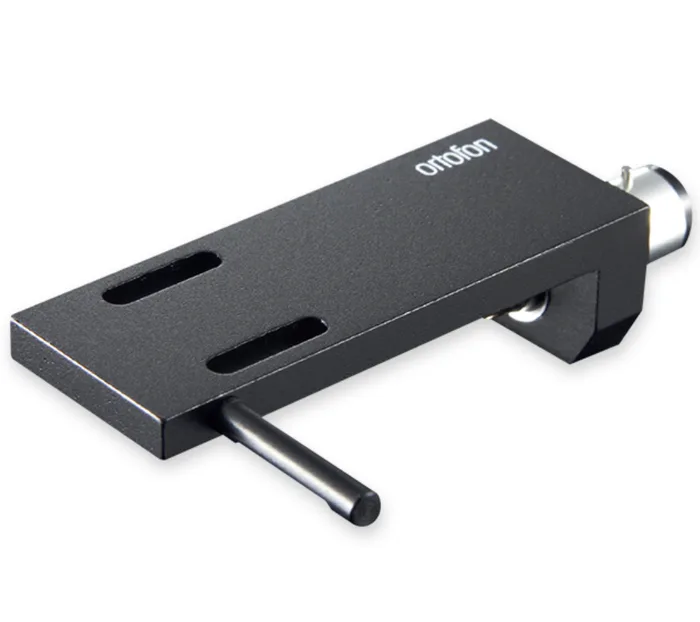
A 15.5 g solid aluminium shell with a generous slot range, which is exactly right for a stiff low-compliance cartridge and exactly wrong for a springy one.
Best for: A low-compliance moving coil on a low or medium effective mass arm that needs mass added to reach the resonance window.
- Ortofon publishes 15.5 g without screws plus a mounting distance range of 35.3 to 43.4 mm, so you can check alignment before buying.
- Solid aluminium construction with slots long enough to set overhang on most bayonet arms.
- Colour-coded lead wires are included, and Ortofon documents which colour is hot and which is ground for each channel.
- No azimuth adjustment appears in Ortofon's published specification.
- 15.5 g is a lot of mass to add if your cartridge is a high-compliance moving magnet, and it can drive the resonance below Ortofon's own 7 Hz floor.
- Ortofon notes its headshell pins are 1.0 mm while its cartridge pins are 1.2 mm, so lead wire fit is not symmetrical at the two ends.
- Ortofon quotes mass without screws, so add the cartridge hardware yourself before you do the arithmetic.
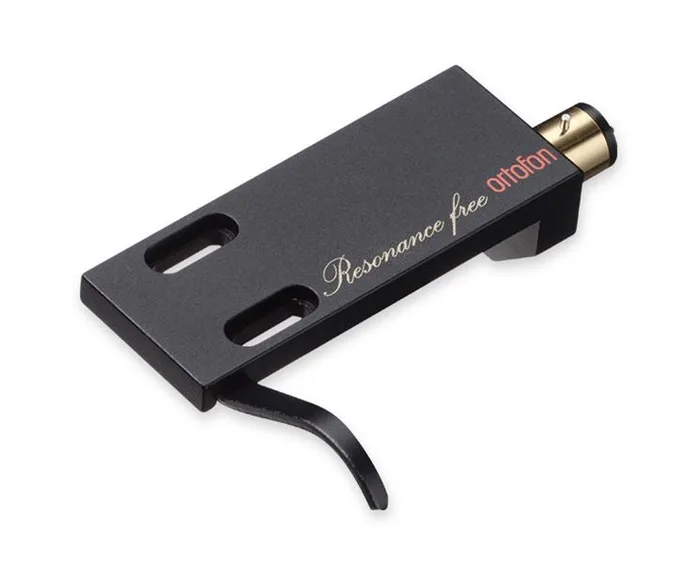
Ortofon's flagship shell asks the highest price here for a magnesium and carbon fiber body whose resonance claim carries no published measurement, and it is the heaviest of the four.
Best for: Owners of the high-end Ortofon moving coils it is designed around, who have already checked the mass arithmetic and want the matching part.
- Ortofon publishes 16.8 g without screws and a 38.1 to 44.9 mm mounting distance range, so the geometry is checkable up front.
- Ortofon names the cartridges it is intended for, including the Cadenza series, MC A95, MC Diamond and MC Windfeld Ti.
- Lead wires are supplied, and Ortofon documents the colour coding of its cartridge terminals.
- Ortofon describes it as made with carbon fiber resin for the elimination of unwanted resonances but publishes no measurement to support that.
- It costs substantially more than the LH-2000 while offering the same slot-based overhang adjustment and no published azimuth adjustment.
- At 16.8 g it is the heaviest shell here, which narrows rather than widens the range of cartridges it suits.
- Its minimum mounting distance of 38.1 mm is longer than the LH-2000's 35.3 mm, so it gives you less room to pull a cartridge back.
| Criteria | AT-LH13H Top pick | AT-HS6 | LH-2000 | LH-9000 |
|---|---|---|---|---|
| Verdict | Buy it | Buy it | It depends | Skip it |
| Best for | Someone who swaps cartridges, or who wants to dial azimuth rather than trust the arm to be perfect. | A high-compliance moving magnet cartridge on a bayonet arm, where light is what you want anyway. | A low-compliance moving coil on a low or medium effective mass arm that needs mass added to reach the resonance window. | Owners of the high-end Ortofon moving coils it is designed around, who have already checked the mass arithmetic and want the matching part. |
| Price tier | $$ · mid-range | $ · budget | $$ · mid-range | $$$ · premium |
| Published mass | 13.4 g bare, 14.2 g with leads, no screws | 8.4 g bare, 9.3 g with leads, no screws | 15.5 g without screws | 16.8 g without screws |
| Body material | Aluminium, hard anodised | Die-cast aluminium | Solid aluminium | Magnesium with carbon fiber |
| Other masses in the range | 11 g, 15 g and 18 g siblings | None published | LH-4000 at 14.3 g, LH-6000 at 13.5 g | Top of the Ortofon LH range |
| Azimuth adjustment | Yes, adjustable cylinder | Not published | Not published | Not published |
| Overhang adjustment | Via the cylinder; round cartridge holes | Slotted mounting holes | Slots, 35.3 to 43.4 mm | Slots, 38.1 to 44.9 mm |
| Lead wires supplied | Yes, OFC | Yes, colour-coded | Yes, colour-coded, 1.0 mm shell pins | Yes, colour-coded, 1.0 mm shell pins |
| Mount | Universal half-inch, four-pin bayonet | Universal half-inch, four-pin bayonet | Bayonet, SME type | Bayonet, SME type |
| Price tier | $$ · mid-range | $ · budget | $$ · mid-range | $$$ · premium |
Which one is right for you?
- Someone who swaps cartridges, or who wants to dial azimuth rather than trust the arm to be perfect. Buy it Audio-Technica AT-LH13H
- A high-compliance moving magnet cartridge on a bayonet arm, where light is what you want anyway. Buy it Audio-Technica AT-HS6
- A low-compliance moving coil on a low or medium effective mass arm that needs mass added to reach the resonance window. It depends Ortofon LH-2000
- Owners of the high-end Ortofon moving coils it is designed around, who have already checked the mass arithmetic and want the matching part. Skip it Ortofon LH-9000
How we judged the field
Five things decide whether a headshell is right for you, and only one of them is about how it looks. Mass comes first, because the headshell adds directly to the arm’s effective mass and that total sets the resonance frequency of the arm and cartridge together. Ortofon publishes both the formula, F = 1000 / (2 x pi x the square root of (M x C)), and the target: 7 to 12 Hz optimal, 6.5 to 7 and 12 to 14 workable, outside that questionable. Second is what the published mass actually includes, because makers do not agree: Audio-Technica’s manual gives the AT-HS6 as about 9.3 g with lead wires and 8.4 g without, while Ortofon quotes 15.5 g for the LH-2000 without screws. Third is adjustment, meaning whether the cartridge holes are slots or fixed holes and whether azimuth can be set at all. Fourth is what comes in the box, since lead wires, washers and the right screws are not universal. Fifth is fit, which is why the published mounting distance range matters more than the marketing.
The field splits cleanly on price and on intent. At the bottom sit die-cast aluminium shells under 10 g, made to hold a moving magnet cartridge and nothing more, and the AT-HS6 is the clearest example of that done properly. In the middle sit machined shells in the 13 to 16 g band, where you are paying either for adjustment, as with the Audio-Technica LH series, or for solid metal, as with the Ortofon LH-2000. At the top sit exotic-material shells that ask a lot more and justify it with claims about resonance, and the Ortofon LH-9000 is the one most people will be tempted by. We picked one from each of those tiers plus a second Audio-Technica so the mass range on show spans 9.3 g to 16.8 g, which is roughly the span that decides whether your particular cartridge lands inside the window or outside it.
Audio-Technica AT-LH13H
Buy itThe AT-LH13H is the shell to buy if you want the decision to stay reversible. Audio-Technica calls it a 13 gram headshell, and the Japanese spec sheet is more precise: about 13.4 g bare and about 14.2 g with the OFC lead wires fitted, both excluding cartridge screws. The body is aluminium with a hard anodised finish, the terminal pins are PCOCC, and the fitting is the universal half-inch four-pin bayonet. The part that earns the money is the adjustable cylinder at the connector, which Audio-Technica states sets both azimuth and overhang, and which is why a hex wrench is in the box. That matters because the cartridge screw holes themselves are round rather than slotted in Audio-Technica’s own product photo, so all fore and aft trim comes from the cylinder. The trade-off is cost and one more joint to keep tight. What makes it the pick anyway is the family: the identical design exists at 11, 15 and 18 grams, so if 13 turns out to be wrong you change a number rather than a philosophy. For anyone who swaps cartridges or wants azimuth control, this is the one.
Audio-Technica AT-HS6
Buy itThe AT-HS6 is what a cheap headshell should be. Audio-Technica’s manual puts it at about 9.3 g with the lead wires fitted and about 8.4 g without, excluding the cartridge screws, and the body is die-cast aluminium with a moulded finger lift. The mounting holes are slotted, clearly visible in the maker’s own photo, and the manual tells you to leave the screws loose until overhang is set, then align the stylus tip against a reference. Colour-coded lead wires, screws, nuts and washers are all included. There is no azimuth adjustment published, and the finger lift is part of the casting, so what you get is a fixed geometry that either suits your arm or does not. The strength is the mass. At 9.3 g it is the lightest shell here, which is the correct direction for the high-compliance moving magnet cartridges most people are running, because those need the total system mass kept down to stay inside the resonance window. If your cartridge is a typical moving magnet, this is the sensible default and the cheapest of the four.
Ortofon LH-2000
It dependsThe Ortofon LH-2000 is a tool for a specific job. It is 15.5 g without screws, solid aluminium, with slots giving a mounting distance range of 35.3 to 43.4 mm, and colour-coded lead wires included. That mass is the whole story. Ortofon’s own guidance says high system mass requires low compliance, and its resonance page classifies cartridges around 5 to 10 micrometres per millinewton as very low compliance and arms of 11 to 25 g effective mass as moderate. Put an Ortofon MC Cadenza Bronze, 10.7 g and 12 micrometres per millinewton, on a 10 g arm with this shell and the total is 36.2 g, which the formula puts at about 7.6 Hz, inside the optimal band. Put a 2M Blue on the same arm with the same shell and you land near 6.2 Hz, below Ortofon’s own floor and close to warp frequencies. There is no published azimuth adjustment, and Ortofon notes its shell pins are 1.0 mm against 1.2 mm cartridge pins. Buy it if the arithmetic asks for mass, not because it is machined from a solid block.
Ortofon LH-9000
Skip itThe Ortofon LH-9000 is the one to leave alone unless you own what it was built for. It is 16.8 g without screws, magnesium with carbon fiber, with slots giving a 38.1 to 44.9 mm mounting distance range, and it sits at the top of the price range here. Ortofon names its intended partners plainly, the Cadenza series, MC A95, MC Diamond and MC Windfeld Ti, and against a cartridge like the Cadenza Bronze the mass genuinely works: 10.7 g of cartridge, 16.8 g of shell and a 10 g arm come out near 7.5 Hz, comfortably inside the window. The problem is everyone else. You are paying a large premium over the LH-2000 for the same slot-based overhang adjustment and no published azimuth adjustment, and the differentiating claim, that carbon fiber resin eliminates unwanted resonances, comes with no published measurement. Its minimum mounting distance is also 2.8 mm longer than the LH-2000’s, so it gives you less room to pull a cartridge back. For owners of those specific Ortofon moving coils it is the matching part. For anyone else it is the wrong end of the price list.
Sources
Specs in this review come from these pages.
- Ortofon - Resonance frequency, support (ortofon.com)
- Ortofon - Technical FAQ (ortofon.com)
- Audio-Technica - AT-LH13H product page (audio-technica.com)
- Audio-Technica - AT-HS6 user manual (PDF) (docs.audio-technica.com)
- Audio-Technica - AT-VM95E specifications (audio-technica.com)
- Rega - RB330 tonearm technical specifications (rega.co.uk)
Audio-Technica AT-LH13H vs Audio-Technica AT-HS6: which should you buy?
The AT-LH13H and the AT-HS6 are the same manufacturer answering two different questions. The HS6 answers the cheap one: get a cartridge onto a bayonet arm, keep the mass low, give the user slots so overhang can be set, and include decent lead wires. At about 9.3 g with those wires fitted, it is the light end of this comparison, and light is what a high-compliance moving magnet wants. The LH13H answers the fussy one: give the user azimuth as well as overhang, publish four masses across the same design so mass becomes a variable, and supply OFC wires with PCOCC pins. At about 14.2 g with wires, it is a meaningfully different thing on the end of your arm, not a nicer-looking version of the same object.
Choose by doing the sum before you shop. Weigh or look up your cartridge, find your arm’s effective mass, then add the headshell figure and run Ortofon’s formula. If the answer with a 9 g shell already sits in the 7 to 12 Hz band, buy the HS6 and put the difference towards a better stylus. If the answer comes out above 12 Hz, you need mass and the LH series gives you a choice of how much. If you swap cartridges, or if you have ever suspected your arm’s azimuth is not quite square, the LH13H’s adjustable cylinder is worth the money on its own. And if the answer comes out below 7 Hz with any of them, the honest conclusion is that the cartridge and arm are mismatched and no headshell will rescue it.
What to look for
- Published mass, and what it includes: Audio-Technica quotes the AT-HS6 both with lead wires (9.3 g) and without (8.4 g) while Ortofon quotes the LH-2000 without screws (15.5 g), so compare like with like before you add anything up.
- Mounting distance range: Ortofon prints a minimum and maximum for each shell, 35.3 to 43.4 mm on the LH-2000 for instance, and that range tells you whether you can actually reach correct overhang on your arm.
- Slots versus fixed holes: slots let you set overhang at the cartridge, fixed round holes push that adjustment somewhere else, which on the Audio-Technica LH series is the cylinder at the connector.
- Azimuth adjustment, stated not assumed: Audio-Technica says the LH series cylinder sets azimuth and overhang, and none of the other shells here publish an azimuth adjustment, so do not assume one exists because the shell looks expensive.
- What is in the box: every shell here comes with lead wires, Audio-Technica adds plastic washers and both lengths of M2.6 screw, the AT-HS6 adds nuts, and a hex wrench comes with the LH series, which saves a separate order.
- Material claims without measurement: treat body material as a mass and stiffness decision, and be sceptical of resonance claims like the LH-9000’s carbon fiber resin description unless the maker publishes data behind it.
Our final take
Buy the headshell your arithmetic asks for, not the one that photographs best. Find your cartridge’s compliance, note the frequency it was measured at, add your arm’s effective mass and the shell mass, then run Ortofon’s formula. Land between 7 and 12 Hz and you are done. For most people running a moving magnet on a bayonet arm, the AT-HS6 is the right answer and the cheapest one. If you swap cartridges or want azimuth control, the AT-LH13H is worth the step up, and its 11, 15 and 18 gram siblings are the reason. The Ortofon LH-2000 earns its place when a stiff moving coil needs mass added. The LH-9000 is the matching part for a few costly Ortofon cartridges and the wrong buy for everyone else.
Questions, answered
Does a heavier headshell give me better bass?
Not as a rule, and treating it that way is how people end up with a worse-sounding deck. Mass changes where the arm and cartridge resonance sits, and Ortofon puts the optimal answer at 7 to 12 Hz using the formula F = 1000 / (2 x pi x square root of (M x C)), where M is the summed effective mass of arm, cartridge, headshell and screws, and C is the cartridge compliance. Adding mass pushes that frequency down. If your combination was already sitting near the bottom of the window, extra mass moves it into the 4 to 6 Hz region that Ortofon warns record warps will excite, and what you hear is woolly, unstable low end rather than more bass. If your combination was sitting high because you are running a stiff low-compliance cartridge, then yes, mass helps, because it brings the number back into range.
How do I know whether my turntable takes a detachable headshell at all?
Look at the front end of the arm. If there is a knurled collar behind the cartridge that unscrews and lets a plug pull straight out, you have the universal bayonet fitting these shells use, and Ortofon calls that mount Bayonet or SME type while Audio-Technica calls it universal half-inch mount for four-pin cartridges. Not every arm works this way; Rega's RB330, for example, is specified by Rega as a complete arm with one effective mass figure, 11 g, and no separate headshell is listed. If yours is built in, there is nothing here for you to buy.
My cartridge's compliance is printed with 100 Hz next to it. Can I just use that number?
No, and this is the single most common way the calculation goes wrong. Audio-Technica publishes the AT-VM95E as 7 x 10 to the minus 6 cm per dyne of dynamic compliance at 100 Hz, and separately as 17 x 10 to the minus 6 static, which shows how far apart figures for the same cartridge can be depending on how they were taken. The resonance formula wants the low-frequency lateral compliance, which is what Ortofon quotes in micrometres per millinewton, and the two are not interchangeable. The units themselves do line up: 1 x 10 to the minus 6 cm per dyne equals 1 micrometre per millinewton, so the conversion is trivial even though the measurement conditions are not. If your maker only prints a 100 Hz figure, treat any number you calculate from it as a rough sighting shot and confirm with a test record rather than trusting it.
Do I have to redo the alignment when I change headshells?
Yes, and you should assume that from the outset. Overhang is set by where the stylus tip sits relative to the platter spindle, and every headshell puts the cartridge at a slightly different distance: Ortofon publishes a mounting distance range of 35.3 to 43.4 mm for the LH-2000 and 38.1 to 44.9 mm for the LH-9000, so even two shells from the same maker do not land in the same place. Tracking force also needs resetting, because a different shell mass changes the balance point and your counterweight has to move. Audio-Technica's AT-HS6 manual tells you to tighten the cartridge screws only lightly at first so the position can still be adjusted, which is the right habit. Budget an hour with an alignment protractor and a stylus force gauge.
Are the supplied lead wires good enough, or should I buy better ones?
All four shells here come with lead wires already, and the makers do say what they are: Audio-Technica fits OFC wires with PCOCC terminal pins on the LH series and colour-coded wires on the AT-HS6, while Ortofon supplies colour-coded wires with its shells. Fit matters more than metallurgy. Ortofon points out that its cartridge terminal pins are 1.2 mm across while its headshell pins are only 1.0 mm, so a lead has to grip two different diameters properly at its two ends, and a loose clip is an audible fault in a way that wire alloy is not. Start with what is in the box, check every clip is snug, and only go shopping if one of them will not hold. Nobody has published a controlled measurement showing an audible benefit from upgraded leads on an otherwise correct install.
Deciding between the top two? See our head-to-head: Audio-Technica AT-LH13H vs Audio-Technica AT-HS6.
More Audio reviews
 The Best Home Karaoke Machines: 4 Compared (and One to Skip)
  The Best Volume-Limited Kids' Headphones: 4 Compared (and One to Skip)
  The Best Microphone Boom Arms: 4 Compared (and One to Skip)
  The Best Microphone Shock Mounts: 4 Compared (and One to Skip)
  The Best MIDI Keyboard Controllers: 4 Compared (and One to Skip)
  The Best Music Streamers: 4 Compared (and One to Skip)