Explained
Gym Chalk, Explained
After reading, you'll know which form suits your training and your gym, what grind size changes, and how much chalk you actually need.
In this guide
Chalk is magnesium carbonate, and it improves grip by absorbing moisture from your skin so that friction comes from contact rather than from a film of sweat. Everything else in this category is about how that compound is delivered: as a block, as loose powder in a particular grind, suspended in alcohol as a liquid, or in a dispenser designed to keep it off the floor.
The 30-second version
- Magnesium carbonate is the active ingredient, whatever form it is sold in.
- Grind changes feel and consumption, with fine coating evenly and chunky laying down a heavier layer.
- Mess is why gyms ban it, so check whether the rule covers loose, block or all chalk.
- Liquid lasts longer per application, and produces almost no airborne dust.
- You need less than you think, since roughly 10 grams covers around 40 uses.
The products this guide is about
Our verdict on each, with the full reasoning on the companion review.
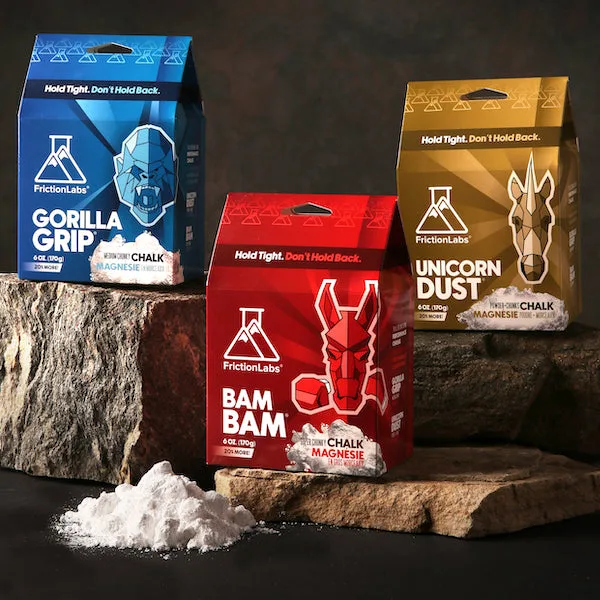
- Buy Friction Labs Loose Chalk Three named grinds in three sizes, so you can find the texture you actually like.
- Buy Spider Chalk Super Performance Powder Chalk Ten ounces of US-made lab-grade magnesium carbonate, in your choice of two grinds.
- It depends Bear KompleX Clean Chalk Pod A twist-up magnetic dispenser for gyms that have banned the loose stuff.
- Skip Gymreapers Gym Chalk, 1 lb A pound of blocks to crush yourself, with nothing published about what is in them.
What actually matters
- Form - block, loose, liquid or dispenser. This decides how much dust you create and whether your gym permits it.
- Grind or particle size - fine powder coats evenly and quickly; chunky blends are crushed in the hand and leave a thicker, longer-lasting layer.
- Composition - magnesium carbonate, ideally with a purity figure, plus any drying agents or, in liquid chalk, the alcohol carrier.
- Quantity - from 10 gram refills to five pound boxes, with cost per gram varying enormously between them.
- Packaging - resealable bags, boxes, individually wrapped blocks or refillable pods, which determines what happens in a gym bag.
- Origin - whether the maker manufactures the chalk or rebags someone else's, which the better brands state.
- Hygiene - whether the product is shared by hand from a communal container, which dispensers and liquids avoid.
The specs, in plain English
Green flags vs red flags
Green flags
- Grind or texture offered as an explicit choice.
- Magnesium carbonate named, with a purity figure if available.
- Country of manufacture stated, and whether the maker produces or rebags.
- Quantity given in grams or ounces with a usage guide.
- Resealable or refillable packaging.
Red flags
- Premium chalk claimed with no composition at all.
- No grind or texture information on a loose chalk.
- No country of manufacture anywhere on the page.
- Additives implied but not listed.
- Quantity given only as a pack with no weight.
Who's who: the brands
- Friction Labs - Colorado maker selling loose chalk by named texture in three blends and three sizes, in fully recyclable packaging, alongside a liquid chalk.
- Spider Chalk - US manufacturer of lab-grade magnesium carbonate in large resealable bags, offering powder and chunky textures plus block and liquid versions.
- Bear KompleX - Functional fitness brand whose Clean Chalk Pod is a refillable twist-up magnetic dispenser aimed at gyms that ban loose chalk.
- Gymreapers - Value strength brand selling block chalk by the pound, chalk balls and liquid chalk alongside its belts and sleeves.
- Black Diamond - Climbing equipment maker whose loose chalk, chalk balls and liquid chalk are the reference products in the climbing market.
How to read a listing without getting fooled
Start with your gym's rules, because they may rule out most of the category before you compare anything, and the rule is usually about loose and block chalk rather than chalk as such. Then look for a grind or texture option, because that is the difference you will actually notice and a maker offering a choice has taken the question seriously. Look for composition, and be aware that a purity figure is rare enough that its absence is normal rather than suspicious, though a page that will not even name magnesium carbonate is telling you something. Check the quantity against realistic use, remembering that around 10 grams covers roughly 40 applications, so a pound is a very long time for one person. Check whether the packaging reseals, since an open box in a gym bag is a disaster. And note whether the brand says it manufactures the chalk, because a lot of what is on sale is bulk product in a new bag.
How much should you spend?
Chalk is cheap in absolute terms and the price per gram varies by more than a factor of twenty across this category, which makes it worth thinking about. Block chalk by the pound is by far the lowest cost per gram and is the right purchase for a home gym or a garage, accepting that you crush it yourself and that it is messy. Loose chalk in a large resealable bag is the sensible middle, and one 10 ounce bag will last an individual a very long time. Premium loose chalk sold in small boxes costs several times as much per ounce, and the thing you are actually buying is the ability to choose a grind, which is a legitimate purchase once and a questionable one every time. Dispenser pods are the most expensive per gram by a distance and are bought for compliance with gym rules and for travel rather than for value.
Questions, answered
Is chalk bad for my skin?
It dries the skin, which is the point, and over time that can lead to cracking and splitting, particularly for climbers who use a lot of it on already-callused hands. The usual management is to wash the chalk off after training rather than leaving it on, and to use a hand salve or moisturiser afterwards. Some chalks include drying agents that make this worse, and almost nobody lists their additives, so if you get irritation, switching to a plainer product is a reasonable experiment.
Can I use climbing chalk in the gym and vice versa?
Yes, it is the same compound and the same product. Spider Chalk sells its chalk explicitly for bouldering, rock climbing, weightlifting, powerlifting and functional fitness, and Gymreapers lists the same range of uses. The differences that exist are about preference rather than application: climbers often favour chunkier blends they can work into their fingertips, while lifters frequently want a fine coat across the whole palm. Buy for the texture you like, not the sport on the label.
Does liquid chalk work as well as loose?
It lasts longer per application and it is far less messy, which is why gyms permit it when they ban the rest. What it does not do is let you top up in a few seconds between attempts the way a chalk bag does, since liquid needs a moment to dry. Many people use both, putting down a liquid base coat at the start of a session and adding loose chalk on top for heavy sets. Every brand in this comparison sells a liquid version alongside its loose or block chalk.
How should I store chalk?
Sealed and dry, because magnesium carbonate does exactly what it is supposed to do and absorbs moisture from the air. Chalk that has gone clumpy or pasty has been storing humidity rather than your sweat, and it will not work as well. A resealable bag, a screw-top container or the individually wrapped blocks that Gymreapers uses all address this. Keep it out of a damp garage over winter, and do not leave an open box in a gym bag with a wet towel.
Or jump to the head-to-head: Friction Labs Loose Chalk vs Spider Chalk Super Performance Powder Chalk.