Explained
Lifting Belts, Explained
After reading, you'll know which closure and thickness suit your lifting, how to size a belt correctly, and what to check in the construction.
In this guide
A lifting belt does not hold your back together. It gives your abdominal wall something to push against, which raises the pressure inside your torso and makes the whole trunk stiffer under load. Everything that follows, the thickness, the width, the stiffness of the leather, is about giving you a consistent surface to brace into.
The 30-second version
- The belt is a surface to brace against, not a support that holds you up.
- Lever closes identically every time, prong adjusts freely but is slower and less consistent.
- 10mm suits most lifters, 13mm is stiffer, harder to break in and aimed at maximal powerlifting.
- Width is capped by federations, and rounding the edges quietly reduces it.
- Size from your waist at the navel, not from your trouser size.
The products this guide is about
Our verdict on each, with the full reasoning on the companion review.
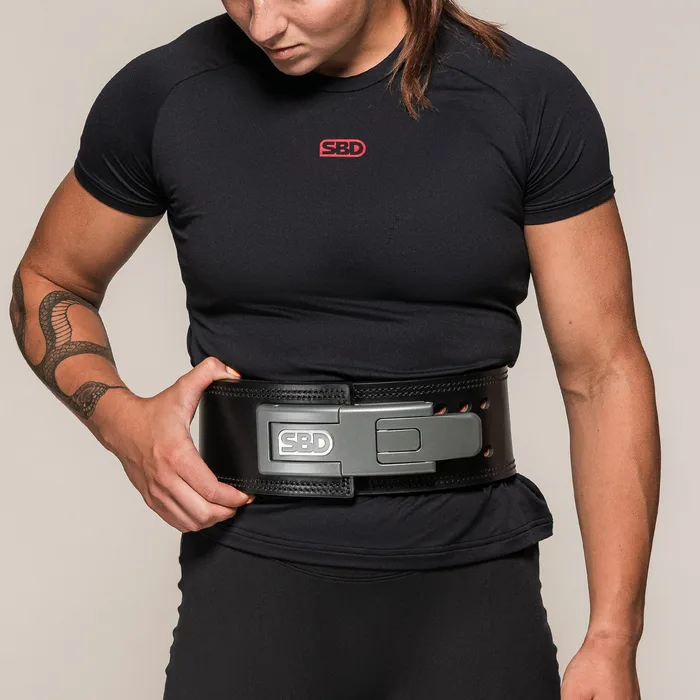
- Buy SBD 10mm Lever Belt A gliding lever that adjusts like a prong belt, in British hide, with both dimensions published.
- Buy Gymreapers 10MM Lever Belt Four federation approvals, published waist ranges, and a lifetime warranty on the belt as well as the lever.
- It depends Inzer Forever Lever Belt 10MM One solid thickness of hide, unrounded edges on principle, and a two month wait.
- Skip Strength Shop 10mm Lever Belt Synthetic rather than hide, with a lifetime warranty that covers the buckle and not the belt.
What actually matters
- Closure type - lever for identical tension every time and fast removal, prong for free adjustment, and gliding levers that combine the two.
- Thickness - 10mm or 13mm. Thicker is stiffer and gives more to brace against, at the cost of comfort and break-in time.
- Width - usually up to 10cm, capped by federation rules. It is the surface area you push into, and it is the number most makers omit.
- Leather construction - a single solid thickness, two cuts chosen for different properties, or laminated layers bonded together. The last is the one that can delaminate.
- Edge treatment - rounded edges are more comfortable against the legs in a deep squat; square edges preserve the full bracing width.
- Federation approval - IPF, IPL, USPA and USAPL each publish equipment rules covering thickness, width and construction.
- Warranty - and specifically whether it covers the belt, the buckle or both, since the two are often warranted differently.
The specs, in plain English
Green flags vs red flags
Green flags
- Width and thickness both published in millimetres or centimetres.
- The leather construction described, single thickness or named cuts.
- Waist circumference ranges against each size.
- Federation approvals named specifically.
- A warranty that states whether it covers the belt, the buckle or both.
Red flags
- No width published on a product whose width is regulated.
- Leather described only as premium or genuine.
- A lifetime warranty that turns out to cover only the hardware.
- Sizes given as letters with no waist measurement.
- No mention of lead time on a made-to-order product.
Who's who: the brands
- SBD - British maker of IPF approved powerlifting equipment, known for the patented gliding lever and for publishing full dimensions and manufacturing origin.
- Gymreapers - Value-focused American brand with wide federation approval, published waist ranges and lifetime warranties covering both belt and lever.
- Inzer - Long-established American powerlifting manufacturer whose Forever Belt is made from one solid thickness of hide, built to order in most configurations.
- Strength Shop - UK strength equipment retailer and brand, notable for IPF approved belts made from Amara synthetic rather than hide.
- Pioneer - American maker known for custom-cut leather belts and a wide range of buckle and lever options, popular in raw powerlifting.
How to read a listing without getting fooled
Find the thickness first and then look for the width, because width is regulated and most makers do not print it. If a belt claims competition legality without stating a width, that is a gap rather than a reassurance. Read how the leather is put together, and look specifically for whether it is one thickness or bonded layers, since delamination is the failure mode that ends a belt's life. Check the edge treatment and understand the trade: rounded is kinder to your legs in a deep squat, square keeps the whole bracing surface. Then find the federation approvals, which are the only independent check here. Read the warranty to the end and work out what it actually covers, because a lifetime warranty on a lever is not a lifetime warranty on a belt. Finally check the sizing method and the lead time, and measure your waist at the navel with a tape before ordering anything.
How much should you spend?
Lifting belts last a long time, which makes the spend easier to justify than most gym equipment. The budget tier now buys a genuine leather lever belt with multiple federation approvals, published waist ranges and a lifetime warranty, which is enough for almost any lifter and is the right place to start. It also buys synthetic belts, which are cheaper still and are the one thing to avoid if you expect to keep it. The mid-range buys single-thickness hide from a specialist maker with decades of reputation behind it, usually at the cost of a long wait. The flagship tier buys published dimensions, domestic manufacture, a tool-free lever and careful attention to how the belt sits against your body. If you compete, treat it as equipment and buy once; if you are still deciding whether belted lifting suits you, the budget tier will tell you without regret.
Questions, answered
How do I size a lifting belt?
Measure around your waist at the level of your navel, standing relaxed, and buy to the maker's chart. This is not your trouser size, which is measured lower and usually smaller, and buying by trouser size is the most common sizing mistake in this category. Gymreapers and Strength Shop both publish waist ranges against every size, which makes it straightforward; where a maker does not, look for a chart elsewhere on the site before ordering. If you are between sizes and using a lever, the smaller size usually works because levers are adjustable.
How long does it take to break in a leather belt?
Weeks to months, depending on thickness. A 10mm belt conforms to your body sooner than a 13mm, which Inzer states directly, and a stiff new belt can feel like a plank for the first several sessions. Rolling it, wearing it around the house and simply using it all help. Do not soak it, bake it or crease it deliberately; a good belt is designed to take a shape gradually and hold it, and forcing the process is how you create a weak point.
Can I use a lever belt in any federation?
Check the rules of the specific federation rather than assuming. The IPF, IPL, USPA and USAPL all publish equipment lists and all of them regulate thickness and width, and belts are approved individually rather than by category. Gymreapers lists four approvals, SBD and Strength Shop list IPF, and Inzer states none on its product page. If you intend to compete, look up the current approved equipment list for your federation before buying, because these lists change.
Should I wear a belt for deadlifts as well as squats?
Most lifters do, on their heaviest sets of both. The mechanism is the same in each case: bracing against the belt raises intra-abdominal pressure and stiffens the trunk. Some people find a thick belt uncomfortable in the deadlift start position, particularly at 13mm, and lift heavier without it; that is worth testing rather than assuming. As with squats, belt the top sets rather than everything, so your trunk still does unassisted work.
Or jump to the head-to-head: SBD 10mm Lever Belt vs Gymreapers 10MM Lever Belt.