

Outdoors & Fitness
The Best Gym Chalk: 4 Compared (and One to Skip)
We compared four gym chalks on form and grind, published composition, quantity per pack, country of manufacture and how much mess each one makes.
The short version
Friction Labs Loose Chalk is the one to buy: three genuinely different blends described by texture, Unicorn Dust as powder with chunks, Gorilla Grip as chunky and Bam Bam as super chunky, in 2.5, 6 and 12 ounce fully recyclable boxes, made in Colorado. Spider Chalk Super Performance is the value pick, lab-made pure magnesium carbonate in an ultra-refined grind, in a 10 ounce resealable bag with a choice of Chunky or Powder texture, manufactured in the USA rather than rebagged. The Bear KompleX Clean Chalk Pod is the answer for gyms that ban loose chalk: a twist-top magnetic dispenser measuring 3.5 by 2 inches, pre-filled with 10 grams of chalk for around 40 uses, sticking to a rack so it is always within reach and putting chalk on your hands rather than the floor. The Gymreapers Gym Chalk is the one to skip: a pound of premium magnesium carbonate in eight individually wrapped 2 ounce blocks, with no grind, no purity figure and no country of manufacture published. Best for: anyone whose bar is slipping on the last set.
Our picks at a glance
- Friction Labs Loose Chalk - Buy. Three named grinds in three sizes, so you can find the texture you actually like.
- Spider Chalk Super Performance Powder Chalk - Buy. Ten ounces of US-made lab-grade magnesium carbonate, in your choice of two grinds.
- Bear KompleX Clean Chalk Pod - It depends. A twist-up magnetic dispenser for gyms that have banned the loose stuff.
- Gymreapers Gym Chalk, 1 lb - Skip. A pound of blocks to crush yourself, with nothing published about what is in them.
The verdict in 30 seconds
What mattered most
- Form
- Grind options
- Quantity
- Composition published
- Purity figure
- Made in
Gym chalk is magnesium carbonate, and that is where the agreement ends. It comes as blocks you crush yourself, loose powder in three different grinds, and a twist-up stick that puts it on your hands and nowhere else. The differences that matter are the particle size, which decides how it feels and how long it lasts, how much you get for the money, and how much of it ends up on the floor, which is the reason most gyms ban the loose stuff. Almost nobody publishes a purity figure, which is the one number that would settle any of it.
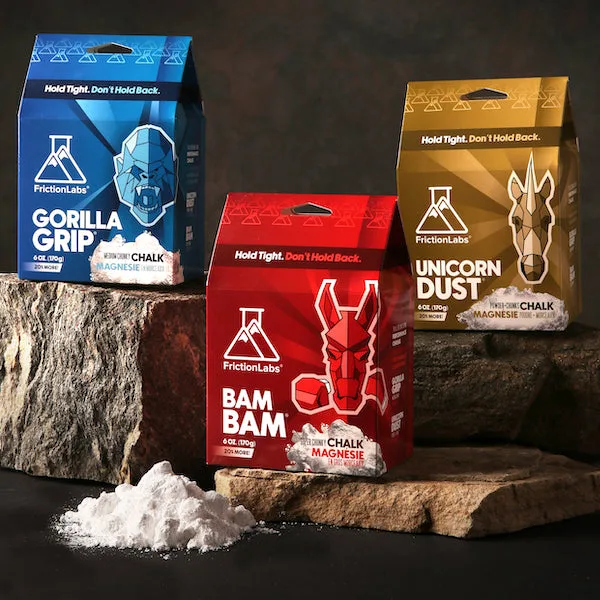
Three named grinds in three sizes, so you can find the texture you actually like.
Best for: Climbers and lifters who care how chalk feels and want to choose a grind deliberately.
- Three distinct blends sold by texture rather than weight: Unicorn Dust as powder with chunks, Gorilla Grip as chunky and Bam Bam as super chunky.
- Three sizes at 2.5, 6 and 12 ounces, so a small box is a cheap way to test a blend before committing to a large one, with a bundle of all three offered at a discount.
- Made in Colorado, in fully recyclable packaging that Friction Labs says should leave nothing for landfill.
- It is by a wide margin the most expensive chalk here per ounce.
- No magnesium carbonate purity figure or composition is published.
- Blend names describe texture in words rather than in particle size, so the only way to compare them is to buy them.
- No drying agents or additives are listed either way.
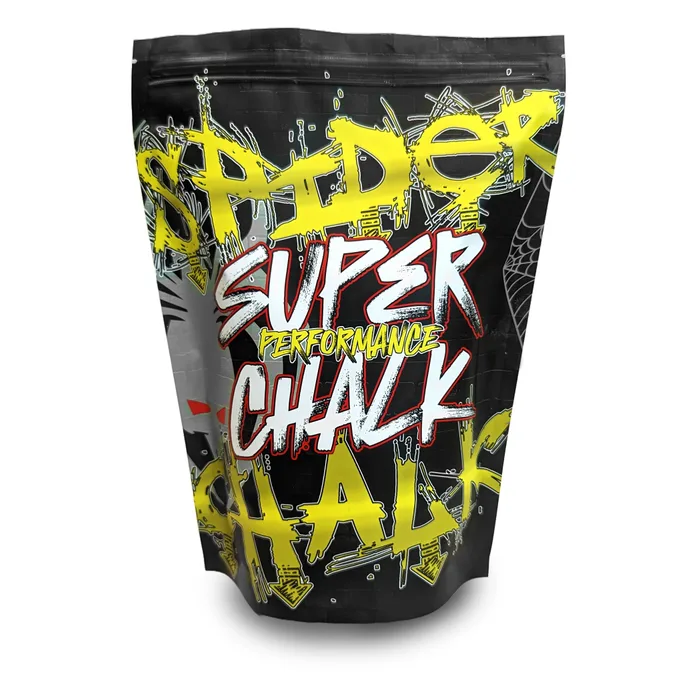
Ten ounces of US-made lab-grade magnesium carbonate, in your choice of two grinds.
Best for: Anyone who already knows they want loose chalk and would rather buy it by the bag.
- Lab-made pure magnesium carbonate in an ultra-refined grind, which Spider Chalk says is why it lasts longer and stays dry through a sweaty session.
- A 10 ounce extra-large resealable zip-lock bag, which is real volume rather than the small bags the climbing market usually sells.
- A choice of two textures, Chunky with dense block pieces mixed through powder or Powder as a fine consistent grind, and Spider Chalk states it manufactures in the USA rather than relabelling imports.
- Lab-grade and ultra-refined are descriptions rather than measurements, and no purity percentage is published.
- One size only, at 10 ounces, with no small trial option.
- No particle size figure is given for either texture.
- Much of the product copy is devoted to criticising competitors rather than describing the chalk.
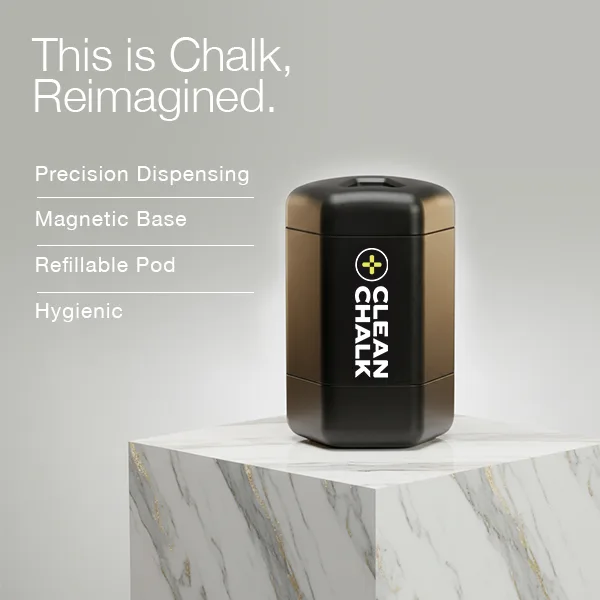
A twist-up magnetic dispenser for gyms that have banned the loose stuff.
Best for: Commercial gyms with a no-loose-chalk rule, and anyone who travels with their own chalk.
- A twist-top design with no removable cap, so chalk goes on your hands rather than into a dust cloud, which is the specific reason many gyms ban loose chalk.
- A magnetic base that sticks to a rack or rig, keeping the chalk within arm's reach rather than across the room in a bucket.
- Small at 3.5 by 2 inches, refillable with either granular or fine chalk, and shareable without passing a communal bucket around.
- It ships with 10 grams of chalk, described as about 40 uses, so refills are the real running cost.
- The chalk itself is named only as Super Grip Chalk, with no composition or purity given.
- Built to last and drop-resistant are claimed with no material named.
- Per gram of chalk it is the most expensive option in this comparison by some distance.
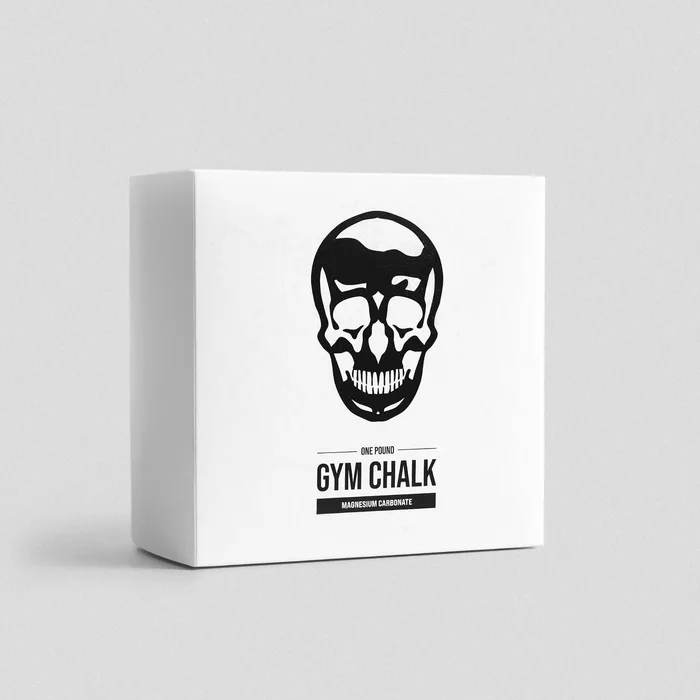
A pound of blocks to crush yourself, with nothing published about what is in them.
Best for: A home gym buying in bulk where cost per pound is the only consideration.
- Eight individually wrapped 2 ounce blocks in a 1 pound box, so the unopened blocks stay clean and dry in a gym bag.
- Available in a 5 pound box as well, which is the cheapest way to chalk a home gym.
- Premium magnesium carbonate suitable across weightlifting, powerlifting, functional fitness, gymnastics and climbing.
- Block chalk has to be crushed by hand, which is the messiest form of an already messy product.
- No grind or particle size is offered or described, because you create it yourself.
- No purity figure, no composition and no country of manufacture are published.
- Gymreapers states that chalk is not eligible for exchanges or returns, so a blend you dislike is a pound of blend you keep.
| Criteria | Loose Chalk Top pick | Super Performance Powder Chalk | Clean Chalk Pod | Gym Chalk, 1 lb |
|---|---|---|---|---|
| Verdict | Buy it | Buy it | It depends | Skip it |
| Best for | Climbers and lifters who care how chalk feels and want to choose a grind deliberately. | Anyone who already knows they want loose chalk and would rather buy it by the bag. | Commercial gyms with a no-loose-chalk rule, and anyone who travels with their own chalk. | A home gym buying in bulk where cost per pound is the only consideration. |
| Price tier | $$$ · premium | $$ · mid-range | $$ · mid-range | $ · budget |
| Form | Loose, three blends | Loose, two textures | Twist-up dispenser stick | Blocks, eight per box |
| Grind options | Powder with chunks, chunky, super chunky | Chunky or powder | Refillable with granular or fine | None, you crush it |
| Quantity | 2.5, 6 or 12 oz | 10 oz | 10 g, about 40 uses | 1 lb or 5 lb |
| Composition published | Not published | Pure magnesium carbonate, lab-made | Not published | Premium magnesium carbonate |
| Purity figure | No | No | No | No |
| Made in | Colorado, USA | USA, manufactured not relabelled | Not published | Not published |
| Mess | Loose, high | Loose, high | Minimal, no dust cloud | Highest, crushed by hand |
| Packaging | Fully recyclable boxes | Resealable zip-lock bag | Refillable magnetic pod | Individually wrapped blocks |
| Portability | Box | Large bag | 3.5 x 2 in, pocketable | Wrapped blocks |
Which one is right for you?
- Climbers and lifters who care how chalk feels and want to choose a grind deliberately. Buy it Friction Labs Loose Chalk
- Anyone who already knows they want loose chalk and would rather buy it by the bag. Buy it Spider Chalk Super Performance Powder Chalk
- Commercial gyms with a no-loose-chalk rule, and anyone who travels with their own chalk. It depends Bear KompleX Clean Chalk Pod
- A home gym buying in bulk where cost per pound is the only consideration. Skip it Gymreapers Gym Chalk, 1 lb
How we judged the field
Gym chalk is one compound, so the first thing we looked for was any statement about what is in the packet beyond the word magnesium carbonate. Purity, particle size, additives, drying agents: all of these change how a chalk behaves, and none of these four publishes a purity percentage. Two of them name the compound and state where it is manufactured, one describes its grind in words, and one says only that it is premium.
Given that, the useful comparisons move to form and grind. Block, loose and dispenser are three different products with three different mess profiles, and mess is not a trivial consideration when many commercial gyms ban loose chalk outright. Grind decides how the chalk feels and how fast you get through it, and the makers who offer a choice are the ones taking it seriously. Then quantity, where the range runs from 10 grams to five pounds and the cost per gram varies by more than an order of magnitude. And finally the practicalities: resealable packaging, individually wrapped blocks, recyclability, and whether the thing sticks to a rack.
Friction Labs sells chalk the way a coffee roaster sells beans, by character rather than by weight, and that is the reason to buy it. There are three blends and they are genuinely different: Unicorn Dust is powder with chunks through it, Gorilla Grip is chunky, and Bam Bam is super chunky. Since almost nobody publishes a particle size, describing a grind in words and then letting you buy a small box of each is the most practical help anyone in this category offers. The sizes are 2.5, 6 and 12 ounces, with a bundle of all three at a discount, so finding your preference costs very little. It is made in Colorado, and the packaging is fully recyclable, with Friction Labs stating that no part of it should end up in landfill. The reservations are about price and about information. It is the most expensive chalk here per ounce by a considerable margin, and behind the blend names there is no purity figure, no composition and no statement about additives, so the texture descriptions are all you have to go on.
Spider Chalk Super Performance is the sensible bulk purchase and its page is unusually specific about provenance. The chalk is lab-made pure magnesium carbonate, ultra-refined, and Spider Chalk argues that the refinement is why it lasts longer and stays dry through a sweaty session rather than turning to paste. It comes in a 10 ounce resealable zip-lock bag, which is deliberately larger than the small bags the climbing market usually sells, and there is a choice of two textures: Chunky, which is dense block pieces mixed through powder, and Powder, which is a fine consistent grind. Spider Chalk also states plainly that it manufactures in the USA rather than relabelling imported chalk, which is a meaningful claim in a category where a great deal of product is rebagged. The gaps are the same ones that run through this whole comparison. Lab-grade and ultra-refined are adjectives, not measurements; there is no purity percentage and no particle size for either texture; and there is only one size, so trying it means buying 10 ounces. A noticeable share of the product copy is spent on competitors rather than on the chalk.
The Bear KompleX Clean Chalk Pod is not really competing with the others, which is why it is a qualified recommendation rather than a ranking. It is a twist-top dispenser with no removable cap, so chalk is applied directly to the hands with no dust cloud and nothing to spill, and a magnetic base sticks it to a rack or rig so it is within reach rather than in a bucket across the gym. It measures 3.5 by 2 inches, small enough for a gym bag or a pocket, it is refillable with either granular or fine chalk, and because nobody dips their hands into it, it can be shared without passing bacteria around a communal bucket. For a gym that bans loose chalk, this is a genuine solution rather than a compromise. The limits are arithmetic. It arrives with 10 grams of chalk, which Bear KompleX rates at about 40 uses, so the pod is the purchase and the refills are the ongoing cost, and per gram of chalk it is far and away the most expensive thing here. The chalk inside is described only as Super Grip Chalk, and the claim that it is drop-resistant and gym-proof comes without a material.
Gymreapers Gym Chalk is the cheapest way to buy magnesium carbonate in this comparison and the least informative. A 1 pound box holds eight individually wrapped 2 ounce blocks, which is a sensible format in that the unopened blocks stay clean and dry in a gym bag rather than coating everything, and a 5 pound box is available for a home gym. The chalk is described as premium magnesium carbonate and recommended across weightlifting, powerlifting, functional fitness, gymnastics and climbing, which is true of all magnesium carbonate. Beyond that the page says nothing. There is no purity figure, no composition, no country of manufacture and no particle size, because with block chalk the grind is whatever you produce by crushing it in your hands, which is also the single dustiest way to use chalk and the practice most responsible for gym bans. Gymreapers also notes that chalk is not eligible for exchanges or returns, which is reasonable on hygiene grounds and does mean that a pound you dislike is a pound you keep.
Friction Labs Loose Chalk vs Spider Chalk Super Performance Powder Chalk: which should you buy?
Friction Labs against Spider Chalk is a choice between selection and volume. Friction Labs is the only brand here that treats grind as the product, offering three named textures from powder-with-chunks through to super chunky, and selling them in 2.5 ounce boxes so trying all three costs very little. Since nobody in this category publishes a particle size, that ability to sample is worth more than any claim on either page, and the Colorado manufacture and fully recyclable packaging are real points in its favour.
Spider Chalk answers with ten ounces in a resealable bag for a fraction of the price per ounce, a choice between two textures rather than three, and a clear statement that it manufactures the chalk in the USA rather than rebagging someone else’s. For anyone who already knows whether they prefer fine powder or chunks, that is the better purchase by a wide margin, and the resealable bag is more practical than a box once opened. Buy the Friction Labs sampler if you have never thought about grind and want to find out what you like. Buy the Spider Chalk once you know.
What to look for
- The form, and your gym’s rules: block and loose chalk are banned in many commercial gyms, and dispensers and liquids usually are not.
- A named grind or texture option: particle size changes how chalk feels and how fast it goes, and a maker offering a choice has thought about it.
- Composition beyond the word chalk: magnesium carbonate stated, and ideally a purity figure, which nobody in this comparison publishes.
- Quantity against how much you actually use: around 10 grams is roughly 40 applications, so a pound is a gym purchase rather than a personal one.
- Country of manufacture: a great deal of chalk is rebagged, and the brands that manufacture say so.
- Packaging that reseals: an opened box of loose chalk in a gym bag ends badly, and a zip-lock or a screw-top does not.
Our final take
Gym chalk is one compound sold four ways, and since nobody publishes a purity figure, the sensible basis for choosing is texture, quantity and mess. Friction Labs Loose Chalk is the one to buy: three named grinds, three sizes so sampling is cheap, Colorado manufacture and fully recyclable packaging. Spider Chalk Super Performance is the better value once you know which texture you want, with ten ounces of US-made lab-grade magnesium carbonate in a resealable bag. The Bear KompleX Clean Chalk Pod is the right answer for a gym that bans the loose stuff or for travel, as long as you understand you are buying a dispenser and then buying the chalk. And a pound of unmarked blocks you crush by hand is the cheapest chalk and the least you will ever know about what you are putting on your hands.
Questions, answered
What is gym chalk actually made of?
Magnesium carbonate, which absorbs moisture and increases friction between your skin and the bar. That is the whole active ingredient, and it is the same compound whether it comes as a block, a powder or a liquid. What differs between brands is purity, particle size and whether anything else has been added, such as drying agents or, in liquid chalk, alcohol as a carrier. Notably, none of the four products here publishes a purity percentage, which is the one figure that would let you compare them on substance rather than on texture.
Block, loose or liquid?
Block is cheapest and messiest, because you crush it yourself and the crushing is where most of the floor dust comes from. Loose is the standard for climbing and weightlifting, sold in bags or boxes and used from a chalk bag or bucket. Liquid chalk is magnesium carbonate suspended in alcohol that evaporates and leaves a thin bonded layer, which lasts longer per application and produces almost no dust, which is why it is often the only chalk a commercial gym allows. Many people use liquid as a base coat and loose on top.
Does grind size really matter?
It changes how the chalk feels and how much you use. A fine, consistent powder coats evenly and quickly and disappears faster; chunkier blends let you crush a piece in your hand and work it in, which puts down a heavier layer that lasts longer. Friction Labs sells three grinds specifically because people disagree about this, and Spider Chalk offers two. Neither publishes a particle size in microns, so the only way to find your preference is to buy a small quantity of each, which is an argument for a brand that sells 2.5 ounce boxes.
Why do some gyms ban chalk?
Because loose chalk becomes airborne dust that settles on every surface, works into ventilation systems and mirrors, and takes staff time to clean. The ban is almost always on loose and block chalk rather than on chalk as such, which is why liquid chalk and dispenser products like the Clean Chalk Pod exist and market themselves on it. If your gym has a rule, read it: a twist-up applicator or a liquid usually complies where a bucket of loose chalk does not.
How much chalk do I actually need?
Far less than the packaging suggests, if you are using it properly. A thin even coat on the palms and fingers is the goal; a thick crust does not grip better and mostly ends up on the bar and the floor. As a rough guide, Bear KompleX rates 10 grams at around 40 uses, which is a useful benchmark: a 10 ounce bag is therefore hundreds of sessions for one person. Buying a pound at a time makes sense for a gym and very little sense for an individual.
Deciding between the top two? See our head-to-head: Friction Labs Loose Chalk vs Spider Chalk Super Performance Powder Chalk.
More Outdoors & Fitness reviews
 The Best Hammock Straps: 4 Compared (and One to Skip)
  The Best Handlebar Bags: 4 Compared (and One to Skip)
  The Best Handlebar Tape: 4 Compared (and One to Skip)
  The Best Headlamps of 2026: Honest Picks for Trail, Camp, and Everyday
  The Best Heart Rate Monitors: 4 Compared (and One to Skip)
  The Best Hiking Boots of 2026