Explained
Knee Sleeves, Explained
After reading, you'll know which thickness suits your training, how to size a sleeve correctly, and what federation approval does and does not guarantee.
In this guide
A knee sleeve is neoprene compression around a joint. It warms the tissue, it gives you a clearer sense of where the joint is under load, and at the thicker grades it returns a little energy out of the bottom of a squat. It is not a brace, it is not a treatment, and understanding that boundary is most of what you need before buying one.
The 30-second version
- 7mm is for heavy and short, 5mm for volume and conditioning.
- Length is capped at 30 centimetres under IPF rules, and almost nobody publishes theirs.
- Size from a tape measure, not from the letter on your shirt.
- Anatomical multi-panel construction holds compression at depth, where a plain tube gaps at the top.
- A sleeve is not a brace, and persistent knee pain is a clinician's question.
The products this guide is about
Our verdict on each, with the full reasoning on the companion review.
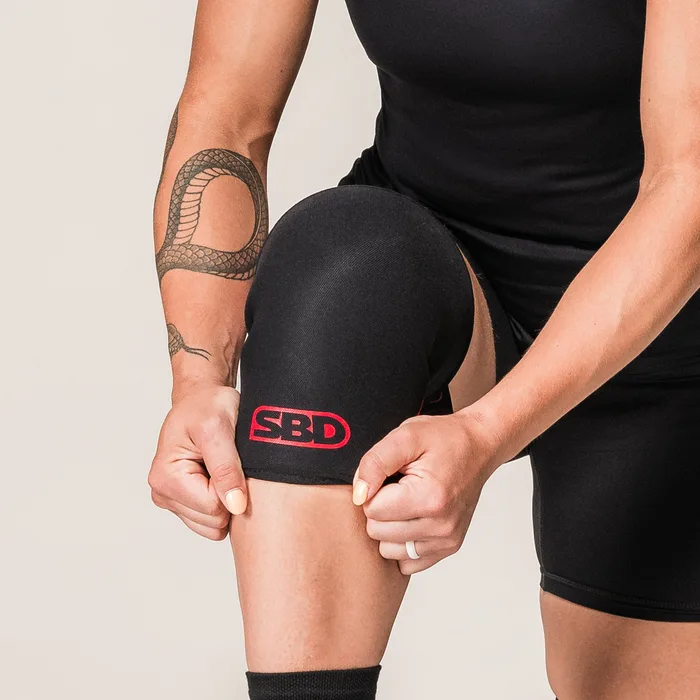
- Buy SBD 7mm Knee Sleeves IPF approved, IWF compliant at the legal maximum length, and the only maker here that states it.
- Buy Gymreapers 7MM Knee Sleeves Four federation approvals, and the only sizes given as an actual knee measurement.
- It depends Rehband RX Knee Sleeve 7mm A 4-panel anatomical shape that holds compression at the bottom of the squat, and honest about its limits.
- Skip Bear KompleX Knee Sleeves One federation approval, hand wash only, and claims the page does nothing to support.
What actually matters
- Thickness - 5mm or 7mm neoprene. 7mm gives more support, more warmth and more rebound; 5mm gives more mobility and comfort over long sessions.
- Length - how far the sleeve extends above and below the joint. Longer means more support, and competition rules cap it, typically at 30 centimetres.
- Federation approval - IPF, IWF, IPL, USPA and USAPL each have equipment rules. An approval means the sleeve has been checked against a written specification.
- Construction - whether the sleeve is a straight tube or an anatomically shaped multi-panel design, and whether the seams are reinforced.
- Sizing - ideally published as a knee circumference range per size. This is where most purchases go wrong.
- Material treatment - antimicrobial finishes that limit the bacterial growth responsible for neoprene odour.
- Care - hand wash and air dry is the standard, since machine washing and heat degrade neoprene.
The specs, in plain English
Green flags vs red flags
Green flags
- Named federation approvals, ideally more than one.
- A published sleeve length in centimetres.
- Knee circumference ranges given against each size.
- Construction described, such as panel count or reinforced seams.
- Care instructions and a named material grade.
Red flags
- Claims to reduce pain, increase blood flow or prevent injury.
- Sizes given only as letters with no measurement.
- No length published on a product that competition rules restrict by length.
- Neoprene named with no grade, seam or panel detail.
- No care instructions on a product that cannot be machine washed.
Who's who: the brands
- SBD - British maker of IPF approved powerlifting equipment, publishing length compliance, seam construction and antimicrobial treatment across its range.
- Gymreapers - Value-focused American brand with IPF, IPL, USPA and USAPL approvals and published knee circumference sizing on its sleeves.
- Rehband - Swedish brand with a background in medical supports, known for patented anatomical multi-panel sleeves in 3mm, 5mm and 7mm.
- Bear KompleX - Cross-training accessory brand offering 5mm and 7mm sleeves within single listings, with USPA approval.
- Stoic - Budget strength equipment line whose sleeves are a common first purchase, sold alongside belts and wraps.
How to read a listing without getting fooled
Look for a federation approval first, because it is the only independent check in this category and it implies the maker has met a written specification for thickness, length and material. Then look for the length in centimetres, and if you compete, treat its absence as a risk rather than an oversight. Read the construction: a panel count or a mention of anatomical shaping tells you the sleeve was designed to stay in contact at depth, where a plain tube gaps. Then go to sizing, and strongly prefer a maker that publishes a knee circumference range against each size, because more sleeves are wrong-sized than are badly made. Check for an antimicrobial treatment, which on neoprene is worth real money over a year. Finally read the claims, and be sceptical of any sleeve sold on reducing pain or preventing injury, because those are clinical claims and a tube of neoprene is not a clinical device.
How much should you spend?
Knee sleeves cost little relative to the training they support, and the spread is narrow enough that the cheap option is not a compromise. The budget tier now buys multiple federation approvals, published sizing and 7mm neoprene, which is genuinely all most lifters need and the right place to start. The mid-range buys anatomical multi-panel construction and named material blends, which is worth paying for if your sleeves lose contact at the bottom of a squat or if you train in them often enough to care about fit at depth. The premium tier buys reinforced seams, an antimicrobial finish, domestic manufacture and a published length that confirms competition legality, which pays for itself if you compete or if you would rather buy one pair for several years. Whatever you spend, buy a pair rather than a single sleeve, and measure your leg before ordering.
Questions, answered
Should I wear knee sleeves for every session?
No, and wearing them constantly is a mild but real mistake. Sleeves warm and compress the joint, and if the joint is never asked to stabilise itself without them, you are training around the tissue rather than through it. The common approach is to put them on for the heavy working sets and take them off for warm-ups, accessory work and anything light. Rehband makes essentially the same point when it describes 7mm as earning its place in short heavy sessions rather than long ones.
Knee sleeves or knee wraps?
Different tools for different jobs. A sleeve is a tube you wear through a session for warmth, compression and a modest amount of rebound. A wrap is a long elastic strip wound tightly around the joint immediately before a single heavy attempt, giving far more support and far more discomfort, and it is removed between lifts. Wraps are a competition tool in specific federations and divisions. For almost everyone training normally, a sleeve is the correct choice and a wrap is unnecessary.
Why do my sleeves slide down?
Almost always because they are too large, or because they have stretched with use. Neoprene loses some compression over months of heavy use, which is normal and is why reinforced seams and higher grade material are worth paying for. If new sleeves slide, they are the wrong size; measure just below the kneecap and order to the maker's chart. If old ones slide, they have done their service. Putting them on over dry skin rather than sweaty skin also helps considerably.
Can I wear them if my knee already hurts?
Talk to a clinician before you rely on one. Compression and warmth often make a painful knee feel better during a session, and feeling better is not the same as being better, which is the specific risk: a sleeve can mask the signal that would otherwise make you stop. Pain that persists, swells, locks or gives way is a reason to get the joint looked at, not a reason to buy thicker neoprene. Used sensibly alongside proper advice, a sleeve is a reasonable part of returning to training.
Or jump to the head-to-head: SBD 7mm Knee Sleeves vs Gymreapers 7MM Knee Sleeves.