Explained
Guitar Tuners, Explained
After reading, you'll understand cents accuracy, strobe displays, calibration and bypass well enough to read any tuner's spec sheet.
In this guide
Tuner listings lean on jargon: cents, strobe, polyphonic, true bypass, A4. The words are simple once you know them, and a few of them separate a good buy from one you cannot judge. First-time buyers also tend to mix up clip-ons, which read vibration, with pedals, which read your cable signal. This guide covers the terms we used in the comparison.
The 30-second version
- Format comes first, because a clip-on suits acoustics and ukuleles and a pedal suits a pedalboard.
- A published cents figure is a good sign, and a missing one means you cannot compare tuners.
- Strobe displays read finer movement, but most players never need more than a standard LED meter.
- Calibration range matters if you play with a piano or tune to a reference pitch other than A440.
- Check power, since a clip-on coin cell and a pedal 9V battery behave very differently.
The products this guide is about
Our verdict on each, with the full reasoning on the companion review.
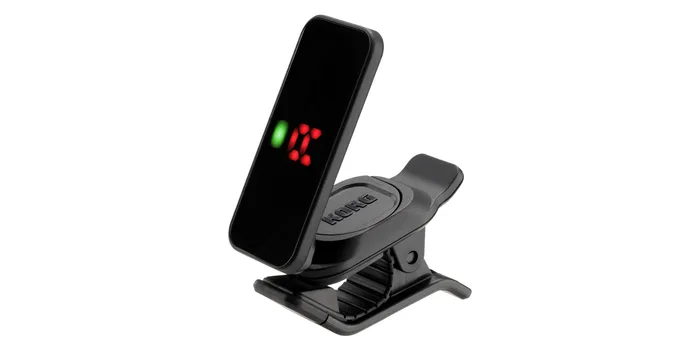
- Buy Korg Pitchclip 2 A tiny LED clip-on that Korg specs at +/- 1 cent with a 24 hour coin cell, a reverse display for the back of the headstock and a rubberized clip.
- Buy D'Addario Micro Headstock Tuner A very small full-color clip-on with four selectable screen orientations, a ratchet clamp and a 410 to 480 Hz calibration range. Amazon
- Buy BOSS TU-3 Chromatic Tuner The stage-standard pedal tuner: a 21-segment LED meter, silent tuning, buffered bypass and +/- 1 cent accuracy per BOSS. Amazon
- It depends TC Electronic PolyTune 3 A pedal that reads every string from one strum, with chromatic and strobe modes and a built-in buffer. Amazon
- It depends Peterson StroboClip HD A clip-on true-strobe tuner with 0.1 cent accuracy, more than 50 sweetened tunings and adjustable calibration. Amazon
- Skip Snark ST-8 Super Tight A widely sold clip-on whose own product page gives no accuracy, range, battery or calibration figures to check. Amazon
What actually matters
- Cents accuracy - A cent is one hundredth of a semitone. A tuner that states +/- 1 cent is finer than most ears hear.
- Display type - LED meters are quick to read, LCDs can show more detail, and strobe displays move to show tiny drift.
- Tuning modes - Chromatic reads any note, while Guitar mode guides you string by string. Flat and capo modes help with drop tunings.
- Calibration - This sets the reference pitch, usually A4 at 440 Hz. A wider range helps with other instruments.
- Power - Clip-ons use a coin cell such as a CR2032, and pedals use a 9V battery or supply. Battery life is only useful when stated.
- Format - Clip-ons attach to the headstock and sense vibration, and pedals sit on the floor and read the cable signal.
- Bypass - On a pedal, true bypass sends the signal straight through when off, and buffered bypass passes it through a small circuit.
The specs, in plain English
Green flags vs red flags
Green flags
- A cents accuracy figure printed on the maker's page.
- A stated battery type and battery life.
- A stated calibration or reference range.
- A display that can be flipped or rotated.
- A clip lined with rubber to protect the finish.
Red flags
- A product page that gives no accuracy, range or battery figures.
- Many near-identical models with no spec tables to tell them apart.
- Contradictory figures on one maker page.
- No stated power source for a pedal.
- Claims like 'superb accuracy' with no number.
Who's who: the brands
- Korg - A long-time tuner maker whose Pitchclip line is a common clip-on pick.
- D'Addario - A string maker that also owns Planet Waves and makes Micro and Eclipse clip-on tuners.
- BOSS - Introduced the TU line of pedal tuners, with the TU-3 as its current model.
- TC Electronic - Known for polyphonic tuning in the PolyTune line, and part of Music Tribe.
- Peterson - Makes strobe tuners across clip-on, pedal and bench formats.
How to read a listing without getting fooled
Start with the maker's own product page, not a retailer summary. Find the accuracy figure in cents, the power source and any battery life, the calibration or reference range, and the list of modes. Note whether the number is a maker claim or a measured result, and watch for model names that differ by one letter. If a page gives no figures, treat the product as unverified.
How much should you spend?
Clip-on tuners cluster at the lowest tier, with the Korg Pitchclip 2 and the D'Addario Micro both there. Pedal tuners and strobe clip-ons, such as the BOSS TU-3, TC Electronic PolyTune 3 and Peterson StroboClip HD, sit one tier up. The extra cost buys a larger display, more modes or finer precision, not necessarily a more useful tuner for standard tuning.
Questions, answered
Can I use one tuner for several instruments?
Usually yes. A chromatic tuner reads any pitch, so a clip-on can move between guitar, bass and ukulele. Korg says the Pitchclip 2 works from a ukulele to an electric guitar. Check the detection range if you play low basses.
Why do some tuners drift or jump?
Clip-ons sense vibration, so a loose clip or a note that is still decaying can cause a jumpy reading. Pluck one string cleanly and let it ring. D'Addario says the Micro's updated piezo control helps in noisy rooms.
Do I still need to tune by ear?
A tuner gets each string to a reference pitch, but a quick chord check against the open strings catches small errors. Sweetened tunings, like those on the Peterson, exist because equal temperament is not perfect across the neck.
What does buffered bypass do on a pedal?
It keeps a small circuit in the signal path even when the pedal is off. That can help preserve tone over long cable runs. BOSS lists buffered bypass on the TU-3, and TC Electronic lets you pick True Bypass or a buffer on the PolyTune 3.
Or jump to the head-to-head: Korg Pitchclip 2 vs D'Addario Micro Headstock Tuner.