Explained
Looper Pedals, Explained
After reading, you'll understand loop time, overdubs, memories, bypass types and power requirements well enough to read any looper pedal spec sheet.
In this guide
First-time buyers often assume the longest loop time wins, then find the pedal is hard to operate with a foot or does not fit their board. Spec sheets mix terms such as overdub, buffered bypass and phrase memory without explaining them. Most loopers share the same basic functions, so a few details make the real difference. This guide covers those details.
The 30-second version
- Loop time is not storage, because one loop's maximum length and the total saved across memories are different numbers.
- Undo/redo saves mistakes, so check it exists and that it is on the footswitch.
- Bypass type affects tone, and some pedals let you switch between true and buffered.
- Power varies a lot, with some pedals shipping without an adaptor.
- One track or two, decides whether you can build sections or only stack layers.
The products this guide is about
Our verdict on each, with the full reasoning on the companion review.
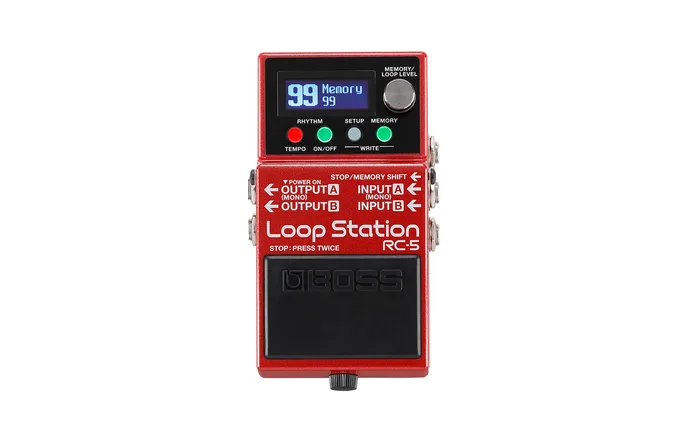
- Buy BOSS RC-5 Loop Station A compact single-track looper with 99 memories, a backlit LCD, built-in rhythms and undo/redo on the pedal switch. Amazon
- Buy NUX Loop Core Deluxe A small 24-bit looper with 99 memories, a drum machine and a switch between true bypass and buffered bypass.
- Buy TC Electronic Ditto Looper A one-knob, one-footswitch looper with five minutes of loop time, undo/redo and true bypass once the loop is cleared. Amazon
- It depends Electro-Harmonix 720 Stereo Looper A stereo looper with 12 minutes of loop time, ten independent loops, reverse and half-speed effects, and an adapter in the box. Amazon
- It depends Sheeran Loopers Sheeran Looper+ A two-pedal, dual-track looper with a microphone input, USB audio, batteries in the box and over 3 hours of storage. Amazon
- Skip Donner Circle Looper A cheap looper with a drum machine and 40 slots, held back by 4 minutes per track and contradictory power instructions on its own page. Amazon
What actually matters
- Loop time - How long a single loop can run. Short riffs need little, but long backing parts need more.
- Overdub - Recording a new layer over the existing loop. Look for unlimited layers if you like to build up parts.
- Memories - Saved loop slots you can recall later. They are useful for songs with a verse and chorus.
- Undo/redo - Removes or restores the last overdub. It matters most on stage, where you cannot stop to fix things.
- Bypass - What happens to your signal when the pedal is off. True bypass passes it untouched, and buffered bypass helps long cable runs.
- Tracks - Separate loops that play together or in sequence. Two tracks suit song sections, and one track suits simple layering.
- Power - Whether the pedal runs on batteries, an adaptor or both, and how many milliamps it needs.
The specs, in plain English
Green flags vs red flags
Green flags
- The maker lists undo/redo on the footswitch.
- Memories and loop time are both published.
- Bypass type is clearly stated.
- An adaptor is included, or the power need is stated once and clearly.
- Weight and dimensions are listed.
Red flags
- The page gives two different current figures for the same pedal.
- Key specs such as bypass or undo are absent.
- No adaptor is included and the requirement is vague.
- Loop time per track is short and not explained.
- The page mixes up units or product versions.
Who's who: the brands
- BOSS - Known for the Loop Station series, which runs from the simple RC-1 to multi-track models.
- TC Electronic - Part of Music Tribe, known for the Ditto series of simple, compact loopers.
- Electro-Harmonix - A New York pedal maker known for the 720 and other loopers with long loop times.
- NUX - Known for the Loop Core line of compact loopers.
- Sheeran Loopers - An inMusic line, designed with Ed Sheeran, built around two-pedal, dual-track looping.
How to read a listing without getting fooled
Start with the loop time, then check whether the figure is per track or total. Next, look for the memory count and how you select a loop. Check the controls for undo/redo and what the footswitch does on a press, a double press and a hold. Then read the power line for adaptor current, battery option and whether an adaptor is included. Finally, look at the bypass type and the connections you need, such as stereo, USB or MIDI. If a spec is missing, treat it as unknown rather than assuming a feature is there.
How much should you spend?
Looper pedals fall into three tiers. The budget tier covers simple pedals such as the TC Ditto Looper and compact options such as the NUX Loop Core Deluxe. The mid-range tier adds screens, memories and rhythms, as the BOSS RC-5 and EHX 720 do. The premium tier covers larger dual-track units such as the Sheeran Looper+. Pay for memories and undo/redo first, then for tracks, and only buy drums if you will use them. Check whether an adaptor is included before comparing prices, since a missing one adds to the total.
Questions, answered
What is the difference between a looper and a delay pedal?
A delay repeats your signal a few times and fades it out. A looper records a phrase and plays it back indefinitely until you stop it. Some pedals do both, but most dedicated loopers focus on recording, overdubbing and storing loops. If you only want echoes, buy a delay.
Can I use a looper with an acoustic guitar or a microphone?
Many can. The Sheeran Looper+ lists a combo XLR and 1/4 inch microphone input alongside its instrument inputs. For other pedals, check the input type and level on the maker's page.
Do loops survive when I switch the pedal off?
It depends on the model. TC says the Ditto keeps its loop in internal memory after power down, and BOSS, NUX and Sheeran list saved memories. Check the maker's page for the model you want. If you need to keep a loop between sessions, choose a pedal with stored memories.
Is a footswitch needed on top of the pedal's own?
Not for basic looping. The BOSS RC-5 and the Sheeran Looper+ run record, overdub, play, stop and undo from the pedal's own switches. An external footswitch adds extra functions such as stop or memory change. It is worth considering if you play live and want hands-free control.
Or jump to the head-to-head: BOSS RC-5 Loop Station vs NUX Loop Core Deluxe.