Explained
Frying Pans, Explained
After reading this you'll understand every coating and spec on a frying pan listing and know which ones actually change how the pan cooks and how long it lasts.
In this guide
A frying pan is the pan most kitchens reach for daily, yet the listings are full of confusing terms like PTFE, PFAS-free, hard-anodized, and clad base. What trips people up most is coating chemistry: a pan can look identical to another but wear out in a fraction of the time. This guide decodes the labels so you can match a pan to your stovetop, your cooking style, and how gently you plan to treat it.
The 30-second version
- Coating chemistry drives the verdict. traditional PTFE nonstick generally keeps its slick release longer, while ceramic is PFAS-free but tends to fade faster, so the coating decides both performance and lifespan.
- Match the base to your stovetop. induction cooktops need a magnetic base, and bare-aluminum pans simply won't heat on them no matter how good the coating is.
- Even heating beats every other spec. a heavy or clad base spreads heat and prevents the scorched ring that ruins eggs and pancakes, which is the single thing a good frying pan must do.
- Every nonstick coating is a consumable. no coating lasts forever, so how you treat the pan (heat level, utensils, washing) matters as much as which one you buy.
- Weight and handle feel matter more than the spec sheet. a pan you can lift and flip comfortably one-handed will get used and cared for, while a heavy one may not.
The products this guide is about
Our verdict on each, with the full reasoning on the companion review.
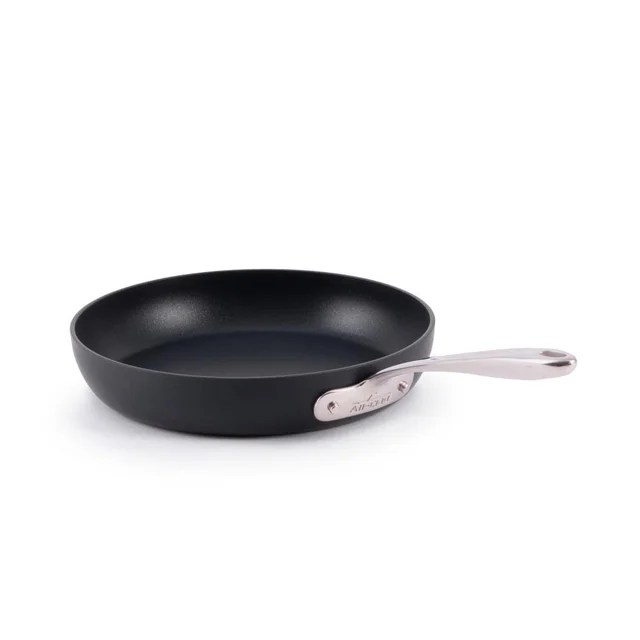
- Buy All-Clad HA1 Hard-Anodized Nonstick 10-Inch Fry Pan The most even, most durable everyday nonstick pan here, if you accept the weight and the price. Amazon
- Buy OXO Professional Ceramic Non-Stick 10-Inch Frypan The value pick and the easy choice if you want PFAS-free cooking without a premium price. Amazon
- It depends Tramontina Professional Nonstick 10-Inch Fry Pan A restaurant-grade workhorse for the money, but the bare-aluminum base rules out induction. Amazon
- Skip GreenPan Valencia Pro Ceramic Nonstick 10-Inch Frypan A well-made PFAS-free ceramic pan, but you pay premium money for a coating with a limited lifespan. Amazon
What actually matters
- Coating type decides how slick the pan is and how long that lasts: PTFE (traditional nonstick) usually keeps its release longer, while ceramic is PFAS-free but generally fades sooner.
- Heat evenness determines whether food cooks uniformly or scorches in a ring; a heavy-gauge or clad base spreads heat far better than thin, cheap aluminum.
- Induction compatibility is a hard yes/no: if you cook on induction you need a magnetic (usually stainless or magnetized) base, and no coating can fix a bare-aluminum bottom.
- Weight and balance affect daily use; a lighter pan is easier to flip and maneuver, while a heavier one often feels more planted and durable.
- Oven-safe temperature adds versatility for finishing dishes under heat, but the handle material usually sets the real limit.
- Care requirements are part of the purchase: low-to-medium heat, soft utensils, and hand-washing extend the life of any nonstick pan, so a pan that demands gentle handling only lasts if you provide it.
- Honest value ties it together; a premium price is only worth it when the coating and build actually last longer than a cheaper alternative.
The specs, in plain English
Green flags vs red flags
Green flags
- A magnetic base you can confirm with a fridge magnet if you cook on induction
- A heavy-gauge or clad base, which points to even heat and resistance to warping
- A clearly stated coating type (PTFE or ceramic) so you know what lifespan to expect
- A comfortable, secure handle, ideally stay-cool, that you can lift and flip one-handed
- An honest oven-safe temperature and PFOA-free or PFAS-free labeling
- A price that matches the build; a durable coating and solid base justify spending more
Red flags
- A premium price on a ceramic pan, since ceramic's shorter coating life is hard to justify at the top of the market
- No mention of induction support when you cook on an induction stovetop (assume it won't work)
- Very thin, lightweight bodies that heat unevenly and warp, causing wobble and hot spots
- Vague coating claims with no PTFE or ceramic specifics, or buzzwords with no substance
- A handle that gets hot, feels loose, or is uncomfortable to grip
- Marketing that implies a nonstick coating lasts forever; all coatings are consumables
Who's who: the brands
- All-Clad - A premium American cookware maker known for even-heating, durable clad construction; its HA1 line is a benchmark everyday nonstick.
- OXO - A housewares brand known for thoughtful, comfortable design; its Professional Ceramic pans pair PFAS-free coatings with easy handling at sensible prices.
- Tramontina - A Brazilian manufacturer known for restaurant-grade value; its commercial aluminum nonstick pans deliver toughness for the money.
- GreenPan - A pioneer of ceramic nonstick focused on PFAS-free cooking, offering well-built pans though at prices that can outrun ceramic's lifespan.
- T-fal - A widely available mainstream nonstick brand known for affordable PTFE pans, often with a heat-indicator dot; a common entry-level choice.
- Calphalon - A well-known maker of hard-anodized nonstick cookware, positioned in the mid-range with durable bodies and familiar everyday designs.
How to read a listing without getting fooled
Start with the coating line, because it sets your expectations for both slickness and lifespan: PTFE (sometimes called by a brand name) generally lasts longer, while ceramic is PFAS-free but fades sooner. Next, find the base and body material. Hard-anodized aluminum is a good, durable body, but check separately for a magnetic or clad base if you have induction, because a pan can be hard-anodized and still not work on induction. Treat oven-safe numbers as the handle's limit, not the coating's. Be skeptical of adjectives with no chemistry behind them (diamond-infused, ultra-durable) and of any claim that a coating is permanent. The most useful facts in a listing are almost always the plain ones: coating type, base material, weight, and induction support.
How much should you spend?
The value sweet spot for a frying pan is a well-built mid-range pan with a clearly stated coating and a base that suits your stovetop; that's where most cooks get durability without overpaying. Spending more can be worth it for a premium PTFE pan when you want even heat and a long coating life from a pan you'll use daily for years. Spending more is harder to justify for a premium ceramic pan, because ceramic's release fades faster regardless of price, so a premium ceramic pan can cost as much as a longer-lasting PTFE one while wearing out sooner. At the budget end, commercial-style aluminum pans can offer remarkable toughness for the money, with the main tradeoff being no induction support and a utilitarian look. Since every nonstick coating is ultimately a consumable, think of the price partly as a running cost: a cheaper pan you replace more often can make sense, and so can one premium pan you baby for years.
Questions, answered
Is ceramic nonstick better than traditional PTFE nonstick?
They trade off. Ceramic coatings are PFAS-free and start out very slick, which appeals to buyers who want to avoid fluorinated chemistry, but ceramic is generally reported to lose its easy release faster than modern PTFE. Traditional PTFE pans generally keep their nonstick longer, provided you avoid high heat and metal utensils. Choose ceramic if PFAS-free matters most to you; choose PTFE if you want the release to last longer.
How do I know if a frying pan will work on my induction cooktop?
The base has to be magnetic. The easiest test is to hold a fridge magnet to the bottom of the pan: if it sticks firmly, the pan will work on induction. Pans with a bare aluminum base, including some otherwise excellent commercial pans, will not heat on induction no matter how good the coating is, so confirm a magnetic or clad base before buying.
How can I make a nonstick coating last longer?
The same habits help every coating: cook on low to medium heat rather than high, avoid metal utensils and abrasive scrubbers, let the pan cool before washing, and hand-wash even when it's labeled dishwasher safe. Overheating an empty nonstick pan is the fastest way to degrade any coating, ceramic or PTFE. Treated gently, a good pan lasts years; treated roughly, even a premium one wears out quickly.
Are nonstick coatings safe to cook on?
Current PFOA-free PTFE and PFAS-free ceramic coatings are widely considered safe for normal home cooking when used as directed and not overheated while empty. The old PFOA concern has been phased out of cookware. This is general product information, not health or medical advice; if you have specific health concerns about cookware materials, consult a qualified professional.
What size frying pan should I buy first?
A single 10-inch pan is the most versatile everyday size and what most cooks reach for first; it handles eggs, vegetables, and quick sautes for one or two people comfortably. If you regularly cook for a family, an additional 12-inch pan gives you more room, but a good 10-inch skillet is the one pan worth getting right before you build out a set.
Is a more expensive pan always more durable?
Not necessarily. Price often tracks durability for PTFE pans, where a premium body and coating can last longer. With ceramic it's less reliable, because ceramic's coating fades faster no matter what you pay, so a premium ceramic pan can cost as much as a longer-lasting PTFE one while wearing out sooner. Judge durability by coating type, base construction, and gauge rather than price alone.
Or jump to the head-to-head: All-Clad HA1 Hard-Anodized Nonstick 10-Inch Fry Pan vs OXO Professional Ceramic Non-Stick 10-Inch Frypan.