Explained
Hand Mixers, Explained
After reading this you will understand what makes one hand mixer better than another and how to match one to the baking you actually do.
In this guide
A hand mixer is the small, handheld beater most home bakers reach for to whip cream, beat egg whites, cream butter and sugar, and mix cake, cookie, and pancake batters. It is cheaper, lighter, and easier to store than a stand mixer, but the specs on the box, wattage, speed counts, and long attachment lists, are easy to misread. The thing that trips people up most is assuming more watts or more speeds means a better mixer, when balance, splatter control, and the right attachments matter far more.
The 30-second version
- Watts measure power draw, not mixing skill. a well-geared motor beats a high-wattage one that bogs down, so treat wattage as a rough hint rather than a ranking.
- Attachments decide how far the mixer stretches. beaters, a whisk, dough hooks, and sometimes a blending rod are what let one tool cover several jobs.
- A true slow-start speed is worth more than a high top speed. it keeps flour and liquid in the bowl instead of on your counter.
- Stiff dough is where cheap mixers fail. if you knead heavier doughs, favor a model independent testing rates well under load, because small motors strain and die early.
- Comfort and noise matter more than they seem. balance, weight, and a quieter motor decide whether long mixing sessions are pleasant or a chore.
The products this guide is about
Our verdict on each, with the full reasoning on the companion review.
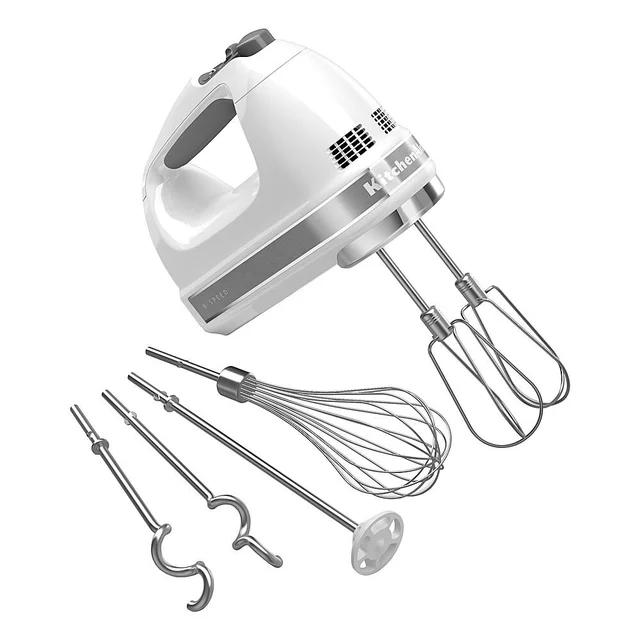
- Buy KitchenAid 9-Speed Hand Mixer (KHM926) The most versatile all-rounder, with a deep accessory kit and reassuringly quiet, balanced handling. Amazon
- Buy Cuisinart Power Advantage Plus 9-Speed Hand Mixer (HM-90) The value pick that punches above its price with strong even mixing and a genuinely useful storage case. Amazon
- It depends Breville Handy Mix Scraper (BHM800) A polished flagship with clever scraper beaters, but you pay for delicacy, not raw dough power. Amazon
- Skip Hamilton Beach 6-Speed Hand Mixer (62620) Cheap and well-equipped on paper, but the motor strains on anything stiff and it does not age gracefully. Amazon
What actually matters
- Motor headroom is how much reserve power the mixer has when the batter gets thick; a mixer that cruises through stiff dough will outlast one that strains, regardless of the wattage number.
- Included attachments determine versatility; beaters handle everyday batter, a whisk adds air for cream and meringue, dough hooks work soft doughs, and a blending rod adds immersion-blender duty.
- Slow-start / splatter control (marketed as SmoothStart, pulse-start, or a genuine low setting) keeps ingredients in the bowl and is an appreciated everyday feature.
- Handling and balance decide fatigue over a long mix; a well-balanced body that does not force your wrist up matters more than a few extra ounces of weight.
- Noise varies widely between models and is hard to un-notice once it bothers you; quieter motors make frequent baking more pleasant.
- Cleanup hinges on removable, dishwasher-safe beaters; postless or clog-resistant beater designs rinse far faster than old center-post styles.
- Storage and warranty round it out; a snap-on case keeps attachments together, and a longer warranty signals the maker's confidence in the motor.
The specs, in plain English
Green flags vs red flags
Green flags
- A genuine slow-start or pulse-start low speed that eases into the mix
- A kit that already includes the attachments you need, especially a whisk and dough hooks
- Removable, dishwasher-safe, postless or clog-resistant beaters
- Independent testing and owner reports that agree it stays composed under stiff dough
- A snap-on storage case that corrals every attachment
- Comments that it runs quiet and feels balanced over long sessions
Red flags
- Marketing that leans hard on a big wattage number with little said about handling or gearing
- Repeated owner reports of the motor straining, bogging down, or smelling hot on dense dough
- Flimsy-feeling beaters or noticeable beater wobble
- No true low speed, so every mix starts with a splatter
- A conspicuously short or vague warranty on an otherwise pricey model
- Attachments that are hard to remove or awkward to clean
Who's who: the brands
- KitchenAid - A mainstay of home baking known for versatile, well-balanced mixers with deep accessory kits.
- Cuisinart - Mid-range kitchen brand offering everyday hand mixers; check each model's warranty on the maker page.
- Breville - Premium maker; the Handy Mix Scraper lists Beater IQ, 9 speeds plus boost, and rubber scraper beaters.
- Hamilton Beach - Budget-focused brand that packs in features and attachments; its 62620 lists 6 speeds, QuickBurst, and a snap-on case.
How to read a listing without getting fooled
Start by ignoring the biggest number on the box. Wattage tells you how much power the motor draws, not how well it mixes, so a mixer with smart gearing and a solid build can beat a higher-wattage rival that overheats on thick batter. Next, read the speed line for quality, not quantity: look for a genuinely gentle lowest speed and confirmation that the top speed holds steady under load, rather than just counting to nine. Then scan the attachment list and ask what each piece actually does for your baking, a whisk for air, dough hooks for soft dough, a blending rod for small blending jobs, and treat a long list as useful only if you will use it. Finally, weigh the softer claims (quiet, balanced, easy to clean) against independent testing and a large body of owner reports, and trust findings most where both agree.
How much should you spend?
You are mostly paying for motor quality, build materials, refinement, and the depth of the attachment kit, not for raw watts. The value sweet spot sits in the mid-range, where you get strong, even everyday mixing, splatter-taming low speeds, easy-clean beaters, and often a longer warranty without premium-tier polish. Spending up to a flagship makes sense only if quiet operation, scraper beaters, and delicate-work finesse genuinely matter to you, since the priciest models are not always the strongest on heavy dough. At the very bottom, the savings are real but so is the risk: budget motors tend to strain on stiff dough and wear out sooner, so stepping just above the cheapest tier usually buys a meaningfully better and longer-lasting tool.
Questions, answered
Do I need a hand mixer or a stand mixer?
For whipping cream, beating egg whites, creaming butter and sugar, and mixing cake, cookie, and pancake batters, a good hand mixer is plenty, and it is far easier to store and clean. A stand mixer earns its counter space mainly if you routinely knead large batches of bread dough or want to walk away mid-mix.
Does higher wattage mean a better mixer?
Not on its own. Wattage measures how much power the motor draws, not how effectively it mixes. Gearing, build quality, and balance matter just as much, so a lower-wattage mixer can outperform a higher-wattage one that bogs down or overheats. Read wattage as a rough hint, then lean on independent testing and owner reports.
What do the extra attachments actually do?
Beaters are your everyday tool for batter and creaming. A whisk incorporates the most air, so it is best for whipped cream and meringue. Dough hooks handle soft yeast and cookie doughs. A blending rod, included on some premium models, purees and blends small quantities like an immersion blender. Favor the models whose included kit covers the jobs you actually do.
Are the beaters and attachments dishwasher safe?
On most current mixers the beaters and hooks are removable, while the motor body must be wiped by hand. Some are dishwasher safe, so check the manual. Postless and rubber-edged scraper beaters are designed to resist clogging and rinse more easily. Always check the manual for your specific model and finish before putting anything in the dishwasher.
How long should a hand mixer last?
Treated to light and medium tasks, a quality hand mixer lasts many years, and premium motors with metal gearing tend to outlast budget plastic ones. Overloading a small motor with stiff dough is a common cause of early failure. This is general product guidance to help you choose, not a durability guarantee for any individual unit.
Can a hand mixer knead bread dough?
With dough hooks, a capable hand mixer can knead soft, small-batch yeast and cookie doughs, but stiff or double-batch bread dough will strain most of them. If heavy dough is a regular part of your baking, choose a model that independent testing rates well under load, or step up to a stand mixer for those jobs.
Or jump to the head-to-head: KitchenAid 9-Speed Hand Mixer (KHM926) vs Cuisinart Power Advantage Plus 9-Speed Hand Mixer (HM-90).