Explained
Home Safes, Explained
After reading, you will know exactly what a home safe protects against, how to read its ratings, and why bolting it down matters more than the marketing.
In this guide
A home safe quietly does two very different jobs: it keeps a house fire from turning your documents to ash, and it slows down a thief long enough to matter. Most affordable safes are genuinely good at the first job and only modest at the second, which is the single fact that trips up first-time buyers. The trick is matching the safe's ratings to what you actually keep inside and being honest about what a box of thin steel can and cannot stop.
The 30-second version
- Fire and theft are separate problems. Most consumer safes are built to survive fire and water first, with theft resistance a distant second, so pick based on which risk you actually face.
- A UL fire rating is the number that matters most. It tells you how long the inside stays cool enough to protect paper, and it is independently tested rather than a manufacturer claim.
- Water resistance is easy to overlook and expensive to skip. Firefighting water, burst pipes, and floods can pulp documents a fire never touched, so an ETL water rating is worth prioritizing.
- No consumer safe is truly burglar-proof. Its real value is deterrence and delay, which is why anchoring it to the floor is the most important thing you will do.
- Match the rating to the media. Standard fireproof safes protect paper, not hard drives or photos, which need a lower-temperature media rating.
The products this guide is about
Our verdict on each, with the full reasoning on the companion review.
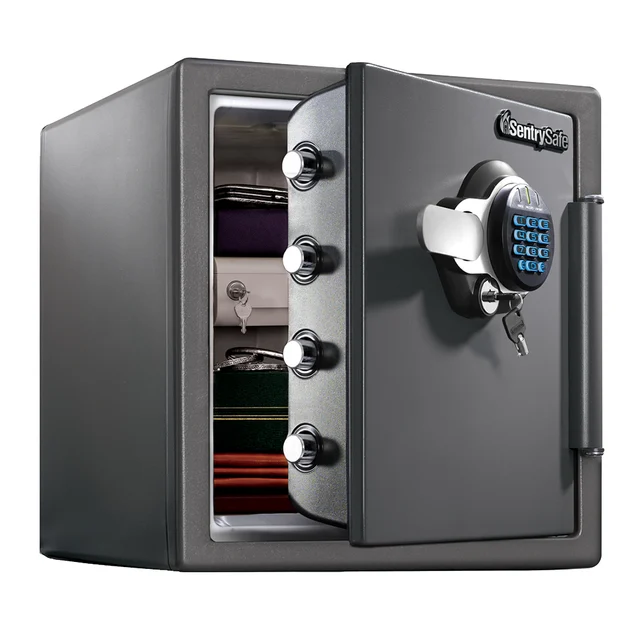
- Buy SentrySafe SFW123GDC Fireproof & Waterproof Safe The all-rounder most homes should buy: UL 1-hour fire rating, verified water resistance, and enough room for documents plus small valuables. Amazon
- Buy SentrySafe SFW205GQC Extra Large Fireproof & Waterproof Safe Same fire and water protection as our top pick, scaled up to 2 cu ft for households with more to store. Amazon
- It depends Honeywell 2115 Digital Fire Safe A heavier fire safe with a longer stated fire rating, but only a water-resistant door, no named test lab, and a linked listing that says 1 hour.
- Skip First Alert 2037F Water and Fire File Chest A waterproof file chest with a carry handle and a latch lock, good for papers in a flood and weak against a thief.
What actually matters
- UL fire rating (time and temperature) because it defines how long your documents survive a fire and how hot the outside can get before the inside crosses the paper-damage threshold.
- ETL water resistance because water from sprinklers, hoses, or burst pipes routinely ruins contents that survived the heat, and a verified water rating is the clearest proof it will hold.
- Theft resistance and anchoring because a light, unbolted safe is a portable safe; look for a pre-drilled bolt-down hole and plan to use it.
- Interior capacity (cubic feet) because usable space is often smaller than the box looks, and you want room for what you store plus a little growth, not the biggest unit on the shelf.
- Lock type and reliability because a digital keypad is convenient but battery-dependent, and a backup physical key or mechanical dial can save you from being locked out of your own safe.
- Weight and placement because heft is a real deterrent to grab-and-go theft, but a very heavy safe is a two-person job to position and may need a solid floor.
- What you are protecting because the answer decides everything else: paper documents, cash and jewelry, and digital media each have different rating needs.
The specs, in plain English
Green flags vs red flags
Green flags
- A clearly stated UL fire rating with both a time (for example 1 hour) and an external temperature (for example 1700°F).
- An ETL water-resistance verification if the safe will live anywhere water could reach it.
- A pre-drilled bolt-down hole, with anchoring hardware included or available.
- A backup access method, such as a physical key alongside a digital keypad, or a mechanical dial.
- Honest capacity described in cubic feet, ideally with interior dimensions so you can check real fit.
- Meaningful weight for its size, which raises the effort a grab-and-go thief has to make.
Red flags
- A carrying handle on anything sold as a security safe; portability is the opposite of theft protection.
- Only a keyed privacy latch and no real locking bolts, which signals a privacy box rather than a safe.
- Vague fire language like 'fire resistant' with no UL time-and-temperature rating attached.
- Claims of protecting electronics or photos without a specific media or data rating.
- No bolt-down provision, leaving the safe easy to pick up and open elsewhere.
- Marketing that emphasizes 'burglar-proof' or 'unbreakable', which overpromises what consumer steel can do.
Who's who: the brands
- SentrySafe - The dominant mainstream name in fire-and-water home safes, with a wide range of UL-classified and ETL-verified models at accessible prices.
- First Alert - Best known for smoke and fire alarms; its fire-rated safes and chests are made by a separate safe company under a trademark license, so check the safe maker's own spec page.
- Honeywell - Its safes are made under license by LH Licensed Products, with a broad line of fire safes and fire and water chests, often with digital keypads.
- Amazon Basics - Budget-oriented steel security safes; fine for basic lockup and deterrence, but generally lighter on independent fire and water certification.
- Stack-On - Known for larger security and gun safes; more focused on lockable storage volume than on high fire ratings.
How to read a listing without getting fooled
Start with the fire rating and refuse to accept vague words: 'fireproof' or 'fire resistant' means little without a UL classification stating a time and an external temperature, such as one hour at 1700°F. Next, look for an ETL water mark if water is any risk where the safe will sit; if it is absent, assume the safe offers no water protection at all. Then check capacity in cubic feet and, if listed, the interior dimensions, because the outside of a safe is always bigger than the inside. Confirm there is a bolt-down hole and that hardware is included. Finally, read the lock description carefully: a 'keyed' or 'privacy' latch is not the same as locking bolts, and a digital keypad should come with a backup key. If a listing leans hard on words like 'burglar-proof', treat that as marketing rather than a spec.
How much should you spend?
Spend according to which disaster you are actually guarding against. If your goal is protecting paper documents from fire and water, the value sweet spot is a mid-range safe that carries both a one-hour UL fire rating and an ETL water rating; paying more mostly buys you capacity and heft rather than better protection. Going cheaper usually means dropping the water rating or the independent fire certification, which is a false economy if the documents matter. Spending significantly more makes sense only when you genuinely need a larger interior, a longer fire rating for irreplaceable records, or a dedicated media rating for hard drives. Do not overpay for the illusion of theft resistance in this class; the money is better spent on a safe you will actually bolt down and on keeping a separate backup of anything irreplaceable.
Questions, answered
What does a UL fire rating actually mean?
UL Classified means an independent lab, Underwriters Laboratories, heated the safe in a furnace and confirmed the interior stayed below a set threshold for a stated time, for example one hour with the outside reaching up to 1700°F. The common paper rating keeps the inside under about 350°F, which protects documents but not electronics. Because it is a tested result rather than a manufacturer claim, the UL rating is the fire number worth trusting; match the time and temperature to what you store.
Are home safes actually burglar-proof?
No. Treat no consumer-grade home safe as burglar-proof. These models are engineered first to survive fire and water, which means relatively thin steel and simple locking that a determined thief with time and tools can pry or defeat. Their real security value is deterrence and slowing down a smash-and-grab, not stopping a patient burglar. Because of that, the single most important thing you can do is bolt the safe to the floor: many full-size models offer bolt-down hardware (sometimes a separate kit) so you can anchor them to concrete or a stud, which turns a portable box into a genuine obstacle. Keep the safe out of sight and back up anything irreplaceable elsewhere.
Do I really need water resistance as well as fire protection?
For paper and photos, water protection matters more than most people expect. Firefighters use water, sprinklers discharge, and pipes burst, so contents that survive the heat can still be pulped or grow mildew. If your safe will live in a basement or a flood-prone area, an ETL water rating is worth prioritizing over a fire-only model.
Can I store a hard drive, USB stick, or photos in a standard fireproof safe?
Be careful. Standard fireproof safes are rated to protect paper by keeping the interior under roughly 350°F, but hard drives, flash media, and film can degrade well below that. If you need to protect digital media, look for a safe specifically rated for media or data at a lower interior temperature, and keep a separate offsite or cloud backup regardless.
Digital keypad or mechanical dial, which is better?
It depends on your priorities. A digital keypad is fast and convenient for daily access, but it depends on batteries, so choose one with a physical backup key in case the electronics fail. A mechanical dial never needs power and tends to last, but it is slower to open. Either is fine for a home safe; just make sure you have a reliable backup way in.
Or jump to the head-to-head: SentrySafe SFW123GDC Fireproof & Waterproof Safe vs SentrySafe SFW205GQC Extra Large Fireproof & Waterproof Safe.