Explained
Food Processors, Explained
After reading this you will understand what a food processor's wattage, bowl size, discs, and feed tube really tell you, and how to match a machine to how you cook.
In this guide
A food processor is a bowl with a spinning blade and a set of swappable discs that chop, slice, shred, and knead far faster than a knife. The hard part of shopping is that listings lead with numbers, mostly wattage and cup counts, that sound decisive but only tell half the story. What trips people up is buying either more machine than they will ever use or a cheap one that stalls and leaks the first time it meets stiff dough.
The 30-second version
- Match the bowl to your batch size. A 12-to-14-cup bowl covers most households, and going bigger only helps if you routinely cook in volume.
- Wattage matters most for hard jobs. A stronger motor earns its keep on stiff dough and dense loads, but for everyday chopping and shredding, mid-range power is plenty.
- More discs mean more capability and more cleanup. Adjustable slicing and dicing kits add real versatility, but every extra part is another thing to wash and store.
- The unglamorous details decide whether it gets used. Noise, a lid that seals without leaking, and dishwasher-safe parts matter more day to day than the spec sheet suggests.
The products this guide is about
Our verdict on each, with the full reasoning on the companion review.
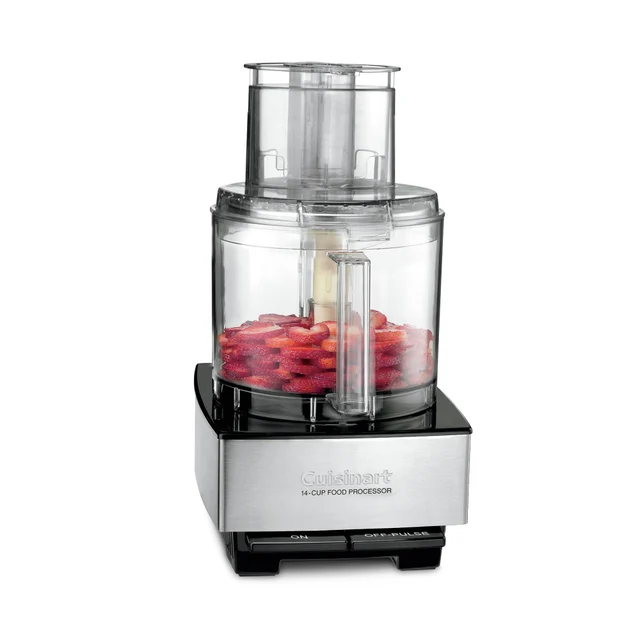
- Buy Cuisinart Custom 14 (DFP-14BCNY) A quiet, durable 14-cup workhorse that does the core jobs well and skips the gimmicks.
- Buy Breville Sous Chef 16 (BFP810) The most capable and versatile of the group, if you have the counter space and budget for it. Amazon
- It depends KitchenAid 13-Cup with Dicing Kit (KFP1319) Feature-rich for the tier, with an external slicing lever and dicing kit, but a lighter motor.
- Skip Hamilton Beach Stack & Snap (70725A) Easy to assemble and cheap, but loud, uneven at chopping, and prone to leaking.
What actually matters
- Bowl capacity decides how much you can process at once; too small forces you to work in batches, too large wastes counter and cupboard space.
- Motor strength determines whether the machine powers through dough and dense vegetables or bogs down and overheats on long runs.
- Slicing and dicing control ranges from a single fixed disc to adjustable dials and dicing kits, which is the difference between one thickness and dialing in exactly what you want.
- Feed tube design affects how much pre-cutting you do; a wide chute swallows whole tomatoes and potatoes, while a narrow one means slicing everything down first.
- Cleanup and part count shape whether the processor stays on the counter or hides in a cabinet, because more accessories mean more washing after every use.
- Build quality and sealing decide durability and mess, since metal-clad bases and gasketed lids outlast all-plastic bodies that can crack, wear, or leak.
- Noise level is easy to ignore in a store but obvious at home, where a machine near 90 decibels becomes something you avoid using.
The specs, in plain English
Green flags vs red flags
Green flags
- A metal-clad or heavily reinforced base that feels solid and does not walk across the counter under load
- A motor that handles stiff dough without stalling, bogging down, or smelling hot
- A lid with a real gasket that seals against leaks when the bowl is filled with liquid
- Bowl, lid, and discs that are dishwasher-safe and store together in a caddy rather than scattering in a drawer
- A wide feed tube that fits whole or halved produce so you pre-cut less
Red flags
- Operation loud enough to be unpleasant, roughly around 90 decibels, which makes the machine one you avoid using
- Uneven chopping that leaves large chunks and forces extra pulses to finish the job
- A gasket-free lid or all-plastic bowl that sprays or leaks liquid near the fill line
- Flimsy plastic latches and clips that owners report wearing or cracking over time
- A spec sheet leaning entirely on accessory count and wattage while saying nothing about build or sealing
Who's who: the brands
- Cuisinart - The long-running all-rounder, known for durable, quiet workhorses that cover the core jobs well without gimmicks.
- Breville - The premium, feature-forward maker, known for adjustable slicing, wide feed chutes, dual bowls, and digital timers.
- KitchenAid - A mainstream kitchen brand offering feature-rich mid-tier machines with external slice levers and dicing kits, though often with lighter motors.
- Hamilton Beach - A budget staple focused on easy assembly and low price, where results and durability tend to slip.
How to read a listing without getting fooled
When you read a listing, do not let the biggest number decide for you. Start by translating cup capacity into your actual habits: a 14-cup bowl is generous for most people, and 16 cups only helps if you batch-cook. Treat wattage as a hint about power for hard jobs, not proof of quality, and weigh it against whether you knead dough or mostly chop vegetables. Look past the accessory count to what each part does and whether you will really use adjustable slicing or a dicing kit, because every disc is one more thing to wash. Finally, hunt for the details listings bury: whether the lid has a gasket, whether the parts are dishwasher-safe, and what owners say about noise and long-term durability. A machine that is loud, leaks, or feels flimsy is the one that ends up in the cupboard, no matter how strong its headline numbers look.
How much should you spend?
Spend according to how hard you push the machine, not how impressive the spec sheet looks. Budget models tend to cut corners exactly where it hurts, with loud motors, uneven chopping, and gasket-free lids that leak, so the very cheapest tier is usually a false economy unless you use a processor only rarely. The value sweet spot sits in the mid-range, where a durable, capable machine handles chopping, shredding, and dough for years without drama, and that is the right target for most kitchens. Stepping up to the flagship tier pays off only if you genuinely want adjustable slicing, dicing, dual bowls, and a timer and will use them regularly; if your processor mostly chops onions and shreds cheese on weeknights, the extra money buys headroom you will not touch. In short, buy quality in the middle before you buy features at the top.
Questions, answered
What size food processor should I buy?
Most households are well served by a 12-to-14-cup bowl, which handles dough, batch chopping, and shredding without crowding. Choose 16 cups only if you regularly cook in large volume. Smaller bowls save storage space but force you to work in batches.
Do I really need a high-wattage motor?
For everyday chopping, shredding, and slicing, a mid-range motor is enough. Higher wattage mainly matters if you knead stiff dough, grind nuts, or process dense loads regularly, where a stronger motor resists stalling and overheating during longer runs.
Is a food processor the same as a blender?
No, they solve different problems. A food processor chops, slices, shreds, and kneads dry or chunky ingredients in a wide bowl with a flat blade, while a blender purees liquids smoothly in a tall jar. For salsa, dough, and shredded cheese the processor wins; for smoothies and soups, use a blender.
How many discs and attachments do I actually need?
Most cooks are happy with the basics: an S-blade for chopping, a slicing disc, a shredding disc, and a dough blade if you bake. Adjustable slicing and dicing kits add real capability, but only buy them if you will use them, because each extra part is one more thing to wash and store.
Why do some food processors leak?
Leaks usually come from a lid without a proper gasket or from filling the bowl past its liquid line, which is lower than its dry-cup capacity. Machines with sealed, gasketed lids handle liquids like soups and batters far better than all-plastic bowls that lack a seal.
Or jump to the head-to-head: Cuisinart Custom 14 (DFP-14BCNY) vs Breville Sous Chef 16 (BFP810).