Explained
Food Dehydrators, Explained
After reading this, you'll understand why airflow design decides everything, and you'll be able to read any dehydrator's spec sheet without getting fooled.
In this guide
A food dehydrator is a low, steady heat source plus a fan that pulls moisture out of food over many hours, turning fruit, meat, and herbs into shelf-stable snacks. The category looks simple, but the format you pick, box versus stacked, quietly decides whether every tray dries evenly or whether you spend the day rotating trays. Most first-time buyers focus on tray count and price when the real question is how the air moves.
The 30-second version
- Airflow design is the whole game. Horizontal (rear-fan) box units dry every tray evenly, while stacked top- or bottom-fan units dry unevenly and make you rotate trays.
- A real, adjustable thermostat matters more than raw wattage. You want to run hot for jerky and low for herbs, and you want the unit to actually hold the setting you chose.
- Format decides livability. Flat rectangular trays use space better for jerky, stainless is sturdy and easy to clean, and box units are more even but harder to store.
- Buy for how you'll actually use it. Occasional driers can go small and cheap, but anyone making regular jerky or processing harvests should step up to horizontal airflow.
- Noise is a real spec. These run for hours, sometimes overnight, so a loud fan near living space is a daily annoyance you can't return away.
The products this guide is about
Our verdict on each, with the full reasoning on the companion review.
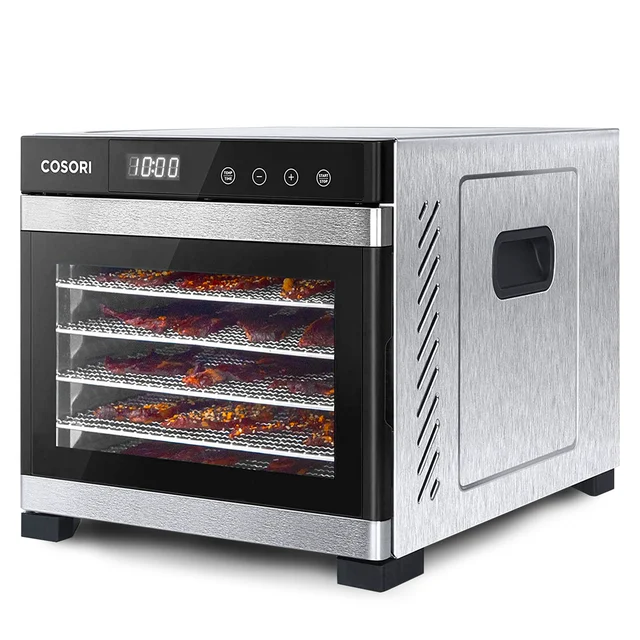
- Buy COSORI Premium Stainless Steel Food Dehydrator (6-Tray, CP267-FD) The best-balanced everyday dehydrator: quiet, even, and stainless trays. Amazon
- Buy Excalibur 3926TB 9-Tray Food Dehydrator The volume workhorse: horizontal airflow and a big flat capacity built for serious batches.
- It depends Nesco Gardenmaster Digital Pro FD-1040 A powerful top-fan stacker that expands to a huge capacity, if you can live with the round format.
- Skip Hamilton Beach Digital Food Dehydrator (32100A) Cheap and cheerful, but the small stacked design fights you the moment you get serious. Amazon
What actually matters
- Airflow design is the single biggest differentiator. Horizontal airflow (a fan mounted at the back) pushes air across each tray at the same rate; stacked designs blow from the top or bottom, so trays nearest the fan finish first and you rotate them mid-run.
- Temperature control determines what you can make. A wide, adjustable range that holds its setting lets you cover everything from delicate herbs to meat jerky; fixed or drifting temperatures are where cheap units fall down.
- Capacity and expandability decide how much you dry per run and whether you'll outgrow the machine. Consider both the number of trays and whether the format wastes space on rectangular loads like jerky strips.
- Tray material and cleanup affect daily use. Stainless steel feels food-safe with hot, acidic, or fatty foods and is easy to clean; plastic is lighter and cheaper but can stain and hold odors. Check each maker's care guidance.
- Noise matters because dehydrators run for many hours. A fan that's tolerable for ten minutes becomes grating over an overnight batch.
- Footprint and storage are the trade-off for evenness. Flat box units dry more uniformly but eat counter and cupboard space; round stackers store more compactly but dry less evenly.
- Timer and auto-shutoff save you from over-drying. A programmable timer lets you set a long run and walk away instead of babysitting the machine.
The specs, in plain English
Green flags vs red flags
Green flags
- Horizontal, rear-mounted fan described as drying evenly with little or no tray rotation
- A wide, adjustable temperature range that owners say holds its setting over long runs
- Flat rectangular trays, ideally stainless, that remove fully for tall loads
- A programmable timer with auto-shutoff so you can set it and walk away
- Owner reports that specifically call the unit quiet enough to run overnight
Red flags
- Stacked round trays with a top or bottom fan and reviews mentioning constant tray rotation
- A fixed temperature or a vague 'auto' setting with no real adjustment
- Complaints that the thermostat runs hot or cold, or drifts during a long run
- All-plastic trays that owners say stain, retain odors, or feel flimsy
- A loud fan flagged repeatedly in owner reports, especially for overnight use
- No expandability paired with small capacity if you expect the hobby to stick
Who's who: the brands
- COSORI - Known for approachable stainless, horizontal-airflow units that balance even drying, quiet operation, and stainless trays.
- Excalibur - The volume-and-evenness specialist; large flat-tray box units with horizontal 'Parallexx' airflow favored by serious batch driers.
- Nesco - Popular for expandable, top-fan round stackers that scale to big garden harvests, with the trade-offs of the stacked format.
- Hamilton Beach - A budget-focused maker of small, entry-level stacked dehydrators aimed at first-timers testing the hobby cheaply.
How to read a listing without getting fooled
Start with airflow, because a listing will often bury it. If the fan is at the back and the trays are flat and rectangular, you're looking at horizontal airflow and even drying; if the unit is round and the fan sits on top or bottom, it's a stacked design that will need tray rotation, no matter how many trays it lists. Treat branded airflow names like 'Parallexx' as marketing for that same horizontal idea. Next, confirm the temperature control is a real adjustable range that holds, not a single fixed setting or a vague 'auto.' Then read tray material (stainless versus plastic) and what the maker says about cleanup. Don't be seduced by high wattage or a big tray count on their own; a nine-tray stacker that dries unevenly is worse than a six-tray box that dries every rack the same. Finally, scan owner reports for two words the spec sheet won't tell you: 'loud' and 'rotate.'
How much should you spend?
Spend based on how often and how much you'll dry, not on tray count alone. Budget stacked units are fine as a cheap way to test whether you enjoy dehydrating, but their uneven drying and small capacity mean you'll outgrow them fast if the hobby sticks. The value sweet spot for most households is a mid-range horizontal-airflow unit: it costs more than an entry stacker but buys you even drying, quieter operation, and often sturdier stainless trays, which pays back in time saved and better results. Stepping up to a premium box unit is worth it only if you regularly fill every tray, dry big jerky or harvest batches, and want the largest, most uniform capacity available; for someone drying a tray of apples now and then, that premium is money spent on capacity you won't use. In short, match the spend to your volume, and pay for airflow and temperature stability before you pay for extra trays.
Questions, answered
What's the real difference between a stacked and a box dehydrator?
It comes down to how the air moves. Box units mount the fan at the back and push air horizontally across flat trays, so every rack dries at a similar rate. Stacked round units blow air from the top or bottom through the stack, so trays nearest the fan dry first and you rotate them partway through. Box units are more even and better for jerky; stacked units are cheaper, more compact, and often expandable, but fussier.
Do I really need stainless-steel trays?
You don't need them, but many owners prefer stainless because it feels more food-safe with hot, acidic, or fatty foods and it is easy to clean. Plastic trays work fine and cost less, but they can stain and hold odors. If easy cleanup matters to you, stainless is a genuine quality-of-life upgrade.
How much capacity do I actually need?
For occasional fruit, herbs, and small jerky batches, a modest unit is plenty. If you hunt, garden, or batch-cook, you'll want more flat tray space, and possibly expandability, so you're not running the machine three times to finish one harvest. Remember that flat rectangular trays use their space more efficiently for jerky strips than round trays do.
What temperature should I use for jerky, fruit, and herbs?
As a general guideline, owners point to higher settings for meat jerky, moderate settings for fruit and vegetables, and the lowest settings for delicate herbs so they keep their color and oils. This is general product information, not food-safety or medical advice; for meat jerky in particular, follow a trusted, current food-safety source for safe internal temperatures and handling.
Are the cheap stackable dehydrators worth buying?
For testing the hobby, yes, a budget stacker can be a reasonable low-cost start. But owners frequently report uneven drying, constant tray rotation, and limited capacity. If you already know you'll make jerky or process harvests regularly, spending a bit more on a horizontal-airflow unit usually pays off in time saved and more consistent results.
How loud are dehydrators, and does it matter?
It varies a lot by model, and it matters because these run for hours, sometimes overnight. Horizontal box units are often quieter, while some top-fan stackers are noticeably loud. If the machine will sit near living or sleeping space, treat noise as a real buying criterion and favor units owners describe as quiet.
Or jump to the head-to-head: COSORI Premium Stainless Steel Food Dehydrator (6-Tray, CP267-FD) vs Excalibur 3926TB 9-Tray Food Dehydrator.