Explained
Escape Ladders, Explained
After reading, you'll understand what ASTM F2175 actually covers, how to read a rated load, and how to measure your own window before you spend anything.
In this guide
First time buyers of escape ladders make the same three mistakes. They read the biggest number on the box as the amount of weight the ladder will hold, when it is usually a destructive test figure rather than a rated load. They assume the hooks fit any window, when every maker publishes a sill thickness range with a minimum as well as a maximum. And they assume a safety product this important must be inspected by somebody, when in fact there is one voluntary standard and no certification body behind it. None of that makes escape ladders bad. It makes reading the manual before you buy unusually valuable.
The 30-second version
- There is one standard, ASTM F2175, currently the 2023 edition, and it is the only active standard under ASTM's fire ladders subcommittee.
- Nobody certifies it, so every compliance claim on a box is the manufacturer's own declaration rather than a third party finding.
- Rated load is not test load, and the rated figure is typically a one person limit in the low hundreds of pounds, not the four figure number in the advertising.
- Many ladders are single use, which means the manufacturer forbids the practice deployment that fire safety guidance asks you to perform.
- Sill thickness is the usual failure, so measure from the inside wall face to the outside wall face before you order anything.
The products this guide is about
Our verdict on each, with the full reasoning on the companion review.
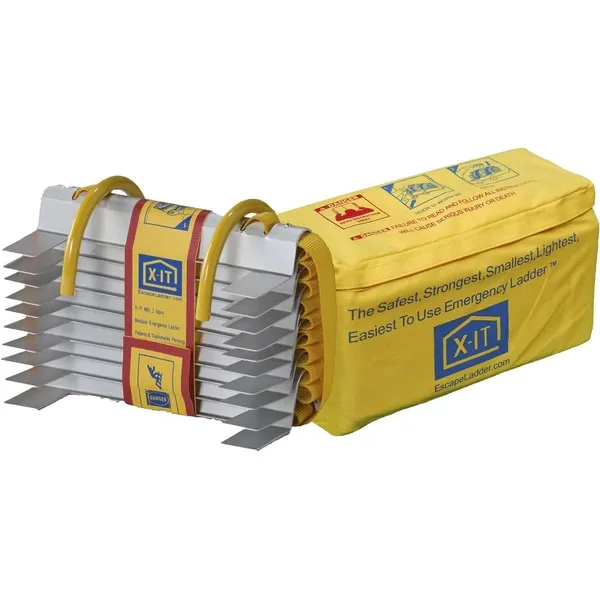
- Buy X-IT Products X-IT Escape Ladder, 2 Story The one escape ladder whose own instruction sheet tells you to deploy it, climb it, and pack it back up, which is the only way anyone ever learns to use one. Amazon
- Buy First Alert Two-Story Fire Escape Ladder, 14 Feet A 14 foot steel and nylon ladder with a stabilizer on every rung, repackable so you can rehearse, and cheap enough to put one in each upstairs bedroom. Amazon
- It depends Rescue Ready RetroFit Fire Escape Ladder, 2 Story A ladder bolted to the studs under your bedroom window, so in the dark there is nothing to find, unfold, or hook onto anything.
- Skip Kidde 2-Story Fire Escape Ladder KL-2S A widely sold escape ladder is, by Kidde's own printed instruction, a single use product you are told not to deploy during practice. Amazon
What actually matters
- Rated load - the weight the manufacturer permits you to put on the ladder, which on the products we checked is a single person figure in the 333 to 375 lb range. Treat any larger number in the marketing as a destructive test result rather than permission.
- Sill thickness range - the span of wall thickness the hooks are designed to sit across, published as a minimum and a maximum. A sill thinner than the minimum leaves the hooks unsupported just as a sill thicker than the maximum stops them seating.
- Stand-off - the projection that holds the rungs away from the wall so your fingers and the front of your foot have somewhere to go. It is one of the named requirements in ASTM F2175, and a ladder flat against siding is far harder to climb than people expect.
- Single use versus reusable - whether the maker permits you to deploy the ladder and pack it back up. This is the single biggest practical difference between two ladders that look identical on a shelf, because it decides whether you can ever rehearse.
- Deployment weight - how much the packed ladder weighs, which matters because the person who has to carry it to the window at night may be a child or an older adult rather than the buyer. It is a named requirement in the standard.
- Portable versus permanent - a portable ladder hooks over the sill and can move house with you; a permanent one is anchored to the studs and is always in position but commits you to one window and rules you out if you rent.
- Window opening minimums - the smallest opening the maker will sanction, published in width and height. Storm windows, security grilles and sashes that do not open fully defeat ladders regardless of how good the ladder is.
The specs, in plain English
Green flags vs red flags
Green flags
- The manual is published online and states a rated load in pounds with the words 'one person at a time' or an equivalent limit.
- The maker describes a practice deployment and supplies repacking instructions or a repacking video.
- A sill thickness range is published with both a minimum and a maximum, plus a minimum window opening size.
- Stand-offs are specified on every rung rather than only at the hooks.
- The ASTM F2175 claim names an edition, and the packed weight of the ladder is published so you can judge who can carry it.
Red flags
- The only load number given is a four figure test result with no rated load anywhere in the documentation.
- The listing says a ladder is UL listed, since there is no UL listing for residential escape ladders and the relevant standard is ASTM F2175.
- The manual tells you not to complete a practice deployment, or says to discard the ladder after one use.
- No sill thickness range appears anywhere, which usually means it was never tested against a range of walls.
- The product page claims a standard but no manual, spec sheet or edition number is available to check it against.
Who's who: the brands
- X-IT Products - A maker of a step escape ladder sold mainly direct, notable (per its instruction sheet) for a clear rated load and practice and repacking instructions.
- First Alert - The mass market home fire safety brand, whose escape ladders are steel rungs on nylon strapping with a stabilizer on every rung and repacking steps in its manual.
- Kidde - The other big home fire safety name, whose escape ladders are widely sold in the category and are documented by Kidde as single use products.
- Rescue Ready - A company making a permanently installed ladder anchored to the studs under the window.
How to read a listing without getting fooled
Ignore the front of the box and go looking for the owner's manual, which almost every manufacturer posts as a PDF. Find three things in it. First, the rated load, expressed in pounds with a statement about how many people may be on the ladder at once, and treat any larger figure elsewhere as a test result. Second, the window requirements: sill thickness minimum and maximum, minimum opening width and height, and any exclusions such as storm windows, security grilles, sliders or multi window units. Third, the reuse language, because a manual that tells you to discard the ladder after a single deployment is also telling you that you may never rehearse with it. If the manual names an ASTM edition, note which one, since some manuals still cite editions from the early 2000s. And if a listing claims a UL listing, be sceptical, because the applicable standard here is ASTM F2175 and there is no equivalent UL listing for residential escape ladders.
How much should you spend?
Budget tier ladders are the folding chain and strap designs sold in hardware aisles, and they are where the single use models live, so read the manual before assuming a cheap ladder can be practiced with. Mid-range buys a reusable steel and nylon portable with a stabilizer on every rung and a published rated load, which is enough ladder for most two storey houses and cheap enough to put one in each upstairs bedroom, which is the better use of the money than one expensive ladder in the master. Premium covers two quite different things: rigid step portable ladders that are light, repackable and sold direct, and permanently installed units anchored to the studs under the window. The permanent option costs the most once installation is counted and commits you to a single window, so it makes sense for owners solving one specific room rather than for a whole house. Across all three tiers, the cheapest real upgrade is free: measure your sill and rehearse once.
Questions, answered
Does a smoke alarm or a sprinkler make an escape ladder unnecessary?
No, they solve different problems. An alarm buys you warning time and a sprinkler slows the fire, but neither creates a second way out of a bedroom whose door opens onto a burning hallway. Fire safety guidance is built around every sleeping room having two ways out, and for a room above the main floor the second one is usually a window. The ladder is what makes that window a real exit rather than a theoretical one.
How many ladders does a two storey house need?
Think per room rather than per house. A single ladder is only useful if it is in the room you happen to be trapped in, and in a fire you do not get to walk down the hall to fetch it. Fire safety guidance is built around every family member being able to get out of a second floor room, and manufacturers echo it by telling you to store the ladder near the window it is meant for. Practically, that means one per occupied sleeping room above the main floor, which usually argues for a mid-range ladder bought several times over rather than one premium ladder.
Where should the ladder be stored?
In the room it is meant for, near the window it is meant for, and nowhere else. Fire safety guidance says to store it near the window in an easily accessible location so you are not searching for it during a fire, and manufacturers say the same. Under the bed nearest the window or in the front of that room's closet both work. Do not store it on another floor, behind heavy furniture, in direct sunlight or anywhere it gets hot, and do not bury it behind seasonal storage.
Do these ladders expire?
They do not have a hard expiry date the way an extinguisher gauge does, but Kidde recommends replacing the ladder every 15 years to ensure optimum strength and performance, and stamps the date of manufacture on the bottom rung. Webbing degrades with ultraviolet light and heat, which is why every manual tells you not to store the ladder in sunlight or a hot attic. If yours was inherited with the house, check the date before you rely on it.
Or jump to the head-to-head: X-IT Products X-IT Escape Ladder, 2 Story vs First Alert Two-Story Fire Escape Ladder, 14 Feet.