Explained
Fire Extinguishers, Explained
After reading, you'll understand exactly what the letters and numbers on an extinguisher label were tested against, which agent belongs in which room, and what maintenance a home unit actually needs.
In this guide
Almost nobody reads the rating on a fire extinguisher, and the shorthand that gets repeated about it is mostly wrong. The A number is not a literal count of gallons of water and the B number is not literally the square footage of the fire it can handle. Both are indexes derived from standardized test fires under UL 711, and knowing that changes which unit you buy. The other thing that trips up first-time buyers is assuming the pressure gauge is a health readout for the whole device. It is not.
The 30-second version
- The letters are the fuel, and the numbers are a tested index of capacity, not a physical measurement of the fire.
- Class C carries no number, because it only tests whether current can travel back up the discharge to you.
- ABC dry chemical is acidic, and its residue will corrode untreated metal if it is not cleaned up quickly.
- A disposable unit is a sealed box, exempt from internal examination because nobody can open it, not because it does not need one.
- A gauge in the green shows pressure, which is why NFPA's monthly check also asks you to lift or weigh the unit.
The products this guide is about
Our verdict on each, with the full reasoning on the companion review.
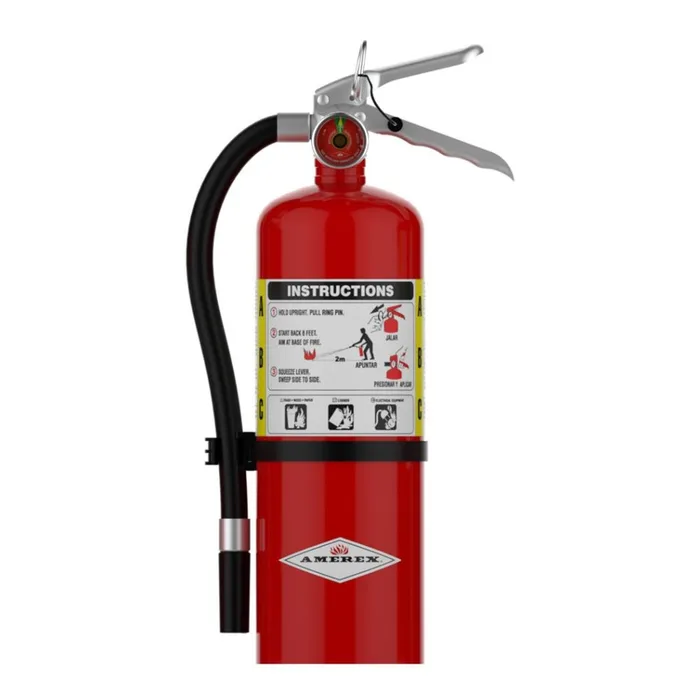
- Buy Amerex B402 5 lb ABC Dry Chemical Extinguisher A fully documented 3-A:40-B:C rechargeable that a service shop can open, inspect and refill for decades. Amazon
- Buy First Alert PRO5 Heavy Duty Plus Rechargeable Fire Extinguisher (FE3A40GR) The same 3-A:40-B:C rating as the Amerex in a unit sold through ordinary retail, with a longer warranty and a thinner spec sheet.
- It depends Element E50 Fire Extinguisher A 230 gram stick with a 50 second discharge that solves the storage problem in a car, as long as you understand it is a supplement and not a replacement. Amazon
- Skip Kidde Basic 110 Fire Extinguisher (FA110G) The default cheap home extinguisher: the smallest useful rating, a plastic handle, and a sealed design nobody opens to check. Amazon
What actually matters
- UL 711 rating - This is the only performance figure on the label that was earned against a standardized fire rather than asserted by marketing. It is what lets you compare two red cylinders that look identical.
- Rechargeable versus disposable - A rechargeable unit can be opened, inspected internally at 6 years and hydrostatically tested at 12. A disposable can only be looked at from the outside and then thrown away.
- Valve and handle material - The CPSC recall that covered about 37.8 million US units was defined around plastic handle designs that could clog or need excessive force to fire. Metal is worth paying for here.
- Agent chemistry - ABC dry chemical is the versatile default but leaves an acidic residue. Clean agents leave no residue. Class K wet chemical is the one meant for cooking oil.
- Weight you can actually use - NFPA's home advice is to choose a multi purpose extinguisher large enough to put out a small fire but not so heavy that it is hard to handle. A rating you cannot aim is worthless.
- Discharge time - A 5 pound ABC unit gives you roughly 14 seconds. That is the entire budget, and it is why standing too close or hesitating costs so much.
- Placement and count - NFPA 10 caps travel distance to a Class A extinguisher at 75 feet in regulated buildings, and NFPA's home guidance is to install near an exit so your escape route stays behind you.
The specs, in plain English
Green flags vs red flags
Green flags
- A UL or ULC listing printed on the label with a full rating such as 3-A:40-B:C.
- The word rechargeable, plus a metal valve body and a metal pull pin.
- A manufacturer spec sheet that states discharge time, range, cylinder material and temperature limits.
- An included bracket that is listed for that specific extinguisher rather than a generic strap.
- A visible date of manufacture on the cylinder so you can tell how old the unit actually is.
Red flags
- No UL 711 rating anywhere on the packaging, only marketing language about fire classes.
- A molded plastic handle and lever on a unit you intend to keep for a decade.
- Single use or service free framing, which means no internal examination is possible.
- A spec page that lists a rating and nothing else, with no discharge time, range or materials.
- A gauge that reads full on a unit with an unknown or missing date code.
Who's who: the brands
- Amerex - US manufacturer whose ABC portable line is documented down to discharge time, valve material and temperature limits, with a 6 year warranty.
- First Alert - The mainstream retail brand, whose rechargeable PRO line reaches a 3-A:40-B:C rating with a 12 year limited warranty.
- Kidde - A widely sold home extinguisher brand, with the single use Basic line and a 2017 plastic handle recall in its history.
- Element - Italian maker of the non-traditional stick format, which trades a UL rating for a 50 second discharge and a package that fits in a glovebox.
How to read a listing without getting fooled
Start at the rating block, usually printed just below the instruction panel. You want a letter combination that covers your hazard and numbers in front of the A and the B, because those numbers are the only comparable performance figures on the product. Then find the word rechargeable, or its absence, since that single word decides whether the unit can ever be inspected internally or refilled. Next check what the valve and handle are made of, which is often visible in the product photo even when the spec sheet is silent. Finally look for a manufacturer spec sheet that gives discharge time, range and cylinder material. Brands that publish those figures tend to be the ones that will still honour a warranty in year five, and brands that publish nothing beyond the rating are telling you something too.
How much should you spend?
Budget in this category buys either a small disposable at the bottom of the rating scale or, if you shop carefully, a rechargeable unit with a commercial rating and a thin spec sheet. That second option is the best value in the whole category and it is worth hunting for. Mid-range buys a fully documented rechargeable from a dedicated fire equipment manufacturer, with published discharge time, range and materials, plus the compact non-traditional formats aimed at vehicles. Premium is mostly a different agent rather than a better cylinder: clean agent, water mist and Class K wet chemical units cost considerably more because of what is inside and what they will not leave behind on your electronics or your cooktop. The honest advice is that spreading a mid tier budget across two or three rechargeable units beats concentrating it in one, because reaching the extinguisher matters more than the last increment of rating.
Questions, answered
Does a home extinguisher legally have to be inspected?
In an existing single family home, generally no, because NFPA 10 governs regulated buildings rather than private residences. That does not make the schedule irrelevant; it is simply the best available definition of what keeps an extinguisher working. NFPA 10 calls for a monthly visual inspection anyone competent can do, an annual external maintenance examination by a certified person, an internal examination every 6 years for stored pressure dry chemical units, and a hydrostatic test on a 5 or 12 year cycle depending on type. Landlords, home offices and workshops may fall under local rules, so check with your authority having jurisdiction.
What should I actually buy for a kitchen?
For most home kitchens a multi purpose ABC unit near an exit door is the right answer, because household kitchen fires are usually not deep fryer fires. Class K wet chemical is the agent specifically rated for cooking oils and fats, and the K rating carries no number. Water mist is a different thing again and is not a substitute for a Class K unit on a pan of burning oil. If you deep fry regularly at home, a Class K unit alongside your ABC unit is a defensible purchase.
How do I tell whether my old extinguisher is under recall?
Find the model number on the label and the date code, then check both against the CPSC recall notice rather than a forum post. CPSC recall 18022 covers plastic handle Kidde models, including the FA110G, with date codes for units manufactured through August 15, 2017. If yours is on the list, the remedy is a free replacement.
Is it worth training on one before there is a fire?
Yes, and the reason is arithmetic. A 5 pound ABC extinguisher discharges for about 14 seconds, so there is no room to work out the sequence while a fire is growing. NFPA's guidance is to use one only when the fire is confined to a small area and not growing, everyone has left, the fire department has been called and the room is not filled with smoke, and to operate it using PASS: pull, aim, squeeze, sweep. Many fire departments and equipment distributors run hands on sessions. NFPA is also explicit that children should not be trained to use extinguishers, because the message for them is to get out and stay out.
Or jump to the head-to-head: Amerex B402 5 lb ABC Dry Chemical Extinguisher vs First Alert PRO5 Heavy Duty Plus Rechargeable Fire Extinguisher (FE3A40GR).