Explained
Foot Spas, Explained
After reading this you will be able to look at any foot spa listing and tell whether it will genuinely heat your water and whether its massage does any actual work.
In this guide
Foot spas all photograph the same way: a plastic tub, some bubbles, a foot looking relaxed. The listings then bury the one difference that decides whether you enjoy the thing, which is whether the tub contains a real heating element or simply a lid and a marketing word. This guide translates the spec sheet so you can spot that difference, plus the smaller ones behind massage, basin depth, cleanup, and noise, before you buy rather than after.
The 30-second version
- Heating is the whole ballgame. A tub with a real heating element warms cool tap water and holds it there for a full session, while one without simply slows the cooling of whatever you poured in, which is why so many owner reports describe water going lukewarm within minutes.
- The word "heat" on the box proves nothing. What proves something is a stated temperature range, a thermostat with selectable levels, or explicit wording that the unit heats cold or room-temperature water; vague heat language with no numbers almost always means heat retention only.
- Rollers, bubbles, and nubs are three different products. Motorized rollers press into your arch on their own, bubble jets tickle and soothe without working muscle, and molded plastic nubs do nothing at all unless you rub your foot back and forth over them yourself.
- Weight when full is the spec nobody prints. Water is heavy, and a deep basin you have to carry to the bathtub to empty is a foot spa that quietly stops getting used, so a drain spout, a light body, or a spot on the floor near a drain matters as much as the feature list.
- Accessory count is the weakest signal on the page. Pumice heads, brushes, and loofah pads cost the manufacturer almost nothing and pad out a bullet list, while the things that actually determine satisfaction, heating and massage mechanism, are usually described in the vaguest language on the listing.
The products this guide is about
Our verdict on each, with the full reasoning on the companion review.
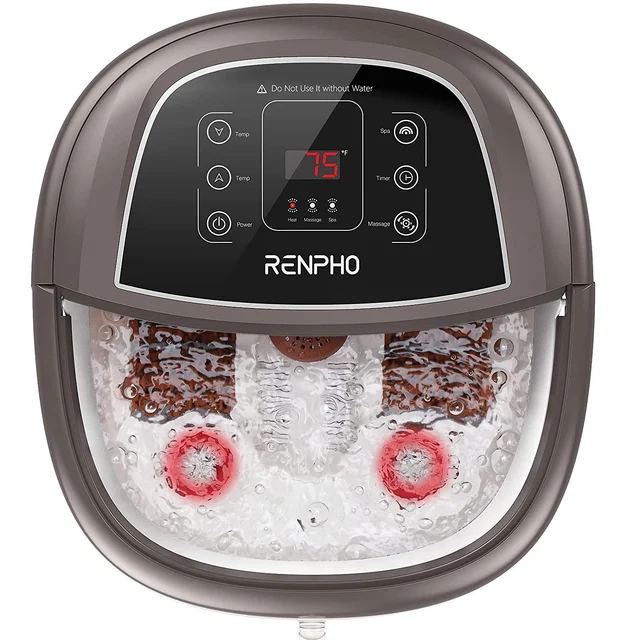
- Buy RENPHO Foot Spa Bath Massager with Heat, Bubbles and Motorized Rollers The rare foot spa that heats cold tap water, holds the temperature, and adds motorized rollers that actually knead.
- Buy HoMedics Bubble Spa Elite Footbath with Heat Boost (FB-450H) The sensible budget pick: it really does warm the water, and it is light enough that you will actually use it.
- It depends Beurer FB50 Luxury Foot Spa with Water Heater Well-built and genuinely adjustable, but you are paying a premium partly for infrared and magnet features that do not earn their keep. Amazon
- Skip Conair Waterfall Pedicure Foot Spa with LED Lights Pretty lights and a waterfall jet, but no real heating element, so the water goes cold while you are still settling in.
What actually matters
- A true heating element. This is the single criterion that separates a soak that stays pleasant for twenty minutes from one that turns tepid while you are still settling in. Look for a stated temperature range, a numbered thermostat, or explicit wording that the unit heats cold water rather than maintaining warmth.
- Temperature control. A single on-off heat toggle gives you whatever the manufacturer decided is hot. Selectable levels or a digital setpoint let you dial in something you actually find comfortable, which usually sits lower than the maximum most units advertise.
- Massage mechanism. Motorized rollers do the work for you. Bubble jets soothe the surface. Passive reflexology nodes require you to supply the movement. Knowing which one you are buying prevents the most common disappointment after heating.
- Adjustability of the massage. Fixed-intensity rollers are too strong for plenty of people, particularly on bony or tender feet. Multiple speeds or modes are worth more than a higher advertised maximum you will never use.
- Basin depth and capacity. Ankle-deep tubs feel meaningfully more like a treatment than foot-only basins, and they benefit calves and lower shins too. The trade is size, storage footprint, and a lot more water to carry.
- Filling, draining, and cleaning access. Jets and roller channels trap residue and skin, so removable parts and a smooth basin turn cleaning from a chore into a rinse. A drain plug or spout saves you from tipping a full tub over a bathtub edge.
- Noise. Pumps and roller motors are loud enough that noise is one of the most common owner complaints across the category. If the plan is to soak while watching something, weight this heavily, because a spa you cannot hear over is a spa you stop reaching for.
The specs, in plain English
Green flags vs red flags
Green flags
- A published temperature range in actual degrees, or a thermostat with numbered levels, rather than a lone heat button
- Wording that explicitly says the unit heats cold or room-temperature water, not that it keeps water warm
- Massage described with a mechanism and multiple intensity settings, so you can dial it down if your feet are sensitive
- A drain plug or spout, a carry handle, or a stated water capacity, all of which suggest the designer thought about emptying it
- Roller heads, pedicure attachments, and jet covers that pop out for rinsing, plus a smooth basin with few crevices
- A manual you can find online before buying that states clearly whether salts and additives are permitted
Red flags
- A heat feature with no temperature figure anywhere on the listing, the manual, or the box
- A run of owner reports that all describe the same thing, water going lukewarm within a few minutes
- Massage described only as acupressure points, nodes, or nubs, which means you are supplying the movement
- Magnet therapy, far infrared, or ionic detox presented as headline reasons to buy
- A long accessory list doing the persuading while heating and massage are described in a single vague sentence
- No timer or auto shut-off on a unit that heats, which is both a convenience and a safety gap
Who's who: the brands
- RENPHO - Direct-to-consumer personal care brand that leans on feature density.
- HoMedics - Long-running mass-market massage and wellness brand, widely stocked, with light, easy-to-store footbaths.
- Beurer - German health-device maker, though its foot spa marketing also carries infrared and magnet claims worth ignoring.
- Conair - Familiar drugstore personal-care name; its footbaths are inexpensive and attractive, but the cheaper models often rely on heat retention rather than a true heating element.
- Kendal - Value-focused maker of larger foot tubs.
- Ivation - Budget housewares brand that competes on size and feature count.
How to read a listing without getting fooled
Start at the heating claim and be pedantic about it. Search the listing text for a number: a degree range, a thermostat with levels, anything quantified. If the only evidence is the word heat next to a flame icon, assume heat retention until proven otherwise, and check the manual, which is usually downloadable and far more candid than the sales copy. Next, work out the massage mechanism from the words rather than the picture, because photographs of rollers do not tell you whether a motor turns them; look for motorized, powered, or shiatsu, and treat nodes, nubs, and acupressure points as passive. Then read the bullet list backwards. Manufacturers front-load the cheap wins, so pumice stones, loofah pads, and LED lighting near the top with heating and massage described vaguely further down is itself a signal about where the money went. Finally, filter owner reports for the words lukewarm, cold, loud, and leak. Those four turn up the failure modes that matter, and a category-wide pattern in the reviews of a specific model is more reliable than any single spec on the page.
How much should you spend?
Spending very little almost always buys a basin that cannot heat, which defeats the point, so the floor worth considering is wherever a genuine heating element starts rather than the cheapest tub on the shelf. Just above that floor sits the sweet spot for most people: a light, heated, bubble-driven footbath that warms tap water, empties easily, and lives in a closet, which suits anyone who soaks a couple of times a week for relaxation or pedicure prep. Stepping up to the mid range buys the one genuine upgrade in the category, motorized rollers plus a deeper basin and a temperature you can set and hold, and that is worth paying for if you are on your feet all day and will use it several times a week. Premium money mostly buys build quality, finer temperature control, and better pedicure attachments, all real but incremental; where it stops being worth it is when the premium is attached to infrared panels, embedded magnets, or detox claims, since none of those earn their keep. The honest test is frequency of use. Occasional soakers are better served by the cheapest unit that truly heats, because a light tub gets pulled out while a heavy one does not, and nightly users get their money back from rollers and a deep basin.
Questions, answered
Do foot spas actually heat cold water, or do they just keep it warm?
Both kinds exist and the listings deliberately blur the line. Units with a proper heating element raise the temperature of cool tap water and then hold it, which is what lets a twenty minute soak stay pleasant to the end. Units without one have an insulated body and a heat label, and all they do is slow the cooling of the water you poured in hot. The way to tell them apart before buying is to hunt for a number: a stated temperature range or a thermostat with selectable levels indicates a real heater, while heat with no figure attached usually does not.
Is soaking my feet safe if I have diabetes, neuropathy, or poor circulation?
This is general product information and not medical advice, so please talk to a doctor or podiatrist who knows your situation before making foot soaking a routine. The concerns clinicians usually raise are that reduced sensation means you may not feel water that is dangerously hot, and that prolonged soaking softens skin and can worsen cracks, calluses, or wounds that are slow to heal. Many practitioners advise people with diabetes or neuropathy against regular hot foot soaks for exactly those reasons. A product page is not the right place to settle that question.
How hot should the water be, and how long should I soak?
Check the stated maximum for your model, and most people find a temperature well below the maximum comfortable. Start lower than you think you want and check the water with your hand rather than trusting the display, since basin sensors are not laboratory instruments. Short sessions are the commonly recommended length. Going much longer mainly softens skin without adding to the relaxation.
Can I add Epsom salt, bath bombs, or essential oils?
Check your specific manual first, because manufacturers genuinely disagree. Some tubs are rated for salts, while others warn that salt accelerates corrosion of the heating element and jet hardware and will void the warranty. Oils and bath bombs are the riskier group, since they leave residue inside jet channels that is very hard to flush out. If your model allows additives, rinse it thoroughly afterwards and dry it before storing. If it does not, a few drops of oil on a nearby towel gets you the scent with none of the plumbing consequences.
Are motorized rollers worth paying more for than plain bubbles?
If you want a massage rather than a warm bath, yes. Bubbles feel nice and help the water circulate, but the sensation stays at the surface. Motorized rollers press into the arch and the ball of the foot with steady pressure, which is the difference owners describe between soaking and being worked on. The costs are real though: more noise, more weight, more bulk to store, and an intensity that some people find too much. If you go this route, prioritize a model with several speeds or modes over one with a single fixed setting.
How do I keep a foot spa clean, and does it matter?
It matters, because warm water plus skin cells plus dark jet channels is a good environment for things you do not want near feet. Empty it after every use rather than leaving water sitting, wipe the basin down, and let it dry fully with the lid off before storing. Every few weeks, run a cycle with a mild cleaning solution the manual approves, then a plain water cycle to flush the jets. This is exactly why removable roller heads, pop-out attachments, and a smooth basin are worth more at purchase time than a longer accessory list.
Or jump to the head-to-head: RENPHO Foot Spa Bath Massager with Heat, Bubbles and Motorized Rollers vs HoMedics Bubble Spa Elite Footbath with Heat Boost (FB-450H).